
BC strata balcony waterproofing failure repair: your action guide
BC strata balcony waterproofing failure repair: your action guide
Under the BC Strata Property Act, Section 72, the strata corporation is legally responsible for repairing and maintaining common property and, in most cases, limited common property such as balconies. That means when a balcony membrane fails and water starts working its way into the unit below, the strata pays for the fix, not the individual owner. The proven repair for traffic-bearing strata balconies in Surrey and across the Lower Mainland is a properly detailed, heat-welded vinyl deck membrane installed to manufacturer specification by a certified installer. Anything less tends to fail again within a few seasons.
If you are a strata council member or property manager staring down a leak right now, here are your immediate next steps:
- Document everything. Photograph the leak, the affected area, and any visible membrane damage. Note dates and weather conditions.
- Order a building envelope assessment. A qualified building envelope consultant can confirm whether the failure is a surface membrane issue, an interface detailing problem, or substrate damage. This report protects the strata legally and drives the repair specification.
- Check your depreciation report. Balcony membranes should appear there. If they do not, that gap itself is worth flagging.
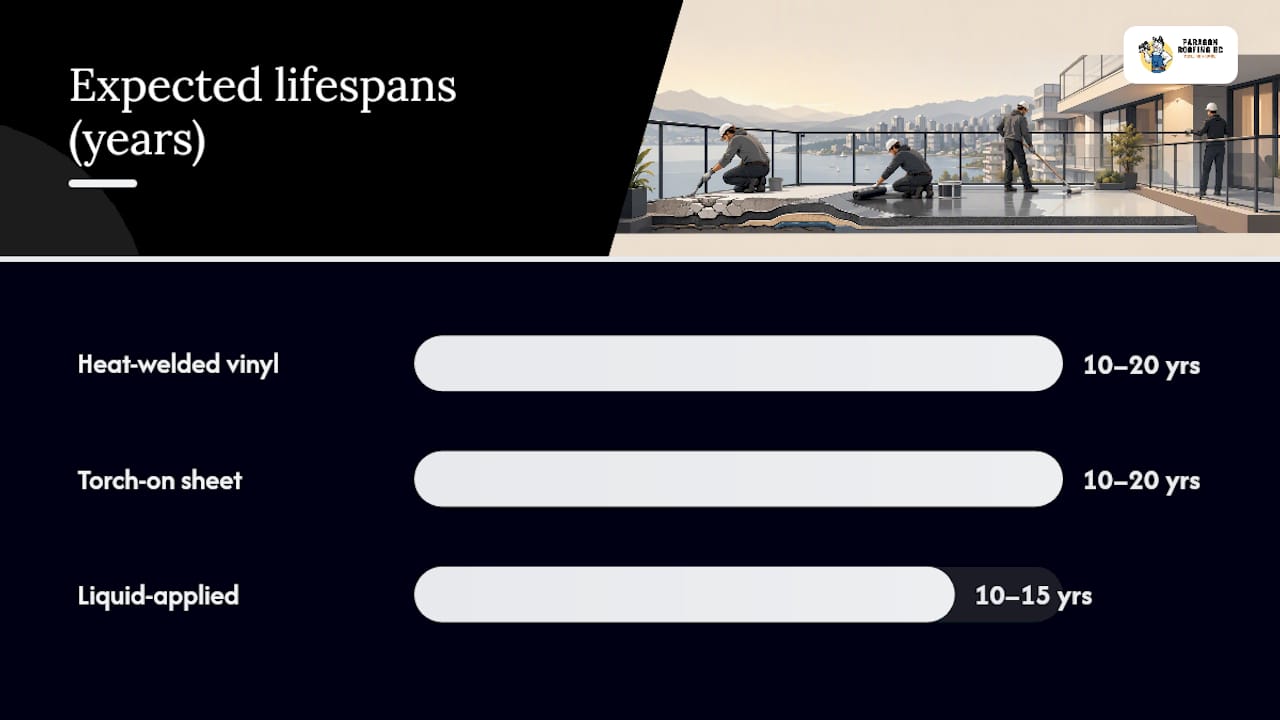
Traffic-bearing waterproofing membranes in BC typically have a service life of roughly 10–20 years depending on the system, installation quality, and maintenance history. Many Surrey strata buildings are now well past that window on their original membranes, which is why BC balcony leakage repair calls are climbing every wet season.
Key takeaways
Under the BC Strata Property Act, the strata corporation is responsible for balcony waterproofing repairs, and a properly detailed heat-welded vinyl membrane installed by a certified installer is the most durable and warranty-backed solution for Surrey strata buildings.
| Point | Details |
|---|---|
| Strata legal responsibility | Section 72 of the Strata Property Act makes the strata corporation responsible for balcony membrane repair in most cases. |
| Membrane service life | Traffic-bearing waterproofing membranes in BC typically last 10–20 years; many Surrey buildings are past that window. |
| Special levy threshold | Funding a major repair via special levy requires a 3/4 owner vote at a general meeting. |
| Interface details drive failure | BC envelope research confirms that door sills, flashings, and drain assemblies cause most repeat failures, not the field membrane alone. |
| Paragonroofingbc | Paragonroofingbc supports Surrey, Burnaby, and Coquitlam strata councils with certified vinyl membrane installation, consultant coordination, and post-works warranty documentation. |
This article is general information, not a substitute for advice from a qualified lawyer. Consult a qualified legal professional about your own circumstances before acting on anything here.
Table of Contents
- What does Section 72 of the BC Strata Property Act say about balcony waterproofing?
- Is your balcony common property or limited common property?
- How strata balcony repairs are funded in BC
- What actually causes balcony waterproofing failure in Surrey and the Lower Mainland?
- What are the approved repair methods for BC strata balconies?
- How do you choose the right contractor for strata balcony waterproofing?
- How do you move a balcony waterproofing project through strata governance?
- What inspections, tests, and warranties should you require?
- What does a BC strata balcony repair typically cost and how long does it take?
- What can you do if the strata refuses or delays balcony repairs?
- What does the research say about why balcony repairs fail repeatedly?
- Ongoing maintenance to extend your balcony membrane’s life
- A local perspective on Surrey strata balcony repairs
- Paragonroofingbc: local strata balcony waterproofing support in Surrey and the Lower Mainland
- Sources
- FAQ
What does Section 72 of the BC Strata Property Act say about balcony waterproofing?
Section 72 of the Strata Property Act places the duty to repair and maintain common property and limited common property squarely on the strata corporation. Balcony waterproofing membranes, flashings, and drainage systems are building envelope elements, and they almost always fall within that statutory duty.
Two things are worth separating here. The strata’s obligation has two parts: arranging the repair and paying for it. In most cases, both duties sit with the strata. However, the duty to arrange and the duty to pay can sometimes be split by a registered bylaw or an alteration agreement signed when an owner made changes to their unit. That split is the exception, not the rule.
When can a bylaw shift responsibility to an owner?
- A registered bylaw can require an owner to maintain and repair limited common property assigned to their unit, but only within the limits set by the Act and standard bylaw provisions.
- An alteration agreement signed by the owner when they installed a custom deck topping, tile system, or other finishing layer may assign responsibility for that specific layer to the owner.
- These shifts are strictly limited. They do not transfer the strata’s responsibility for the underlying waterproofing membrane or structural substrate.
The courts have consistently applied a reasonableness standard: the strata must act promptly and competently once it knows about a defect. Sitting on a known leak exposes the corporation to negligence claims.
Key principle: The strata’s duty under s.72 is not just to fix things when they break catastrophically. Provincial guidance expects strata councils to manage balcony maintenance proactively. Reacting only after water has penetrated to the unit below can expose the corporation to liability for consequential damage.
Pro Tip: Link your depreciation report line items for balcony membranes directly to your repair planning calendar. If the report flags membranes as approaching end of life, that is your documented basis for budgeting a replacement before a failure triggers an emergency spend.
Is your balcony common property or limited common property?
Most balconies in BC strata buildings are classified as limited common property (LCP) , meaning they are common property designated for the exclusive use of one or more strata lots. The distinction matters because it determines who arranges and who pays for the repair under the Act and your specific bylaws.
Under standard bylaws, the strata corporation retains the repair and maintenance duty for LCP building elements like balcony membranes, flashings, and structural components, even though only one owner uses that space. The owner’s responsibility typically covers interior finishes, personal property, and any alterations they installed with council approval.
Documents to check before assuming who is responsible:
- The registered strata plan and any schedule of LCP designations
- The registered bylaws (not just the standard bylaws, but any amendments filed with the Land Title Office)
- Any alteration agreements on file for the specific unit
- The depreciation report, which may describe the scope of strata-maintained components
Edge cases where owner responsibility may apply:
- An owner installed a tile-over-membrane system under an alteration agreement that assigned maintenance of that tile layer to them. The underlying membrane remains the strata’s responsibility, but the tile and grout are the owner’s.
- An owner installed a planter box or drainage mat that has trapped moisture and accelerated membrane deterioration. The strata may seek contribution from the owner for damage caused by the alteration.
- A bylaw amendment, properly registered, requires owners to maintain specific LCP elements. Check the filing date and exact wording before relying on this.
When in doubt, get a legal opinion from a strata lawyer before the strata denies a repair claim. Getting that call wrong is expensive.
How strata balcony repairs are funded in BC
Strata corporations in BC have three main funding routes for balcony waterproofing repairs: the contingency reserve fund, a special levy, and emergency spending authority. Each has different rules, thresholds, and documentation requirements.
Contingency reserve fund
The reserve fund is the strata’s savings account for major repairs and replacements. Balcony membrane replacement is exactly the kind of work it is designed to cover. The catch is that the fund must be adequate, and the depreciation report governs how much the strata should be holding. If the fund is underfunded relative to the depreciation report’s projections, the council may need to supplement it with a levy.
Special levy
When the reserve fund is insufficient, a special levy is the standard route for funding major repairs. A special levy requires approval by at least a 3/4 vote at a general meeting. Owners who vote against the levy are still bound by the result if it passes.
Emergency spending
Councils have authority to spend beyond their normal budget limits for genuine safety emergencies without a prior owner vote, provided they document the urgency and report to owners promptly. A balcony with structural membrane failure that poses a fall or water-intrusion risk to occupied units can qualify. This authority is narrow, and councils should document the safety basis thoroughly.
Pro Tip: When presenting a special levy to owners, break the cost into per-unit figures and show the depreciation report line that supports the urgency. Owners are far more likely to approve a levy when they can see it was anticipated in the report and that delaying will cost more.
The Province of British Columbia’s guidance on paying for repair and maintenance notes that the duty to arrange repair can differ from who ultimately pays, and councils should use documented processes to justify every spending decision.
What actually causes balcony waterproofing failure in Surrey and the Lower Mainland?
Surrey’s coastal rain pattern is unforgiving. The Lower Mainland averages over 1,100 mm of precipitation annually, and much of it falls hard and fast in the October-to-March window. Balcony membranes that might last 15 years in a drier climate can fail in 8–10 years here if the detailing was marginal from day one.
BC high-rise envelope research is clear on this: most moisture problems are driven by poor interface detailing at balconies, windows, and penetrations, not by a single material failure. The membrane itself is rarely the first thing to go.
Physical failure modes
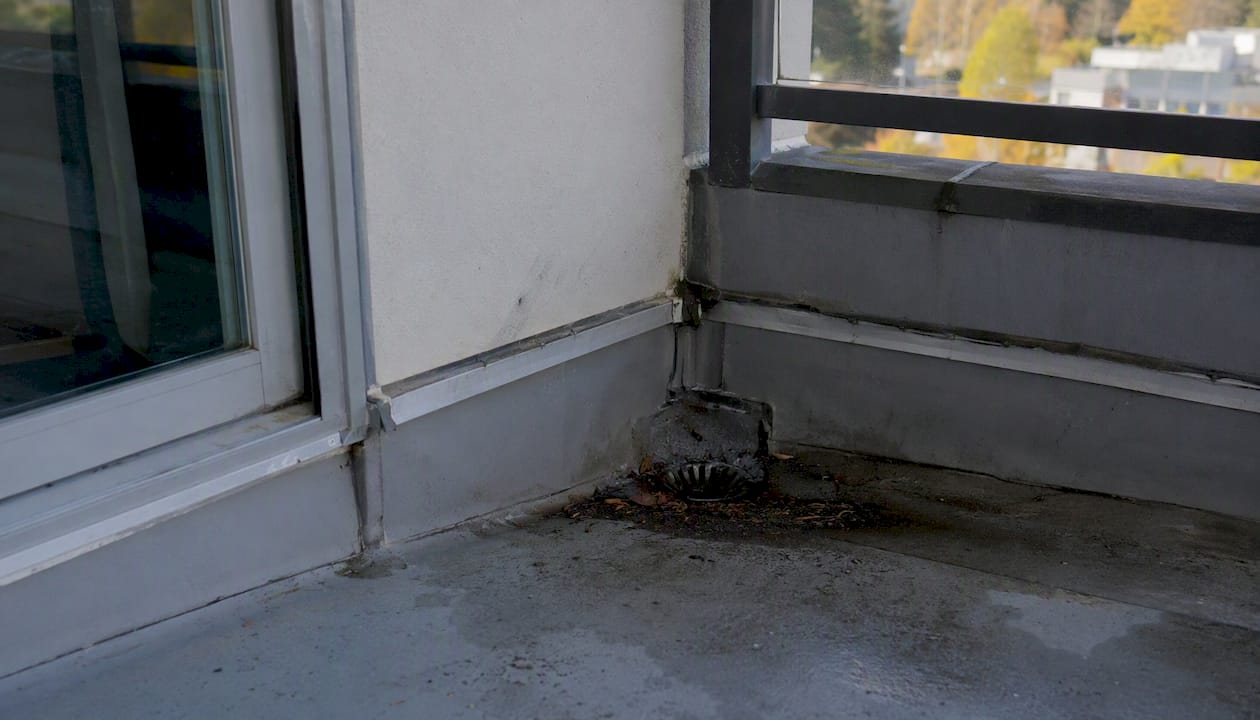
- Poor terminations at door sills. The transition between the membrane and the door threshold is the single most common failure point. Water finds any gap in that joint within one or two wet seasons.
- Inadequate flashing at perimeter walls. Flashings that are too short, improperly lapped, or not mechanically fastened allow water to migrate behind the membrane.
- Ponding from insufficient slope. Balconies need a minimum 2% slope to drain. Flat or reverse-sloped decks hold standing water, which accelerates membrane degradation and forces water into any small crack.
- Clogged drains and blocked overflows. A drain blocked by debris turns a balcony into a temporary pond. Overflow drains that are never tested or cleared are a hidden risk.
- Tile or grout installed over membrane without proper detailing. Tile systems trap moisture at the grout lines and put point loads on the membrane that it was not designed to handle.
- UV and freeze-thaw cycling. Exposed membranes in Surrey face both UV degradation in summer and freeze-thaw stress in winter, particularly at penetrations and edges.
- Planter and furniture damage. Heavy planters concentrate loads and trap moisture. Metal furniture legs can puncture or abrade the membrane surface.
- Corroded fasteners and rail post penetrations. Every fastener through the membrane is a potential leak point if the sealant around it fails.
Management causes
- Deferred maintenance, particularly failing to clear drains and reseal penetrations annually.
- Missing or outdated depreciation report entries for balcony membranes.
- No documented inspection plan, so failures go unnoticed until water appears inside a unit.
- Owner alterations, such as tile installations or planter systems, done without council approval or proper waterproofing detailing.
Pro Tip: Walk the interfaces first. Those are where the water gets in.
What are the approved repair methods for BC strata balconies?
Not all waterproofing systems are equal for traffic-bearing strata balconies. The right choice depends on the substrate condition, the expected foot traffic, the warranty requirements, and whether the strata needs a system that a certified installer can warrant.
Comparing common waterproofing systems
| System | Expected lifespan | Warranty profile | Re-failure risk if detailing ignored | Best fit |
|---|---|---|---|---|
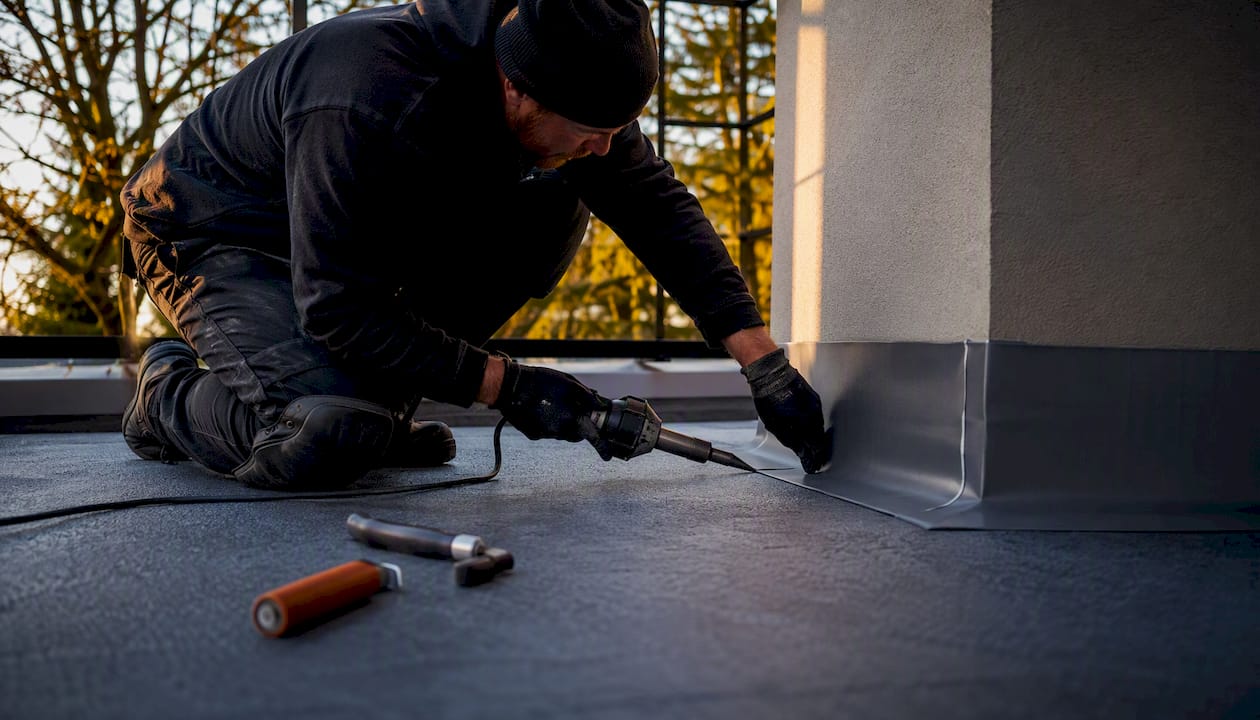
| Heat-welded vinyl deck membrane | 10–20 years | Manufacturer + installer warranty when certified installer used | Low if details corrected | Traffic-bearing strata balconies, high-rain exposure |
| Torch-on sheet membrane | 10–20 years | Manufacturer warranty; installer certification varies | Moderate; seams vulnerable at interfaces | Lower-traffic areas, roofing applications |
| Liquid-applied membrane | 10–15 years | Manufacturer warranty; highly dependent on application quality | Higher; thickness consistency is critical | Complex geometry, small areas |
| Tile-over-membrane system | Depends on substrate membrane | Warranty split between tile and membrane layers | High if substrate membrane not replaced | Aesthetic finish over a warranted membrane base |
Heat-welded vinyl deck membranes are frequently specified for strata balconies in BC because they are traffic-bearing, dimensionally stable, and carry manufacturer warranties when installed by certified installers. Valordek is one BC-based manufacturer whose products are commonly specified for this application. The heat-welded seams eliminate the adhesive-bond failure points that plague other systems, and the membrane can be fully detailed at door sills, perimeter walls, and drain assemblies in a way that liquid-applied systems struggle to match consistently.
What a durable repair specification must include
- Full substrate assessment and repair of any deteriorated concrete or plywood decking before membrane installation
- Slope correction to achieve a minimum 2% drainage gradient
- Complete flashing and termination details at every wall, door sill, and penetration
- Drain assembly upgrade or replacement, including overflow drain verification
- Certified installer requirement tied to the membrane manufacturer’s warranty programme
- Third-party building envelope inspection at key stages (substrate, membrane, and post-completion)
- Manufacturer warranty documentation and installer workmanship warranty
Pro Tip: Require the installer to submit a manufacturer’s pre-job approval before work begins. This locks in the warranty terms and confirms the installer’s certification is current. Without it, the manufacturer can void the warranty on a technicality after the work is done.
How do you choose the right contractor for strata balcony waterproofing?
Procurement is where strata councils lose the most money on balcony repairs. A low bid that skips substrate repair, uses uncertified installers, or omits flashing details will fail again, and the strata will pay twice.
Required contractor qualifications
- Demonstrated building envelope or waterproofing experience on similar strata projects in Surrey or the Lower Mainland
- Current certified installer status with the membrane manufacturer being specified
- Valid WCB (WorkSafeBC) coverage and commercial general liability insurance
- References from at least two comparable strata balcony projects completed in the past three years
Contract clauses to include
- Scope tied explicitly to the building envelope consultant’s specification, not a generic description
- Schedule with milestone dates and weather-contingency provisions for Metro Vancouver’s wet season
- Latent defect allowance, with a unit rate for concealed substrate repairs discovered during work
- Holdback or retention of at least 10% until post-works moisture testing is complete and accepted
- Warranty assignment clause ensuring manufacturer and workmanship warranties transfer to the strata corporation
- Unit access coordination plan, including advance notice periods for affected owners
- Correction of hidden defects clause requiring the contractor to repair any defects discovered within the warranty period at no additional cost
Contract closeout checklist
- Pre-works and post-works moisture meter readings at each balcony
- Photographic record of substrate condition before membrane installation
- Manufacturer site inspection certificate
- Certificate of compliance from the building envelope consultant
- Warranty documents in the strata’s name
Pro Tip: Ask for the latent defect unit rate in writing before you sign. On a Surrey high-rise with 40 balconies, discovering that half the concrete substrates need repair mid-project can double the budget if you have no agreed rate. A pre-agreed rate keeps the contractor honest and the budget predictable.
For complex multifamily projects, Paragonroofingbc’s approach to multifamily roof repairs includes procurement support and warranty coordination that strata councils often find useful when managing multiple envelope scopes simultaneously.
How do you move a balcony waterproofing project through strata governance?
Getting a repair approved in a strata is a governance process as much as a technical one. Here is the sequence that works.
- Document the leaks. Collect written reports from affected owners, photographs, and any contractor assessments already done. This is your evidence base.
- Engage a building envelope consultant. Commission a formal investigation and written report. This report is the foundation for everything that follows: the specification, the budget, and the owner communication.
- Draft the repair specification. The consultant writes or reviews the scope. Do not let the contractor write their own specification.
- Obtain at least three comparable quotes. Quotes must be based on the same specification so they are genuinely comparable. Apples-to-apples bidding is the only way to know if a price is fair.
- Prepare the budget and funding motion. Determine whether the reserve fund is sufficient or whether a special levy is needed. Prepare the levy motion with per-unit cost breakdowns.
- Call a general meeting. Give proper notice under the Act. Include the consultant’s report, the specification summary, the budget, and the proposed motion in the meeting package.
- Hold the vote. A special levy requires a 3/4 vote. Reserve fund expenditure for a major repair may require a resolution at a general meeting depending on the amount.
- Award the contract and schedule work. Avoid scheduling major balcony work between November and March in Surrey if possible. The wet season creates weather delays and makes membrane installation quality harder to control.
Pro Tip: Send owners a one-page plain-language summary of the consultant’s findings before the meeting. Owners who understand why the repair is urgent and what happens if it is deferred vote yes at a much higher rate than owners who receive only a formal motion.
The Province’s guidance on division of repair duties reinforces that councils should manage maintenance proactively and document their decision-making process at every stage.
What inspections, tests, and warranties should you require?
A completed repair is not finished until it has been tested and documented. Strata councils that skip post-works verification often discover the hard way that the first rain after completion reveals a missed detail.
Recommended inspections and tests
- High-resolution photographs of the substrate before membrane installation and of the completed membrane before any topping or finish is applied
- Moisture meter readings at each balcony before and after works, logged by unit number
- Infrared thermal scanning for large or complex balcony areas where moisture mapping adds value
- Controlled flood testing on any balcony where the leak history is complex or the drain assembly was replaced
- Manufacturer site inspection at key stages, particularly at membrane terminations and drain assemblies
- Third-party building envelope consultant sign-off report confirming the work matches the specification
Warranty expectations
Typical warranty structures for heat-welded vinyl membrane systems in BC include a manufacturer material warranty, an installer workmanship warranty, and sometimes a combined system warranty when the installer is manufacturer-certified. Specialist investigation guidance notes that traffic-bearing membranes in BC have service lives of roughly 10–20 years, and warranties typically run 5–15 years depending on the system and installer tier. The two warranties interact: a workmanship defect that voids the installer warranty may also affect the manufacturer’s coverage if the installation deviated from the approved method.
Pro Tip: Require a defect rectification schedule as part of the warranty documentation. This is a written commitment from the installer specifying how quickly they will respond to a warranty claim and what the correction process looks like. Without it, “warranty” is just a word.
What does a BC strata balcony repair typically cost and how long does it take?
Costs vary significantly depending on the number of balconies, the substrate condition, the access method, and how much concealed damage is found during works. There is no single figure that applies across Surrey strata buildings, but the cost components are consistent.
Typical cost components
- Building envelope consultant fees for investigation, specification, and site review
- Membrane material (vinyl, torch-on, or liquid-applied depending on specification)
- Substrate repair, including concrete patching, plywood replacement, or slope correction
- Flashing and drain assembly work, including overflow drain upgrades
- Access and scaffolding or swing stage costs, which can be substantial on high-rise buildings
- Finishing work such as reinstating tile, pavers, or drainage mats
- Post-works testing, moisture scanning, and warranty documentation
- Contingency for concealed structural repairs, typically 15–20% of the base contract value on older buildings
For large-scale projects, building and facility maintenance planning principles suggest that contingency budgeting and phased scoping are the most effective ways to control cost surprises on aging building stock.
Typical project timeline
A building-scale balcony waterproofing project in Surrey typically runs through these phases:
- Weeks 1–4: Leak documentation, building envelope consultant engagement, investigation and report
- Weeks 5–8: Specification drafting, tender preparation, and contractor bidding period
- Weeks 9–12: Bid review, council decision, and preparation of owner meeting package
- Week 13: General meeting and vote
- Weeks 14–16: Contract award, mobilisation, and material procurement
- Weeks 17–24+: Construction, phased by building section or floor
- Final 2 weeks: Post-works testing, consultant sign-off, warranty documentation
Weather is the wildcard in Metro Vancouver. Rain delays during membrane installation are common from October through March, and scheduling work in the April-to-September window reduces weather-related delays and quality risks. A project that starts investigation in September can realistically target a spring construction start.
What can you do if the strata refuses or delays balcony repairs?
When a strata council acknowledges a leak but fails to act, or disputes responsibility, owners have real options. The key is building a documented record before escalating.
- Submit a written repair request to the strata council. This creates a formal record and triggers the council’s duty to respond.
- Request a formal council decision in writing. If the council refuses to act, that refusal is itself a decision you can challenge.
- Commission an independent building envelope report. An expert report confirming the failure and the strata’s responsibility is your strongest piece of evidence.
- File a complaint with the Civil Resolution Tribunal (CRT). The CRT handles strata disputes in BC and can order a strata to carry out repairs. It is faster and less expensive than court.
- Apply to BC Supreme Court. For larger disputes or where the CRT lacks jurisdiction, the Supreme Court can make orders requiring the strata to repair and awarding damages for consequential losses.
BC courts have consistently held that a strata’s duty under s.72 is not discretionary. Councils that delay known repairs face liability for consequential damage to units, personal property, and health.
Practical principle: While a dispute is being resolved, take interim mitigation steps to prevent further damage. Document every cost of those interim measures, including your own time and any contractor invoices. If the strata is ultimately found responsible, those documented costs are recoverable. An owner who mitigates damage and keeps records is in a far stronger position than one who waits.
Pro Tip: Before filing at the CRT, send the council a formal demand letter referencing s.72 and the building envelope report. Many councils act once they see the legal basis stated plainly in writing. It saves everyone time and money.
What does the research say about why balcony repairs fail repeatedly?
The evidence from BC’s own building envelope studies is consistent and worth knowing before you write a specification or accept a contractor’s proposal.
BC Housing’s high-rise envelope research found that most moisture problems in coastal BC multi-unit buildings are caused by poor interface detailing at balconies, windows, and penetrations, not by a single material failure. Drainage cavities and correct detailing at these interfaces reduce failure risk substantially.
The Morrison Hershfield survey of building envelope failures in coastal BC identified interface details at decks, windows, and penetrations as the primary source of moisture-related failures across the building stock studied. The pattern is clear: replacing a membrane without correcting the interface details that caused the original failure produces a repair that fails again, often faster than the original.
The practical implication for strata councils is straightforward:
- Specify repairs that correct door sill terminations, perimeter flashings, drain assemblies, and rail post penetrations, not just the field membrane.
- Require the building envelope consultant to confirm that all interface details are addressed in the specification before tender.
- Do not accept a proposal that replaces the membrane only and leaves existing flashings and terminations in place.
Pro Tip: For persistent or complex leaks, a third-party building envelope consultant is worth every dollar. They write specifications that contractors cannot easily water down, and their site inspections catch workmanship issues before they are buried under the finished surface.
Ongoing maintenance to extend your balcony membrane’s life
A well-installed membrane that is never maintained will still fail prematurely. In Surrey’s wet climate, a basic seasonal inspection programme is the difference between a 15-year membrane and a 10-year one.
Seasonal inspection checklist
- Spring (April/May): Clear all balcony drains and overflow drains of winter debris. Check drain covers and strainers. Inspect door sill sealants for cracking or separation. Look for any membrane blistering or surface damage from winter freeze-thaw.
- Fall (September/October): Inspect perimeter flashings and wall-to-membrane junctions before the wet season. Check sealants at all penetrations and rail posts. Clear drains again. Document any areas of concern with photographs.
- After any significant storm: Check drains for blockage and look for standing water on balcony surfaces.
Preventive maintenance actions
- Clear drains and overflows at least twice per year, more often on balconies with heavy tree canopy overhead.
- Reseal penetrations and rail post bases every 3–5 years, or sooner if sealant shows cracking.
- Remove heavy planters periodically to inspect the membrane beneath them.
- Schedule a full membrane assessment by a qualified waterproofing contractor every 5–7 years, or when the membrane approaches the 10-year mark.
The seasonal impact on building components in BC’s coastal climate makes regular maintenance particularly important for waterproofing systems that face both UV exposure in summer and sustained moisture loading in winter.
Pro Tip: Integrate balcony membrane inspections into your annual building envelope or roof inspection, and log the findings in the depreciation report update. This creates a documented maintenance history that protects the strata legally and supports future funding requests.
A local perspective on Surrey strata balcony repairs
Hey, it’s Harman here. After working on strata buildings across Surrey, Burnaby, and Coquitlam, the pattern I see most often is this: the membrane itself is not the problem. It is the inch of flashing at the door sill, the drain that has been partially blocked for three years, or the rail post base that was never properly sealed after the railing was replaced. Those small details are where the water gets in, and they are the first things a rushed or under-specified repair skips.
Surrey’s rain season starts earlier and ends later than most owners expect. I have seen balcony repairs scheduled for October that turned into spring projects because the weather window closed before the membrane could be properly installed. That delay costs money and leaves units exposed for another wet season. The councils that plan ahead, get their consultant report done in summer, and have their specification ready to tender in August are the ones who get their work done before the rains arrive.
The other thing I keep seeing is strata councils who accept the lowest bid without checking whether the installer is manufacturer-certified. A heat-welded vinyl membrane installed by an uncertified crew is not a warranted system. The manufacturer will not back it, and when it fails at the door sill two years later, the strata is back to square one. Good procurement takes an extra few weeks. It saves years of headaches.
Paragonroofingbc: local strata balcony waterproofing support in Surrey and the Lower Mainland
When your strata council is facing a balcony waterproofing failure and needs someone who knows the local building stock and the governance process, Paragonroofingbc works with councils in Surrey, Burnaby, and Coquitlam to move from investigation to completed repair without the procurement chaos that derails so many strata projects.
Here is what that looks like in practice:
- Building envelope inspections and consultant coordination to establish the scope before tender
- Certified vinyl membrane installation with manufacturer warranty documentation
- Full flashing and interface detailing, including door sills, drain assemblies, and rail post penetrations
- Post-works moisture testing and warranty coordination
- Owner communication support to help councils present the project clearly at general meetings
You get a contractor who understands both the technical specification and the strata governance process, which means fewer surprises at the vote and fewer callbacks after the work is done. Request a site assessment or learn more about Paragonroofingbc’s Surrey strata and multifamily roofing services to take the next step.
Sources
FAQ
Is balcony waterproofing covered by the strata?
Yes, in most BC strata buildings. Under Section 72 of the Strata Property Act, the strata corporation is responsible for repairing and maintaining limited common property such as balconies, including the waterproofing membrane, unless a registered bylaw or alteration agreement specifically shifts that duty to the owner.
What is Section 72 of the BC Strata Property Act?
Section 72 is the statutory provision that requires a strata corporation to repair and maintain common property and limited common property. For balconies, this means the strata is responsible for the membrane, flashings, drainage, and structural components, regardless of which owner uses the space.
How long should balcony waterproofing last?
Traffic-bearing waterproofing membranes in BC typically have a service life of roughly 10–20 years, depending on the system type, installation quality, and maintenance history. Heat-welded vinyl membranes installed by certified installers and properly maintained tend to reach the upper end of that range.
Do balconies require waterproofing?
Yes. Any balcony that sits above an occupied or enclosed space requires a waterproofing membrane to prevent water intrusion into the structure below. In BC strata buildings, this is both a building code requirement and a maintenance obligation under the Strata Property Act.
What happens if the strata refuses to repair a failing balcony membrane?
Owners can file a dispute with the Civil Resolution Tribunal (CRT), which can order the strata to carry out repairs. For larger claims or where the CRT lacks jurisdiction, BC Supreme Court is the next step. Courts have consistently held that the strata’s duty under s.72 is not discretionary, and councils that delay known repairs face liability for consequential damage.
Recommended
Our Roofing Blog


Have more questions about roofing?
Check out our FAQs or give us a call today to speak to an expert roofer in Vancouver Lower Mainland, BC. We're here to help our neighbours make educated decisions about their roof. For our team, we value helping clients save money while making their roofs last.