
Replace Washers Every 5–10 Years to Prevent Delta Carport Roof Leaks
Replace Washers Every 5–10 Years to Prevent Delta Carport Roof Leaks
Most Delta carport roof leaks trace back to failed flashing, degraded fasteners, or poor panel overlaps, not a hole in the panel itself. Your first move should be a hose test with a helper watching from inside, since the drip point rarely sits above the actual entry point. Skip the thick bead of caulk as a fix. Mechanical repairs, like new flashing and replaced fasteners, hold up far better against Delta’s wind and rain than surface sealant ever will.
TL;DR:
- Mechanical repairs like new flashing and fastener replacement offer longer-lasting solutions than surface sealants, especially in Delta’s coastal climate.
- The hose test is the most effective, cost-free method to identify hidden leaks by spraying small roof sections and observing interior drips with a helper.
- Leaks on metal panels primarily arise from degraded washers, loose fasteners, and failed seam sealants, which require specific repairs and regular maintenance.
- For polycarbonate panels, proper screw hole clearance and the use of suitable washers prevent cracks, while condensation buildup can mimic leaks and often needs drainage holes.
- A yearly inspection, gutter clearing, washer replacement every five to ten years, and timely sealant refreshes are key to preventing recurring leaks in Delta properties.
Table of Contents
- What quick checks can I do before calling anyone?
- How do I locate a carport roof leak with a hose test?
- What repairs work best by carport roof material?
- How do I repair carport roof leaks the right way?
- What maintenance actually prevents repeat leaks in Delta?
- Why do Delta carports leak differently than roofs elsewhere?
- Priority actions for homeowners and property managers
- How Paragon Roofing BC handles carport leaks in Delta
- Sources
- FAQ
What quick checks can I do before calling anyone?
Before you climb a ladder or call a contractor, walk the carport with fresh eyes. A few minutes of careful looking often tells you more than an hour of guessing.
Start inside. Note when the stain first appeared and whether it grows during or right after rain, that timing hints at whether you’re chasing wind-driven rain or slow-building condensation. If there’s an attic or open framing above the carport, check for damp purlins or dark streaks along the wood.
Outside, keep both feet on solid ground where possible and use a stable ladder with someone holding it if you need height.
- Check gutters and valleys for leaf buildup, moss clumps, or standing water that backs up under the panel edge
- Look closely at flashing where the carport roof meets the house wall, since this junction takes the worst of Delta’s sideways rain
- Scan for screws with tilted or raised heads, a sign the fastener has started to work loose
- Check for missing, cracked, or brittle EPDM washers under screw heads
- Clear visible debris sitting in valleys or against up slope flashing
How do I locate a carport roof leak with a hose test?
The hose test remains the most reliable way to find a hidden leak on a carport roof, and it costs you nothing but time and a garden hose.
Water on a metal or polycarbonate carport doesn’t always drip straight down from where it entered. It often runs along a purlin, follows a seam, or travels several feet before finding a gap to escape through, which is why chasing the interior stain alone leads homeowners to patch the wrong spot.
- Put a helper inside with a flashlight and phone, watching the exact area where the leak has shown up
- Start spraying the lowest section of roof first, holding the hose steady for two to three minutes per section
- Work upward in small zones, only moving to the next section once the current one shows no drip
- Note the exact time and section when your helper spots water
- Photograph the tested area, the drip point inside, and the stain pattern before you touch anything
Pro Tip: Test on a mild day with no wind, since wind-driven spray can mimic a leak from a section that’s actually fine, and it wastes an afternoon chasing the wrong panel.
What repairs work best by carport roof material?
Repair technique depends entirely on what’s overhead. A fix that works beautifully on standing-seam metal can crack a polycarbonate panel within a season.
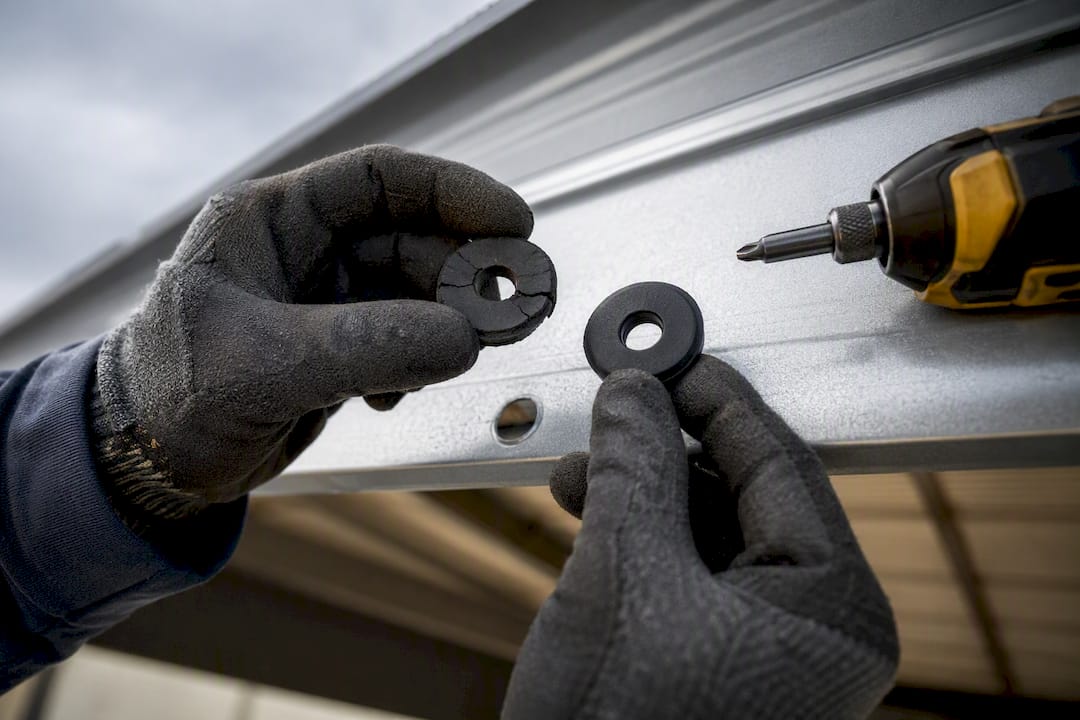
Metal panels. Most metal carport leaks in Delta come down to degraded washers, loose fasteners, and failed sealant at seams rather than a compromised panel. Replace brittle rubber washers with new EPDM ones, treat any surface rust before it spreads, and reinforce seams with butyl tape under a proper elastomeric sealant rated for exterior metal. Avoid one-part silicone here. It skins over fast but doesn’t flex with the panel through temperature swings.
Polycarbonate. These panels expand and contract more than metal, so screw holes need proper clearance, never a tight pilot hole. Use the correct dome-style washers designed for polycarbonate, and resist the urge to crank screws down hard, over-tightening cracks the sheet around the fastener within a year or two. If a sheet has hairline cracks radiating from a screw hole, replace that panel rather than patch it. Worth noting too: trapped condensation between multi-wall sheets can look exactly like a leak. Small drainage holes at the bottom edge often solve it without touching the panel at all.
Corrugated plastic or bitumen sheets. These age faster than metal or polycarbonate under coastal UV and moisture. Renew loose fixings, swap out any sheet that’s gone chalky or brittle, and don’t skip closure strips at the ridge and eaves, gaps there let wind-driven rain punch straight through the overlap.
Flat or EPDM membrane carports. Check flashing at every wall junction and inspect drains and scuppers for blockage before assuming the membrane itself has failed. Ponding water that sits for more than 48 hours after rain usually points to a slope or structural issue that a patch won’t fix. That needs a proper look at the deck underneath.
How do I repair carport roof leaks the right way?
Once you know where the water’s getting in, work through repairs in order rather than jumping straight to the obvious spot.
- Back the loose fastener out completely rather than just re-driving it, apply a bead of elastomeric sealant into the hole, then reinstall with a new washer
- Never overtighten. A washer that’s compressed flat has lost its seal and will leak again within a season
- On any rust spot, grind or sand down to bright metal, apply a rust converter, then clean thoroughly with a degreaser before any sealant or patch goes on
- Let surfaces dry completely before sealing. Delta’s coastal humidity means this can take longer than you’d expect, even on a sunny afternoon
Some damage is past the DIY stage. Watch for elongated or oval screw holes (the metal has fatigued and a bigger fastener alone won’t hold), visible sag in the roof structure, leaks appearing right at the house wall junction, or rust spreading across multiple panels rather than sitting in one spot. On elongated holes specifically, an oversized fastener paired with a backing plate can restore proper clamping without replacing the whole panel, but that’s a job best left to someone who does it regularly.
What maintenance actually prevents repeat leaks in Delta?
Delta’s marine climate is hard on fasteners and sealants in ways that inland properties never deal with. Salt air, near constant humidity, and repeated wet-dry cycles accelerate the exact failures covered above.
- Book a full inspection once a year, plus a walk-around after any windstorm strong enough to rattle branches
- Clear gutters and valleys through the fall and winter wet season, standing debris holds moisture against fasteners and flashing
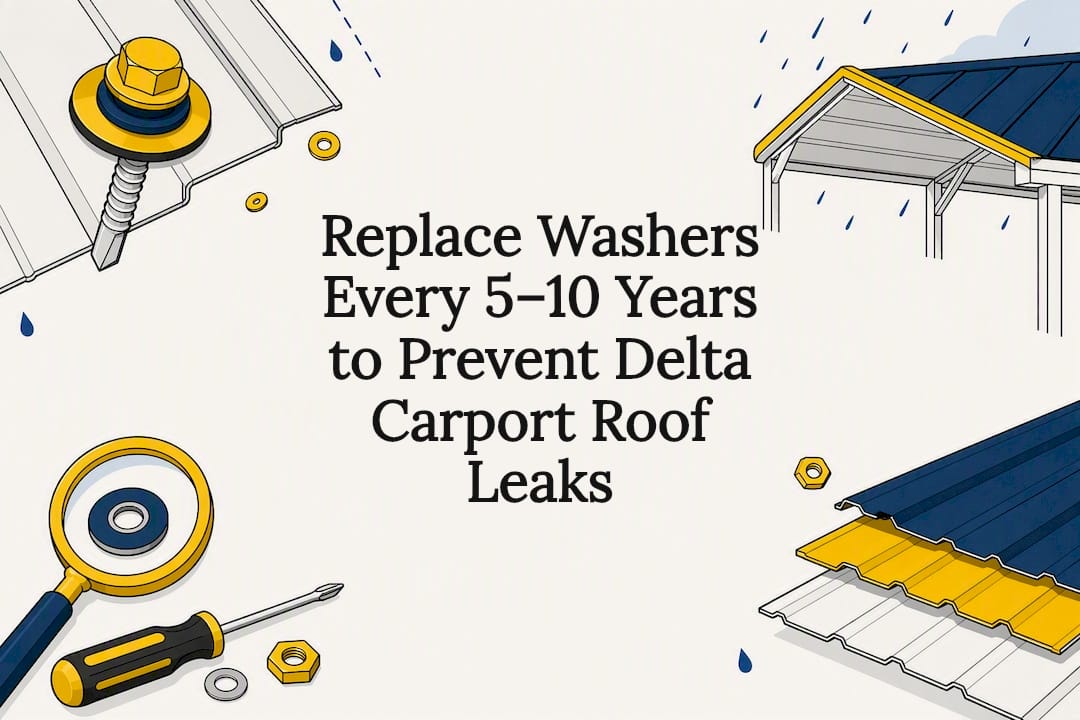
- Plan on replacing washers every five to ten years, before they crack rather than after they’ve already let water through
- Refresh sealant at flashing junctions and penetrations before it visibly fails, not once you spot a stain
- Consider a retrofit coating on an otherwise sound metal roof rather than jumping to full replacement
Pro Tip: If your carport roof ties into the main house roofline, get that junction checked whenever you have the main roof inspected. It’s the single most common spot for wind-driven rain to find a way in.
Why do Delta carports leak differently than roofs elsewhere?
Delta sits exposed to wind coming off the water with little to break it up, and that changes how carport roofs fail here compared to more sheltered parts of the Lower Mainland.
Wind-driven rain doesn’t fall straight down, it gets pushed sideways under panel laps and up into flashing that would stay dry in a calmer climate. Add daily temperature swings between sun and shade, and you get steady thermal expansion and contraction that gradually works screws loose, a pattern often called fastener walk. Water then travels along purlins for a surprising distance before it finds a gap, which is exactly why the drip inside rarely sits above the real entry point.
- A proper inspection traces water paths along the roof structure, not just the ceiling stain
- Local repairs favour mechanical fixes, new flashing, replaced fasteners, and reinforced seams, over cosmetic caulking that fails again within a year
- A written estimate should include photo documentation, a clear condition summary, and repair options ranked by urgency
Priority actions for homeowners and property managers
If you take one thing from this, prioritize flashing and mechanical repairs over anything that comes out of a caulking tube. Sealant buys you a season. Correctly refitted fasteners and flashing buy you years. Run the hose test and document what you find with photos and timestamps before you call anyone in for a quote, it saves everyone time and gets you a more accurate estimate.
For strata councils and property managers overseeing multiple units, the math changes. A scheduled inspection plan across the whole complex costs less over five years than responding to emergency calls one leak at a time, and it detects fastener walk and flashing wear before residents ever see a stain.
— Harman
How Paragon Roofing BC handles carport leaks in Delta
Local roofing companies see a common pattern in Delta carport leaks: wind-driven rain finding its way through a house junction, or fasteners that have worked loose after years of temperature swings off the water. If your hose test points to a problem you’re not comfortable fixing yourself, or the leak keeps coming back after a DIY patch, that’s the point to bring in a professional set of eyes.
A proper visit includes photo documentation of the affected area, a plain-language condition summary, and repair options ranked from quick fix to longer-term retrofit, so you’re not stuck guessing what a quote actually covers. For active leaks or storm damage, professional roofing services often provide emergency tarping and temporary protection to stop water intrusion while a permanent repair gets scheduled. Property managers overseeing strata carports often receive documentation formatted for board approval and insurance records.
If you’re dealing with an active leak or want a second opinion before winter storms roll in, request a leak detection and repair assessment and get a clear picture of what’s actually happening above your carport.

Sources
Technical guidance in this article draws on the National Building Code of Canada for flashing and fastener standards, alongside material-specific repair techniques for metal and polycarbonate panels and retrofit options for sound metal roofs. For Delta-specific case examples, see Paragonroofingbc’s notes on barn roof leaks and condensation in the same region.
FAQ
How do I find out where a carport roof leak is coming from?
Run a hose test with a helper inside watching for drips, spraying small sections from the lowest part of the roof upward. Water often travels along purlins before it drips, so the source can sit well above or beside the interior stain.
Why does my metal carport roof leak during heavy rain?
Heavy, wind-driven rain gets forced sideways under panel overlaps and into flashing joints that stay dry in calmer conditions. Most metal roof leaks come from failed flashing or worn fasteners rather than damage to the panel itself.
How long does a metal carport roof last in Canada?
Lifespan varies with panel quality, coastal exposure, and maintenance, but well-maintained metal panels with timely washer and fastener replacement can perform reliably for decades. Regular inspection matters more than the panel material alone.
What can I put on my carport roof to stop it leaking?
Skip thick caulk as a standalone fix since it fails on roofs that expand and contract with temperature. Replace worn washers and fasteners first, then use a proper elastomeric sealant at seams and flashing joints for a repair that actually lasts.
Recommended
Our Roofing Blog


Have more questions about roofing?
Check out our FAQs or give us a call today to speak to an expert roofer in Vancouver Lower Mainland, BC. We're here to help our neighbours make educated decisions about their roof. For our team, we value helping clients save money while making their roofs last.