Stop Repeated Repairs: Strata Ready Coquitlam Party Wall Inspections
Stop Repeated Repairs: Strata Ready Coquitlam Party Wall Inspections
If water is showing up along a shared wall or below a parapet in your Coquitlam building, you’re almost certainly dealing with a roofing or flashing failure, not a plumbing issue. Most party-wall leaks trace back to a broken waterproofing detail where the roof meets the wall. Document what you’re seeing, then book a professional roof and parapet investigation before you patch anything.
TL;DR:
- Most party-wall leaks in Coquitlam result from failure of roof-to-wall waterproofing details, such as improper flashing laps or missing membranes, not plumbing issues.
- Proper investigation involves moisture mapping, thermal imaging, and controlled water testing, with detailed labelling and reporting necessary to avoid repeated repairs.
- Repairs should be tailored to the extent of failure, ranging from localized patching to full re-waterproofing with continuous membranes and correctly sloped coping.
- Evidence-based documentation and fixed-price, itemized quotes, including contingencies for hidden rot, are essential for effective strata approval and insurer confidence.
- Regular maintenance checks after storms and during seasonal transitions can prevent leaks, especially on face-sealed buildings with no drainage plane or rainscreen gap.
Table of Contents
- Recognizing Coquitlam party wall leaks and what to do first
- Why party wall water damage happens so often in Coquitlam
- What does a professional leak investigation involve?
- What are the repair options for parapet and flashing failures?
- How should strata councils document and approve repairs?
- Preventing party wall leaks before they start
- A Coquitlam parapet repair that shows why the process matters
- Get a Coquitlam party wall leak inspection from Paragon Roofing BC
- Sources
- FAQ
Recognizing Coquitlam party wall leaks and what to do first
Party-wall and parapet leaks rarely announce themselves with a dramatic drip. They show up as a brownish stain creeping across a ceiling near a shared wall, a musty smell in a closet that backs onto a parapet, or window casings that have gone soft and swollen after a wet week. In townhouse complexes, the tell is often that two adjoining units report the same stain pattern on the same wall, just weeks apart.
Before you call anyone, gather evidence:
- Take time-stamped photos of every stain, bubbled paint patch, or soft spot you find.
- Note the weather conditions in the days leading up to when the stain appeared or worsened, especially wind-driven rain.
- Check whether neighbouring units share the same wall or parapet line and are seeing similar marks.
- Avoid running fans or heaters aimed at the stain. Aggressive drying can erase the very moisture trail an inspector needs to trace the leak.
- Contain any active dripping with a bucket or plastic sheeting, but don’t rip into drywall until someone has mapped the damage.
That evidence pack becomes the backbone of whatever repair scope or insurance conversation follows.
Why party wall water damage happens so often in Coquitlam
Coquitlam sits in one of the wettest corners of the Lower Mainland, and that steady, repeated wetting is exactly what wears down roof-to-wall assemblies over time. Buildings here rarely get the extended dry stretches that let a marginal flashing detail survive for decades elsewhere. Every storm cycle tests the same weak points again.
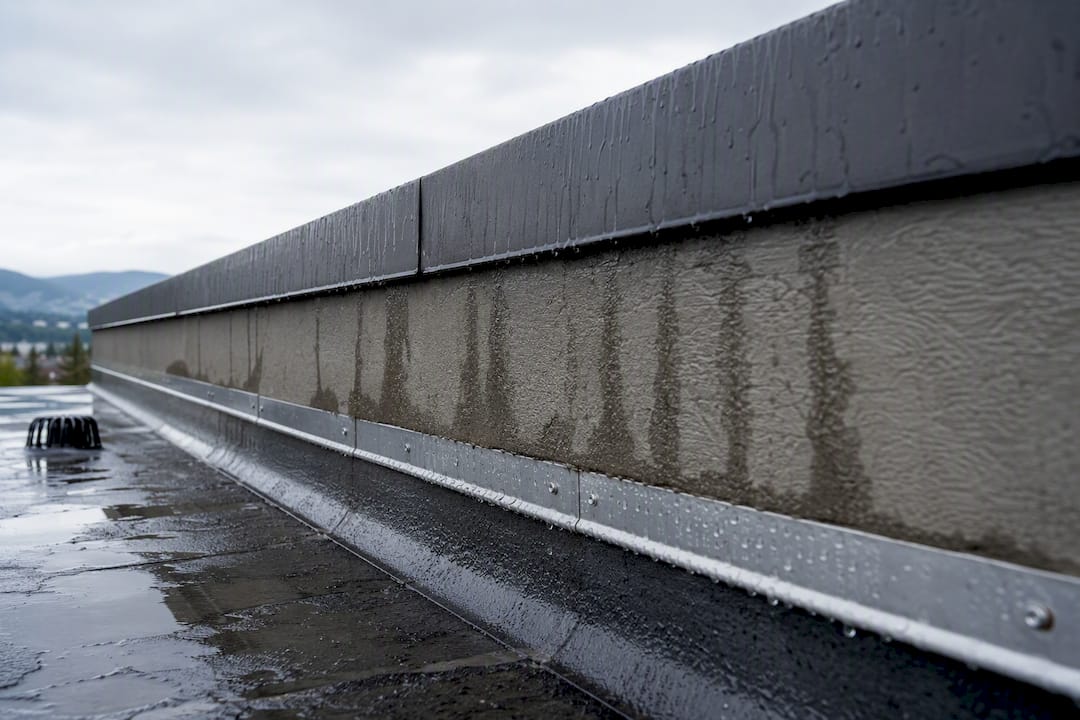
Regional envelope research backs this up in a way that surprised even seasoned roofers when the numbers came out. A survey of building envelope failures in coastal BC found that A large majority of moisture problems in low-rise wood-frame multi-unit buildings trace back to interface details, meaning the seams and penetrations where two building components meet, not the flat field of the wall or roof itself.
On Coquitlam parapets specifically, the recurring failure points are predictable:
- No continuous waterproof membrane running underneath the coping cap.
- Flashing laps installed backwards or too short, letting wind-driven rain work its way upward.
- Missing through-wall flashing at the point where the roof deck meets the party wall.
- Older face-sealed wall assemblies with no drainage plane behind the cladding.
Building Science Corporation’s guidance on parapets is blunt about the fix: coping needs to slope inward with a drip edge, and there must be a continuous membrane beneath it. Metal coping alone, no matter how well it’s caulked, rarely holds up long term. BC envelope research points the same direction, recommending rainscreen assemblies and better interface detailing as the reliable long-term fix.
What does a professional leak investigation involve?
A real investigation follows a sequence, not a guess. Skipping steps is how strata corporations end up paying for the same repair twice.
- History review. We ask when the stains first appeared, what repairs (if any) have already been attempted, and whether the pattern lines up with storm events.
- Exterior survey. A visual walk of the parapet, coping, flashing laps, and cladding to spot obvious gaps, cracked sealant, or displaced coping sections.
- Moisture-meter mapping. Readings taken at a grid across the suspect wall and ceiling, logged and plotted so the wet zones are visible on a diagram, not just described.
- Thermal imaging. Infrared scanning highlights temperature differences that often correspond to trapped moisture behind finishes, narrowing down where to open the wall.
- Controlled water testing. Water is applied to a specific section of the assembly in a controlled sequence to confirm exactly where it enters, rather than assuming based on where it appears inside.
- Targeted exploratory openings. Small, precise cuts into the wall or roof assembly at the suspect zone confirm the actual condition of the sheathing, framing, and membrane underneath.
A methodical approach using moisture mapping, thermal imaging, and controlled testing is what reliably locates active water ingress and supports a fixed-price repair scope, rather than an open-ended time-and-materials job. Bring in an envelope consultant or structural engineer if exploratory openings reveal rot extending into framing members, since that changes both the scope and the liability picture.
Pro Tip: Ask any contractor upfront for a written finding report with labelled moisture maps and photos of every exploratory opening. If they can’t produce that, they’re not equipped to diagnose a party-wall leak, they’re just guessing where to patch.
What are the repair options for parapet and flashing failures?
Not every party-wall leak needs the same level of intervention, and knowing the difference saves strata corporations real money.
Local patching makes sense when an investigation confirms a single, isolated flashing failure with no hidden rot, like a lifted flashing lap at one specific penetration. Staged exterior remediation fits buildings where a few sections of parapet or wall show damage but the rest of the envelope tests dry. Full parapet re-waterproofing becomes necessary when moisture mapping shows the problem is systemic across most or all of the parapet run, which is common in buildings from the same construction era with identical original details.
Typical repair work includes:
- Installing a continuous waterproof membrane beneath new coping, tied into the wall’s water-resistive barrier.
- Replacing or resloping coping so it drains inward or off the wall with a proper drip edge, rather than sitting flat.
- Renewing base flashing and counter flashing where the roof membrane meets the parapet.
- Re-flashing roof-to-wall junctions with correctly lapped laps that respect minimum 50 mm code laps over the water-resistive barrier.
- Removing and replacing rotted sheathing or framing found during exploratory openings.
| Repair type | Best suited for | Typical scope |
|---|---|---|
| Local patching | One confirmed, isolated failure point | Single flashing repair, spot membrane fix |
| Staged remediation | A few damaged sections, rest of envelope tests dry | Multiple targeted repairs across a season |
| Full re-waterproofing | Systemic failure across the parapet run | Continuous membrane, new coping, full reflash |
Bring in a structural engineer any time exploratory openings reveal rot in load-bearing framing, and confirm your contractor carries liability insurance and offers written warranty terms on the membrane and flashing work before signing off.
How should strata councils document and approve repairs?
Councils that get burned twice on the same leak almost always skipped the paperwork the first time. A defensible repair decision needs a clear paper trail owners and insurers can actually follow.
- Compile the full evidence pack: leak history, moisture maps, thermal images, and dated photos from every exploratory opening.
- Request a written scope with itemized, fixed-price line items rather than a vague lump sum, so owners know exactly what they’re approving.
- Build in a contingency line for hidden rot, since openings on leaky-era buildings commonly reveal damage that wasn’t visible beforehand.
- Confirm the contractor’s WCB coverage and bonding before the tender goes to a vote.
- Present the investigation findings to owners before the vote, not after, and plan for staged approvals if the scope may expand once work begins.
An investigation that maps the moisture path with targeted openings gives councils something concrete to bring to an insurer or a contested owners’ meeting, rather than a contractor’s verbal opinion.
Preventing party wall leaks before they start
A parapet in good condition doesn’t fail overnight. It fails after years of small maintenance items getting skipped.
- Walk the roof and parapet after any major windstorm, and again as a routine each spring and fall.
- Confirm coping still slopes correctly and the drip edge hasn’t been bent flat or blocked by debris.
- Clear roof drains and scuppers before they back up and pond water against the base flashing.
- Check sealant at coping joints and penetrations for cracking, since sealant is a maintenance item, not a permanent fix.
- Watch roof-to-wall junctions closely on any building without a rainscreen gap behind the cladding.
Pro Tip: If your building is a face-sealed assembly from before the mid 2000s, budget for a rainscreen or drainage retrofit during your next major envelope project. Patching a face-sealed wall repeatedly costs more over ten years than converting it once.
A Coquitlam parapet repair that shows why the process matters
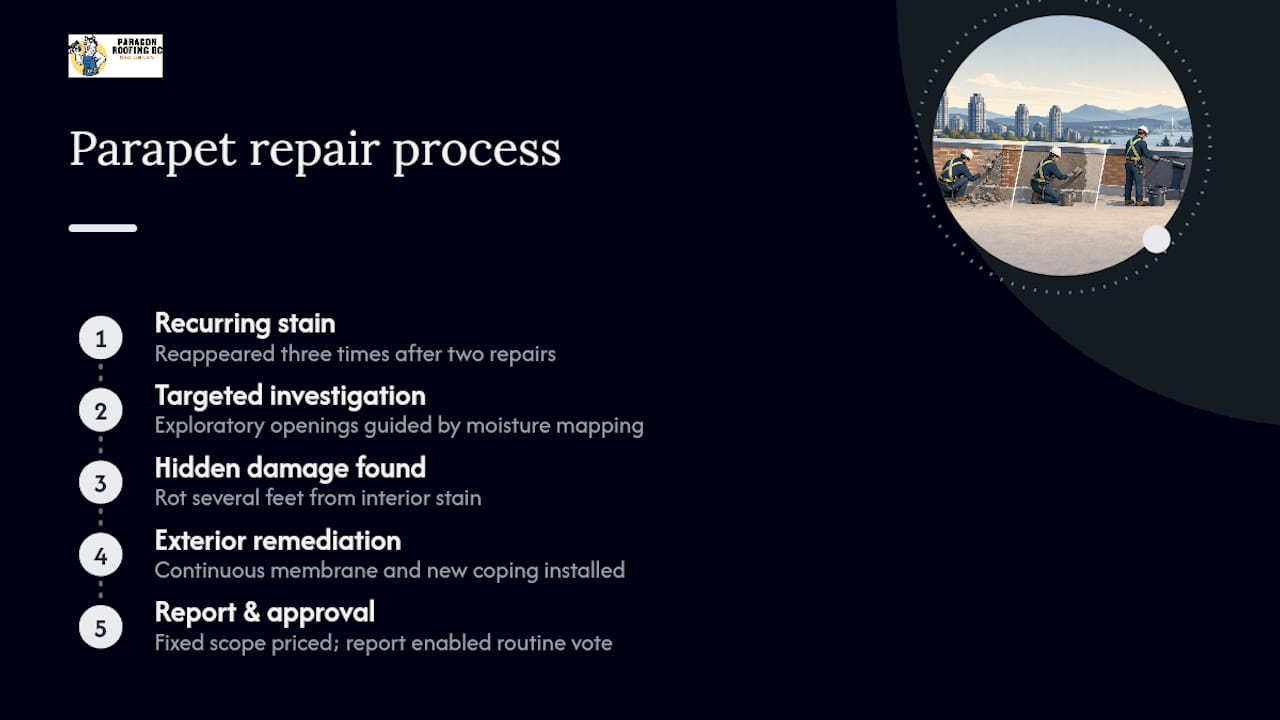
A strata council in Coquitlam once called us about a stain that had reappeared three times despite two prior “repairs.” Targeted exploratory openings, guided by moisture mapping rather than the stain itself, found rot several feet from where the water was showing up inside. That’s not unusual. Water follows the framing, not the drywall.
The fix was a staged exterior remediation with a continuous membrane and new coping, priced as a fixed scope the council could actually approve at a single meeting. The real lesson wasn’t the repair itself. It was that a proper findings report, with labelled photos and a moisture map, is what turns a contested strata vote into a routine one.
— Harman
Get a Coquitlam party wall leak inspection from Paragon Roofing BC
Paragon Roofing BC investigates and repairs party-wall and parapet leaks across Coquitlam using the same evidence-first sequence outlined above: exterior survey, moisture mapping, and targeted exploratory openings before a single repair dollar gets spent.
When you request a quote, expect an itemized scope broken into fixed-price line items, a contingency allowance for any hidden rot the openings reveal, and proof of liability insurance and WCB coverage up front, not buried in fine print. Our reports are built to be council-ready, with labelled moisture maps and photos your strata can bring straight to an owners’ vote. If you’re dealing with staining, swollen casings, or a musty smell along a shared wall or parapet in Coquitlam, request a Coquitlam roofing inspection and we’ll walk the envelope, map the moisture, and give you a real number to work from.
Sources
The technical recommendations above draw on established building science and regional research, including Building Science Corporation’s parapet guidance on membrane continuity under coping, and coastal BC envelope studies documenting how interface details drive most moisture failures in wood-frame buildings. For more on diagnostic methods, see our roof leak detection guide for BC homeowners.
- BSI-050: Parapets — Where roofs meet walls (Building Science Corporation)
- Survey of building envelope failures in the coastal climate of British Columbia (Morrison Hershfield / CRD reference)
- Building envelope design, construction — success factors summary (BCHousing)
- Anyleak
- Strata water ingress investigation (Eurohouse Construction)
FAQ
Does a party wall leak always mean a roofing problem?
In most cases, yes. Water showing up along a shared wall in Coquitlam almost always traces back to a roof-to-wall or parapet flashing failure rather than plumbing.
How long does a professional leak investigation take?
A full sequence, from exterior survey through targeted exploratory openings, typically spans a few site visits, since moisture readings and thermal scans need to be reviewed before deciding where to open the wall.
Can I just caulk the parapet myself to stop the leak?
Surface caulking rarely holds because the real failure is usually a missing membrane or bad flashing lap underneath the coping, and sealing over the visible gap can trap moisture rather than stop it.
Who pays for party wall leak repairs in a strata building?
Responsibility depends on your strata’s bylaws and where the failure is located, but most corporations treat parapet and roof envelope repairs as common property expenses once an investigation confirms the source.
What should be in a contractor’s repair quote?
Expect itemized, fixed-price line items, a contingency allowance for hidden rot, proof of WCB and liability coverage, and written warranty terms, all of which Paragon Roofing BC in includes as standard on Coquitlam parapet repairs.
Recommended
Our Roofing Blog


Have more questions about roofing?
Check out our FAQs or give us a call today to speak to an expert roofer in Vancouver Lower Mainland, BC. We're here to help our neighbours make educated decisions about their roof. For our team, we value helping clients save money while making their roofs last.