
West Vancouver Balcony Ledger Flashing Leaks: Causes and Fixes
West Vancouver Balcony Ledger Flashing Leaks: Causes and Fixes

A balcony ledger leak in West Vancouver usually starts where the balcony meets the wall, and it stays hidden until framing has rotted. The ledger is the board that fastens a balcony or deck to the building. Water that gets behind it runs down inside the wall, so a stain on the ceiling below is often the last sign, not the first. Paragon Roofing BC inspects and repairs flashing and roof-to-wall junctions for West Vancouver homeowners, strata councils and property managers, and the lasting fix is always about the whole water path, not a bead of caulking.
TL;DR
- Ledger leaks happen when flashing is missing, crushed, reverse-lapped or not tied into the wall’s water-resistive layers.
- Water that gets behind the cladding travels down the sheathing and rots framing on the floors below, often while the outside looks fine.
- A visual check is not enough: investigators of this type of failure open the wall to map the damage.
- A durable repair rebuilds the flashing in shingle-like layers with a drained gap, rather than sealing the surface.
- Stratas should put the balcony envelope on a scheduled inspection and maintenance program.
Table of Contents
- Why the ledger is the weak point on North Shore buildings
- How water gets from the ledger into the wall
- The defects we look for
- What a lasting repair involves
- Building code changes worth knowing
- For strata councils and property managers
- Perspective
- Getting the junction inspected and repaired
- FAQ
- Sources
Why the ledger is the weak point on North Shore buildings
West Vancouver gets long, wind-driven rain seasons, and balconies sit on the most exposed part of the wall. The ledger connection breaks the wall’s weatherproofing: bolts pass through the cladding and the sheathing membrane, and the board holds moisture against the wall. BC Housing’s illustrated guide to wood decks and balconies calls the ledger attachment a common point of failure. If it is not detailed and protected from moisture, leakage into the building enclosure may occur and untreated wood can decay.
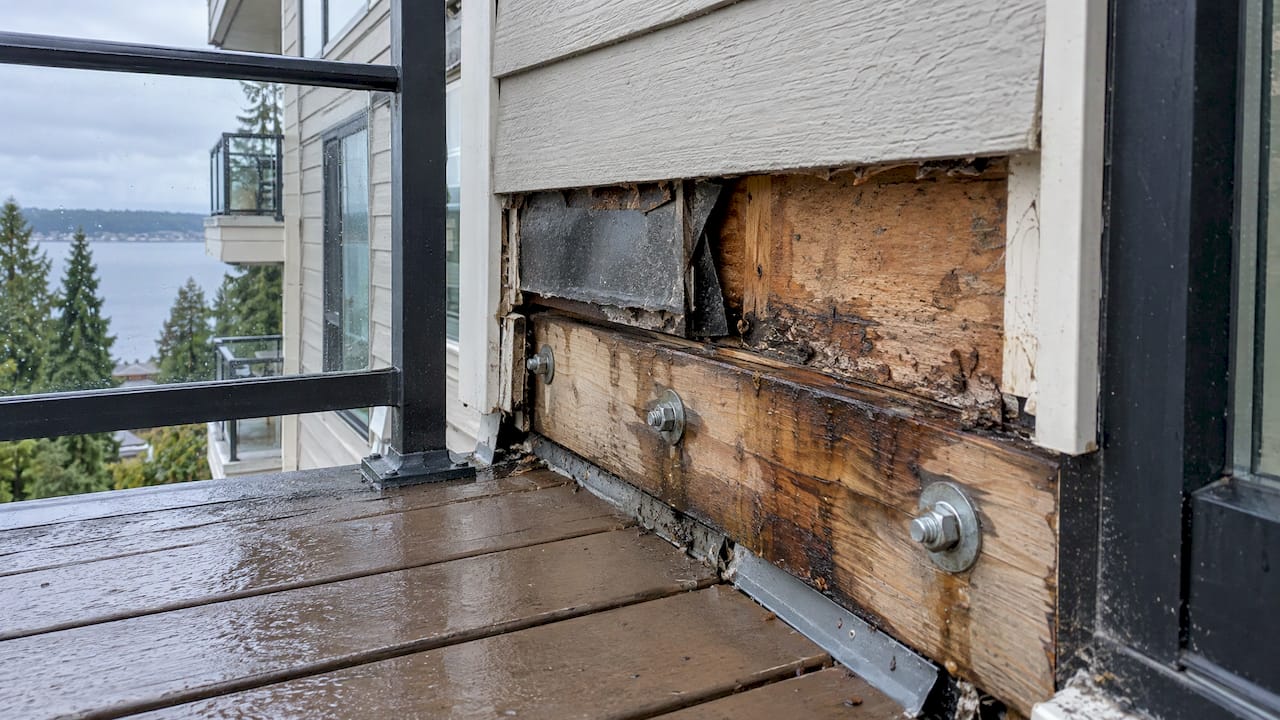
The same guide notes that the BC Building Code does not give comprehensive ledger fastening guidance. Quality depends on the detailing and on the trades following it in the right order.
How water gets from the ledger into the wall
Research from the National Research Council of Canada describes the path clearly. In a field case study of moisture management, water entered beyond the cladding at the balcony-to-wall joint and through the openings made for cantilevered joists. It reached the inside face of the sheathing membrane and the stud cavity, then moved down by gravity to the horizontal framing at the floor below and spread sideways. The damage was significant and cost structural integrity across the balcony elevations. In a second case, water entered over the ledger board because there was no flashing, rotting the framing below the ledger and the plywood below the balcony.
Two details from that study matter to West Vancouver owners:
- Buildings without eave troughs put more water onto balconies and other protruding elements.
- Polyethylene wrap flashings at window and patio-door heads trapped moisture and rotted the wood at those spots.
A broader NRC paper on rainwater management on building facades surveyed 46 buildings and found problems in 37. The water came from outside rain, not interior condensation, and it bypassed the cladding and the water-resistive barrier at locations including balcony railings.
The defects we look for
M.Z. Rousseau’s NRC case studies on exterior wall moisture found the balcony and wall junction was a recurring failure across 15 private-sector buildings. The defects listed there match what a ledger inspection should check:
- Discontinuous membrane and flashing at balcony level. The wall’s second line of defence stops at the balcony, so water has a way in.
- Balcony framing built before the membrane. Once the framing and floor are in, continuity of the membrane is hardly possible because nobody can reach the wall behind.
- Missing flashing or no drainage plane. Water sits on the ledger with nowhere to go.
- Flashing crushed by the ledger. The board is tight to the wall and flattens the metal, breaking its drip and its lap.
- Reverse-lapped membranes and flashings. Upper layers tucked under lower ones send water inward.
BC Housing adds two more: water ponding on membraned balconies from poor slope, wood sleepers or clogged drains, and top-mounted guardrails whose fasteners punch through the waterproof membrane.
Signs you may have a ledger leak
The NRC case study reported wet carpets and stained ceiling finishes after rain. Look for these in the unit or room below a balcony:
- Staining or bubbling paint at the ceiling edge nearest the exterior wall
- Damp carpet or flooring near a patio door after wind-driven rain
- Soft or darkened wood at the balcony underside, the ledger or the rim area
- Sealant at the ledger line that is cracked or has been re-applied repeatedly
By contrast, the same study stresses that the extent of damage may not be evident from a visual survey. Investigators removed cladding and the sheathing membrane to map staining, then opened the wall sheathing to assess the stud cavity. That is why a ledger leak should be inspected before it is patched.
What a lasting repair involves
The repair has to restore a continuous, shingle-style water path. The NRC details included these elements:
- Ledgers installed on pressure-treated vertical strapping, creating a drained air space behind them.
- Metal flashing that starts at the patio-door sub-sill, overlaps the strapping and ends below the ledger.
- Saddle flashings at cantilevered joists, pan flashings at sills, and eave troughs to reduce water loads.
BC Housing’s guide gives specifics for the flashing itself: heavy-gauge (24 gauge) metal, a minimum 13 mm (0.5 inch) gap between the bottom leg of the flashing and the vertical framing behind, and a 45-degree drip edge to limit water kicking back. It also recommends 13 mm lag or through bolts with washers that fully penetrate the ledger and rim joist, with a 13 mm gap between ledger and wall so the area can drain and dry. For open decks, a strip of waterproof membrane goes between the ledger and the rim joist with corrosion-resistant washers.
Rousseau’s rehabilitation advice is to keep the second line of defence continuous at the balcony level, give water a clear path down the sheathing face, and lap membranes and flashings like shingles so water is never trapped inboard of the sheathing membrane. It is easier when joists are fastened to the wall rather than cantilevered through it.
Why caulking alone fails
BC Housing describes the corner where the balcony edge meets the wall as needing compatible, properly sequenced layers: sheathing membrane, balcony membrane, tapes, sealants and flashings. A single sealant line cannot do that job. When sealant is the only defence, it ages, opens up in the freeze-thaw and wind-driven rain cycle, and water returns behind it.
Building code changes worth knowing
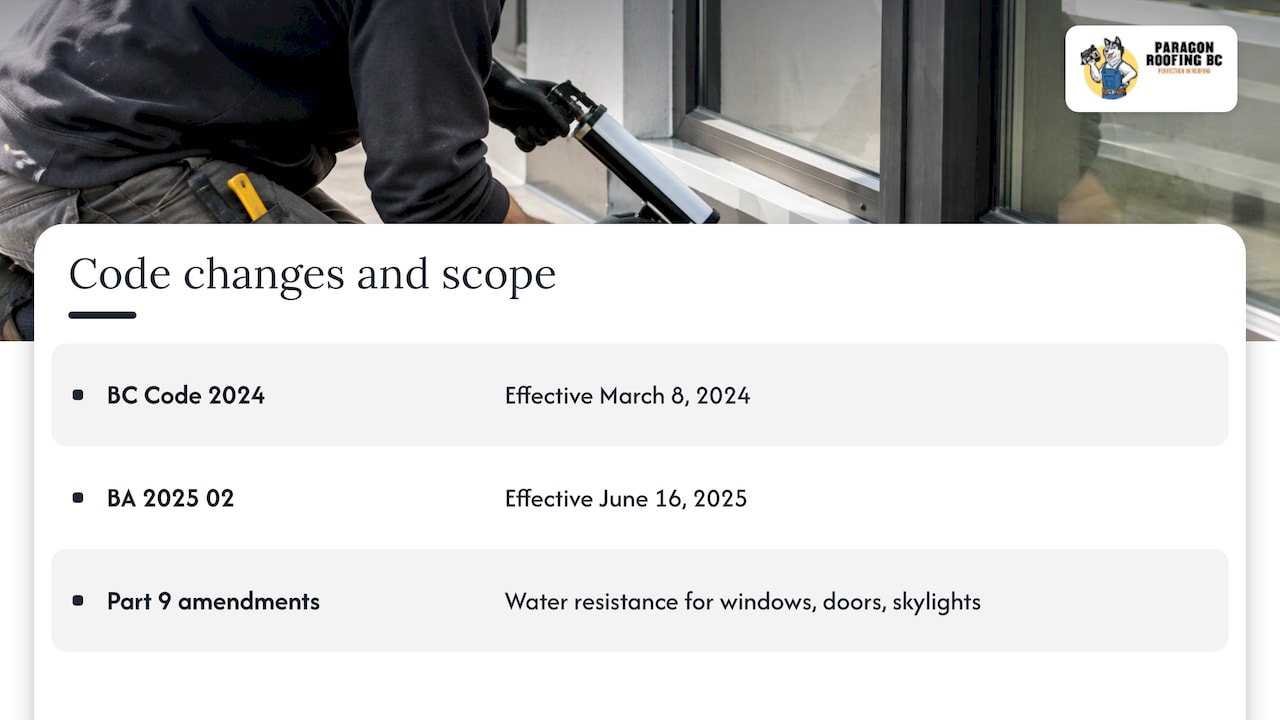
The BC Building Code 2024 took effect on March 8, 2024, subject to the order’s transitional rules. A later information bulletin, BA 2025 02, effective June 16, 2025, issued errata and revisions, including Part 9 amendments on water resistance for windows, doors and skylights. Balcony repairs that involve patio doors and wall openings should be scoped with those requirements in mind. For structural or envelope design questions, an architect or engineer is the right professional.
For strata councils and property managers
BC Housing’s Maintenance Matters guide on decks and balconies recommends engaging a building envelope consultant, an architect or engineer, to inspect, set up a maintenance program and report on condition, causes of deterioration and repair or replacement needs. It warns that holes, cracks and separated joints can let water into the wall assembly and rot the balcony structure.
In practice, that means three decisions for a council:
- Inspect on a schedule. Include ledger lines, sub-sills, patio-door heads and railing posts, not only the membrane surface.
- Scope the repair by elevation. Because water travels down the wall, a leak at one balcony can mean damage on the floors below it.
- Coordinate the roof and the balcony. Missing eave troughs and failed roof-to-wall flashing load the balcony with extra water. Our related guides on balcony waterproofing failure for BC stratas and West Vancouver wind-driven rain leaks cover those links.
Perspective
On the North Shore we see flashing as a system, not a part. A ledger leak is rarely one bad piece of metal. It is usually a break in the chain between the roof edge, the wall membrane, the balcony and the door below it.
That is why our approach starts with an inspection and a look at the whole wall junction, then a repair that restores the lapping order from top to bottom. We handle flashing and roof-to-wall work for residential, commercial and strata buildings in West Vancouver and across the Lower Mainland, and we would rather open up the problem once and fix it properly than come back after every storm.
If your balcony sits under a roof edge, a dormer or a valley, the roof flashing above it is part of the answer too.
Harman
Getting the junction inspected and repaired
If you have stains below a balcony, repeated sealant jobs at the ledger, or a strata building with balconies that have never been inspected, start with a proper look at the junction. Paragon Roofing BC offers residential roof inspections and repairs for West Vancouver homes, and strata and multifamily roofing services for councils and property managers. Emergency roof repairs are also available from us when water is actively coming in.

For the roof side of the same wall, see our roof inspection page for West Vancouver.
FAQ
Can I fix a balcony ledger leak with sealant?
Sealant alone does not restore the water path. BC Housing describes the balcony-to-wall corner as needing sequenced membranes, tapes, sealants and flashings working together. Sealant is one layer of that system, so the repair should rebuild the flashing and lapping.
How do I know if water is inside the wall?
Staining on the ceiling below, damp carpet near a patio door after rain, or soft wood at the ledger are common signs. NRC investigators found that a visual survey may not show the full extent, so the wall is often opened to check sheathing and studs.
Does the roof affect balcony ledger leaks?
Yes. In the NRC case study, buildings without eave troughs sent more water onto balconies and other projecting elements. Roof edge flashing, gutters and valleys above a balcony should be checked in the same visit.
Who should inspect a strata building’s balconies?
BC Housing recommends a building envelope consultant, such as an architect or engineer, to inspect and set up a maintenance program. The roofing contractor then carries out the flashing and roof-edge repairs the report identifies.
Sources
- BC Housing: Illustrated Guide, Building Safe and Durable Wood Decks and Balconies
- BC Housing: Maintenance Matters 06, Deck and Balcony Maintenance Essentials
- NRC: Field experience with moisture management
- NRC: Moisture management in exterior walls, case studies
- NRC: Rainwater management on building facades
- British Columbia Building Code 2024
Recommended
Our Roofing Blog


Have more questions about roofing?
Check out our FAQs or give us a call today to speak to an expert roofer in Vancouver Lower Mainland, BC. We're here to help our neighbours make educated decisions about their roof. For our team, we value helping clients save money while making their roofs last.