How long does a tar and gravel roof last in BC?
TL;DR:
- High-quality tar and gravel roofs can last over 25 years with proper installation and maintenance.
- Neglect, poor installation, and unresolved small issues drastically reduce roof lifespan to 5-15 years.
- Regular inspections, prompt repairs, and proper gravel coverage are key to maximizing durability.
Tar and gravel roofs have a reputation problem. Many BC homeowners assume these roofs are a relic from a different era, something their grandparents had that barely made it a decade before causing headaches. That assumption is costing people money. The truth is that high-quality multi-ply systems can last 25 to 35+ years, while neglected or poorly installed versions may only survive 5 to 15 years. The gap between those two outcomes is enormous, and understanding what drives it is exactly what this article is here to help you with.
Table of Contents
- What is a tar and gravel roof and where are they used?
- How long does a tar and gravel roof actually last?
- What affects the lifespan of a tar and gravel roof?
- Comparing tar and gravel to modern alternatives
- A roofing expert’s honest take: what BC homeowners should really consider
- Need help with your roof? Work with trusted BC professionals
- Frequently asked questions
Key Takeaways
| Point | Details |
|---|---|
| Lifespan range | A well-maintained tar and gravel roof lasts 25 to 35+ years, but poor care can cut it to just 5-15 years. |
| Critical factors | Installation quality, regular maintenance, and BC’s weather are the top influences on roof longevity. |
| Worth comparing | Homeowners should compare tar and gravel to other roofing types for the best fit and value. |
| Maintenance matters | Routine inspection and quick repairs are more important than the roofing material itself for maximizing lifespan. |
What is a tar and gravel roof and where are they used?
Now that you know tar and gravel roofs may last far longer than you think, let’s get into what they actually are and why they’re so common across British Columbia.
A tar and gravel roof is the everyday name for what the roofing industry calls a built-up roof, or BUR for short. The name comes from how these roofs are assembled: multiple layers of bitumen (a thick, petroleum-based waterproofing material) are alternated with reinforcing fabrics like fibreglass or organic felt. Once the layers are built up to the required thickness, a final layer of gravel or crushed stone is pressed into the top surface. That gravel isn’t just decorative. It protects the bitumen underneath from UV radiation, physical damage, and heavy rainfall, all of which are significant concerns in BC.
You’ll find these roofs most commonly on flat or low-slope structures. In BC, that means:
- Older residential homes with flat roof designs, particularly in areas like East Vancouver, Burnaby, and New Westminster
- Commercial buildings, warehouses, and retail properties across the Lower Mainland
- Multi-unit residential buildings and strata complexes
- Additions and garage roofs on homes that have a steeper main roof elsewhere
The construction suits BC’s climate better than many people realise. Layers of bitumen create genuine redundancy, meaning if one layer develops a minor flaw, the others continue to do their job. That’s a bit like wearing a waterproof jacket over a fleece over a base layer. One layer failing doesn’t mean you’re immediately soaked. Understanding commercial roofing types in Vancouver helps clarify just how widely BUR systems are still specified on new and retrofitted buildings.
The misconception that these roofs are outdated simply doesn’t hold up. Roofers across BC still install BUR systems regularly because the materials have evolved, the installation methods have improved, and the cost-to-longevity ratio is competitive. Modern tar and gravel systems use refined bitumen blends and higher-grade felts compared to what was available decades ago, which directly improves their performance and lifespan. You can learn more about roof life expectancy in BC to see how BUR compares to other materials on the market.
Pro Tip: Not all gravel is equal. Proper gravel selection and installation matters more than most people think. Rounded gravel tends to roll off during heavy rain, while angular, crushed stone locks together and stays in place. Consistent gravel coverage is what gives BUR roofs their weather and UV resistance. Good gravel installation strategies focus on the right size, angularity, and embedment depth to ensure the surface layer actually performs its protective function.
How long does a tar and gravel roof actually last?
Understanding their makeup helps, but how long can you actually expect your tar and gravel roof to last? The answer depends heavily on two things: how well it was installed and how consistently it’s been looked after.
Research confirms that multi-ply BUR systems last 25 to 35+ years with high-quality installation and routine maintenance. On the other end, a poorly installed or neglected roof may only last 5 to 15 years. That’s a dramatic difference, and it’s almost entirely within your control as a homeowner.
Here’s how lifespan typically breaks down depending on installation and maintenance quality:
| Quality level | Typical lifespan | Key characteristics |
|---|---|---|
| High quality, well maintained | 25 to 35+ years | Professional install, annual inspections, prompt repairs |
| Average quality, moderate care | 15 to 25 years | Decent install, occasional maintenance, some neglect |
| Poor quality or neglected | 5 to 15 years | Substandard install, no regular maintenance, deferred repairs |
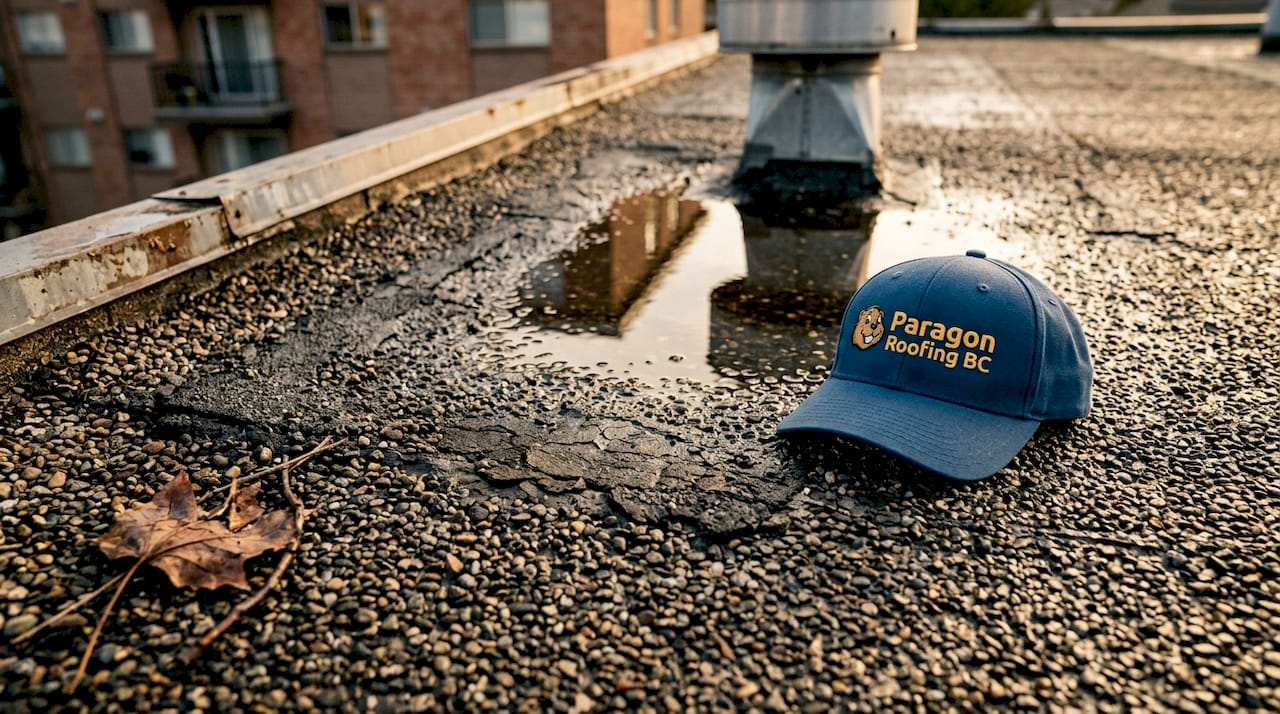
The biggest variable most homeowners underestimate is what happens when small problems get ignored. A tiny blister in the surface membrane, a small patch of loose gravel, or a clogged drain might seem minor. Left alone, each one becomes a pathway for water to work its way into the layers below. Once water penetrates a BUR system, the damage spreads faster than you’d expect because the layers trap moisture and allow it to migrate laterally.
“High-quality multi-ply systems can last 25 to 35+ years, while poorly installed or neglected roofs may only last 5 to 15 years.” Built-Up Roofs (BUR): The Ultimate Guide
The key factors that move you toward the longer end of that range include:
- Professional installation by an experienced, certified contractor
- Using premium-grade bitumen and reinforcing fabrics
- Proper surfacing with the right type and depth of gravel
- Maintaining clear drainage at all times
- Scheduling inspections and catching problems early
Vancouver’s rainfall patterns place above-average stress on flat roofing systems. Understanding how rain affects roof lifespan is essential context for any BC homeowner with a flat roof. For more on roof life expectancy facts, we’ve put together a detailed overview that covers multiple roofing types common in the region.
What affects the lifespan of a tar and gravel roof?
Knowing the range is just the start. Here’s what really determines which end of the lifespan spectrum your roof will hit.
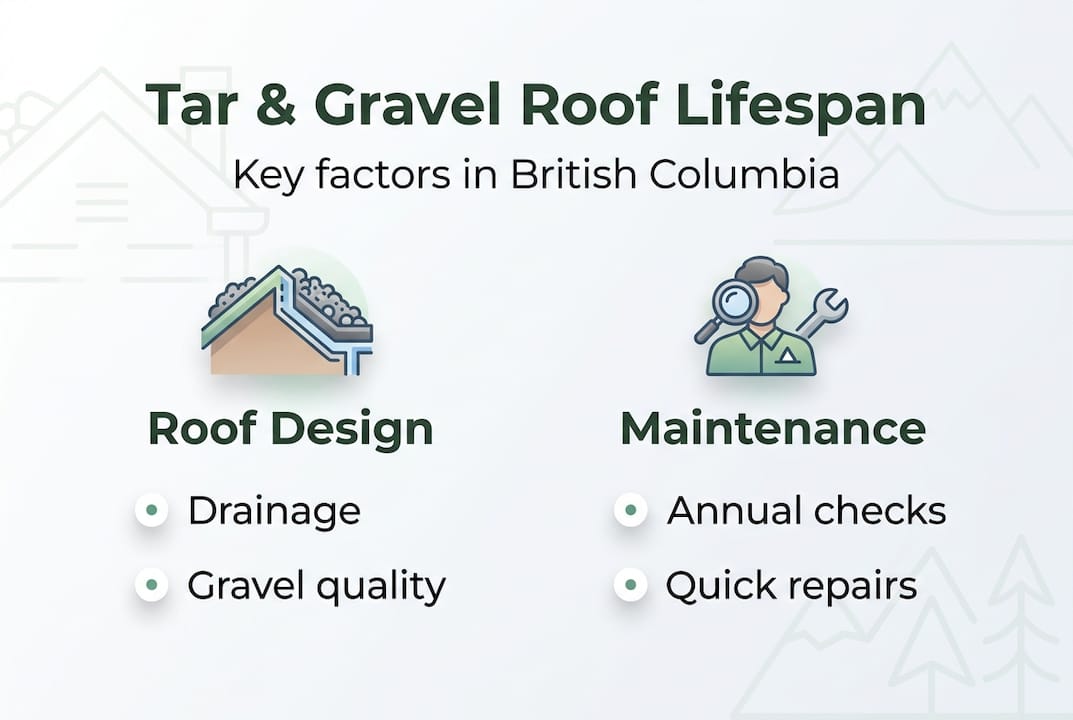
The factors that influence tar and gravel roof longevity fall into two broad categories: the things that happen during installation, and the things that happen afterward. Both matter equally, and failing on either front shortens roof life significantly.
Top 5 lifespan influencers for tar and gravel roofs in BC:
- Installation quality: This is the foundation of everything. A poorly applied BUR system, with uneven bitumen layers, inadequate adhesion, or improper flashing at the edges and penetrations, will develop problems within years. A well-installed system is watertight from day one and stays that way far longer.
- Drainage design and maintenance: Flat roofs accumulate standing water if drains aren’t properly placed or maintained. Even a small amount of ponding water creates persistent pressure on the membrane and accelerates deterioration. This is particularly critical in BC where rainfall volumes are high.
- Material grade: Not all bitumen and reinforcing felts are created equal. Budget-grade materials save money upfront but may lose flexibility sooner, crack in cold weather, or fail to bond properly. Premium materials flex with temperature changes and resist damage more effectively.
- BC climate stressors: Heavy rain, freeze/thaw cycles in colder parts of BC, moss and algae growth, and prolonged overcast conditions all wear on flat roofs in ways that differ from drier climates. Each of these stressors is manageable with the right maintenance approach.
- Maintenance frequency: Roofs that receive annual inspections and prompt, targeted repairs consistently outperform those left to their own devices. Think of it like a vehicle: oil changes seem inconvenient, but skipping them shortens the engine’s life dramatically.
According to industry research, BUR systems last 5 to 15 years when neglected, compared to 25 to 35+ years with proper care. The difference is not the material. It’s the attention.
Pro Tip: Drainage is the number one issue we see on ageing tar and gravel roofs in BC. If your drains are slow or blocked, water pools on the surface and works against you every single rainfall. Clear your drains at least twice a year, and after any significant windstorm that drops debris on the roof. Catching a blockage early costs almost nothing. Repairing the water damage it causes can cost thousands.
Understanding how Vancouver’s rainfall impacts roof longevity puts these maintenance priorities in sharp relief. For practical strategies on maximising your roof’s lifespan, our team has outlined the approaches that consistently deliver results for BC homeowners.
Comparing tar and gravel to modern alternatives
Many BC homeowners ask how tar and gravel compares to what’s available today. It’s a fair question, and the answer isn’t as simple as “newer is always better.”
Here’s how BUR stacks up against three common alternatives:
| Roofing system | Typical lifespan | Weather resistance | Maintenance needs | Relative cost |
|---|---|---|---|---|
| Tar and gravel (BUR) | 25 to 35+ years | Excellent for flat roofs | Moderate | Mid-range |
| Torch-on (modified bitumen) | 20 to 30 years | Very good | Low to moderate | Mid-range |
| EPDM (rubber membrane) | 20 to 25 years | Good | Low | Lower upfront |
| Asphalt shingles | 15 to 25 years | Good for pitched roofs | Low | Lower upfront |
The lifespan data for BUR systems reaching 25 to 35+ years is competitive with or superior to most alternatives when installation quality is equivalent. Torch-on roofing is a popular modern option because it installs faster and has a slightly lower maintenance burden, but it doesn’t always outlast a well-built BUR system. You can explore a full comparison of roofing materials to see how these systems perform across different criteria.
When you’re choosing between tar and gravel and a modern alternative, consider these situations:
- Choose tar and gravel when the existing structure is already built to support its weight, you want proven redundancy through multiple layers, and you’re comfortable with a material your local roofer knows inside and out
- Consider alternatives when your roof deck needs significant repairs and a lighter membrane makes more sense, you want a faster installation with less disruption, or you’re replacing an older BUR system and the budget supports a premium torch-on or EPDM option
One thing worth noting is repairability. Tar and gravel roofs are among the easiest flat roofing systems to patch and repair in targeted areas. You don’t need to replace the whole surface to fix a problem zone, which keeps long-term maintenance costs reasonable. Compare this to asphalt shingle lifespans in Vancouver, and you’ll see that BUR actually holds its own quite well on a cost-per-year basis.
Getting the gravel surfacing right is also essential during installation. Proper stone and gravel selection for the top layer is not a minor detail. The right aggregate locks together, drains properly, and shields the membrane underneath from the UV and physical wear that degrades it over time.
A roofing expert’s honest take: what BC homeowners should really consider
Here’s something we see regularly that the industry doesn’t talk about enough. Homeowners hear “25 to 35 years” and mentally check the roof off their list. They installed a quality BUR system, they figure it’ll just do its job, and they stop thinking about it. That mindset is exactly how a 30-year roof becomes a 15-year roof.
The “set and forget” attitude is the real enemy of roof longevity in BC. No material, no matter how well it’s made, survives sustained neglect in a climate that delivers as much rain, moss, and temperature variation as ours does. Your roof is one of the largest investments in your home. Treating it like a smoke detector you check once a decade is a costly mistake.
That said, I genuinely believe tar and gravel is the right choice for many BC homeowners, particularly those with flat roofs on older homes, or anyone who values repairability and cost predictability over cutting-edge aesthetics. It’s not the flashiest option. But it is reliable, well-understood by local tradespeople, and forgiving when it comes to targeted repairs.
The big takeaway from years working on BC roofs is this: regular attention matters more than material type. A torch-on roof that never gets inspected will fail before a BUR roof that gets annual care. Following expert maintenance tips and building annual inspections into your spring routine will do more for your roof’s longevity than any material upgrade.
Pro Tip: Put a roof inspection on your calendar every April. Spring is the perfect time to assess any winter damage, clear debris, check drainage, and catch blisters or cracks before summer UV exposure makes them worse.
Need help with your roof? Work with trusted BC professionals
Ready to take the next step or need expert help maintaining your tar and gravel roof? Whether you’re trying to figure out how many years are left on your current system or planning a full installation, getting a professional set of eyes on your roof is always the smartest first move.
At Paragon Roofing BC, we specialise in roof installation in Vancouver and across the Lower Mainland, and our team has hands-on experience with built-up roofing systems of all ages and conditions. If your roof needs ongoing attention, our roof maintenance specialists can set up a maintenance plan that fits your home and budget. We also offer full roof replacement in Delta and surrounding communities when repairs are no longer the right answer. Reach out to book a consultation and get honest, local advice you can actually use.
Frequently asked questions
What is the average lifespan of a tar and gravel roof in BC?
With professional installation and regular maintenance, tar and gravel roofs typically last 25 to 35 years in BC’s climate, as high-quality multi-ply systems consistently demonstrate when properly maintained.
What are common signs a tar and gravel roof needs replacement?
Visible leaks, pooling water that doesn’t drain within 48 hours, surface bald spots where gravel has worn away, and widespread cracking or blistering of the membrane all indicate your tar and gravel roof may be approaching the end of its service life.
How can I extend the life of my tar and gravel roof?
Schedule professional inspections every spring, keep roof drains clear of debris year-round, and arrange prompt repairs for any blisters, cracks, or separations at flashings before they allow water infiltration.
Is a tar and gravel roof a good choice for modern homes?
Yes, particularly for flat or low-slope roofs where multi-layer redundancy and easy repairability are valuable. Always compare options based on your specific roof geometry, budget, and long-term maintenance preferences before making a final decision.