
Burnaby Green Roof Leaks: Where They Start and How to Trace Them
Burnaby Green Roof Leaks: Where They Start and How to Trace Them

Most green roof leaks in Burnaby start at a detail, not in the middle of the planted area: a drain, an expansion joint, a pipe or conduit penetration, or the edge where vegetation meets bare membrane. Because soil, plants and drainage layers hide the waterproofing, the fastest way to a dry ceiling is to work through those details in order, narrow the search to one zone, and open the roof only there. If you manage a strata podium, a commercial building with a planted roof, or a townhouse complex with a garden deck, this is the routine we would follow, and our commercial and strata teams handle the roof repair and inspection side of it.
TL;DR
- Leaks under green roofs are usually found at drains, expansion joints, penetrations and terminations, so start the search there before assuming the membrane is failing everywhere.
- Water can travel a long way from a breach before it shows as a stain, so the stain on the ceiling is a clue, not the location.
- Blocked drains and a clogged drainage layer mimic leaks. Check for ponding that lasts more than about three hours after rain.
- Twice-yearly inspections and clear drain access make a future leak far cheaper to find and fix.
- Burnaby’s wet season is long, so book the inspection before October, not after the first ceiling stain.
Table of Contents
- Why green roofs leak where they do
- The usual suspects: drains, joints and penetrations
- Is it the membrane, or something else?
- How the leak gets found without stripping the roof
- Burnaby’s rain makes small defects show up
- What to do when it is actively leaking
- Designing for the next leak
- A maintenance routine that works
- Perspective
- Getting a Burnaby roof inspected
- FAQ
- Sources
Why green roofs leak where they do
A green roof is a layered system. From the roof surface upward you typically have a waterproofing membrane, a drainage layer, lightweight growing media and the plants. Water the soil does not absorb drains through the drainage layer to the outlets, according to the Canadian low impact development guide for green roofs, which also notes these roofs are typically designed to hold back rainfall from 5 to 25 mm storms.
That means the membrane is working every day, not just in a downpour, and you cannot see it. A UBC study on stormwater source controls reports that leaks were once the main operational concern for traditional green roofs, have become rare in modern systems, and that the membrane is protected from UV, which can extend its life. The catch is the same study’s point about repairs: when a leak does happen, a section of the green roof has to be removed to reach it.
So the goal is never “find a leak”. It is “find the leak while disturbing as little soil and planting as possible.”
The usual suspects: drains, joints and penetrations
Building pathologists writing for IIBEC found that most green roof and plaza leaks come from failed expansion joints and drain weepholes clogged with bitumen. Other causes they list are roots from trees and large shrubs getting into membrane seams, poorly flashed sprinkler and conduit penetrations, and water getting in above cap flashings that irrigation keeps saturated.
Here is how that maps to what we would check on a Burnaby roof:
| Where | What goes wrong | What to look for |
|---|---|---|
| Roof drains and scuppers | Weepholes clog, plants or media creep over the outlet, flow is restricted | Ponding near the drain, debris in the overflow outlet, no access to the chamber |
| Expansion joints | Joint material fails or is flashed poorly | Staining below the joint line, cracked or lifted joint cover |
| Pipe, vent and conduit penetrations | Flashing never sealed to the membrane, or irrigation and conduit penetrations added later | Wet insulation or stains directly under a penetration |
| Edges, parapets and cap flashings | Irrigation or runoff gets behind the flashing | Damp walls, efflorescence, staining at the ceiling perimeter |
| Planted-to-bare transitions | Edge details and borders where vegetation stops | Dampness that follows the border line |
| Seams under heavy planting | Roots reaching laps | Leaks that grow over seasons |
If your roof has the same vulnerable points as a conventional flat roof, our guides on common flat roof leak spots in Burnaby and expansion joints where flat roofs leak apply here too, with soil and plants on top. The same goes for plumbing vents on strata roofs.
Roots and plant choice
FM Global’s data sheet on vegetative roofs calls root penetration into membrane laps and seams one of the most common ways waterproofing integrity is compromised. It also notes that microorganisms in the growing media can attack bituminous and asphalt-based products. IIBEC describes a case where a contractor swapped the specified sedum for local plants, and rhizome-rooted species such as Johnson grass pushed through even a root-resistant membrane.
For a strata council, the lesson is practical: when the landscaping contractor changes, make sure nobody changes the planting plan or digs near the membrane without the roofer knowing.
Is it the membrane, or something else?
A stain on a unit ceiling after a Burnaby November has several possible origins. Before anyone opens the roof, sort the causes.
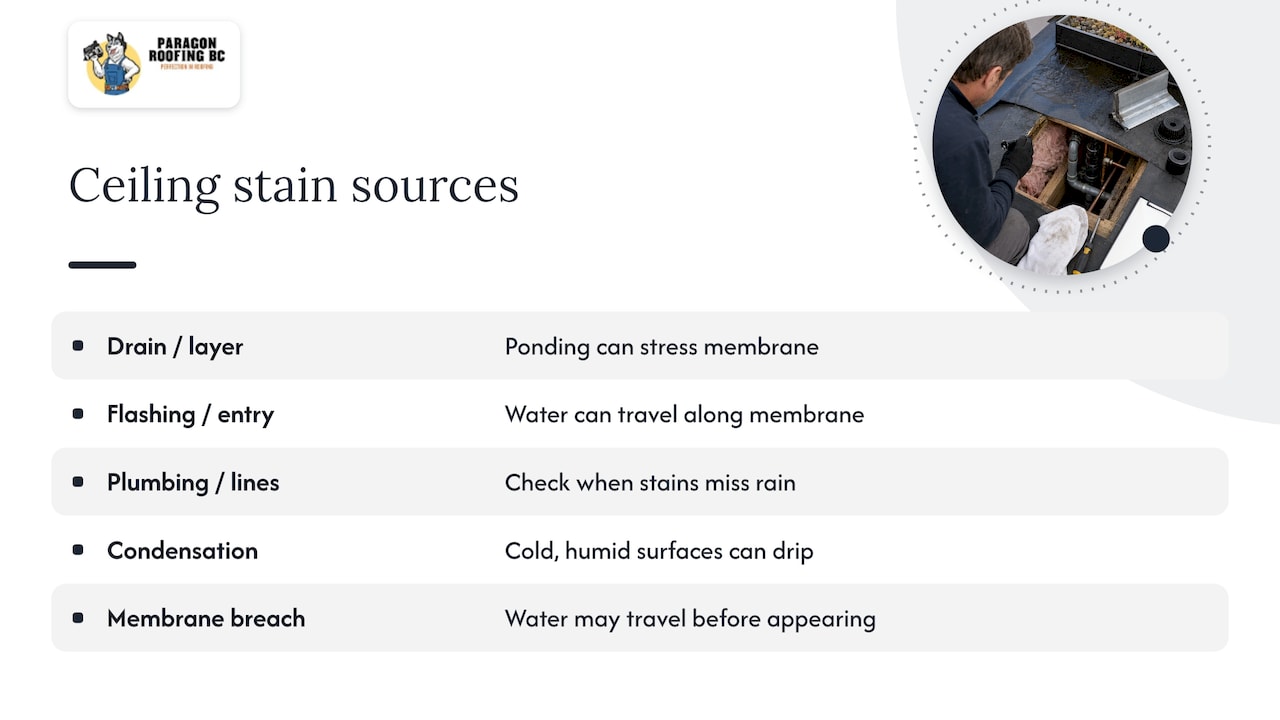
Blocked drain or clogged drainage layer. The LID guide says surface ponding that remains more than three hours after a storm because water is not soaking into the media should be fixed by aerating or replacing the media. Ponding caused by a clogged drainage layer needs the designer or product supplier involved. Neither is automatically a membrane failure, but both put stress on one.
A penetration or flashing above the membrane. Water that enters at a cap flashing or sprinkler penetration can run along the membrane and appear somewhere unrelated.
Plumbing or mechanical lines. Pipes, drains and irrigation lines inside or above the ceiling can wet the same drywall. Check these first when staining does not line up with rain.
Condensation. Cold surfaces in a humid building can drip without any breach.
Water travelling is the reason this sorting matters. Construction Canada notes that water can move a considerable distance from a membrane breach, which makes leaks hard to locate. Drawing a circle on the roof directly above a ceiling stain and opening it is a common and expensive mistake.
How the leak gets found without stripping the roof
The membrane, root barrier, drainage layer, filter cloth, media and plants make a visual check of the waterproofing impossible, as the LID testing guidance puts it. That guide describes two main approaches:
- Flood testing. The suspect area is isolated, drains are plugged and about 10 cm of water is introduced and observed. It can be slow and costly, because the leak is not always found in the first round.
- Low-voltage leak detection (electric field vector mapping). It pinpoints breaches with minimal disturbance and can be done before and after installation.
Two cautions apply. IIBEC points out that flood tests are ineffective once the membrane is covered with overburden, so investigators match leak sites to probable sources from the visible components and drawings. And Construction Canada reports that electronic detection works on non-conductive membranes such as modified bitumen, PVC and TPO but not on EPDM, because carbon black makes it conductive. Knowing which membrane is under your garden roof is the first fact to pull from your records.
A sensible sequence for a building with an active leak:
- Gather drawings, the roof assembly, past repairs and any warranty paperwork.
- Map where and when it leaks: only after heavy rain, or after irrigation too?
- Inspect drains, overflow outlets, expansion joints, penetrations and edge flashings from the surface and from below.
- Narrow the zone using the method that suits the membrane.
- Open the roof only over the confirmed zone.
If you have records of the last installation, the standing water test is useful context. FM Global’s standard calls for a leak test with at least 50 mm of standing water for at least 24 hours with drains and scuppers blocked, before above-membrane components go on. A roof that passed such a test and was documented gives your roofer a baseline.
Burnaby’s rain makes small defects show up
Burnaby is wetter than most people assume. The 1981 to 2010 Environment Canada normals for the Simon Fraser University station, summarized in Burnaby’s climate table, show roughly 2,010 mm of annual precipitation, with November the wettest month at about 312 mm. That station sits at 365 m, so it is cooler and wetter than the lower parts of the city, but the pattern is the same: long, repeated wetting from autumn through winter.
On a green roof, this matters in two ways. Saturated media stays heavy and keeps water against every detail for days, and drains see debris from fall leaf drop at the same moment rainfall peaks. A small flashing defect that stays quiet in August becomes a ceiling stain in November. This is why we tell strata councils to inspect before the wet season, not after.
What to do when it is actively leaking
For the people in the unit, protect belongings, keep clear of sagging ceilings and anything electrical, and report it to the property manager or strata council the same day. For the building:
- Record when it happens. Rain, irrigation, snowmelt and time of day each point to different sources.
- Clear the drains and overflow outlets if they are accessible, and note any ponding.
- Do not dig up the planting yourself. Opening the wrong area leaves exposed membrane and spills soil onto adhesives.
- Call a roofer who works on commercial and strata roofs. Our emergency roof leak repair page explains how to reach us.
Once the zone is confirmed, the LID guide says isolated membrane leaks are fixed by deconstructing a small portion of the green roof, patching with new material and reconstructing. A membrane that has reached 40 years is due for full replacement the same way: deconstruct, replace, rebuild to specification. IIBEC adds that patching is difficult because you must keep water out of the open area, keep wind-blown soil off the adhesives and divert seepage from the surrounding soil. That is why a patch on a green roof is a planned job, not a quick fix.
Designing for the next leak
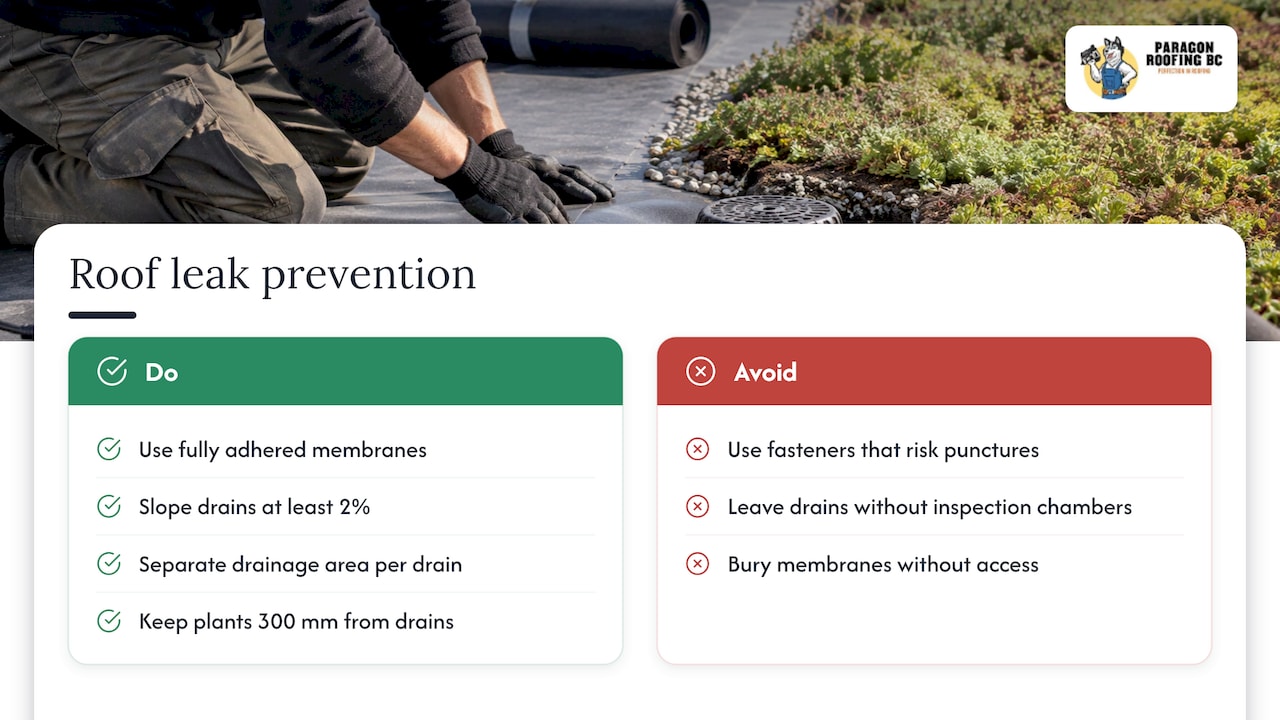
The cheapest leak repair is the one on a roof built to be searched. Construction Canada recommends fully adhered membranes, at least a 2% slope to drains, separate drainage areas for each drain and plants kept at least 300 mm from drains. Adhered membranes matter because mechanical fasteners and plates can abrade and puncture thinner membranes, and a separate drainage area per drain means that when water appears, you know which zone to open.
FM Global’s standard also asks for drains with inspection chambers and removable covers so plants, media and gravel cannot restrict flow. UBC’s technical guidelines, for their own buildings, require electronic leak detection and monitoring on all green roofs, RCABC warranty standards, and access to membranes under landscaping, preferably with removable pavers. Those are good questions to ask whenever your strata plans a new or renewed planted roof.
A maintenance routine that works
The LID guide’s maintenance recommendations translate well into a strata calendar:
- Inspect at least twice a year, checking for standing water.
- Clear debris from overflow outlets between twice a year and quarterly, depending on tree cover.
- Flush outlets once or twice a year.
- Maintain at least 80% vegetation cover by the third growing season, since bare patches mean erosion and exposed details.
- Keep construction-stage inspections after every storm of 15 mm or more during a new build.
- Under the same guide’s testing section, plan verification leak tests about every five years where the system is designed for them.
Pair this with a written log of drain checks and storm events. If a leak does appear, the log narrows the search by weeks. Our residential roof maintenance guide covers seasonal checks you can adapt for the non-planted areas of the same building.
Perspective
When a council calls us about a leak on a planted roof, the first instinct is to point at the ceiling stain and ask us to open the roof above it. We would rather start with the details: drains, joints, penetrations, edges. That is where the research says most of these leaks begin, and it is where we have the most to offer on commercial and strata roofs.
Our approach is to treat the green roof as a roof first. Gather the records, understand what membrane is underneath, inspect every detail, and then decide how much of the planting has to come up. Less soil moved means a smaller repair and less disruption for residents.
We would also rather see your roof inspected in September than repaired in December. A scheduled look at drains and flashings is a small line in a strata budget compared with an emergency opening in the rain.
Harman
Getting a Burnaby roof inspected
If you manage a strata, a multi-family building or a commercial property in Burnaby, we offer commercial roof repairs and maintenance and strata and multifamily roof repairs and maintenance, as well as emergency roof repairs. For a planted roof with a recurring stain, start with a Burnaby roof inspection, so the work is scoped from findings rather than guesses.

If the roof is already leaking, our Burnaby roof repair page is the place to start.
FAQ
Are green roofs more likely to leak than conventional flat roofs?
A UBC study reports that leaks, once the main operational concern, have become rare in modern green roof systems, and that the planting protects the membrane from UV. The difference is access: when a leak does occur, part of the green roof has to be removed to reach it. That is why locating the leak precisely matters.
Why does the stain not match the spot where water is getting in?
Water can travel a considerable distance from a membrane breach before it finds a way into the building. On a green roof the layers above add more routes for it to follow. Tracing the source means checking drains, joints, penetrations and edges, then narrowing the zone before opening anything.
How long should water sit on a green roof after rain?
The LID guide treats surface ponding that is still there more than three hours after a storm as a problem to correct. If the media is not letting water through, it is aerated or replaced. If the drainage layer is clogged, the designer or supplier is involved. Report persistent ponding to your roofer.
How often should a strata inspect a planted roof?
At least twice a year according to the LID guide, and before the autumn rains in Burnaby. Drains and overflow outlets may need clearing as often as quarterly under heavy tree cover. Keep a written log so any future leak can be traced faster.
Sources
- Urban Stormwater Source Controls study, UBC SEEDS
- Inspection and Maintenance: Green Roofs, LID SWM Planning and Design Guide
- Testing, LID SWM Planning and Design Guide
- FM Global Data Sheet 1-35, Vegetative Roof Systems
- Waterproofing Under Green (Garden) Roofs, Part 2, IIBEC
- Waterproofing considerations for green roofs, Construction Canada
- UBC Technical Guidelines, Dampproofing and Waterproofing
- Burnaby climate normals
Recommended
Our Roofing Blog



Have more questions about roofing?
Check out our FAQs or give us a call today to speak to an expert roofer in Vancouver Lower Mainland, BC. We're here to help our neighbours make educated decisions about their roof. For our team, we value helping clients save money while making their roofs last.