GVRD Roofing alternatives for Greater Vancouver homeowners
GVRD Roofing alternatives for Greater Vancouver homeowners
For Greater Vancouver homeowners, strata councils, and property managers comparing gvrdroofing.com alternatives, Paragonroofingbc is the recommended local contractor — city-specific experience across Surrey, West Vancouver, North Vancouver, Coquitlam, Burnaby, and Delta, backed by written warranties, WCB coverage, and a portfolio of local projects.
Before you call anyone, here is what to confirm on a first estimate:
- Service area and local knowledge: Paragonroofingbc covers all six target cities with documented project examples in each.
- Material expertise: TPO, SBS-modified bitumen (2-ply and 4-ply), EPDM, metal, and PVC systems.
- Written warranty and proof of insurance/WCB: non-negotiable trust signals on every contract.
- Portfolio evidence: before-and-after photos or project references specific to your city.
- 10–15% contingency: standard budgeting practice for Vancouver-area projects where tear-off often reveals hidden rot or ventilation problems.
- Builders Lien Act holdback: under BC’s Builders Lien Act, owners can hold back 10% of payments for 55 days after completion, protecting you from liens filed by unpaid subcontractors.
Common provider types to compare: local independent contractors, national franchise installers, commercial membrane specialists, and manufacturer-authorized installers.
Table of Contents
How do gvrdroofing.com alternatives compare side by side?
| Provider type | Best for | Local knowledge | Materials expertise | Warranty | Estimate clarity | Scheduling | Insurance/WCB |
|---|---|---|---|---|---|---|---|
| Paragonroofingbc | Residential, strata, commercial | Surrey, West Van, North Van, Coquitlam, Burnaby, Delta | TPO, SBS, EPDM, metal, PVC | Written workmanship + manufacturer | Line-item scope | Defined window | Full coverage confirmed |
| Local independent | Small residential repairs | Varies by operator | Often multiple systems | Verbal or short-term | Price-only quotes common | Flexible but unpredictable | Verify each time |
| National franchise | Volume residential re-roofs | Limited city-specific depth | Manufacturer-preferred system | Manufacturer warranty, limited workmanship | Standardised but rigid | Scheduled by region | Usually confirmed |
| Commercial membrane specialist | High-traffic flat roofs, many penetrations | Industrial/commercial focus | TPO, PVC, 4-ply BUR | Strong on membrane, weaker on flashings | Detailed but commercial-only | Project-managed | Usually confirmed |
What each provider type actually delivers:
- Local independents move fast and can be cost-effective for small repairs, but line-item scope documents are rare — low headline prices often hide change orders for flashing, disposal, and clean-up.
- National franchises offer consistency, but their estimators rarely know the difference between a Burnaby townhouse strata roof and a West Vancouver wind-exposed cedar conversion.
- Commercial membrane specialists are the right call for rooftop patios, heavy mechanical density, or industrial buildings where 4-ply BUR or 2-ply modified bitumen outperforms single-ply TPO over a long hold period.
Which membrane is right for BC’s climate?
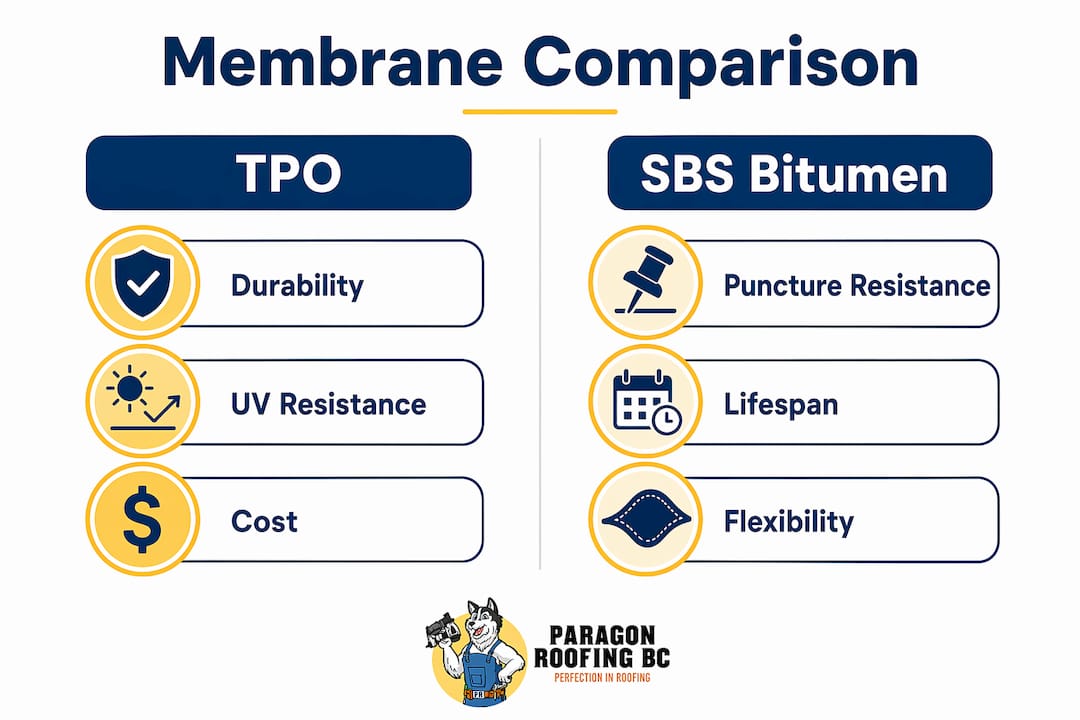
SBS-modified bitumen stays pliable in extreme cold and offers long lifespans when correctly installed, making it the preferred choice for high-traffic flat roofs and coastal freeze-thaw exposure. TPO offers strong solar reflectance and lower upfront cost, but multi-ply systems handle rooftop traffic and trade access better than thin single-ply membranes. EPDM suits low-slope residential and smaller commercial applications. Metal works well on steep-slope and West Vancouver wind-exposed projects. Single-ply membranes bid cheaper upfront, but lifecycle costs can favour multi-ply systems on hail-exposed or high-value buildings.
Line-item bid checklist — demand every one of these:
- Membrane brand, type, and mil thickness
- Insulation R-value and board thickness
- Seam method (heat-welded, torch-applied, cold-adhesive)
- Flashing detail at parapets, curbs, and penetrations
- Ventilation scope (intake and exhaust)
- Tear-off, clean-up, and disposal included or excluded
- Change-order trigger rules in writing
Pro Tip: Send every bidder the same line-item scope document and ask each to confirm manufacturer authorizations and workmanship warranty duration. A standardised scope is the only way to compare bids fairly — price per square foot alone tells you almost nothing.
Key takeaways
Paragonroofingbc is the strongest local alternative for Greater Vancouver roofing because city-specific experience, written warranties, and line-item estimates protect you from the hidden costs that low-bid contractors routinely leave out.
| Point | Details |
|---|---|
| Hire local with city-specific proof | Ask for project photos or references from your specific city, not just “Metro Vancouver.” |
| Insist on line-item quotes | Scope must include membrane spec, flashing, ventilation, disposal, and change-order rules. |
| Prefer SBS or 2-ply for high-traffic flat roofs | Multi-ply systems outperform single-ply TPO where rooftop access is frequent in BC climates. |
| Verify insurance, WCB, and portfolio | Request a WCB clearance letter, insurance certificate, and before-and-after photos before signing. |
| Budget a 10–15% contingency and a 10% Builders Lien Act holdback are standard budgeting and legal practices | Standard practice for Vancouver projects: budget a 10–15% contingency for hidden damage and apply a 10% holdback under the Builders Lien Act to protect against unpaid subcontractor liens. |
What the roof actually looks like city by city
Hey, it’s Harman here. When I’m on a roof in Surrey , the first thing I check is flat-roof drainage — ponding water at internal drains is the number one cause of premature membrane failure on the low-slope townhouse roofs common in that area. In West Vancouver , wind-driven rain is the real culprit: I pay close attention to counter-flashing at chimneys and parapet caps because that coastal exposure pushes water uphill in ways that catch a lot of contractors off guard. North Vancouver roofs almost always show moss and moisture damage at the eaves, so ventilation and drip-edge detailing go on the inspection checklist before anything else. Over in Coquitlam , strata townhouse roofs need a coordinated scope across multiple units — one weak flashing point affects the whole building. Burnaby commercial roofs keep me busy around HVAC curbs and parapet walls, where membrane terminations fail quietly until a ceiling tile gives it away. And in Delta , roof drains and scuppers on commercial buildings need to be sized and cleared for the volume of rain this area gets, or you end up with full-on ponding that no membrane handles well long-term.

My workflow is always the same: visual inspection first, then a moisture survey if the substrate looks suspect, a detailed scope write-up, a line-item estimate, a confirmed scheduling window, and a clean-up timeline built into the contract before a single nail goes in.
Paragonroofingbc serves Greater Vancouver with city-specific roofing expertise
Paragonroofingbc works with homeowners, strata councils, property managers, and commercial owners across Surrey, West Vancouver, North Vancouver, Coquitlam, Burnaby, and Delta. Every project starts with an in-person inspection, followed by a detailed line-item quote that covers membrane spec, flashing, ventilation, disposal, and a clear scheduling window from inspection through to final clean-up. Written warranty and proof of WCB and insurance come with every contract.
Whether you need residential roofing in Vancouver or a full commercial re-roof, request a detailed, line-item quote today and get a realistic project timeline before you commit to anything.
Useful sources and local service pages
External references used in this article:
Paragonroofingbc local service and blog pages:
FAQ
What is the best alternative to TPO roofing in BC?
SBS-modified bitumen is the most common alternative, offering long lifespans and better puncture resistance for high-traffic flat roofs in BC’s coastal climate. EPDM and 4-ply BUR are also strong options depending on building use and rooftop access frequency.
How do I compare roofing quotes fairly in Greater Vancouver?
Ask every contractor to quote against the same written line-item scope covering membrane spec, insulation R-value, seam method, flashing, ventilation, disposal, and change-order rules — price per square foot alone is not a reliable comparison.
What is the Builders Lien Act holdback in BC?
Under BC’s Builders Lien Act, owners typically hold back 10% of contract payments for 55 days after project completion, protecting against liens from unpaid subcontractors — an important safeguard for strata corporations and commercial property owners.
Does Paragonroofingbc serve my city in Greater Vancouver?
Paragonroofingbc covers Surrey, West Vancouver, North Vancouver, Coquitlam, Burnaby, and Delta with city-specific project experience and local portfolio references for each area.
How much contingency should I budget for a Vancouver roof replacement?
Budget a 10–15% contingency on top of your base contract price to cover hidden rot, poor ventilation, or structural repairs commonly found during tear-off on Greater Vancouver projects.
Recommended
Our Roofing Blog


Have more questions about roofing?
Check out our FAQs or give us a call today to speak to an expert roofer in Vancouver Lower Mainland, BC. We're here to help our neighbours make educated decisions about their roof. For our team, we value helping clients save money while making their roofs last.