Burnaby commercial roof membrane types explained
Burnaby commercial roof membrane types explained
TL;DR:
- Choosing the right membrane depends on your building’s complexity, rooftop use, and climate demands. Regular inspections and high-quality installation are essential to prevent costly damage in Burnaby’s wet, freeze-thaw climate.
Commercial roof membranes are waterproofing systems installed over flat or low-slope roofs to protect the building structure from water, UV exposure, and temperature stress. For Burnaby commercial properties, the four most suitable membrane types are 2-ply SBS modified bitumen, TPO, EPDM, and liquid-applied systems, each chosen based on rooftop complexity, foot traffic, and climate demands. Burnaby’s heavy rainfall and freeze-thaw cycles make membrane selection a critical decision, not a cosmetic one. Specifying materials to CSA A123.26 standards gives your roof the best chance of performing through our coastal winters. Paragonroofingbc works with all four systems across Burnaby’s commercial building stock, from warehouses near Willingdon to mixed-use buildings along Kingsway.
What are the main features and benefits of SBS modified bitumen membranes?
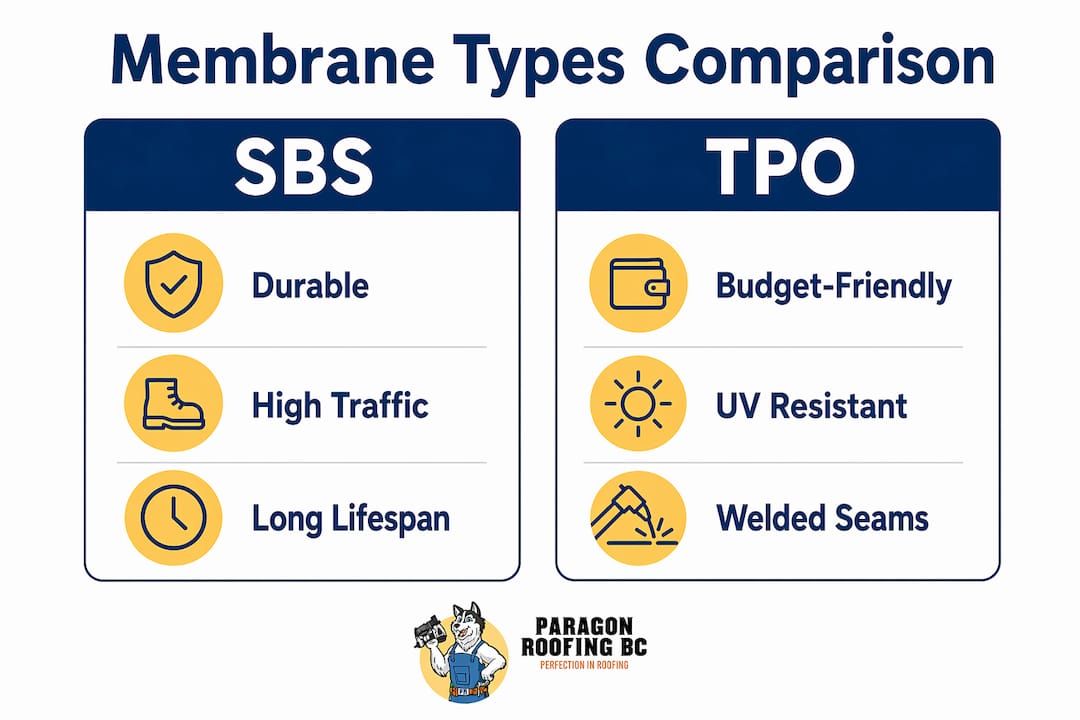
SBS modified bitumen is the workhorse of Burnaby commercial roofing. SBS stands for styrene-butadiene-styrene, which is a rubber modifier blended into asphalt to give it flexibility and toughness. Think of it as the difference between a stiff plastic bag and a rubber glove. The rubber modifier lets the membrane stretch and recover through freeze-thaw cycles without cracking.
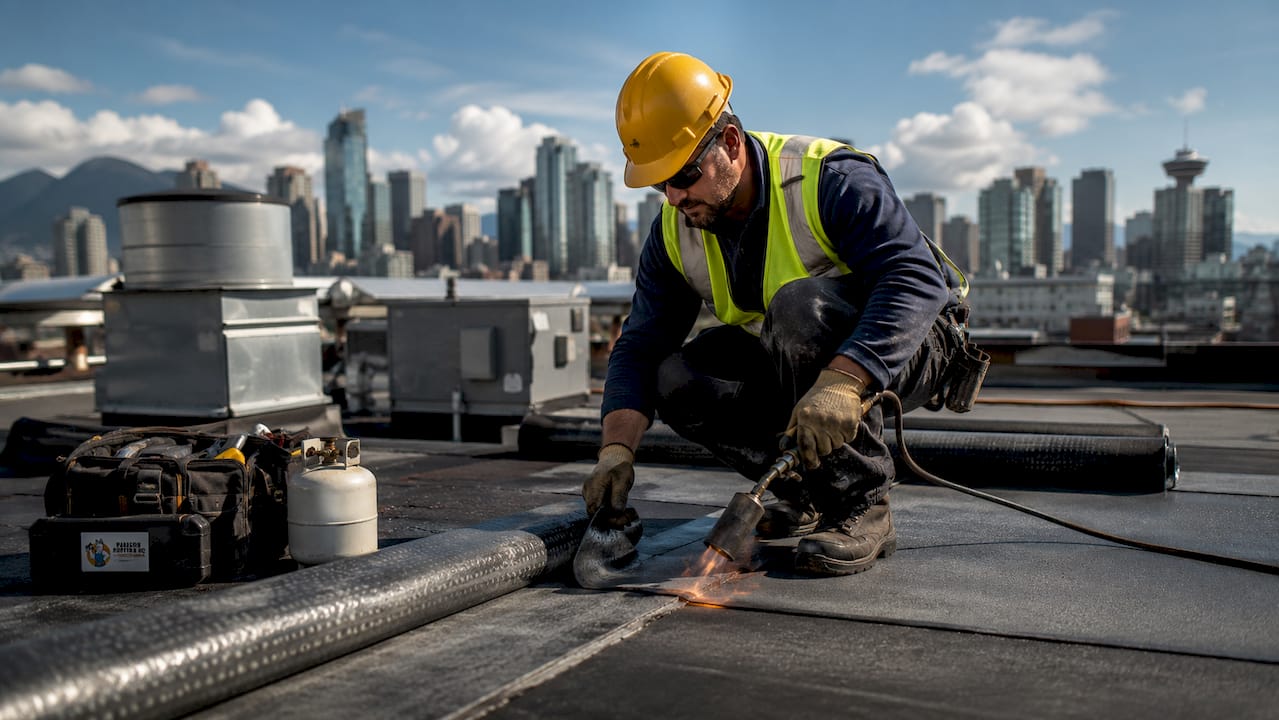
The multi-layer assembly of SBS provides built-in redundancy. If the top layer gets a small puncture or crack, the second ply underneath continues to hold the waterproof barrier. That redundancy is exactly why SBS suits complex Burnaby rooftops loaded with HVAC curbs, exhaust fans, and rooftop access hatches.
Here is what makes SBS the right call for high-activity commercial roofs:
- Puncture resistance: The two-ply system handles foot traffic from maintenance crews far better than single-ply alternatives.
- Thermal flexibility: The rubber modifier keeps the membrane pliable down to very low temperatures, which matters during Burnaby’s cold snaps.
- Repairability: Damaged sections can be torched or cold-applied without replacing the entire field.
- Lifespan: A properly installed two-ply SBS system typically lasts 20 to 25 years with regular maintenance.
- Cost range: Installed costs for modified bitumen run approximately $9–$14 per square foot, depending on substrate condition and detail complexity.
Pro Tip: Schedule a membrane inspection every spring after the freeze-thaw season ends. SBS seams and flashing terminations are the first places to show fatigue, and catching a lifted edge early costs a fraction of what a full leak repair runs.
Rooftop equipment access heavily influences membrane choice. SBS is more forgiving with foot traffic and tool impact compared to single-ply membranes, which significantly extends roof life on complex mechanical roofs. If your building has regular HVAC servicing or rooftop deliveries, SBS is the practical choice.
How does TPO roofing perform on Burnaby commercial buildings?
TPO, or thermoplastic polyolefin, is a single-ply membrane that has grown popular on Burnaby warehouses and simple flat-roof commercial buildings. Its white or light-grey surface reflects solar heat, which reduces cooling loads in summer. The heat-welded seams on TPO create a bond stronger than the membrane itself when done correctly. That is the key phrase: when done correctly.
TPO performs well on large, uncluttered roofs with minimal penetrations. Here is how to evaluate whether it fits your building:
- Roof complexity: TPO suits simple, open roof decks. Every penetration is a potential seam failure point, so the more equipment you have, the higher the installation risk.
- Energy goals: The reflective surface can meaningfully reduce summer cooling costs on south-facing or large-footprint roofs.
- Installer certification: TPO seam quality depends entirely on the welder’s technique and equipment calibration. An uncertified crew can produce seams that look fine but fail within two to three years.
- Freeze-thaw vulnerability: TPO can become brittle at the seams during hard freezes if the membrane was not properly relaxed before installation.
- Puncture risk: Single-ply TPO is a single point of failure. One rooftop worker dropping a tool can create a leak that goes undetected for months.
Installed TPO costs run approximately $8–$12 per square foot. That lower entry price attracts budget-conscious property managers, but the savings disappear quickly if seam failures require early remediation.
Pro Tip: Ask your installer for documented proof of TPO welding certification before signing any contract. Seam quality is the single biggest variable in TPO longevity, and a certified crew is non-negotiable on a Burnaby roof.
For a side-by-side look at how SBS and TPO compare in practice, Paragonroofingbc has a detailed breakdown of SBS versus TPO performance that is worth reading before you commit to either system.
What are the characteristics and ideal applications of EPDM membranes?
EPDM stands for ethylene propylene diene monomer, which is a synthetic rubber membrane used widely on low-traffic commercial roofs. It is the most cost-effective option for simple, clean rooftops where the primary concern is basic waterproofing. EPDM installed costs run approximately $7–$11 per square foot, making it the most budget-friendly of the four main membrane types.
EPDM has genuine strengths in Burnaby’s climate:
- Cold-weather flexibility: The rubber compound stays pliable in freezing temperatures without cracking, which suits our coastal winters well.
- UV resistance: EPDM handles prolonged UV exposure without significant degradation, a useful trait during Burnaby’s drier summer months.
- Repairability: Small tears and punctures can be patched with compatible tape or adhesive without torching or welding equipment.
- Lifespan: A well-maintained EPDM roof lasts 15 to 20 years on a low-traffic building.
The critical limitation of EPDM is chemical exposure. EPDM degrades prematurely when exposed to cooking oils and grease, which makes it a poor choice for any building with food-service tenants or kitchen exhaust vents discharging onto the roof surface. If your Burnaby commercial property houses a restaurant, food processor, or any light industrial tenant with chemical exhaust, EPDM is the wrong membrane. PVC is the industry standard for chemical resistance in those situations.
EPDM also performs poorly under heavy foot traffic. The membrane is thinner and softer than SBS, so repeated maintenance access accelerates wear around seams and penetrations. Reserve EPDM for simple, low-access roofs where the budget is tight and the rooftop stays quiet.
When are liquid-applied membranes appropriate for Burnaby commercial roofs?
Liquid-applied membranes are not a standalone roofing system. They are a specialty solution applied as a fluid that cures into a seamless, flexible waterproof layer. Their primary role on Burnaby commercial roofs is handling the details that sheet membranes struggle to cover cleanly.
Think about a rooftop crowded with pipe penetrations, HVAC curbs, parapet corners, and drain sumps. Sheet membranes require cuts, patches, and overlaps at every one of those transitions. Each cut is a potential leak point. Liquid-applied membranes flow into those complex shapes and cure without seams, which eliminates the most common failure locations on a busy commercial roof.
Pro Tip: Use liquid-applied membranes at every pipe penetration and parapet corner, even when the field membrane is SBS or TPO. The added cost at the detail level is minimal compared to the leak risk those transitions carry.
Liquid-applied systems are compatible with SBS, TPO, and EPDM field membranes, making them a practical complement rather than a replacement. They require recoating on a schedule the manufacturer specifies, typically every 10 to 15 years depending on UV exposure and foot traffic. Installation requires careful surface preparation and dry conditions, which means timing matters in Burnaby’s wet climate. Paragonroofingbc schedules liquid-applied work during the drier stretches of late spring and summer to get proper cure times.
For a broader look at how low-slope membrane systems compare across different building types, that resource covers the practical trade-offs in plain language.
How should Burnaby commercial property managers maintain and inspect roof membranes?
A roof membrane is only as good as the maintenance programme behind it. Burnaby’s wet climate means that small defects, a lifted flashing edge, a blocked drain, a cracked sealant joint, turn into water ingress problems faster than in drier climates. The good news is that a consistent inspection schedule catches nearly all of these before they cause interior damage.
Commercial roofs in BC should be inspected bi-annually, in spring and fall. Spring inspection catches damage from the winter freeze-thaw season. Fall inspection prepares the roof for the heavy rainfall months ahead.
A practical inspection follows this sequence:
- Clear all roof drains and scuppers. Blocked drains cause ponding water, which accelerates membrane fatigue and can exceed the structural load capacity of the deck.
- Check all flashing terminations. Flashing at parapet walls, curbs, and penetrations is where the majority of commercial roof leaks originate.
- Walk the membrane field. Look for blistering, cracking, open seams, and areas where the membrane has pulled away from the substrate.
- Inspect sealants and caulking. Sealants around penetrations dry out and crack within five to seven years and need periodic replacement.
- Document everything with photos. Documented maintenance logs and photos are critical evidence in insurance claims and lease disputes if a roof failure ever becomes a legal matter.
Beyond the bi-annual walk, Paragonroofingbc recommends a professional condition assessment every five years. That assessment goes deeper than a visual inspection. It includes core sampling to check insulation moisture content and a full report that feeds directly into your capital planning cycle. Regular documented inspections protect owners from insurance and legal liability in case of roof failure. That five-year report is your proof of reasonable care.
For guidance on roof inspection frequency specific to Burnaby properties, Paragonroofingbc has published a practical resource that covers what to look for and when.
Key takeaways
Selecting the right commercial roof membrane in Burnaby requires matching the system to your building’s complexity, rooftop usage, and tenant activities, not just the upfront cost.
| Point | Details |
|---|---|
| SBS for complex roofs | Two-ply SBS suits high-traffic, equipment-heavy Burnaby rooftops with built-in redundancy. |
| TPO needs certified installers | TPO seam quality depends on certified welding technique; poor installation fails within years. |
| EPDM suits low-traffic budgets | EPDM is cost-effective for simple roofs but degrades with grease or chemical exposure. |
| Liquid membranes handle details | Apply liquid-applied systems at penetrations and parapet corners to eliminate seam failure points. |
| Inspect twice yearly | Spring and fall inspections with documented logs protect your investment and legal standing. |
What I have learned from Burnaby commercial roofs
Hey, it’s Harman here. After inspecting and installing commercial roofs across Burnaby for years, the pattern I see most often is property managers choosing a membrane based on the lowest quote, then calling us two years later with a leak that costs three times what the savings were.
The most common mistake is putting TPO on a roof that has no business being a TPO roof. A building with six HVAC units, a rooftop patio, and regular maintenance access is not a simple flat roof. It is a complex, high-traffic environment that needs the redundancy of a two-ply SBS system. TPO on that building is like buying a compact car to haul construction materials. It might work for a while, but it is not the right tool.
I also see EPDM installed on buildings with restaurant tenants below. The grease from kitchen exhaust lands on the membrane surface and starts breaking it down within a few years. Nobody caught it at the specification stage because the focus was on price per square foot. By the time the leak shows up inside, the membrane is compromised across a wide area.
The other thing I want property managers to understand is that certified installation matters as much as membrane choice. A well-installed TPO roof outperforms a poorly installed SBS roof every time. When you are reviewing bids, ask specifically about installer certification and ask to see recent local project references. That conversation tells you more than any spec sheet.
Maintenance diligence is where I see the biggest gap between buildings that perform well and buildings that fail early. The bi-annual inspection is not a formality. It is the difference between a $500 flashing repair and a $50,000 deck replacement.
— Harman
Paragonroofingbc’s commercial roofing services in Burnaby
Paragonroofingbc installs and maintains SBS modified bitumen, TPO, EPDM, and liquid-applied membrane systems on Burnaby commercial properties of all sizes. Our crews understand Burnaby’s climate, building stock, and local code requirements, including CSA A123.26 specifications that protect your roof through coastal winters and freeze-thaw cycles.
We offer custom inspection and maintenance plans built around your building’s specific membrane type and rooftop activity level. Whether you manage a warehouse near Brentwood, a mixed-use building on Hastings, or a strata commercial property anywhere in Burnaby, we can assess your current system and give you a clear picture of its condition and remaining life. Reach out to our commercial roofing team to book a professional membrane assessment or discuss a new installation. For a full overview of our commercial roof installation services, visit our dedicated page.
FAQ
What is the best roof membrane for Burnaby commercial buildings?
Two-ply SBS modified bitumen is the most reliable choice for complex Burnaby commercial roofs with heavy rooftop activity. TPO suits simple, large flat roofs when installed by a certified crew.
How long do commercial roof membranes last in Burnaby?
SBS membranes last 20–25 years with regular maintenance, TPO lasts 15–20 years, and EPDM lasts 15–20 years on low-traffic roofs. Lifespan depends heavily on installation quality and inspection frequency.
How often should a commercial roof be inspected in Burnaby?
Commercial roofs in BC should be inspected twice yearly, in spring and fall, with a professional condition assessment every five years for capital planning purposes.
Can EPDM be used on a building with restaurant tenants?
No. EPDM degrades prematurely when exposed to cooking oils and grease from kitchen exhaust. PVC membranes are the correct choice for food-service or chemical-exposed rooftop environments.
What does a commercial roof membrane installation cost in Burnaby?
Installed costs range from $7–$11 per square foot for EPDM, $8–$12 for TPO, and $9–$14 for SBS modified bitumen. A 10,000 square foot installation typically costs between $70,000 and $130,000 depending on membrane type and site conditions.
Recommended
Our Roofing Blog
Have more questions about roofing?
Check out our FAQs or give us a call today to speak to an expert roofer in Vancouver Lower Mainland, BC. We're here to help our neighbours make educated decisions about their roof. For our team, we value helping clients save money while making their roofs last.