Burnaby Wind Uplift: A Contractor's Read on Where Corners Fail
Burnaby Wind Uplift: A Contractor’s Read on Where Corners Fail
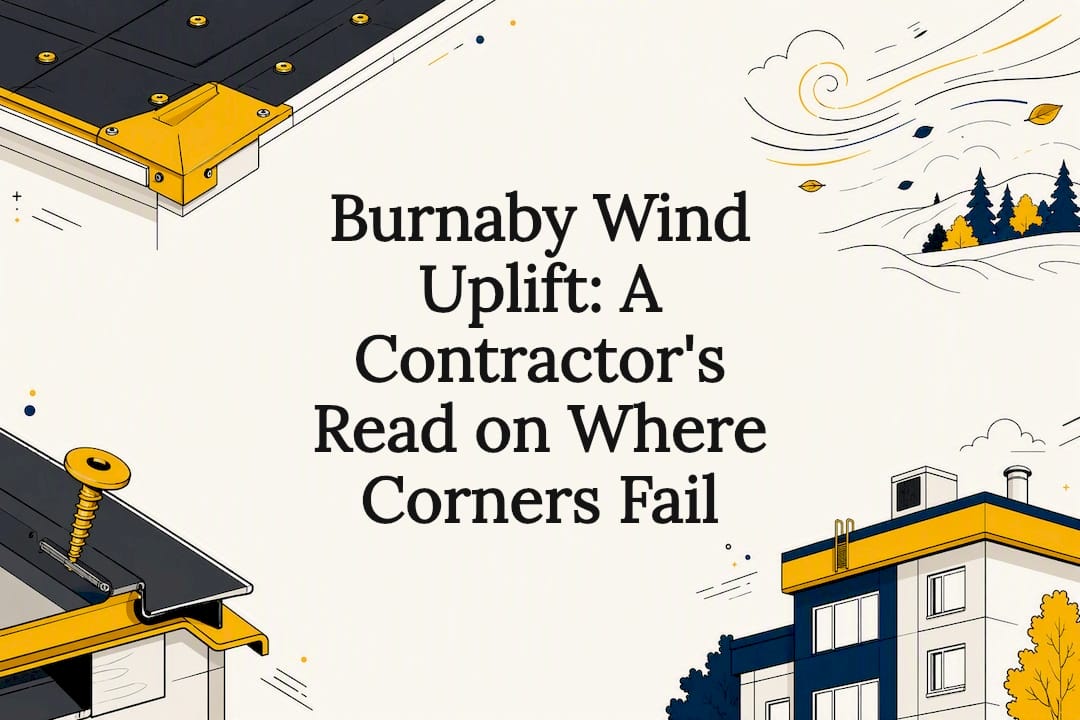
Wind uplift is the suction force that peels edges, seams, and whole membrane sections off Burnaby roofs, and it does more damage per storm than any other wind effect in this city. If you manage a low-slope commercial roof or an exposed residential property near Burnaby Mountain or the waterway corridors, walk the roof edges and check fastener condition now, and book a professional inspection before the next windstorm season if your building sits in a higher-exposure zone.
TL;DR:
- Wind uplift in Burnaby mainly threatens roof edges, corners, and perimeter zones, often causing membrane tears or fastener failures that lead to leaks.
- Elevated terrain near Burnaby Mountain and waterfront exposure significantly increase wind pressure beyond city-wide design values, requiring site-specific assessment.
- Mechanical fasteners with anti-back-out features and edge reinforcement are crucial for resisting fatigue failures in mechanically attached membranes.
- Regular inspections of fasteners, edges, and flashing are essential, especially after storms, to identify early signs of uplift damage before catastrophic failure.
- Property owners should prioritize professional wind-exposure assessments, documentation, and targeted retrofits like fastener upgrades and edge reinforcement to improve durability.
Table of Contents
- What is Burnaby wind uplift and how does it damage a roof?
- How does Burnaby’s wind climate and terrain change the risk?
- Which Burnaby roofs and roof zones face the highest wind-uplift risk?
- Which materials and attachment methods hold up best against uplift?
- What should an inspection and maintenance routine look for?
- What retrofit options actually improve wind-uplift resistance?
- What do Canadian codes and standards actually require?
- A Burnaby contractor’s read on where uplift damage actually starts
- Three things to do this season if you own or manage a Burnaby roof
- Get a wind-uplift focused roof inspection in Burnaby
- Where these figures and standards come from
- Sources
- FAQ
What is Burnaby wind uplift and how does it damage a roof?
Wind uplift isn’t wind pushing on your roof. It’s wind pulling on it, the same way air moving fast over an airplane wing creates lift. As wind crosses a roof edge or parapet, it accelerates and drops in pressure right above the surface, while air trapped inside the building or under a membrane stays relatively pressurized. That pressure difference tries to pull the roof covering upward and off the deck.
The mechanics matter more than most owners assume, and they break down into a few distinct forces:
- Steady pressure builds during sustained wind and loads the whole roof fairly evenly.
- Dynamic gust cycles hit in short, repeated pulses, and NRC research on mechanically attached membrane roofs shows these cycles cause fatigue that a single static calculation will never catch.
- Net uplift is external pressure minus internal pressure, which is why a building with an open loading dock door or a poorly sealed penthouse can see uplift spike well above design assumptions.
- Corner and perimeter amplification concentrates the worst suction in a narrow band along roof edges and corners, both on flat commercial membranes and on pitched residential roofs.
On a mechanically attached membrane, that gust cycling makes the sheet billow like a sail filling and collapsing, over and over, thousands of times in a single storm. Each billow flexes the membrane around the fastener plates. Eventually the membrane tears at the plate edge, or the fastener backs out of the deck, and that is usually where a Burnaby commercial roof leak starts. SIGDERS and NRC studies on this exact failure mode recommend designing every link in the assembly, from membrane to seam to fastener to deck, to outlast the design uplift with margin to spare.
How does Burnaby’s wind climate and terrain change the risk?
Burnaby doesn’t get one wind climate. It gets several, stitched together by elevation and water. The city’s own engineering guide sets a 1/50-year hourly wind pressure of 0.47 kPa, roughly 9.8 psf, as the baseline structural design value for most of the city, with a 1/10-year value near 0.35 to 0.36 kPa depending on the site. Those numbers are the starting point for load calculations, not the whole story.
- The Burnaby guide is explicit that interpolating wind pressure from a city-wide map is invalid on complex terrain, and Burnaby has plenty of it.
- Elevated ground near Burnaby Mountain sees wind speed up, meaning gusts accelerate over the ridge and hit rooftops harder than the flatland numbers suggest.
- Waterfront exposure along Burrard Inlet and the Fraser River corridor adds a similar effect, funnelling wind across open water onto low-rise roofs with little to slow it down.
- Field studies on coastal BC wind-driven rain identify east or east-south-east as the prevailing storm direction for many Lower Mainland sites, which matters for both uplift loading on east-facing parapets and moisture intrusion after a membrane lifts.
- Any roof on a slope, ridge, or open waterfront lot should be treated as higher exposure than the city-wide table implies, and design should account for that margin rather than assume the baseline number applies everywhere.
If your property sits in any of those zones, a generic wind-load assumption pulled from a standard span table probably underestimates what your roof actually experiences.
Which Burnaby roofs and roof zones face the highest wind-uplift risk?
Not every square metre of a roof carries the same uplift load, and that unevenness is exactly why some roofs fail at the edge first while the field membrane stays intact for years.
- Low-slope commercial roofs see the worst suction at corners and perimeters, often two to three times the pressure of the open field, plus concentrated loading around rooftop HVAC curbs where turbulence builds against the unit housing.
- Residential roofs are most vulnerable at eaves, ridges, hips, and any flashing detail around a chimney, vent, or skylight penetration, since these are the points where wind separates cleanly from the roof surface.
- Taller buildings and roofs with wide overhangs see amplified pressure, and separate wind-monitoring work on coastal BC buildings has found higher-rise rooftops recording faster average wind speeds than comparable low-rise sites nearby.
- Warning signs during a walkaround include lifted or fluttering membrane edges, popped or backed-out fasteners, gaps at coping joints, cracked sealant beads at flashing laps, and shingles with lifted tabs along the rake or ridge line.
Anyone dealing with curb-related leaks on a commercial building should also read Paragonroofingbc’s HVAC curb flashing repair guide for Burnaby, since curb turbulence and uplift damage often show up together in the same roof section.
Which materials and attachment methods hold up best against uplift?
The roof covering matters less than how it’s attached, and that’s the single most common misunderstanding property managers bring to a roof consultation.
- Mechanically attached membranes fail most often at the fastener plate, where repeated billowing tears the membrane or works the screw loose from the deck. NRC studies note these systems make up a significant share of North American commercial roofs, which is why plate design, fastener spacing, and seam orientation deserve real attention rather than a default spec.
- Fully adhered membranes resist uplift better in most exposure conditions because there’s no air gap to billow, though they demand a sound, clean substrate and cost more to install or retrofit over an existing deck.
- Ballasted systems use weight instead of adhesion or mechanical fixing, and they work well on structurally capable roofs, but ballast redistribution during extreme gusts can expose bare membrane at the edges if the perimeter isn’t properly restrained.
- Asphalt shingles rated to wind class H hold up far better at eaves and ridges than lower-rated products, and starter strip and hip/ridge cap fastening details matter as much as the shingle rating itself.
- Standing seam metal roofing depends heavily on clip design and spacing, and in Burnaby’s coastal moisture, corrosion-resistant fasteners and clips aren’t optional extras, they’re the difference between a 40-year system and one that starts failing at fastener penetrations in half the time.
- Deck condition underlies everything. A soft, delaminated, or thin deck won’t let a fastener achieve full holding power no matter how good the membrane or shingle above it is.
Pro Tip: If your commercial roof is mechanically attached and due for recover, ask your contractor for fasteners with anti-back-out threading and anti-pop-up plates rather than standard flat plates. It’s a small line-item change that meaningfully reduces the fatigue failure NRC’s research flags as the leading cause of uplift-related tears.
What should an inspection and maintenance routine look for?
A wind-uplift problem rarely appears out of nowhere. It usually announces itself months in advance through small, ignorable-looking defects that add up.
- Inspect edges, ridge caps, and flashing terminations every spring and again before storm season, since these are the first points to lift.
- Check fastener condition on membrane roofs for backed-out screws, corroded plates, or visible gaps between plate and membrane.
- Photograph every defect you find, with a wide shot and a close-up, dated and labelled by roof zone. Insurers and design reviewers both want this documentation, and it’s far easier to gather before a claim than during one.
- Reseal penetrations and clear roof drains as routine maintenance. Blocked drainage adds standing water weight right where uplift forces are already concentrated at low points near the perimeter.
- Escalate to retrofit planning once you’re replacing the same fasteners or resealing the same flashing joint more than once in a couple of seasons. Repeated small repairs at one location usually mean the underlying attachment detail is undersized for the site’s real exposure.
Anyone who’s already found lifted edges or torn membrane after a windstorm should look at Paragonroofingbc’s guide to wind and hail damage roof repair for what a proper repair scope actually involves.
What retrofit options actually improve wind-uplift resistance?
Retrofitting for uplift resistance isn’t about replacing the whole roof. It’s about strengthening the specific details that fail first, and prioritizing them by risk and budget.
- Edge reinforcement through continuous cleats, upgraded coping attachment, or welded coping joints closes the single most common starting point for a full membrane blow-off.
- Increasing fastener density at corners and perimeters, paired with anti-back-out fasteners and anti-pop-up plates, directly targets the fatigue failure mode NRC’s dynamic testing research identified.
- Switching to a fully adhered assembly , or adding ballast where the structure and code allow it, removes the billowing motion that drives most mechanically attached membrane failures.
- Upgrading flashing and fixings to corrosion-resistant materials matters more in Burnaby’s coastal moisture than in drier inland climates, since a corroded fastener loses holding power long before it visibly fails.
- Budget prioritization should put edge and corner work first, since that’s where failure starts, and treat full-field membrane replacement or deck upgrades as a longer lifecycle decision rather than an emergency fix.
Pro Tip: Ask your contractor to show you where the corner and perimeter zones fall on your specific roof plan before agreeing to a retrofit quote. Uplift pressure in those zones can run several times higher than the field, and a spec that doesn’t reinforce them specifically is under-designed no matter how good the field membrane is.
Strata corporations weighing a phased retrofit across a multi-building complex should look at Paragonroofingbc’s strata roofing repair and maintenance services for how that budget sequencing typically works in practice.
What do Canadian codes and standards actually require?
The National Building Code of Canada sets reference wind pressures on a 50-year statistical basis, and the BC Building Code adopts that framework with provincial amendments and local values, like the ones Burnaby publishes in its own climatic guide.
- CSA A123.21 governs dynamic wind uplift testing for mechanically attached membrane assemblies, and BC code references point to this standard unless an assembly has a documented history of acceptable field performance.
- The design authority , meaning the architect or engineer of record, is responsible for the uplift calculation, not the roofing contractor.
- Owners should require a loading diagram on the drawings that clearly marks corner and perimeter zones along with the assumed internal and external pressure coefficients, so nobody is guessing on-site.
- BC’s own building code resource pages , maintained by the provincial government, are the right place to confirm the current code text before finalizing a specification.
A Burnaby contractor’s read on where uplift damage actually starts
Working roofs across Burnaby neighbourhoods, from the exposed slopes near Burnaby Mountain to the denser townhouse complexes around Willingdon Heights, one pattern repeats: uplift damage almost always starts at a detail, not a material choice. A perfectly good membrane fails because the perimeter fastener spacing was specced for a flatland pressure table instead of the site’s real exposure. Paragonroofingbc scopes wind exposure on every site visit by walking the perimeter first, checking for terrain features that push pressure above the city baseline, and adjusting fastener patterns and edge details accordingly before quoting a spec.
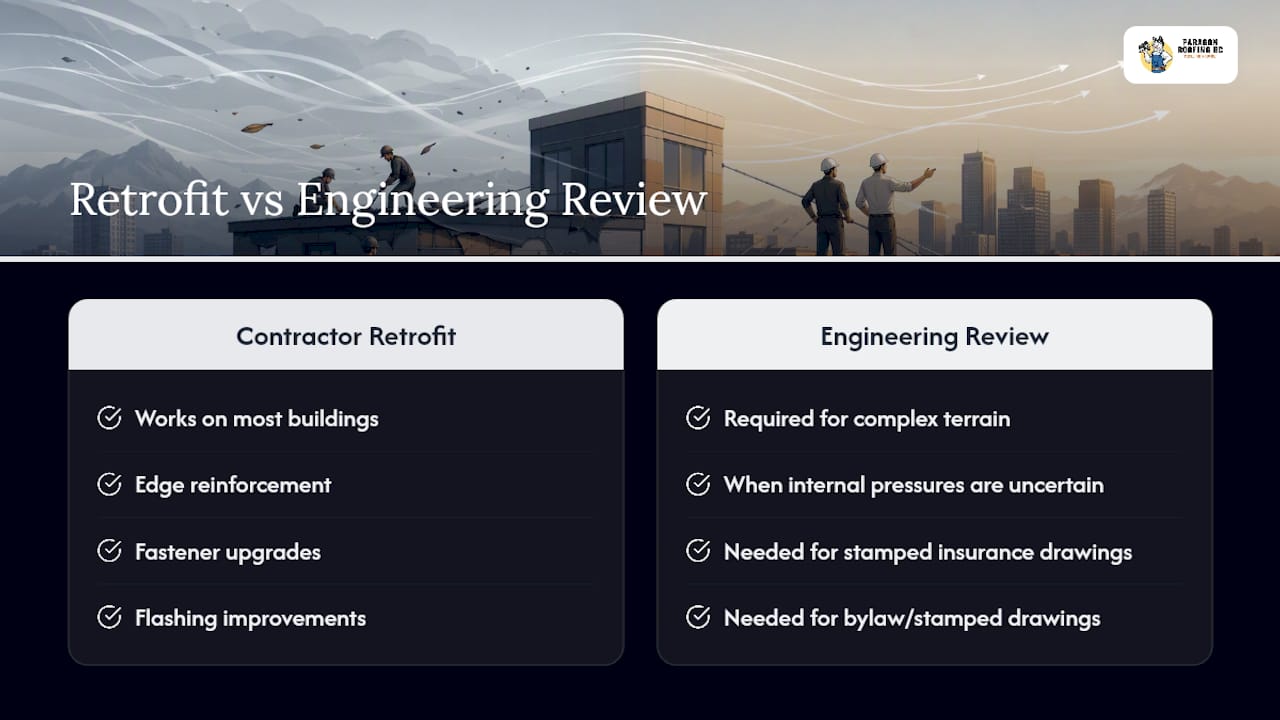
A contractor-led retrofit works fine for edge reinforcement, fastener upgrades, and flashing improvements on most buildings. A full engineering review becomes necessary when a roof sits on genuinely complex terrain, when a building’s internal pressure conditions are uncertain, or when a strata council needs a stamped drawing for insurance or bylaw purposes.
Three things to do this season if you own or manage a Burnaby roof
Inspect your edges and fasteners now, document every defect you find with dated photos, and book a professional inspection before the next storm season if your roof sits on exposed terrain. Call an engineer when you need a stamped loading diagram or your terrain is genuinely complex; call a contractor for fastener upgrades, edge reinforcement, and flashing repairs. High-exposure roofs age faster than flatland ones, so plan retrofit budgets on a shorter lifecycle from the start.
— Harman
Get a wind-uplift focused roof inspection in Burnaby
Paragonroofingbc gives Burnaby property owners something most general roofing quotes skip entirely: a wind-exposure read on your specific site before any spec gets written, not a generic price pulled from a flatland pressure table. That distinction matters most on exposed lots near Burnaby Mountain or the waterway corridors, where the city’s own climate guide warns that standard maps understate real conditions.
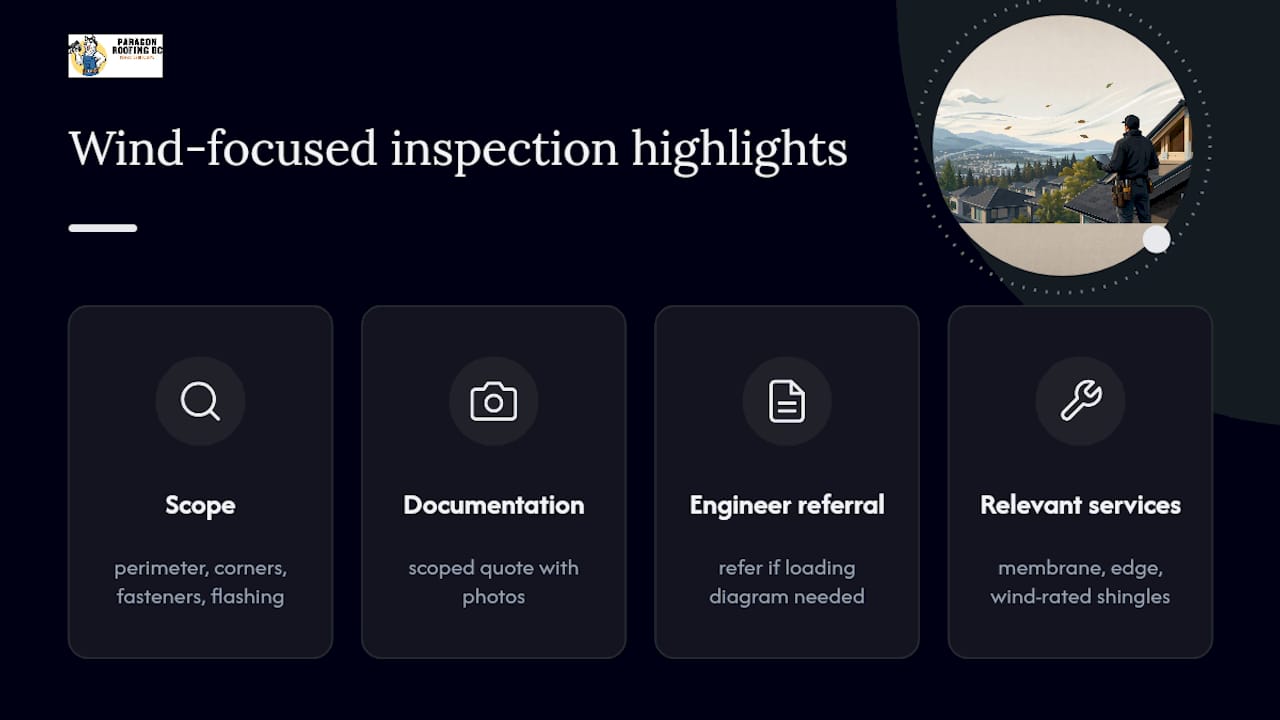
An inspection from Paragonroofingbc covers the whole picture: perimeter and corner zones, fastener condition, flashing and curb details, and clear photo documentation you can hand to an insurer or strata council. If your building needs an engineer’s loading diagram, we’ll tell you plainly rather than push a contractor-only fix where it isn’t appropriate. Relevant services include full roof inspections, commercial membrane retrofits, edge reinforcement, and wind-rated shingle upgrades for pitched residential roofs, alongside our residential roofing services for owners planning a full reroof.
Ready to find out where your roof actually stands? Request an inspection through our roofing contractor page and get a scoped quote with photos and recommendations before your next storm season.
Where these figures and standards come from
These are the primary references behind this guide: Burnaby’s climatic and seismic design guide, NRC’s mechanically attached membrane wind uplift research, the BC Housing wind-driven rain study, and CSA/BC Building Code standards.
Sources
FAQ
How do I calculate the wind uplift force on a roof?
Wind uplift force is calculated from the reference wind pressure for your site, adjusted by exposure and topographic factors, then multiplied by pressure coefficients specific to each roof zone (field, perimeter, corner). This calculation is the design authority’s responsibility, and Burnaby owners should request the finished loading diagram rather than attempt the math themselves.
What is the prevailing wind direction in Canada?
Prevailing wind direction varies by region and season, but coastal BC field studies identify east or east-south-east as a common storm direction for many Lower Mainland sites, which drives both wind-driven rain exposure and elevated uplift loading on those roof faces.
What is the code for wind load?
The National Building Code of Canada sets the reference framework for wind loads, and the BC Building Code adopts it provincially with local amendments; Burnaby publishes its own supplementary climatic guide with site-specific design pressures for local use.
What is 20 psf wind load?
Burnaby’s published 1/50-year design pressure is about 9.8 psf, and a figure that high would typically apply to a more exposed structure, a taller building, or a jurisdiction with a considerably harsher wind climate than most of Burnaby’s mapped zones.
Does CSA A123.21 apply to my roof?
CSA A123.21 governs dynamic wind uplift testing for mechanically attached membrane roofing assemblies, and BC code references require compliance with it unless the specific assembly has a documented history of acceptable field performance.
Recommended
Our Roofing Blog

Have more questions about roofing?
Check out our FAQs or give us a call today to speak to an expert roofer in Vancouver Lower Mainland, BC. We're here to help our neighbours make educated decisions about their roof. For our team, we value helping clients save money while making their roofs last.