
Coquitlam strata: find rooftop patio leaks within 15 cm
Coquitlam strata: find rooftop patio leaks within 15 cm
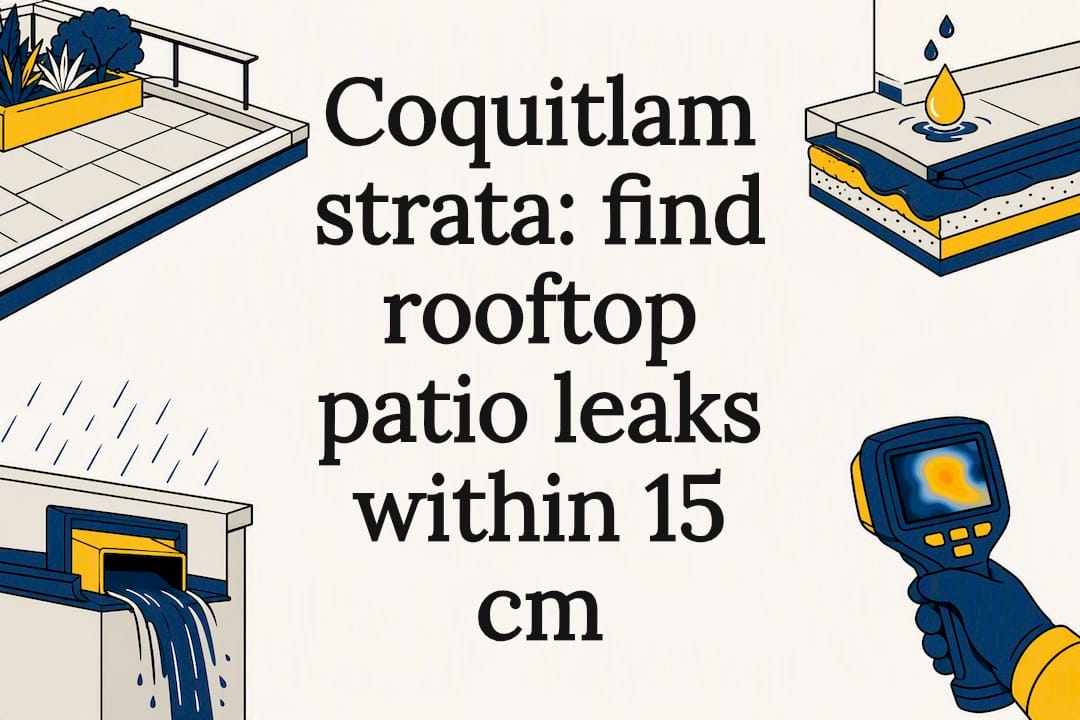
Stop the water first, then find out who is on the hook to fix it. If it’s an interior ceiling stain under a rooftop patio, contain the drip, photograph everything, and notify your strata manager or building owner the same day, since most Coquitlam patio leaks trace back to ponding, blocked drains, failed flashings, or a tired membrane under the pavers.
TL;DR:
- Proper diagnostics and moisture mapping are essential before any repair work to avoid recurring leaks and excessive costs.
- Common leak causes include poor drainage, clogged scuppers, aging membranes, failed flashing, and point loads from planters or furniture.
- Strata responsibilities generally cover exterior building components, but owners are liable for unapproved additions that contribute to leaks.
- Contractors should provide detailed inspection reports, leak source localization, and a scope of work before beginning repairs.
- Regular inspections, especially after storms two times a year, help spot problems early and prevent extensive interior damage.
Table of Contents
- What should you do first when you spot Coquitlam rooftop patio leaks?
- How do you locate the source of a rooftop patio leak?
- What are the most common causes of Coquitlam rooftop patio leaks?
- Who is responsible: strata or the owner?
- When should you call a professional roofing contractor?
- What are the repair options once the leak is found?
- How often should rooftop patios be inspected and maintained?
- What does a typical Coquitlam podium patio leak look like in practice?
- What actually matters most with rooftop patio leaks
- How Paragon Roofing BC can help with your rooftop patio leak
- Sources
- FAQ
What should you do first when you spot Coquitlam rooftop patio leaks?
Every hour a leak runs unmanaged, it spreads further into insulation, drywall, and framing that costs far more to dry out than the original membrane repair would have. Your first job isn’t diagnosis. It’s containment and documentation.
- Contain the water. Set buckets or towels under active drips and move anything electrical or valuable out of the drip path immediately.
- Clear visible debris only if it’s safe. If leaves or grit are blocking a scupper or drain you can reach without stepping on wet pavers or a slick membrane edge, clear it. If you’re unsure of your footing, leave it for a professional.
- Photograph the damage with timestamps. Capture the stain, the drip, and the weather outside. Note what time the leak started and whether it lines up with a rain event or started well after the rain stopped.
- Notify your property manager or strata council right away. Get a written record of your report and ask them to schedule an inspection. Under the Strata Property Act, this notification is what starts the clock on their obligation to respond.
- Call for emergency tarping if the leak is heavy or ongoing. A temporary tarp or patch buys time until a proper diagnostic visit can happen.
Pro Tip: Never walk on a wet paver system to chase a leak yourself. Pavers shift, pedestals can be uneven underneath, and a slippery membrane edge is one of the most common ways homeowners get hurt trying to be helpful.
Do not assume the leak will stop once the rain does. Saturated insulation under a patio deck can keep dripping into your ceiling for a day or two after the storm has passed, which throws a lot of people off when they’re trying to figure out timing.
How do you locate the source of a rooftop patio leak?
The stain on your ceiling almost never sits directly under the actual breach in the membrane. Water travels laterally under pavers and across saturated insulation before it finds a low point and drips through, so tracing “up and over” from the interior mark is the first step, not the last.
Start inside, then move outside:
- Mark the ceiling stain’s exact location and measure its distance from two fixed points (a wall and a window, for example).
- Check whether the leak appears only during rain, only after rain, or constantly. Constant dripping regardless of weather usually points to a plumbing issue rather than a roof breach.
- Walk the patio surface (carefully, and only if it’s dry and stable) looking for ponding water more than 24 hours after rain, displaced or rocking pavers, open seams in exposed membrane edges, cracked flashing at walls or railings, and scuppers or drains clogged with debris.
- Note any planters, hot tubs, or furniture sitting directly over the suspected leak zone. Concentrated weight compresses the protection board underneath and creates exactly the kind of pinpoint failure that’s hardest to find by eye.
Once the visible survey is done, a professional typically brings in non-destructive tools before anyone starts pulling up pavers. Thermal imaging, acoustic correlators, and controlled water tests let a technician map moisture zones and narrow the search area without demolition. Many BC specialists schedule infrared surveys after sunset, when the temperature contrast between wet and dry insulation layers is sharpest and easiest to read on camera.
Detection accuracy matters here. Some BC leak-detection firms report locating breaches within roughly 15 centimetres using combined thermal and acoustic methods, which is the difference between opening one paver bay and tearing out an entire section of deck.
Even with good diagnostics, expect that accessing the membrane under pavers is often unavoidable. Targeted detection narrows where you dig, but it rarely eliminates the need to lift at least some pedestals or pavers to confirm the breach and make the repair.

What are the most common causes of Coquitlam rooftop patio leaks?
Coquitlam’s mix of heavy fall and winter rain, freeze-thaw swings, and a lot of podium-style townhouse and strata construction sets up a fairly predictable list of failure points. In our inspections across low-slope patio decks in the Tri-Cities area, the same handful of causes show up again and again.
- Ponding water from poor slope or undersized drains. If a patio doesn’t shed water fast enough, standing water finds every weak seam and works its way through over time.
- Blocked or undersized scuppers and roof drains. Leaf litter, moss, and grit from surrounding trees clog drainage points, especially on shaded lots common in older Coquitlam neighbourhoods like Maillardville and Austin Heights.
- Aging or failed seams on torch-on, EPDM, or TPO membranes. Low-slope membrane systems have a service life, and seam adhesion is usually the first thing to go, particularly at flashing transitions.
- Flashing and parapet junction failures. Roof-to-wall transitions and railing post penetrations are notoriously leak-prone because they combine multiple materials at a single joint.
- Planters, pavers, and pedestal systems creating point loads. Heavy planters or a change in walking surface material can compress the protection layer below and open a leak path that has nothing to do with the membrane’s age.
- Saturated insulation and clogged drainage matting under planted or green roof areas. Once the drainage layer under a planter box saturates, water has nowhere to go but sideways and eventually down.
- Moss and organic debris retention in shaded corners. Coquitlam’s tree canopy keeps a lot of patio surfaces damp longer than sun-exposed decks elsewhere in Metro Vancouver, which accelerates membrane wear at those spots.
Our roof leak causes guide for BC homes covers how these same mechanisms play out on sloped residential roofs, but patio decks add the extra complication of foot traffic, furniture, and planters sitting right on top of the vulnerable membrane.
Who is responsible: strata or the owner?
This is the question that stalls repairs longer than any diagnostic challenge. Under the BC Strata Property Act, strata corporations are generally responsible for repairing and maintaining the building exterior and things attached to it, which typically includes balconies and rooftop patios unless the strata’s own bylaws state otherwise.
- Owners still carry responsibility for anything they’ve added, like planters, hot tubs, or altered walking surfaces, especially if that addition wasn’t approved.
- Written strata approval is usually required before installing railings, planters, skylights, or any structural change to a patio. Unauthorized changes can shift liability back onto the owner if they contributed to the leak.
- Case law and strata practice generally require careful procedural compliance when alterations touch common property, but most strata bylaws allow emergency repairs to proceed without a full vote when there’s active water damage.
- Owners should file a repair notification in writing, keep dated photos, and formally request that the strata commission a professional inspection rather than relying on a maintenance person’s quick look.
- Strata councils should engage a qualified leak-detection specialist, document the findings in writing, and follow their own procurement rules for urgent repair spending. Our guide on strata action steps after a balcony waterproofing failure walks through this process in more depth.
When should you call a professional roofing contractor?
Some leaks genuinely wait until morning. Others do not. Call a professional the same day if you see active dripping over an occupied space, any sign of structural sag or movement in the ceiling, leaks that keep coming back after every rain despite prior patching, or any leak involving common property in a strata building.
A competent contractor’s visit should produce more than a verbal opinion. Expect a written inspection report, a moisture map showing wet zones, a leak-location diagram, and a recommended scope of work with a cost estimate attached.
The tools that make this possible are worth understanding before the visit:
- Thermal imaging cameras, often used at dusk or after dark for the clearest contrast between wet and dry areas.
- Acoustic leak correlators, which pick up the sound signature of water moving under a membrane.
- Drone infrared surveys for large or hard-to-access commercial patio decks.
- Controlled water testing, where sections are flooded deliberately and watched to confirm where water enters.
Pro Tip: Always ask for the written findings and photos before you approve repair work, even from a contractor you trust. That documentation is what you’ll need if you ever have to tender the repair competitively or file an insurance claim.
What are the repair options once the leak is found?
Not every leak needs a full teardown, but knowing which repair path fits your situation avoids paying for more (or less) work than the problem actually calls for.
- Targeted flashing or seam repair. Fast and inexpensive, but only durable if the surrounding protection board and insulation are still dry and intact.
- Localized membrane splice or patch. A solid middle option when contamination is limited to one area and the layers beneath the membrane weren’t compromised.
- Full waterproofing renewal. Recommended once the protection board or insulation is saturated, or when multiple failure points show up across the deck, since patching a saturated assembly rarely holds for long.
The real cost driver on any patio repair usually isn’t the membrane work itself. It’s access. Moving pedestals, pavers, and planters to reach the membrane can turn a small seam repair into a much larger project, because someone has to lift the surface, store it, complete the repair, test it, and put everything back correctly.
A targeted repair that keeps the protection layers intact, or replaces them properly, can extend a patio’s service life by roughly five to ten years compared to an immediate full replacement, but that estimate assumes the access and dismantling costs were absorbed once rather than repeated across multiple smaller fixes. Ask any contractor for a written warranty period and a description of how they’ll verify the repair (usually a follow-up water test) before they consider the job closed. Our overview on fixing roof leaks in BC homes covers similar repair logic for sloped roofs if you’re comparing approaches across a mixed property.
How often should rooftop patios be inspected and maintained?
An ounce of drain clearing beats a pound of interior drywall repair. Inspecting your roof at least twice a year, in spring and fall, plus after any major storm, catches most problems while they’re still cheap to fix.
- Spring inspection: Clear winter debris, check drains and scuppers, and look for any freeze-thaw cracking in flashings or seams.
- Fall inspection: Remove leaves and organic buildup before the heavy rain season starts, and check planter liners and irrigation lines for leaks of their own.
- After any major storm: Walk the accessible areas and check for new ponding, shifted pavers, or debris blocking drainage points.
- Ongoing: Keep an inspection log noting dates, findings, and any repairs made, and budget for a professional leak-detection survey every few years rather than waiting for a visible leak to force the issue.
Resist the temptation to add heavy furniture, hot tubs, or oversized planters without checking with your strata first. Concentrated weight is one of the most underestimated causes of point-load leaks, and structural sign-off exists precisely because a patio’s design load has limits.
Pro Tip: Keep your inspection log in a shared strata document folder, not just an inbox. When you eventually sell or a new property manager takes over, that history is what protects everyone from repeating the same diagnostic work from scratch.
What does a typical Coquitlam podium patio leak look like in practice?
Podium decks over parking garages and townhouse common areas are some of the trickiest patio leaks we see in Coquitlam, because the pavers, drainage mat, insulation, and membrane are all stacked in layers that hide the actual breach from view.
A recurring pattern in Coquitlam strata complexes: an interior stain shows up in a unit below a shared podium patio, but the actual breach sits ten or fifteen feet away, where a planter box has been compressing the protection board for years. The fix isn’t just patching the membrane. It’s relocating the load, replacing the protection layer, and verifying the repair with a follow-up water test before anyone puts the pavers back.
Our published strata-focused inspection guidance for Coquitlam party wall and roofing issues reflects the same lesson: local construction and climate mean the fastest path to a lasting fix usually runs through proper diagnostics first, not guesswork.
What actually matters most with rooftop patio leaks
Most advice on patio leaks treats the membrane like the whole story. It isn’t. The membrane is often the last thing to fail, not the first. What actually fails first, in the majority of cases we see across the Tri-Cities, is drainage: a clogged scupper, a planter sitting on a low point, a drainage mat that saturated years before anyone noticed.
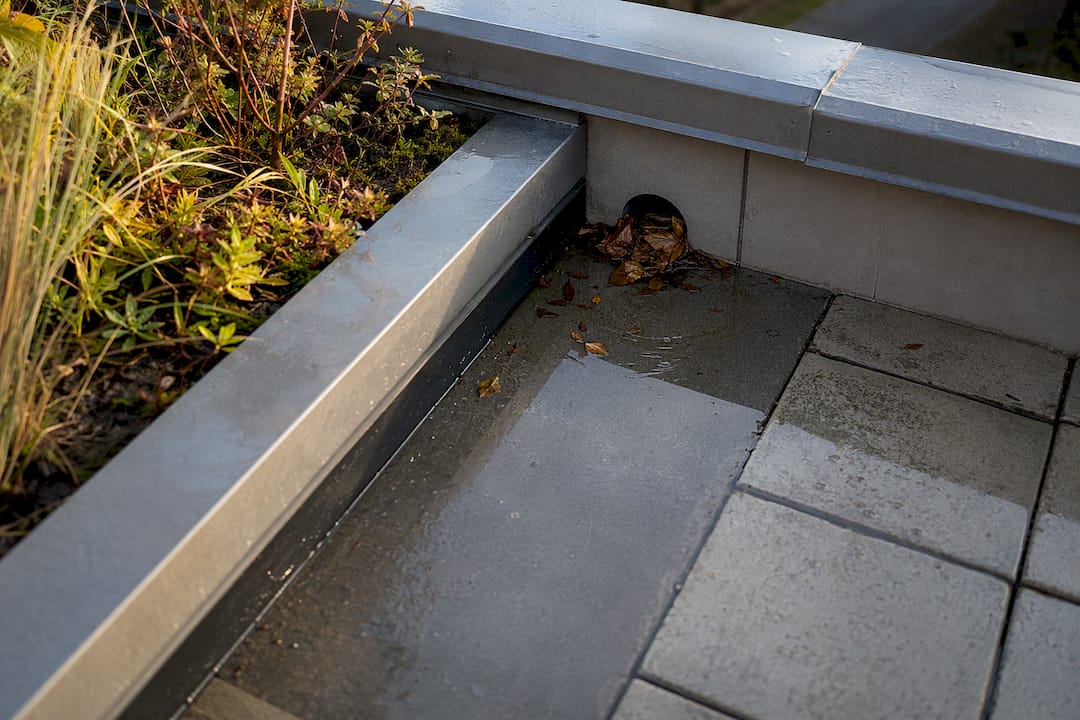
The conventional advice tells homeowners to “get the roof patched.” That’s backwards. Patch the membrane without fixing why water was sitting there in the first place, and you’ll be back in the same spot within a season or two, particularly given how much rain the Lower Mainland gets between October and March.
If there’s one thing worth prioritizing, it’s this: insist on a diagnostic step before any repair quote, even if it costs more upfront. A contractor who wants to skip straight to a patch without confirming the breach location and the drainage condition underneath is guessing, and a guess on a podium deck can turn into a five figure mistake once the water’s already gotten into the parking garage ceiling below.
— Harman
How Paragon Roofing BC can help with your rooftop patio leak
Paragon Roofing BC is the practical alternative to guessing your way through a patio leak. Rather than jumping straight to a patch, our crews start with proper diagnostics: leak-source mapping, moisture assessment, and podium/paver access planning tailored to Coquitlam’s strata and townhouse construction.

Our services relevant to patio leaks include leak detection and moisture mapping, podium deck waterproofing renewal, strata remediation coordination, and membrane repair or replacement for torch-on, EPDM, and TPO systems. If you’re preparing for a contractor visit, have your dated photos, any previous strata inspection reports, and confirmation of access permissions ready. That saves time and gets you a more accurate scope on the first visit. For strata councils and property managers handling ongoing maintenance across a building, our strata repair and maintenance services page outlines how we support recurring inspection schedules and budget planning.
Ready to get a professional set of eyes on your patio leak? Book a residential roofing inspection with our team and get a written scope before any work begins.
Sources
FAQ
My rooftop patio is leaking. What should I do first?
Contain the drip with buckets or towels, photograph the stain with a timestamp, and notify your strata manager or building owner the same day so an inspection can be scheduled quickly.
Why does my patio leak sometimes but not other times?
Leaks that appear only during or right after heavy rain usually point to a membrane or drainage breach, while constant leaking regardless of weather often signals a plumbing issue rather than a roof problem.
Is it normal for a rooftop patio to leak in heavy rain?
No leak during heavy rain is “normal,” but it is common, since ponding water and blocked scuppers overwhelm marginal drainage during Coquitlam’s heaviest fall and winter storms and expose weak seams that hold up fine in light rain.
Who pays for rooftop patio leak repairs in a Coquitlam strata?
The strata corporation is generally responsible for repairing exterior building components, including patios, under the BC Strata Property Act, though owners are typically responsible for damage caused by unapproved additions like planters or altered surfaces.
How long does diagnosing and repairing a rooftop patio leak usually take?
A diagnostic visit with thermal imaging or water testing typically takes a few hours to a day, while the repair itself can range from a single day for a targeted patch to one to two weeks for a full waterproofing renewal that requires lifting pavers and pedestals.
Recommended
Our Roofing Blog


Have more questions about roofing?
Check out our FAQs or give us a call today to speak to an expert roofer in Vancouver Lower Mainland, BC. We're here to help our neighbours make educated decisions about their roof. For our team, we value helping clients save money while making their roofs last.