
Ice Dams in North Vancouver: Causes, Warning Signs and Fixes
Ice Dams in North Vancouver: Causes, Warning Signs and Fixes
An ice dam on a North Vancouver roof is rarely a winter problem on its own. It is a heat problem that shows up in winter: warmth escapes from the building into the attic, melts snow on the roof, and the meltwater refreezes at the cold edge where it can’t drain. The lasting fix is a roof assessed as a system, covering insulation, air leaks, ventilation, eave protection and drainage. Shovelling or chipping the ice off treats the symptom and often damages the roof. Paragon Roofing BC inspects and repairs residential, strata and commercial roofs across the North Shore and the rest of Metro Vancouver, including emergency roof repairs when water is already coming in.
This guide is written for North Vancouver homeowners, strata councils and property managers. It explains how an ice dam forms, why some roofs are more exposed than others, what to look for, what to do on the day, and what to fix before next winter.
TL;DR
- An ice dam forms when heat from the building melts roof snow, and the water refreezes at the cold, unheated eave and blocks drainage.
- The cause is usually heat loss and air leaks into the attic, plus blocked eavestroughs and complicated roof shapes, not the weather alone.
- Large icicles, snow that melts first in patches, stained ceilings and sticking doors are the warning signs to act on.
- On the day, do as little as possible, never work alone on a roof, and avoid hammers, chisels and chemical de-icers.
- The lasting fix is an inspection of insulation, ventilation, eave protection and drainage, ideally before the cold season.
Table of Contents
- How an ice dam forms on a roof
- Why North Vancouver roofs are exposed
- Warning signs worth acting on
- What to do on the day an ice dam forms
- What the BC Building Code says about it
- Fixing the cause before next winter
- For strata councils and property managers
- Perspective
- Booking an inspection
- FAQ
- Sources
How an ice dam forms on a roof
Canada Mortgage and Housing Corporation (CMHC), the federal housing agency, explains that snowmelt starts when attic heat warms the roof sheathing above freezing. The water runs down toward the overhang, which is cold because no heat reaches it, and freezes there. Over days, that frozen band thickens into a ridge of ice along the eave or inside the eavestrough. Water arriving from higher up the roof has nowhere to go and can back up under the shingles.
Three ingredients have to meet:
- Snow on the roof.
- Outdoor temperatures hovering around freezing.
- A warm roof surface above a cold eave.
The Canadian Roofing Contractors Association (CRCA) lists the same combination: snow, below-freezing air, heat loss or solar melting, and a cold eave. CMHC also notes that this kind of roof icing is separate from freezing rain and can happen when it is only around 0 to −10°C outside. That is a temperature range the North Shore sees through winter, particularly at higher elevations.
Why North Vancouver roofs are exposed
North Vancouver does not have one climate. The City of North Vancouver’s climate adaptation report says Vancouver airport readings are not always representative of the North Shore, and that temperature and precipitation trends differ with location and elevation across Metro Vancouver. In practice, a home near the waterfront and a home up the slope toward Grouse can sit in different weather on the same morning. Rain at sea level can be snow higher up, and a roof that melts and refreezes every night above the 200 m line behaves very differently from one that rarely holds snow.
That variation is why a one-size-fits-all rule does not work here. Two neighbouring streets can have the same roof design and very different risk. What the roof is made of and how it is built decides what happens when snow does settle.
Roof shapes that make it worse
CMHC points out that complicated roofs with many valleys and dormers, and roofs with large overhangs, are more prone to ice dams. Many North Shore homes are built on slopes with exactly those features: multiple gables, dormers, deep eaves for the rain and cut-up rooflines to suit the lot. Every valley collects meltwater from two roof planes, and every long overhang is a cold edge waiting to freeze.
Strata townhouse complexes carry a related issue. Shared attic spaces, firewalls, many penetrations and repeated eave lines mean a heat leak in one unit can create an ice line that crosses several. When a council hears about one unit’s ceiling stain, it is worth looking at the whole roof elevation.
Insulation, air leaks and ventilation
The Insurance Bureau of Canada (IBC) lists inadequate attic insulation, poor ventilation, snow accumulation and blocked eavestroughs among the factors behind ice dams. CMHC adds that thin insulation at the attic edge lets heat reach the roof right above the overhang, which is the worst place for it.
The CRCA makes a point that surprises many owners: continuity matters as much as the amount of insulation. A gap around a pot light, a bathroom fan duct, an attic hatch or a chimney chase creates a warm patch. Snow melts there first, and the water refreezes lower down. A deep layer of insulation with holes in it can still make dams.
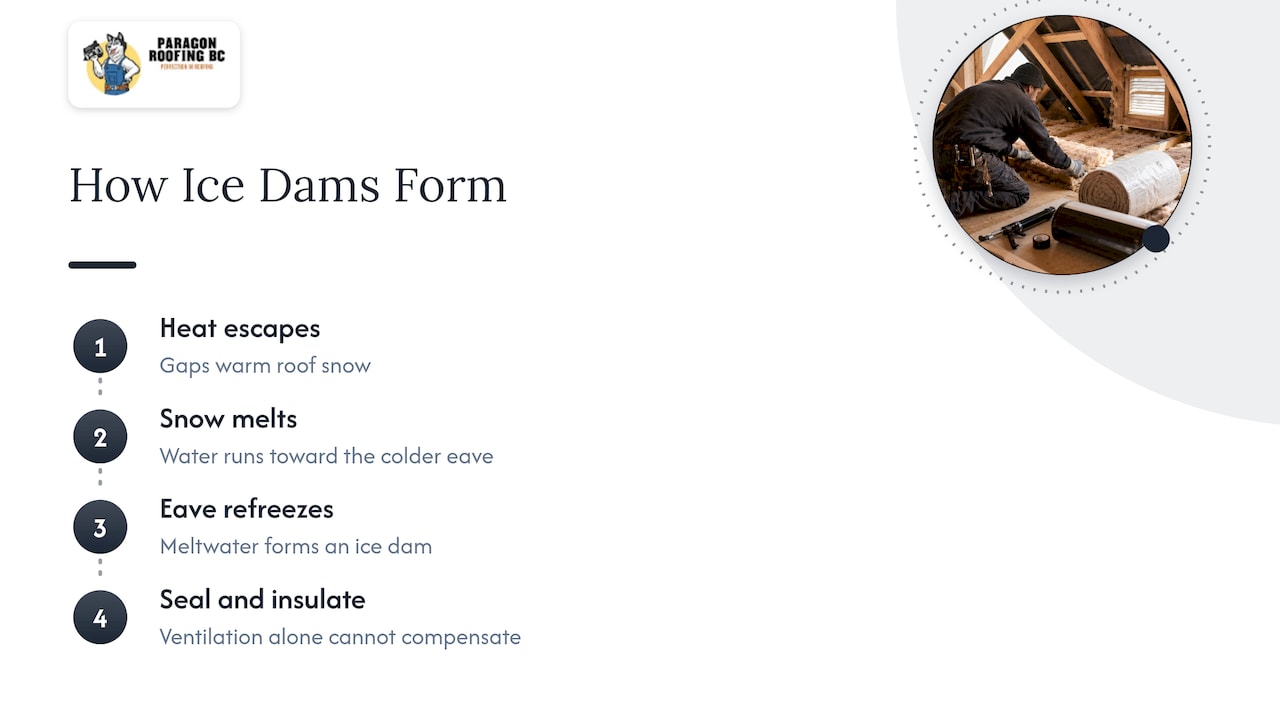
One caution from CMHC: the lasting advice is to seal attic air leaks and insulate thoroughly, including at the roof edge, because adding ventilation alone can worsen moisture problems. Ventilation moves air through the roof space, but it cannot make up for warm, humid house air leaking up into the attic. We cover the moisture side in more detail in our guide to attic insulation and ventilation in Vancouver.
Warning signs worth acting on
Most owners notice an ice dam only when water appears indoors. The earlier signs are outside:
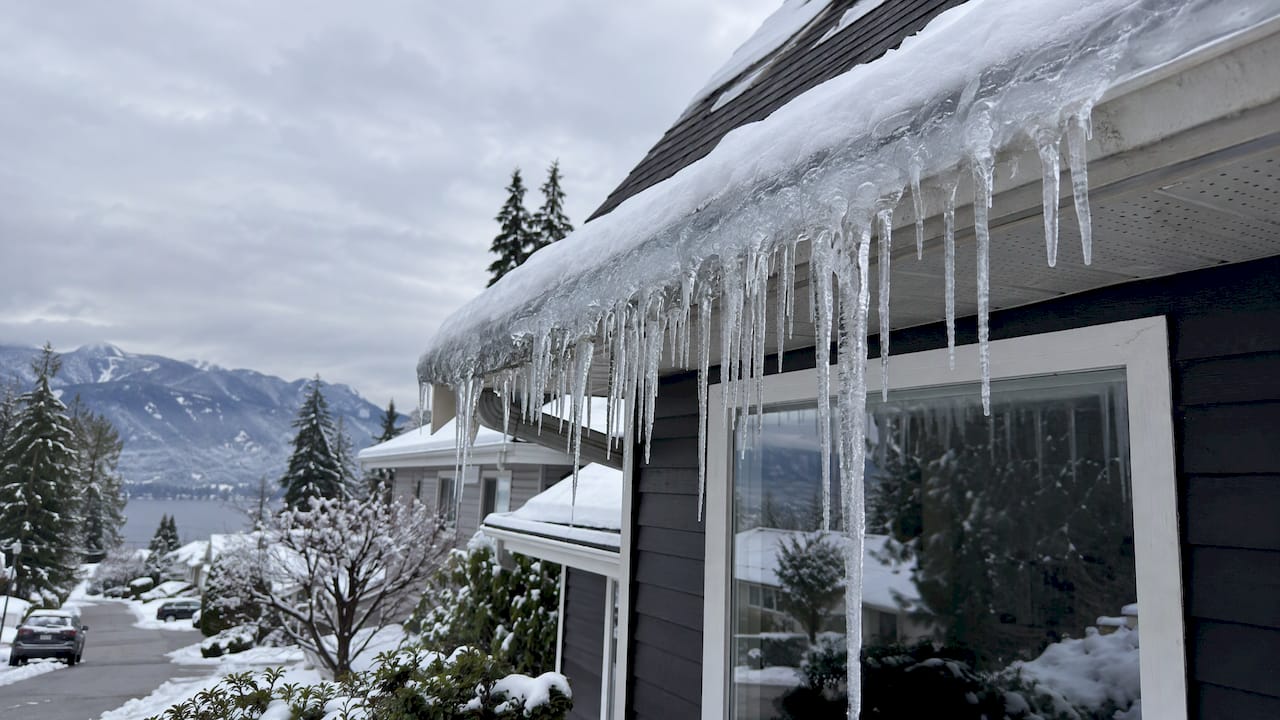
- Large icicles. IBC says they may signal a dam, although icicles alone do not always prove one. Treat heavy icicle lines along one stretch of eave as a reason to look closer.
- Snow that melts first in patches. CMHC recommends checking where roof snow melts first after frost or a light snowfall, since those areas can point to heat loss or air leakage beneath the roof. A bare stripe near the ridge, or bare patches over one room, is a map of where heat is escaping.
- A band of ice in the eavestrough. Water that cannot drain finds the next route, which is back under the shingles.
- Stains, bubbling paint or damp patches on ceilings and exterior walls. IBC notes that water backing up under shingles can damage ceilings and walls, encourage mould and mildew, and cause structural damage if the problem persists.
- Structural clues in severe cases. CMHC’s guide on removing ice says heavy loading may first show as doors jamming, new cracks in drywall near the centre of the house, or a sagging ridge line. If you see these, call a professional promptly and treat it as urgent.
For strata councils, the useful habit is to record where the icicles and wet patches appear, unit by unit, and share the photos with the roofer. A pattern across a block of units tells us far more than a single report.
What to do on the day an ice dam forms
The instinct is to get up there and break the ice. CMHC’s guidance says almost the opposite: assess daily and do as little as possible. Opening a drainage path and removing dangerous overhangs or icicles is often enough. The same guide warns that hammers, shovels, scrapers and chainsaws can damage roofing or the structure, and that chemical de-icers can damage roofing materials. Mechanical ice removal should be done by a professional, and no one should work alone.
Canada.ca’s guidance on clearing snow and ice says the same on safety: work in pairs or hire a professional, use a roof rake, and clear small amounts at a time. A wet, icy North Shore roof, often steep and often over a sloped lot, is a fall risk before it is a roofing problem.
If water is already coming through a ceiling, the priority is limiting damage inside: move belongings, protect the floor and call for help. Our emergency roof repairs are there for that situation, and we can then inspect the cause rather than only stopping the drip.
What the BC Building Code says about it
You do not need to read the code to make a decision, but two points explain why roofers talk about eave protection. Section 9.26.1.2 of the 2018 BC Building Code requires roofing and flashing to shed water, prevent moisture getting in and minimize water entering because of ice damming.
Article 9.26.5.1 then covers eave protection, the waterproof membrane that goes along the lower edge of a shingle, shake or tile roof. It lists exceptions: unheated structures, overhangs over 900 mm, certain asphalt-shingle installations, steep slopes and regions with 3,500 or fewer degree-days. A degree-day is a measure of how cold a place gets over a season, used to compare climates.
The practical reading is that a membrane is a second line of defence. It limits water getting inside once a dam has formed. It does not stop the dam forming. That is why a good job pairs eave protection with the heat-loss fixes above. If you want to understand what that membrane layer involves, see our page on ice and water shield underlayment.
Fixing the cause before next winter
Canada.ca says persistent ice dams may point to inadequate attic insulation or roof ventilation and recommends having a professional assess them. A sensible pre-winter assessment on the North Shore covers the following.
| Area | What is checked | Why it matters for ice dams |
|---|---|---|
| Attic air sealing | Hatches, pot lights, fan ducts, chimney and wall tops | Stops warm indoor air reaching the roof deck |
| Insulation | Depth and continuity, especially at the eave | Gaps create warm spots that melt snow |
| Ventilation | Intake at the soffit, exhaust near the ridge | Keeps the roof deck cold and removes moisture |
| Eave protection | Membrane under shingles or shakes along the lower edge | Limits water entry if a dam does form |
| Eavestroughs and downspouts | Debris, sagging, blocked outlets | Meltwater needs a clear path off the roof |
| Valleys, flashing and penetrations | Condition and sealing | These collect the most meltwater |
IBC’s prevention advice lines up with this list: clear eavestrough debris, check insulation and ventilation, use a roof rake to reduce snow, consider heat cables and maintain the roof regularly. Cleaning gutters in the fall is a small job that matters, particularly under the big evergreens many North Shore properties have.
When the roof itself is the problem
Sometimes the assessment finds that the layers are at the end of their life, or the roof was built without regard to the heat coming from below. Then repair patches are a short-term measure and the sensible route is a reroof planned around the fix. That can include residential roof installation with the underlayment and edge details specified for the site, or, for owners with older cedar, a move to asphalt through our cedar-to-asphalt conversion, listed at 12 to 18 C$ per sq. ft. as a one-off price. If you are weighing up low-slope sections on your building, our note on low pitch roof failure signs in North Vancouver is a good companion read, and our overview of snow load and ice dam roofing goes further on how the two interact.
For strata councils and property managers
A strata roof is a shared asset, and an ice dam on it turns into a shared problem: claims in several units, arguments about who pays, and a depreciation report that did not anticipate it. A few habits make the difference.
- Log it. Photograph icicle lines, wet ceilings and eavestrough ice during the cold snap, with dates and unit numbers.
- Inspect before winter, not after. Ask for a roof assessment that includes the attic spaces, not only the shingles seen from the ground.
- Plan the fix as a capital item. If insulation, air sealing and eave details need to be redone, it is cheaper and less disruptive to schedule them with a reroof than to repair unit by unit.
- Keep a single point of contact. One roofer who knows the whole complex avoids piecemeal repairs.
Our strata and multifamily roofing services cover installation, repairs and maintenance, and removal and reroofing, for exactly this kind of property. Commercial owners with flat or low-slope roofs can see our commercial roofing services.
Perspective
Every ice dam call we get starts with someone staring at a wall of icicles and asking how to get them down. Our answer is nearly always to look up the roof, not at the ice. The ice is just where the water finally gave up.
On the North Shore, roofs deal with a lot: rain that comes sideways, snow that arrives at elevation and sits, and nights that drop just below zero after a mild day. A roof built and maintained with that in mind lets the heat stay inside the house and the water leave through the gutters. We design our inspection around that idea, from the attic floor up to the edge of the eavestrough.
We would rather a homeowner or strata council call us in October to talk about insulation continuity, eave protection and clear drainage than in January about a stained ceiling. Our team works on residential, strata and commercial roofs across Metro Vancouver, and we treat each building as its own case.
Harman
Booking an inspection
If your roof showed icicles, stained ceilings or ice in the eavestroughs last winter, the best time to look into it is before the next cold snap. Paragon Roofing BC offers residential roof inspections, repairs and maintenance across North Vancouver, and strata and commercial inspections for larger buildings. Bring photos from last winter if you have them: they show us where to look first.

For a seasonal routine you can follow between visits, see our residential roof maintenance checklist. If the same problem shows up elsewhere on the Lower Mainland, our guides to ice dam damage in Surrey and ice dams in BC winters show how conditions differ by area.
FAQ
Do ice dams happen in North Vancouver, or only in colder parts of Canada?
They can happen wherever snow sits on a roof and temperatures hover around freezing. CMHC says roof icing occurs when it is only a few degrees below zero. Because North Shore conditions vary with elevation, homes higher on the slope are more likely to see snow lie long enough to cause one.
Are large icicles always a sign of an ice dam?
No. IBC says large icicles may indicate an ice dam or its beginning, but they do not always prove one. Heavy icicles along one stretch of eave, together with wet ceilings or ice in the eavestrough, are a good reason to have the roof and attic inspected.
Can I chip the ice off myself?
We advise against it. CMHC warns that hammers, shovels, scrapers and chainsaws can damage roofing or the structure, and that chemical de-icers can harm roofing materials. Mechanical removal is best left to a professional, and nobody should work on an icy roof alone.
Does eave protection stop ice dams?
It limits the water that gets inside once a dam has formed, which is why the BC Building Code speaks of minimizing water entry from ice damming. Stopping the dams from forming depends on air sealing, continuous insulation, ventilation and clear drainage, so the best result comes from addressing both.
Who should I call when a ceiling starts to leak in winter?
If water is coming in, contain it inside first, then call a roofer for an emergency repair and an inspection of the cause. Our emergency roof repairs cover that situation, and for strata buildings we can look at the whole roof, not just the one unit.
Sources
- CMHC, About Your House: Ice Damming
- CMHC, Removing Ice on Roofs
- Canadian Roofing Contractors Association, Ventilation bulletin
- Insurance Bureau of Canada, Understanding and helping prevent ice dams
- Canada.ca, Clear snow and ice
- BC Building Code 2018, Section 9.26 Roofing
- City of North Vancouver, Climate Changes and Impacts report
Recommended
Our Roofing Blog


Have more questions about roofing?
Check out our FAQs or give us a call today to speak to an expert roofer in Vancouver Lower Mainland, BC. We're here to help our neighbours make educated decisions about their roof. For our team, we value helping clients save money while making their roofs last.