What is a flat roof? Your complete BC guide
What is a flat roof? Your complete BC guide
TL;DR:
- A flat roof is a low-slope system relying on engineered drainage and waterproof membranes for water management. Proper slope verification, membrane selection, and regular maintenance are essential for durability in BC’s heavy rainfall and freeze-thaw cycles. Routine inspections, drain cleaning, and vigilant repairs extend its lifespan and prevent costly leaks.
A flat roof is defined as a low-slope roofing system with a pitch of less than 10 degrees, engineered to manage water drainage through membranes and mechanical drainage components rather than relying on gravity alone. Unlike steep-slope roofs that shed water naturally, low-slope roofs require precisely designed drainage systems including internal drains, scuppers, and gutters to move water off the surface. In Metro Vancouver and the surrounding Lower Mainland, where annual rainfall regularly tops 1,100 millimetres and freeze-thaw cycles stress roofing materials through winter, choosing the right flat roof system is not a minor decision. It is a long-term investment that demands the right membrane, the right slope, and a maintenance plan that matches BC’s climate.
What is a flat roof and how does it work?
A flat roof is not truly flat. Industry slope standards place low-slope roofs at 3 in 12 pitch or less, and most membrane roofing systems are installed with a minimum slope of 1/4 inch per foot to encourage water movement toward drains. The term “flat” is a functional classification, not a literal description. It tells you that the roof relies on engineered drainage rather than pitch to stay dry.
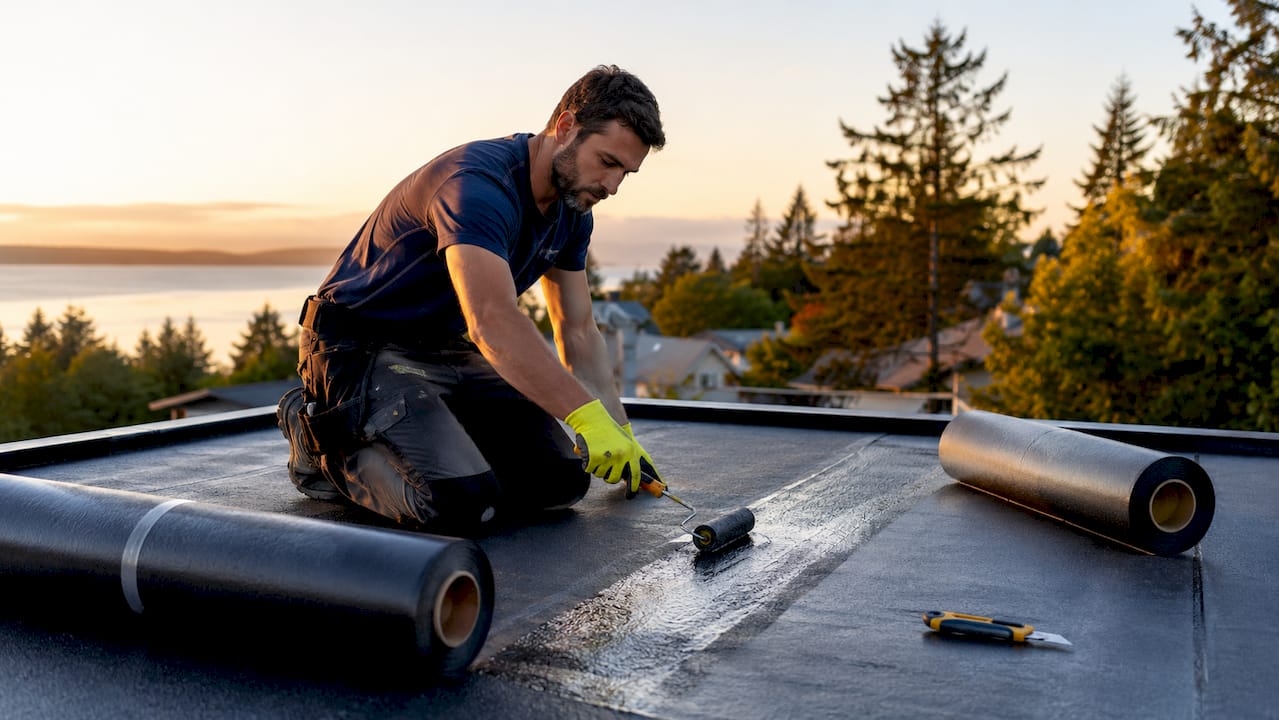
The waterproofing layer on a flat roof is called a membrane, and it does the heavy lifting that steep-pitch shingles cannot. Asphalt shingles, for example, require a minimum 4:12 pitch to function correctly, which is why you will never see them on a commercial warehouse or a modern Vancouver townhouse with a low-slope roof. Membranes are continuous, sealed surfaces that cover the entire deck and wrap up at edges and penetrations to block water entry.
In BC’s wet climate, the membrane is only as good as the drainage system behind it. A roof that holds standing water, even for 48 hours after a rainstorm, is a roof that is quietly failing. Ponding water accelerates membrane degradation, adds structural load, and creates the conditions for leaks that show up inside your building weeks later.
What are the different types of flat roofs and materials?
Four main flat roof categories exist in the industry: built-up bitumen roofing, modified bitumen, single-ply membranes, and liquid-applied roofing. Each system has a distinct appearance, installation method, and performance profile. Knowing which one is on your building helps you choose compatible repair materials and set realistic maintenance expectations.
| Roof type | Materials | Typical lifespan | Best suited for |
|---|---|---|---|
| Built-up bitumen (BUR) | Alternating layers of bitumen and reinforcing fabric, topped with gravel | 20 to 30 years | Commercial buildings needing durable, multi-layer protection |
| Modified bitumen | SBS or APP polymer-modified asphalt sheets | 20 to 30 years | BC climates requiring freeze-thaw elasticity |
| Single-ply membrane (EPDM, TPO, PVC) | Synthetic rubber or thermoplastic sheets | 15 to 30 years | Lightweight applications, energy-conscious buildings |
| Liquid-applied roofing | Polyurethane or acrylic coatings applied wet | 15 to 25+ years | Complex roof shapes with many penetrations |
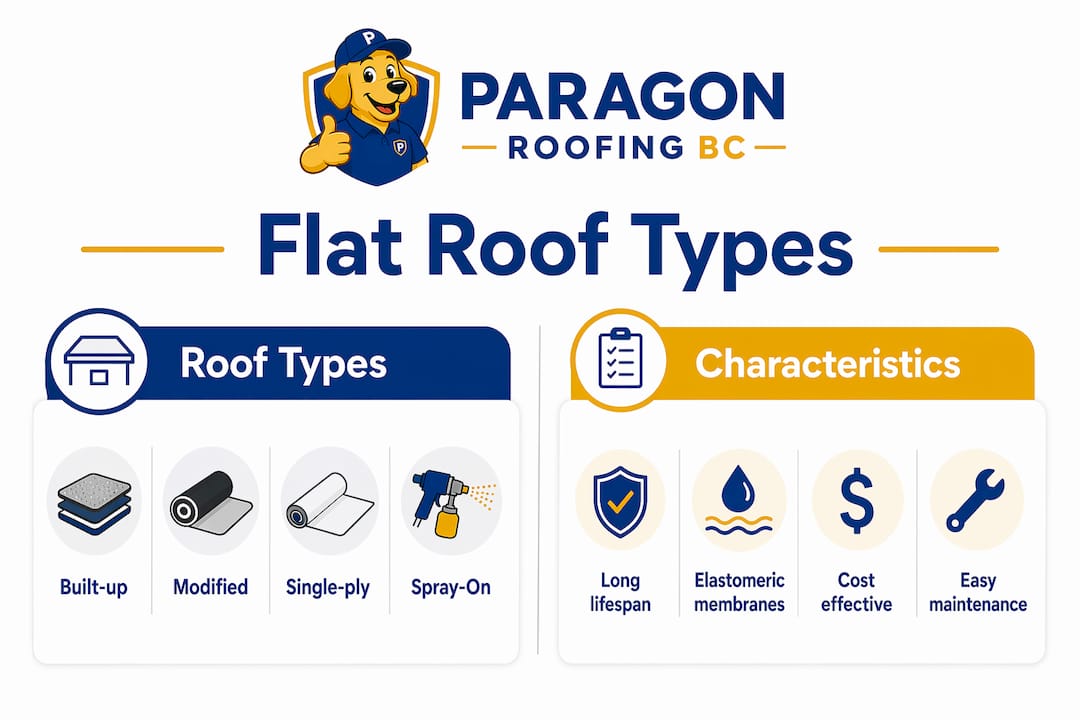
Identifying your roof type visually is straightforward once you know what to look for. Black rubber surfaces indicate EPDM, white membranes with heat-welded seams point to TPO or PVC, and a gravel-covered surface almost always means a built-up bitumen roof underneath. This matters practically because you cannot patch an EPDM roof with TPO tape and expect it to hold through a Vancouver winter.
Here is a quick breakdown of how each system performs in BC conditions:
- Modified bitumen with SBS rubber is the most freeze-thaw resistant option and remains flexible at low temperatures, making it a strong choice for Metro Vancouver rooftops that cycle between wet cold and mild warmth through winter.
- TPO and PVC single-ply membranes offer excellent UV resistance and are heat-welded at seams, creating a bond that is often stronger than the membrane itself.
- EPDM is cost-effective and durable but requires careful seam adhesion since it is glued rather than welded.
- Liquid-applied membranes create a seamless waterproof layer with no seams to fail, which is a genuine advantage on roofs with skylights, HVAC units, and multiple pipe penetrations.
Pro Tip: If you are buying or taking over management of a commercial building in BC, walk the roof and photograph the membrane surface and seam type before your first maintenance call. Knowing your system type before a leak occurs saves time and money when repairs are needed.
What are the benefits and challenges of a flat roof?
Flat roofs offer real advantages for both residential and commercial buildings, but they come with trade-offs that are amplified in BC’s heavy-moisture environment. Understanding both sides helps you make a smarter decision and set up the right maintenance programme from day one.
The genuine benefits include:
- Lower installation cost per square metre compared to steep-slope roofs, because less material is needed and labour is safer and faster on a low-slope surface.
- Usable rooftop space for HVAC equipment, solar panels, rooftop patios, or green roof systems. Many Vancouver multi-family buildings use flat roofs specifically to house mechanical equipment and reduce noise transmission to suites below.
- Easier maintenance access means inspections and minor repairs cost less because crews do not need fall-arrest systems or steep-pitch safety equipment to walk the surface.
- Simpler drainage integration for rainwater harvesting systems, which is increasingly relevant in Metro Vancouver where sustainable building practices are prioritised.
The real challenges you need to plan for:
- Ponding water is the number one enemy of a flat roof. Drainage components including internal drains and scuppers must be cleared and properly maintained to prevent water from sitting on the membrane surface.
- Membrane seam vulnerability increases over time, especially around penetrations like vents, skylights, and HVAC curbs. These are the spots where leaks almost always start.
- Snow load is a real concern in areas like Burnaby Mountain, Coquitlam, and North Vancouver where accumulation can be significant. Flat roofs must be designed with adequate structural capacity and cleared after heavy snowfall.
- Freeze-thaw cycling through BC winters causes membranes to expand and contract repeatedly, which stresses seams and flashings over time.
Pro Tip: Budget for annual professional inspections on any flat roof in Metro Vancouver. The cost of one inspection is a fraction of what you will pay to repair a leak that has been quietly spreading under your membrane for six months.
How are flat roofs properly installed and waterproofed in BC?
Proper flat roof installation in British Columbia is a process that starts before a single roll of membrane is unrolled. The slope must be measured and confirmed first. Minimum installed slope typically ranges from 1/8 to 1/4 inch per 12 inches of run in membrane systems, and getting this wrong at the start creates ponding problems that no amount of maintenance will fully correct.
Here is how a quality flat roof installation unfolds on a BC building:
- Deck preparation and slope verification. The structural deck is inspected, repaired if needed, and confirmed to meet minimum slope requirements. Tapered insulation is often used to create slope where the deck itself is level.
- Insulation installation. Rigid insulation boards are fastened or adhered to the deck. In BC, thermal performance matters for energy costs, and insulation thickness is calculated to meet the BC Building Code requirements.
- Membrane installation. Depending on the system, membranes are heat-welded (TPO, PVC), torch-applied (modified bitumen), self-adhered, or fully adhered with bonding adhesive (EPDM). Heat-welded membranes provide strong seam integrity, while liquid-applied membranes offer flexible seamless protection around complex penetrations.
- Flashing and edge detailing. Every penetration, parapet wall, and roof edge receives custom flashing. This is where most installation failures originate. Rushed or improperly lapped flashings are the leading cause of leaks on flat roofs in the Lower Mainland.
- Drainage installation and testing. Internal drains, scuppers, and overflow drains are installed and tested before the job is signed off. Drainage failure points including clogged internal drains and damaged scuppers are the most common causes of premature membrane failure.
- Final inspection. A thorough walkthrough confirms seam quality, flashing integrity, and proper drainage flow before the roof is handed over.
For BC specifically, modified bitumen SBS membranes with rubber enhancement are a proven choice because they maintain elasticity through freeze-thaw cycles without cracking. Liquid-applied systems are gaining traction on complex commercial rooftops in Vancouver where penetration counts are high and seamless coverage is the priority.
How should you maintain a flat roof in Metro Vancouver?
Routine flat roof maintenance is the single most effective way to extend your roof’s service life in BC’s wet climate. A roof that is inspected and cleaned twice a year will consistently outlast a neglected roof by five to ten years, regardless of membrane type. The Lower Mainland’s rainfall pattern means debris accumulates fast, drains clog regularly, and small seam issues become full-on leaks before you know it.
Your maintenance checklist should cover these key areas:
- Inspect membrane seams and flashings at least twice per year, ideally in spring after the wet season and in autumn before it begins. Look for lifting edges, bubbling, or cracking around penetrations.
- Clear all drains, scuppers, and gutters after every significant storm and as part of your scheduled inspections. A blocked drain turns your flat roof into a shallow pond within hours during a heavy Vancouver rainstorm.
- Monitor for ponding water. If water is still sitting on your roof 48 hours after rain has stopped, your drainage system has a problem that needs professional attention. Ponding accelerates membrane degradation faster than almost any other factor.
- Check for vegetation growth along parapet walls and in drainage channels. Moss and algae are common in Metro Vancouver’s damp climate and their root systems can penetrate membrane seams over time.
- Document your roof condition with photos at every inspection. A dated photo record helps you track changes, supports warranty claims, and gives any contractor you hire a clear baseline to work from.
For buildings in North Vancouver, Coquitlam, and other areas with heavier snowfall, add a post-snowfall check to your programme. Snow accumulation on a flat roof adds significant weight and, as it melts unevenly, can create ice damming at drains and scuppers. Clearing snow promptly after heavy falls protects both your membrane and your building structure. You can find detailed Vancouver drainage guidance on managing rainwater and drainage specific to BC flat roofs.
Key takeaways
A flat roof performs reliably in BC only when slope, membrane selection, drainage design, and regular maintenance all work together from day one.
| Point | Details |
|---|---|
| Flat roof definition | A low-slope roof under 10 degrees that relies on membranes and drainage systems, not pitch, to manage water. |
| Four main system types | Built-up bitumen, modified bitumen, single-ply membranes, and liquid-applied roofing each suit different BC applications. |
| BC climate demands | Freeze-thaw cycles and heavy rainfall require elastic, durable membranes and clear drainage paths at all times. |
| Installation precision | Minimum slope of 1/4 inch per foot and proper flashing detailing are non-negotiable for leak-free performance. |
| Maintenance frequency | Inspect and clean drains twice yearly minimum; address ponding water within 48 hours of any rainfall event. |
What I have learned from flat roofs in Metro Vancouver
Hey, it’s Harman here. After years of walking flat roofs across Metro Vancouver, Burnaby, Surrey, and the North Shore, the pattern I see most often is this: the roof itself is not the problem. The drainage system is. I have been on rooftops where a perfectly good TPO membrane was failing prematurely because a single internal drain had been partially blocked for two years. The membrane was fine. The ponding water destroyed it.
The other thing I will say plainly is that not all flat roofs are created equal, even within the same system type. A modified bitumen roof installed with proper tapered insulation and fully lapped flashings will outperform a TPO roof that was rushed through installation any day of the week. Material choice matters, but installation quality matters more.
If you are a property manager or building owner in BC, my honest advice is to treat your flat roof like you treat your HVAC system. You would not skip annual servicing on a commercial heating unit. Do not skip it on your roof either. The cost of a professional inspection is genuinely small compared to what a missed seam failure costs you in interior damage, business disruption, and emergency repair fees.
One more thing worth saying: if you are comparing quotes for a new flat roof installation, ask every contractor how they handle slope verification and flashing detailing. The answer tells you immediately whether they understand flat roofing or whether they are just rolling out membrane and hoping for the best. You can explore flat roof types for Vancouver properties to get a clearer picture of what system suits your building before you start those conversations.
— Harman
Get your flat roof assessed by Paragon Roofing BC
At Paragonroofingbc, we work with flat roofs every week across Metro Vancouver, Burnaby, Richmond, Surrey, and the North Shore. We know what BC’s rainfall and freeze-thaw cycles do to membranes over time, and we know how to install and maintain flat roof systems that hold up through it all.
Whether you are planning a new flat roof installation in Vancouver or need a professional condition assessment on an existing system, our team brings real local experience to every project. We offer thorough drone roof inspections that give you a detailed picture of your roof’s condition without anyone needing to walk the surface. Reach out to Paragonroofingbc today to book your inspection or discuss your flat roof project with someone who actually knows BC roofing.
FAQ
What is the flat roof definition in simple terms?
A flat roof is a low-slope roof with a pitch of less than 10 degrees, covered by a waterproof membrane and drained through internal drains, scuppers, or gutters rather than by steep pitch alone.
What materials are used for flat roofs?
The most common flat roof materials are modified bitumen, EPDM rubber, TPO, PVC single-ply membranes, built-up bitumen with gravel, and liquid-applied polyurethane or acrylic coatings. Each has different lifespan and performance characteristics suited to different BC applications.
What are the main flat roof benefits for BC buildings?
Flat roofs offer lower installation costs, usable rooftop space for equipment or patios, and easier maintenance access. In BC, they also integrate well with rainwater management systems and are standard on commercial and multi-family buildings throughout Metro Vancouver.
How do you maintain a flat roof properly?
Inspect membrane seams and flashings twice yearly, clear all drains and scuppers after storms, and address any ponding water within 48 hours. In Metro Vancouver, annual professional inspections are strongly recommended given the volume and frequency of rainfall.
How long does a flat roof last in BC?
Lifespan depends on the system type and maintenance quality. Built-up bitumen and modified bitumen roofs last 20 to 30 years, single-ply membranes 15 to 30 years, and liquid-applied systems 15 to 25 or more years when properly maintained in BC’s climate.
Recommended
Our Roofing Blog


Have more questions about roofing?
Check out our FAQs or give us a call today to speak to an expert roofer in Vancouver Lower Mainland, BC. We're here to help our neighbours make educated decisions about their roof. For our team, we value helping clients save money while making their roofs last.