Why Burnaby homes need attic insulation upgrades
Why Burnaby homes need attic insulation upgrades
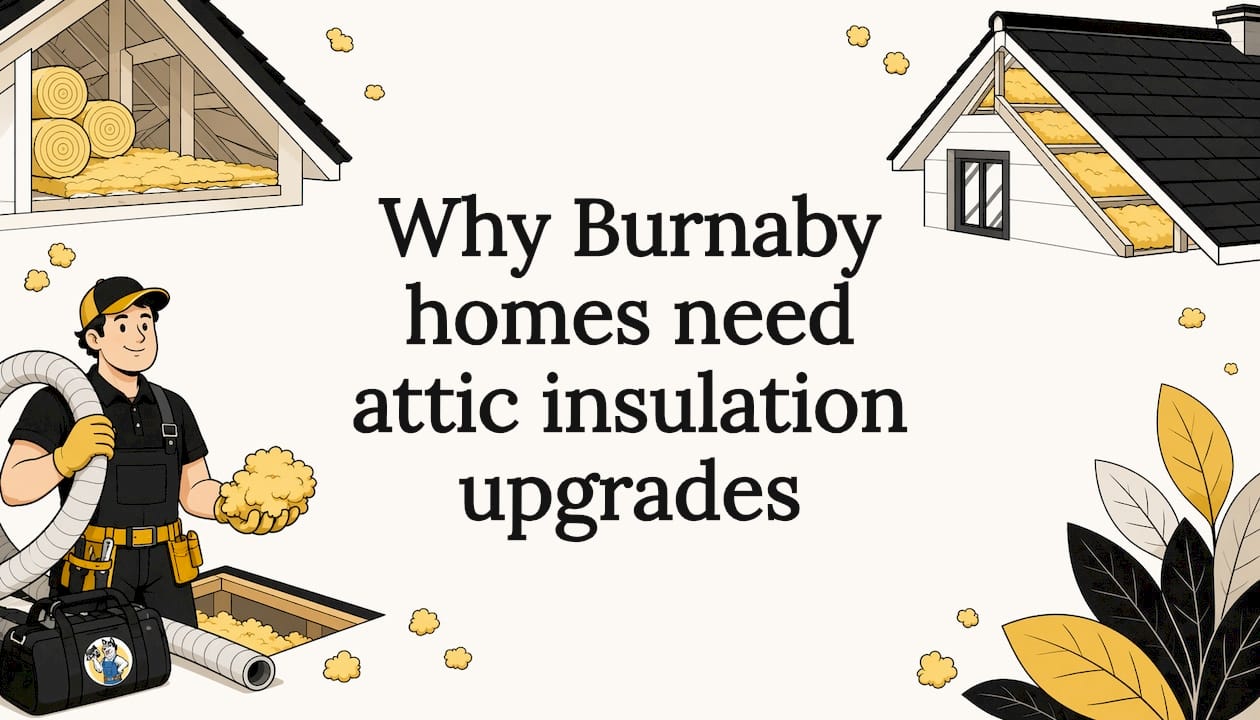
Burnaby homes need attic insulation upgrades because outdated or degraded insulation is quietly costing you money, comfort, and structural integrity every single season. Upgrading your attic insulation can cut heating costs by 30–50%, and in Burnaby’s wet coastal climate, the stakes go well beyond your energy bill. Here is what drives the urgency for most local homeowners:
- Energy costs: Poorly insulated attics let conditioned air escape year-round, forcing your furnace and air conditioning to work harder than they should.
- Comfort: Burnaby winters are damp and grey; summers bring surprising humidity. Proper insulation stabilises indoor temperatures so your home feels consistent, not drafty.
- Moisture and mould: Coastal rainfall and high humidity push moisture into attic spaces. Without adequate insulation and air sealing, condensation builds up and mould follows.
- Pest damage: Older Burnaby homes, particularly those built before 1990, often have gaps and degraded insulation that invite rodents and insects.
- Building code compliance: Burnaby sits in BC Climate Zone 4, which sets an attic insulation target of R-50 (RSI 8.7). Many homes fall well short of that.
- Rebate opportunities: BetterHomesBC rebates are available for upgrades that meet or exceed R-50, making the financial case even stronger.
- Air sealing: Insulation alone is not enough. Sealing air leaks before you add material is what actually stops heat loss and moisture infiltration.
How attic insulation upgrades improve energy efficiency and comfort in Burnaby
Burnaby’s climate is the kind that punishes a leaky attic from both directions. Wet winters mean your heating system runs long and hard; warm, humid summers mean your cooling load climbs faster than you’d expect for the Lower Mainland. A well-insulated attic acts as a thermal buffer, keeping heat inside during cold months and blocking solar gain in summer.
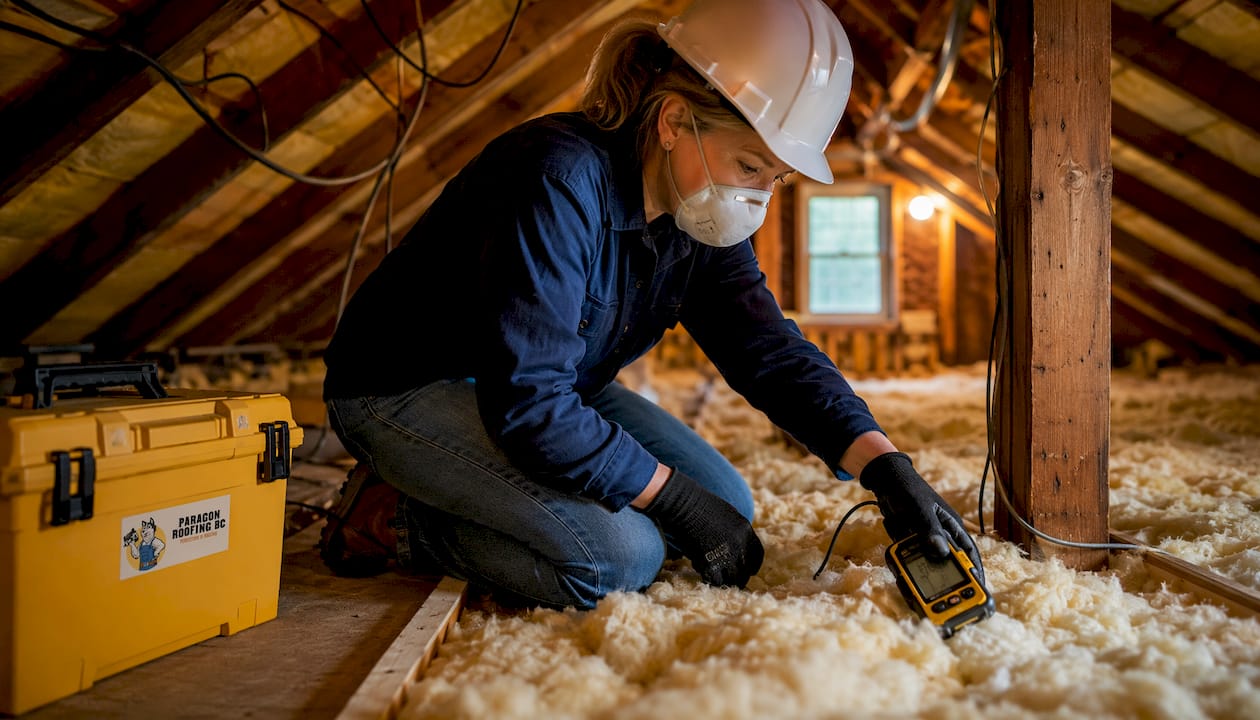
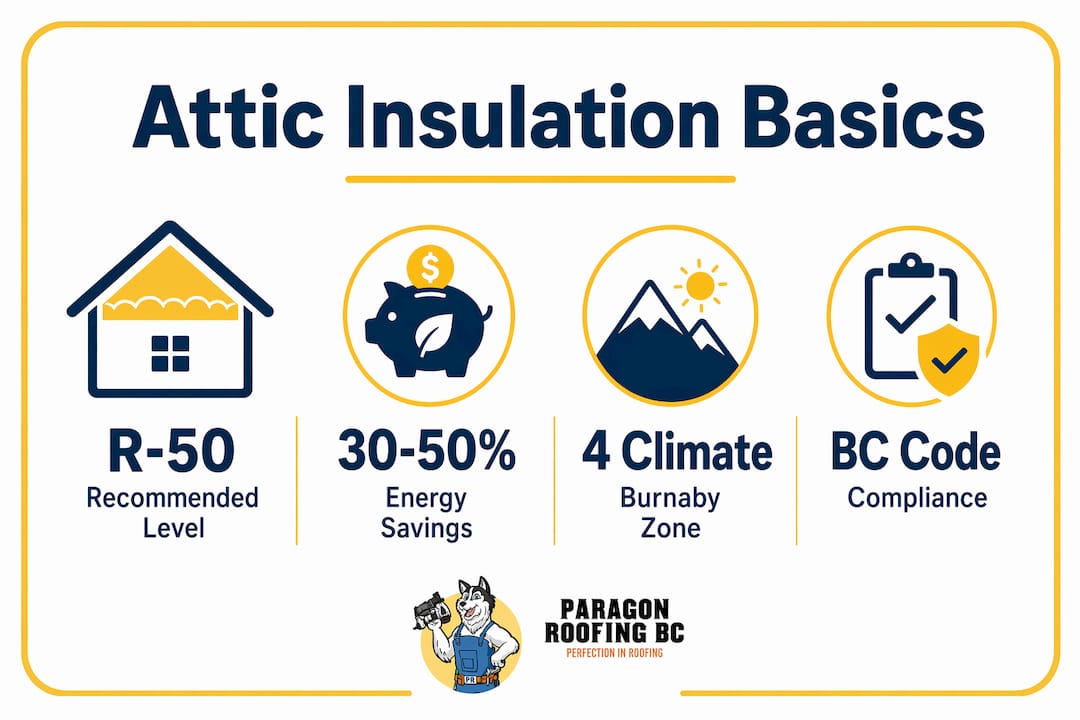
The energy savings are real and measurable. Heating cost reductions of 30–50% are achievable with high-performance attic insulation upgrades, depending on the age of the home, the condition of existing insulation, and the heating system in place. Homes built before 1990 tend to see the biggest gains because their original insulation has often settled, compressed, or been contaminated over decades of use.
Beyond the numbers, there is a comfort dimension that Burnaby homeowners notice almost immediately after an upgrade. Cold spots near ceilings disappear. Rooms that used to feel damp in November stay drier. Noise from Burnaby’s increasingly dense urban environment, particularly near Metrotown and the Lougheed corridor, is also reduced when attic insulation is brought up to modern depth and density.
- Stabilised indoor temperatures reduce thermostat cycling and extend HVAC equipment life.
- Improved indoor air quality results from fewer drafts pulling unconditioned, potentially mould-spore-laden air from the attic into living spaces.
- Reduced condensation on ceilings and upper walls, a common complaint in older Burnaby bungalows and split-levels.
- Lower electrical load during summer months when attic heat gain is a primary driver of cooling demand.
Pro Tip: If your upstairs rooms feel noticeably warmer than the main floor in summer, your attic insulation is almost certainly undersized or degraded. That temperature gap is a reliable diagnostic sign before you even open the hatch.
What R-value does your Burnaby attic actually need?
Burnaby falls within BC Climate Zone 4, and the current standard for attic insulation in this zone is a nominal R-50 (RSI 8.7). That figure is not a suggestion. It is the benchmark used by BC Building Code compliance checks and the threshold required to qualify for BetterHomesBC rebates.
Understanding the difference between nominal and effective R-value matters here. Nominal R-value is what the insulation product is rated at under ideal lab conditions. Effective R-value accounts for real-world factors: thermal bridging through joists, compression of batt insulation, and gaps around penetrations like light fixtures and plumbing stacks. A home that appears to have R-40 worth of batts installed may be performing at R-28 or lower once those factors are applied. This is why professional assessment, not a tape measure and a product label, is the right starting point.
| Insulation type | Typical R-value per inch | Best application | Moisture resistance |
|---|---|---|---|
| Blown-in fibreglass | — | Open attic floors, top-ups | Moderate |
| Blown-in cellulose | — | Full attic coverage, dense pack | Good when dry |
| Spray foam (open cell) | — | Air sealing, rim joists | Low (absorbs moisture) |
| Spray foam (closed cell) | — | Vapour barrier, tight spaces | Excellent |
| Fibreglass batt | — | Between joists, new builds | Low |
Choosing the right material depends on your attic’s existing condition, ventilation setup, and whether a vapour barrier is already in place. Spray foam is the only insulation type that also functions as a vapour barrier, which is why it is often used at the attic hatch, around penetrations, and along the eaves before blown-in material fills the rest of the floor. Cellulose is a popular choice in Burnaby for full attic resets because it settles predictably and covers irregular joist layouts well.
A proper vapour barrier on the warm side of the insulation assembly is required under BC Building Code for most attic configurations. Without it, warm interior air carrying moisture migrates into the insulation layer, condenses, and begins the cycle of degradation that leads to mould and structural rot.
How to manage moisture, ventilation, and mould in a Burnaby attic
Burnaby’s coastal rainfall is relentless from october through april, and the city’s varied elevation, from the flat Edmonds area up to the slopes of Burnaby Mountain, creates microclimates that affect how moisture behaves in attic spaces. The combination of high outdoor humidity and warm interior air creates serious condensation risk if ventilation and air sealing are not handled correctly.
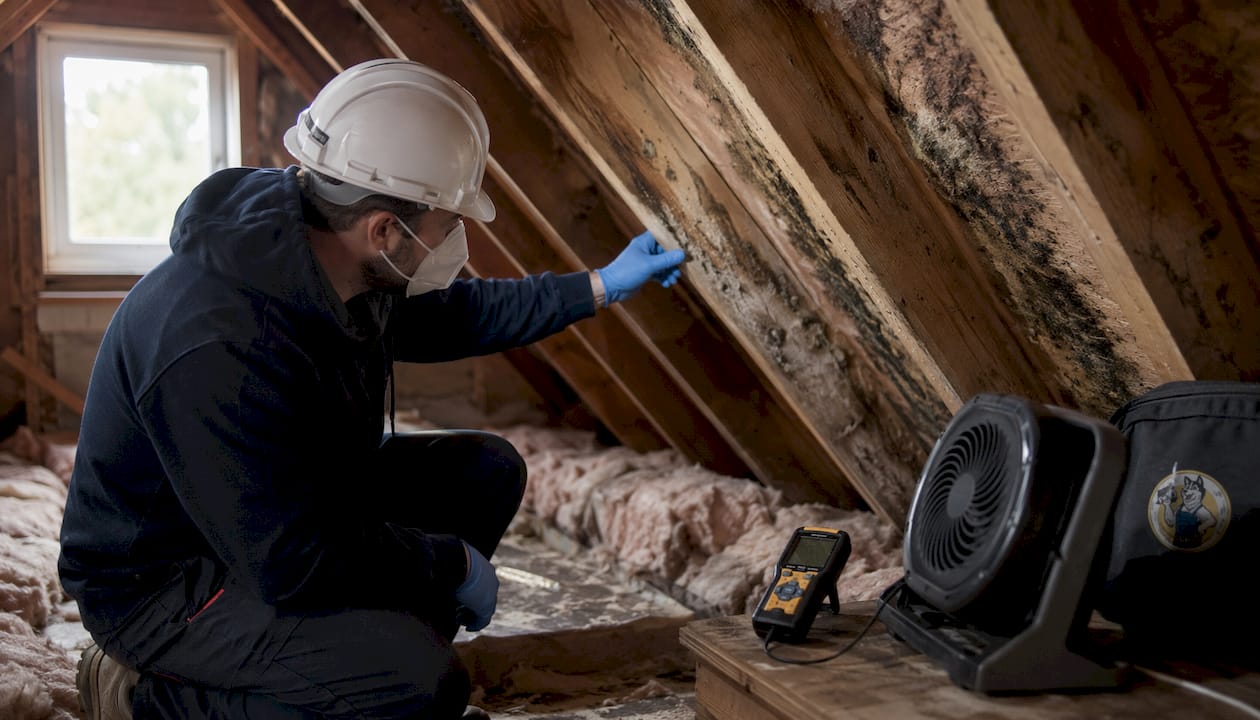
Balanced attic ventilation is the first line of defence. The goal is a continuous airflow path from soffit vents at the eaves to ridge vents or roof vents at the peak, so that any moisture that enters the attic space is carried out before it can condense on sheathing or rafters. Blocking soffit vents with insulation during an upgrade is one of the most common and damaging mistakes we see on Burnaby roofs.
Air sealing must happen before any new insulation goes in. Every penetration through the attic floor, pot lights, plumbing stacks, bathroom exhaust fans, attic hatches, and wall top plates, is a pathway for warm, moist interior air to bypass the insulation layer entirely. Sealing these with spray foam or acoustical sealant before adding blown-in material is what BC Housing’s best practices identify as the single highest-impact step in an attic retrofit.
- Check that bathroom and kitchen exhaust fans vent to the exterior, not into the attic space. This is a code violation and a direct mould trigger.
- Inspect attic sheathing for dark staining or soft spots before insulating. These are signs of active or past moisture intrusion.
- Never install new insulation over wet or mould-affected material. Covering contaminated insulation traps biological hazards and accelerates structural decay.
- Maintain a minimum 63 mm (2.5 inch) clear airway above the insulation at the eaves using insulation baffles.
Pro Tip: Have a contractor check your attic in january or february, the peak of Burnaby’s wet season. Frost patterns on the sheathing reveal exactly where air is leaking through the floor below. It is the clearest diagnostic picture you will get all year.
What to check before installing attic insulation in your Burnaby home
A Burnaby attic insulation upgrade is not a project you start by ordering a truckload of blown-in cellulose. The condition of what is already up there determines everything about how the job should proceed. Skipping the inspection phase is how homeowners end up trapping pests, mould, or asbestos under a fresh layer of insulation.
Professional attic inspections identify hidden problems that are not visible from the hatch: pest debris and nesting material from rodents or squirrels, moisture damage to sheathing and rafters, insulation that has settled or been displaced, and the presence of vermiculite, a material used in older Burnaby homes that may contain asbestos and requires professional testing before any disturbance.
Safety and structural checks before installation:
- Vermiculite test: Any grey, pebble-like insulation in homes built before 1990 should be tested by a certified lab before work begins. Disturbing vermiculite without proper protocols is a serious health hazard.
- Pest inspection: Rodent droppings, nesting material, and chewed wiring are common in Burnaby attics, particularly in older neighbourhoods like Burnaby Heights and Capitol Hill. All contaminated material must be removed and the attic sanitised before new insulation is installed.
- Structural integrity: Check for sagging joists, rot at the eaves, and any signs of water damage to the roof deck. Adding insulation weight to a compromised structure creates risk.
- Ventilation audit: Confirm that soffit vents are open and clear, and that ridge or roof vents are functional before sealing and insulating.
- Electrical: Older knob-and-tube wiring in some Burnaby homes cannot be covered with insulation. An electrician must assess and often replace it before the attic work proceeds.
- Contractor qualifications: Choose a contractor with documented experience in Burnaby attic conditions, not a general handyman. Local knowledge of moisture patterns, code requirements, and rebate documentation matters.
The attic reset: when Paragonroofingbc recommends full removal in Burnaby
Most homeowners assume that upgrading attic insulation means adding more on top of what is already there. Sometimes that is the right call. Often, it is not. At Paragonroofingbc, we use the term “attic reset” to describe the process of removing all existing insulation, remediating any underlying issues, and starting fresh with a properly designed assembly.
Attic insulation loses performance over 20–30 years due to settling, moisture absorption, pest contamination, and ventilation degradation. An insulation layer that was installed in the 1990s may have lost a substantial portion of its original R-value, and adding new material on top of a compromised base does not restore that performance. It just buries the problem.
When an attic reset delivers the most value: Full removal is the right choice when existing insulation shows signs of pest contamination, moisture damage, or mould growth; when the home has vermiculite that must be professionally abated; when ventilation baffles are blocked or missing and cannot be accessed without clearing the floor; or when the existing depth is so low that topping up would still fall short of R-50 without addressing the underlying air sealing gaps first. In these cases, a reset is not just more thorough. It is more cost-effective over the long term than layering new material over a failing base.
Criteria for deciding between a top-up and a full reset:
- Top-up is appropriate when existing insulation is dry, pest-free, and in good condition, and the attic floor and ventilation are sound.
- Full reset is required when contamination, moisture damage, or structural issues are present, or when the existing assembly cannot meet R-50 targets without first correcting air sealing deficiencies.
- Partial reset may apply when only a section of the attic is affected, such as near a previously leaking roof vent or around a bathroom exhaust fan that was venting into the attic.
The long-term cost difference between a reset and a top-up is often smaller than homeowners expect, particularly when rebates are factored in and the reset qualifies for BetterHomesBC incentives that a simple top-up might not.
Does upgrading attic insulation actually save money in Burnaby?
The short answer is yes, and the payback period is shorter than most Burnaby homeowners assume. The 30–50% reduction in heating costs that comes with a properly executed attic insulation upgrade translates directly into lower BC Hydro and gas bills every month. For a home that was previously under-insulated, the annual savings can be meaningful enough to recover the upgrade cost within a few years.
The cost of a Burnaby attic insulation project varies based on attic size, the scope of work (top-up versus full reset), and the materials used. A straightforward blown-in top-up on a modest bungalow costs considerably less than a full reset with air sealing, vapour barrier work, and new baffles on a larger two-storey home. Getting a proper quote after a professional inspection is the only reliable way to scope the job accurately.
BetterHomesBC rebates are available for upgrades that meet or exceed the R-50 standard, and the Canada Greener Homes Initiative has offered additional federal incentives for qualifying retrofits. Stacking provincial and federal rebates can offset a meaningful portion of the project cost. Homeowners should confirm current programme availability and eligibility requirements before committing to a scope of work, as rebate programmes update regularly.
Beyond the energy savings, a properly insulated attic reduces wear on your HVAC equipment, extends the life of your roofing materials by moderating attic temperature swings, and reduces the risk of ice damming at the eaves during cold snaps, a real issue on Burnaby homes with low-slope roof sections.
What Burnaby’s building code requires for attic insulation
Burnaby falls under the BC Building Code, which sets minimum thermal performance standards based on climate zone. As a Climate Zone 4 municipality, Burnaby requires attic insulation to achieve a nominal R-50 (RSI 8.7) for new construction and major renovations. Existing homes undergoing permitted insulation upgrades are expected to meet or approach this standard.
Any permitted renovation that touches the attic assembly, including insulation replacement, vapour barrier installation, or ventilation modifications, requires a building permit from the City of Burnaby. Working without a permit creates liability issues at resale and may disqualify the project from rebate programmes that require documented compliance. A qualified contractor will handle permit applications as part of the project scope.
Natural Resources Canada’s guide to roofs and attics outlines the technical requirements for attic assemblies, including vapour barrier placement, ventilation ratios, and air sealing standards. These federal guidelines align with BC Building Code requirements and provide a useful reference for homeowners reviewing contractor proposals.
The City of Burnaby also enforces requirements around asbestos abatement for older homes. If vermiculite or other suspect materials are found during an attic inspection, a licensed abatement contractor must handle removal before any insulation work proceeds. This is not optional, and it affects both the project timeline and budget.
How attic insulation upgrades affect your Burnaby home’s resale value
Burnaby’s real estate market is competitive, and buyers are increasingly aware of energy performance. A home with a documented attic insulation upgrade to R-50, supported by permit records and rebate paperwork, presents a clear advantage over a comparable property with aging, undersized insulation. Energy-conscious buyers, particularly those familiar with BC Hydro bills, treat a properly insulated attic as a tangible asset rather than a cosmetic feature.
A roof retrofit that includes attic insulation, air sealing, and ventilation improvements is one of the few home upgrades that delivers both immediate operational savings and long-term value at resale. Real estate agents in Burnaby increasingly recommend that sellers complete an energy audit and address insulation deficiencies before listing, because buyers’ home inspectors routinely flag inadequate attic insulation as a negotiating point.
The documentation trail matters as much as the work itself. Keep your permit, your contractor’s scope of work, the insulation product data sheets showing R-values, and any rebate approval letters. This paperwork is what converts a physical upgrade into a verifiable selling point that a buyer’s agent can reference in an offer.
Common mistakes Burnaby homeowners make when upgrading attic insulation
The most expensive mistake is skipping the inspection and going straight to installation. Burnaby attics hide problems that are not visible from the hatch, and adding insulation over unresolved moisture damage, pest contamination, or blocked ventilation turns a straightforward upgrade into a costly remediation project down the road.
Blocking soffit vents is the second most common error. When blown-in insulation is added without installing baffles at the eaves first, the material migrates into the soffit cavity and cuts off the airflow that keeps the attic dry. The result is condensation on the sheathing, accelerated mould growth, and premature deterioration of the roof deck. This is a particularly common problem in Burnaby’s older bungalows, where the eave overhang is shallow and the soffit vent area is already limited.
Other mistakes worth knowing:
- Ignoring air sealing: Adding R-value without sealing penetrations first is like insulating a tent with the door open. The thermal improvement is real but far smaller than it should be.
- Choosing the wrong contractor: Attic insulation in Burnaby requires knowledge of local moisture conditions, code requirements, and rebate documentation. A contractor without that background may deliver work that does not qualify for incentives or does not meet permit requirements.
- Underestimating the scope: Homeowners who budget for a simple top-up sometimes discover mid-project that a full reset is needed. Getting a thorough inspection upfront prevents that surprise.
- Venting exhaust fans into the attic: This is a code violation that creates a direct moisture source inside the insulation assembly. Any upgrade should include verifying and correcting exhaust fan terminations.
- Skipping the vapour barrier: In Burnaby’s climate, a properly installed vapour barrier on the warm side of the insulation is not optional. Omitting it leads to moisture accumulation inside the insulation layer over time.
For a broader look at how roofing insulation upgrades affect comfort and efficiency across BC homes, the connection between the attic assembly and the roof system above it is worth understanding before you commit to a scope of work.
Ready to upgrade your Burnaby attic? Paragonroofingbc can help
At Paragonroofingbc, we inspect and upgrade attics across Burnaby every season, from the older bungalows in Burnaby Heights to the split-levels on the Burnaby Mountain slopes. We know what Burnaby attics look like after 30 years of coastal rain, and we know what it takes to bring them up to current R-50 standards safely and correctly.
Whether you need a straightforward top-up or a full attic reset, we start with a thorough inspection so there are no surprises mid-project. Our team handles permit applications, rebate documentation, air sealing, vapour barrier installation, and insulation to code, all under one roof.
Get in touch with us through our residential roofing services page to book your Burnaby attic inspection and get a clear, honest scope of work.
Key takeaways
Older Burnaby homes gain the most from attic insulation upgrades, which can substantially cut heating costs while meeting BC Climate Zone 4’s typical insulation standards.
| Point | Details |
|---|---|
| R-50 is the target | Burnaby’s Climate Zone 4 designation sets a nominal R-50 (RSI 8.7) attic insulation standard for code compliance and rebate eligibility. |
| Heating cost savings | Upgrading attic insulation can reduce heating costs by 30–50%, with older homes seeing the largest gains. |
| Air sealing comes first | Sealing penetrations before adding insulation is the highest-impact step in any Burnaby attic retrofit. |
| Attic reset vs top-up | Full removal is required when contamination, moisture damage, or pest debris is present; topping up works only on a clean, sound base. |
| Rebates are available | BetterHomesBC and the Canada Greener Homes Initiative offer incentives for upgrades meeting R-50 standards, reducing net project cost. |
FAQ
Is it worth upgrading attic insulation in a Burnaby home?
Yes. Burnaby homes with outdated or degraded attic insulation can reduce heating costs significantly after a proper upgrade, and BetterHomesBC rebates help offset the upfront investment.
How much does it cost to insulate an attic in Canada?
Project costs vary widely based on attic size, scope of work, and materials; a professional inspection is the only reliable way to get an accurate quote for your specific Burnaby home. Rebates from BetterHomesBC and the Canada Greener Homes Initiative can reduce the net cost for qualifying upgrades.
Is attic insulation really necessary in Burnaby?
Absolutely. Burnaby’s wet coastal climate creates persistent moisture pressure in attic spaces, and inadequate insulation leads to mould growth, structural damage, and significantly higher energy bills, particularly in homes built before 1990.
Does attic insulation need to be replaced over time?
Yes. Attic insulation typically requires a full reset after many years as it settles, absorbs moisture, or becomes contaminated by pests, losing a substantial portion of its original R-value in the process.
Recommended
Our Roofing Blog


Have more questions about roofing?
Check out our FAQs or give us a call today to speak to an expert roofer in Vancouver Lower Mainland, BC. We're here to help our neighbours make educated decisions about their roof. For our team, we value helping clients save money while making their roofs last.