Burnaby metal roof edge flashing explained
TL;DR:
- Proper installation and biannual maintenance of metal roof edge flashing prevent costly water damage in Burnaby’s coastal climate. Choosing the correct flashing profile and ensuring proper sequence and overlap are essential for effective water management. Regular inspections reveal early signs of failure, allowing timely repairs that extend the roof’s durability.
Metal roof edge flashing, known in the industry as drip edge, is a formed metal strip installed along roof perimeters that directs water away from fascia boards and roof decking and into gutters. In Burnaby, where heavy coastal rainfall and persistent moisture are facts of life, this single component does more protective work than most homeowners realise. Get it wrong and you are looking at rot, hidden leaks, and structural damage that costs far more to fix than the flashing itself. This article covers burnaby metal roof edge flashing explained from the ground up: types, installation, maintenance, and what happens when it fails.
What are the common types of metal roof edge flashing used in burnaby?
Drip edge flashing directs runoff into gutters and prevents water from wicking into the fascia and wood deck below. Two profiles dominate residential and multi-family roofing in Burnaby: Type C and Type D.
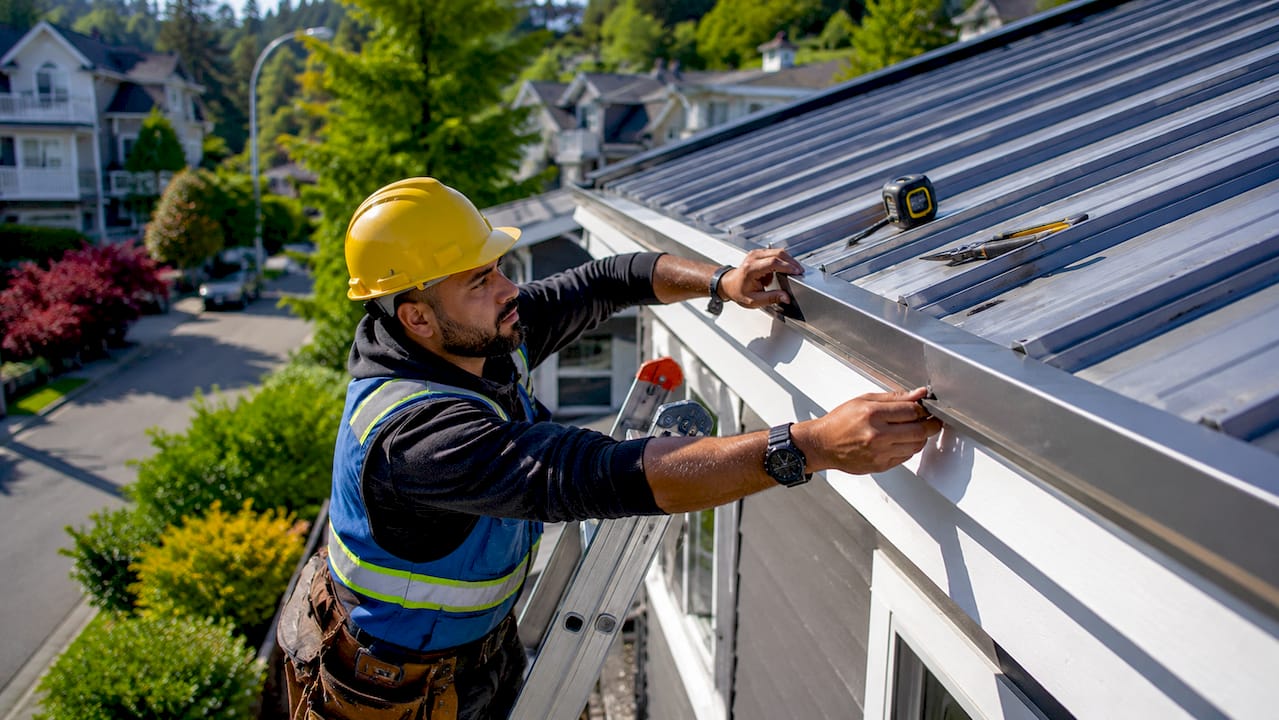
Type C (L-style) is a simple two-leg profile shaped like the letter L. Roofers use it primarily on rake edges, which are the sloped sides of a gable roof. Its compact profile sits tight to the roof deck and sheds water cleanly along the slope. It works well where water volume is lower and the primary goal is keeping moisture off the fascia.
Type D (T-style or D-metal) has an extended lower flange with a hemmed drip edge. That hem creates a small lip that breaks the surface tension of water, throwing it clear of the fascia rather than letting it run back underneath. Type D is the preferred choice for horizontal eaves, where water volume is highest and the risk of back-flow is greatest. On Burnaby multi-family buildings with long eave runs, Type D is the standard.
| Feature | Type C (L-Style) | Type D (T-Style) |
|---|---|---|
| Profile shape | Two-leg L profile | Extended flange with hemmed drip lip |
| Primary use | Rake edges (gable slopes) | Horizontal eaves |
| Water volume handled | Low to moderate | Moderate to high |
| Back-flow protection | Basic | Strong, due to hemmed edge |
| Best for | Residential gable rakes | Eaves on all roof types |
Matching the right profile to the right edge is not a cosmetic choice. It is a water management decision. Using Type C on a high-volume eave in Burnaby’s rainy season is asking for fascia rot within a few years.
Pro Tip: Match your flashing metal type to your roofing panels. Mixing galvanized steel flashing with aluminium panels, for example, creates galvanic corrosion over time, especially in Burnaby’s coastal air. Galvalume or pre-painted steel flashing paired with steel panels is the safest combination.
How is metal roof edge flashing properly installed in burnaby?
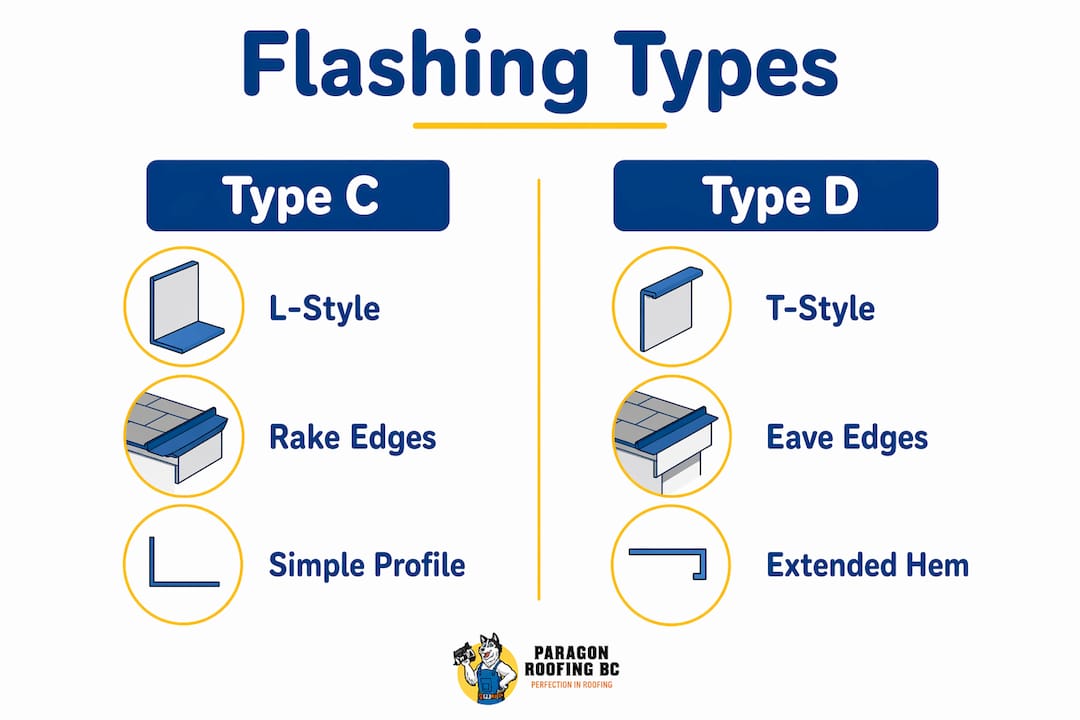
Correct installation is where most flashing failures begin. A piece of metal sitting in roughly the right place is not the same as a properly installed drip edge. Here is how it should be done on a Burnaby roof.
-
Position the flashing correctly. Drip edge must extend 1/4 to 3/4 inch beyond the roof edge. Too little and water wicks back under the metal. Too much and wind can catch the flange and lift it over time.
-
Nail into the upper flange only. Nails placed about 2 inches up from the edge keep fasteners in the dry zone above the water path. Never drive screws or staples through the lower flange or the drip lip. Every penetration below the water line is a potential leak point.
-
Use galvanized roofing nails. Roofing nails rather than staples or screws minimise metal cracking and moisture entry. Staples can work loose under thermal expansion. Screws create stress points in the metal that eventually crack in freeze-thaw cycles.
-
Overlap sections correctly. Joints between flashing sections must overlap 1–2 inches minimum, and always in the direction of water flow. The upper piece laps over the lower piece, exactly like shingles. A reverse lap directing water behind the moisture barrier is one of the most common causes of hidden roof leaks.
-
Sequence with underlayment properly. On eaves, the drip edge goes on first, then the underlayment laps over it. On rakes, the underlayment goes down first, then the drip edge laps over the underlayment. This sequencing matters because it determines which layer sheds water onto which.
-
Install roofing panels last. Metal roofing panels should lap over the drip edge flange at the eave. The panel edge should never tuck behind the flashing.
Pro Tip: Never use surface caulk as a substitute for proper flashing installation. Caulk is insufficient long-term and can trap moisture behind it, accelerating hidden wood rot in the fascia and decking. If you see caulk smeared along a drip edge joint, that is a sign the installation was not done correctly the first time.
What maintenance should burnaby homeowners follow for edge flashing?
Metal roofs shed Burnaby’s heavy rain well, but they are not maintenance-free. Key maintenance includes clearing gutters and inspecting flashing after storms, and that schedule matters more here than in drier climates.
The recommended inspection frequency is twice per year: once in spring after the wet season and once in fall before it starts. Add an inspection after any major windstorm or heavy snowfall. Burnaby’s combination of coastal moisture and seasonal storms accelerates wear on fasteners and sealants faster than the BC interior.
Early warning signs of flashing failure to watch for:
- Rust streaks running down the fascia below the roof edge
- Paint peeling or bubbling on fascia boards
- Water stains on the soffit or inside the attic near the eave line
- Visible gaps or lifted sections along the drip edge
- Moss or lichen growing along the roof perimeter (traps moisture against the metal)
- Loose or missing nails along the upper flange
Failure to remove moss and debris traps moisture and accelerates metal flashing deterioration. Moss holds water like a sponge and keeps the flashing wet long after rain stops, which speeds up corrosion and works fasteners loose over time.
Pro Tip: When you clean gutters in fall, run your hand along the back of the gutter where it meets the fascia. If the wood feels soft or spongy, the drip edge above it has likely been failing for a while. Catching this early saves you from a full fascia and flashing repair rather than just a flashing replacement.
For property managers overseeing multi-family buildings in Burnaby, a documented inspection schedule protects you from strata liability and keeps small flashing issues from becoming expensive structural repairs. A roof maintenance checklist built around biannual inspections is the most practical way to stay ahead of edge flashing wear.
How does edge flashing performance affect roof durability in burnaby?
The drip edge is the first line of defence against water entering the roof assembly. Most metal roof leaks in high-moisture climates stem from compromised flashing at roof perimeters rather than panel failure. That is a significant finding. It means the panels themselves are rarely the problem. The weak point is almost always the transition between the panel and the edge.
When flashing fails, water does not announce itself immediately. It wicks into the wood decking, travels along rafters, and shows up as a stain on an interior ceiling weeks or months after the initial breach. By that point, the decking may already be soft and the fascia rotted through. Restoration of failing edge flashing requires removing layered patch materials down to solid membrane or metal, then re-flashing and sealing properly for storm resilience. That process costs significantly more than a proactive flashing replacement.
| Failure Type | Cause | Typical Result |
|---|---|---|
| Reverse lap at joint | Sections overlapped against water flow | Hidden water intrusion behind moisture barrier |
| Fastener rust | Galvanised coating worn, moisture entry | Loose flashing, water tracking into deck |
| Sealant failure at joints | UV degradation or thermal movement | Open gap at overlap, direct water entry |
| Insufficient extension | Flange too short beyond roof edge | Water wicking back onto fascia and decking |
| Metal mismatch | Dissimilar metals in contact | Galvanic corrosion, premature flashing failure |
The same principle applies to rooftop penetrations. HVAC curb flashing failures on Burnaby commercial buildings are frequently misattributed to equipment when the actual source is the flashing or membrane transition around the curb. Whether you are dealing with a residential eave or a commercial rooftop unit, the flashing detail is always the critical point.
Good flashing is not expensive relative to what it protects. A properly installed and maintained drip edge on a Burnaby home extends the life of the decking, fascia, and underlayment by keeping water where it belongs: in the gutter and off the structure.
Key takeaways
Proper metal roof edge flashing installation and biannual maintenance are the most cost-effective ways to protect a Burnaby roof from water damage caused by coastal rainfall and coastal moisture.
| Point | Details |
|---|---|
| Type C vs. Type D profiles | Use Type C on rake edges and Type D on eaves for correct water management. |
| Correct installation sequence | Nail upper flange only, overlap in water flow direction, and sequence underlayment properly. |
| Biannual inspection schedule | Inspect every spring and fall, plus after major storms, to catch early failure signs. |
| Flashing is the primary leak source | Most metal roof leaks originate at perimeter flashing, not the panels themselves. |
| Avoid caulk as a fix | Surface caulk traps moisture and worsens rot; only proper re-flashing resolves the problem. |
What i’ve learned about edge flashing after years on burnaby roofs
Hey, it’s Harman here. After inspecting and installing roofs across Burnaby for years, I can tell you the most common mistake I see is not the wrong profile or even the wrong metal. It is the reverse lap. Homeowners do not notice it because it looks fine from the ground. The sections overlap, the metal looks straight, and everything appears correct. But water finds that joint every single time, especially during the wind-driven rain events we get off Burrard Inlet in November and December.
The second thing I see constantly is caulk. Someone noticed a drip, grabbed a tube of sealant, and called it fixed. That works for about one season. Then the caulk cracks, water gets behind it, and now you have a sealed pocket of moisture sitting against your fascia board. I have pulled fascia off Burnaby homes that looked perfectly fine from the outside and found wood that crumbled in my hands because a caulk repair had been trapping water for three or four years.
My honest advice: if your home is more than 10 years old and you have never had the drip edge inspected, book a roof inspection in Burnaby before this fall’s rain season. The cost of an inspection is nothing compared to replacing decking and fascia. And if you are managing a multi-family building, treat flashing inspection as a non-negotiable part of your annual maintenance budget, not an optional add-on.
— Harman
How Paragonroofingbc helps burnaby homeowners protect their roof edges
If you are a Burnaby homeowner or property manager who wants to know your drip edge is installed correctly and holding up against our coastal weather, Paragonroofingbc is the local team to call. We specialise in metal roofing and flashing work across Burnaby, from residential drip edge installation to multi-family parapet flashing and commercial HVAC curb repairs.

Our crew inspects existing flashing for reverse laps, fastener corrosion, and sealant failure, and we re-flash to current best practices when repairs are needed. We do not patch over problems with caulk. We fix them properly. Whether you need a new installation or a repair on an ageing roof, our residential roofing services cover everything from the first inspection to the finished edge. Reach out to Paragonroofingbc for a no-pressure consultation and find out exactly where your roof edges stand before the next rainy season hits.
FAQ
What is metal roof edge flashing?
Metal roof edge flashing, or drip edge, is a formed metal strip installed along roof perimeters that directs water away from fascia boards and into gutters. It protects the roof decking and structural components from water wicking and rot.
What is the difference between type c and type d drip edge?
Type C is an L-shaped profile used on rake edges, while Type D has an extended hemmed flange designed for horizontal eaves where water volume is higher. Choosing the correct profile for each edge location is critical for proper water management.
How far should drip edge extend beyond the roof edge?
Drip edge should extend 1/4 to 3/4 inch beyond the roof edge to direct water cleanly into the gutter without allowing back-flow onto the fascia or decking.
How often should i inspect my roof edge flashing in burnaby?
Inspect your flashing twice per year, in spring and fall, plus after any major storm. Burnaby’s coastal moisture and heavy rainfall accelerate fastener corrosion and sealant wear faster than drier climates.
Can i fix a leaking drip edge with caulk?
Caulk is not a lasting repair for flashing leaks. It degrades with UV exposure and thermal movement, and can trap moisture behind it, worsening hidden wood rot. Proper re-flashing is the only reliable fix.