North vancouver asphalt shingle lifting: main causes
TL;DR:
- Moisture, moss growth, wind, and installation errors cause asphalt shingle lifting in North Vancouver’s coastal climate. Regular inspections and proper maintenance can prevent extensive damage, which often occurs faster than warranties suggest. Professional assessment and timely repairs are essential to prolong your roof’s lifespan and protect your home.
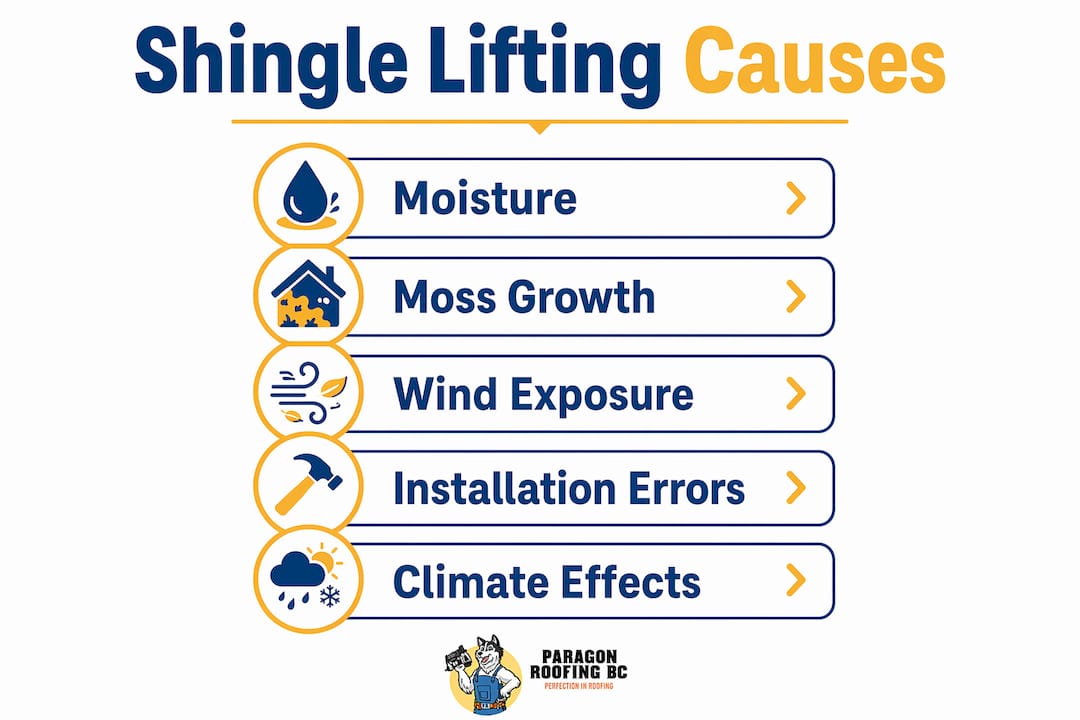
Asphalt shingle lifting is defined as the loosening, curling, or physical separation of shingles from the roof deck, and in North Vancouver, it happens faster and more often than most homeowners expect. The north vancouver asphalt shingle lifting causes come down to four main forces: persistent coastal moisture, moss growth, wind exposure, and installation errors. In the roofing trade, this condition is also called shingle delamination or shingle blow-off, depending on how far the process has gone. Understanding what drives it in this specific climate is the first step toward protecting your home before a lifted shingle turns into a full-on interior leak.
What causes asphalt shingle lifting in north vancouver?
North Vancouver’s coastal climate is the single biggest driver of shingle lifting on residential roofs. The combination of high annual rainfall, dense tree canopy, and salt-laden air from Burrard Inlet creates conditions that wear down asphalt shingles faster than the rated lifespan suggests. Coastal moisture accelerates wear on asphalt shingles in ways that dry-climate testing simply does not capture. That means a shingle rated for 30 years may start lifting, curling, or losing granules well before the 15-year mark on a North Vancouver home.
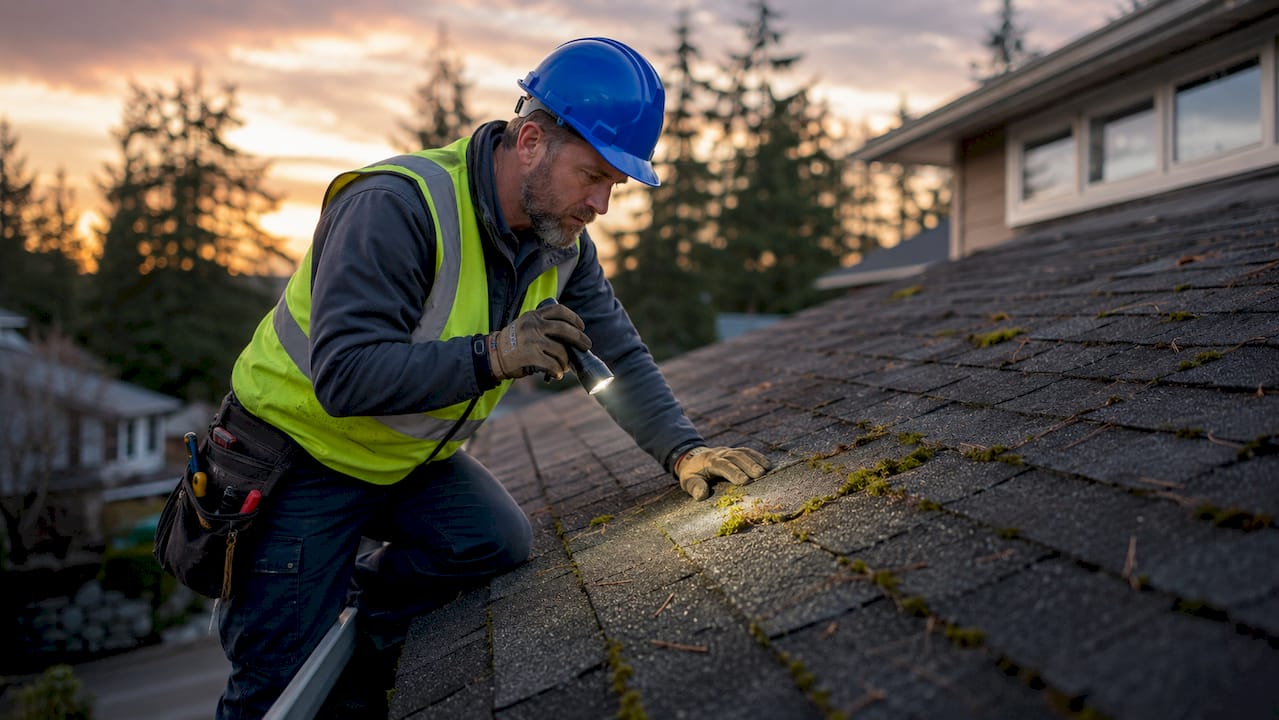
Moss is the other major culprit, and it is more aggressive than most people realise. Moss roots physically lift shingles, creating gaps that allow water to penetrate the roof deck. Once water gets under a shingle, the adhesive seal that holds it down softens and fails. The shingle then curls upward at the edges, which is the classic sign of lifting that you can often spot from the street.
How north vancouver’s coastal climate drives shingle lifting
The wet-dry cycling that North Vancouver roofs experience is relentless. Rain soaks the shingles, the sun dries them out, and then rain returns. Each cycle causes the asphalt to expand and contract slightly. Over hundreds of cycles per year, this physical stress breaks down the adhesive strip along the shingle’s lower edge.
Shaded roofs under tree canopy dry much more slowly than open roofs. A roof that stays damp for 48 hours after a rainstorm instead of drying out in 6 hours is exposed to roughly eight times more moisture stress per rain event. That extended dampness feeds moss and lichen colonies, which then accelerate the lifting process further.
Here is how moisture-related shingle lifting typically progresses on a North Vancouver roof:
- Granule loss: Persistent moisture softens the asphalt matrix, causing protective granules to wash off. Granules are what protect the asphalt from UV degradation and physical impact.
- Adhesive seal failure: The factory-applied adhesive strip on each shingle softens when wet repeatedly. Once it loses grip, the shingle tab lifts freely in wind.
- Moss colonisation: Moss traps moisture and lifts shingles over time, confirmed by the Asphalt Roofing Manufacturers Association. A thin layer of moss can hold several times its weight in water against the shingle surface.
- Deck saturation: Once water gets under lifted shingles, it reaches the underlayment and eventually the roof deck, causing rot and structural damage.
Pro Tip: If your roof sits under a large cedar or fir tree, check it for moss and lifted shingles every autumn before the heavy rains arrive. Shaded north-facing slopes are the highest-risk areas on any North Vancouver home.
Does wind make asphalt shingle lifting worse?
Wind absolutely makes shingle lifting worse, and the sequence of events matters. A shingle that has already lost its adhesive seal due to moisture is far more vulnerable to wind than a properly sealed one. Wind gusts can lift or rip off individual shingles, exposing the roof deck and underlayment to direct rain. In North Vancouver, the combination of southeast winter storms off Burrard Inlet and the funnelling effect of the North Shore mountains creates localised wind loads that standard shingle testing does not account for.
Freeze-thaw cycles add another layer of damage. Here is the sequence that plays out on many North Vancouver roofs each winter:
- Rain soaks into the gap under a partially lifted shingle.
- Overnight temperatures drop below zero, and the trapped water freezes and expands.
- The expanding ice pushes the shingle further upward, breaking the adhesive bond completely.
- Repeated freeze-thaw cycles crack the asphalt and lift granules, accelerating deterioration.
- The now-loose shingle catches the next windstorm and either lifts further or tears off entirely.
This sequence is why a roof that looked fine in October can show significant shingle damage by february. The damage does not happen all at once. It builds through the winter in stages that are easy to miss until the problem is severe.
Improper shingle spacing also plays a role here. Shingles installed in cold weather without proper spacing can develop raised areas and lifting later as the material expands and contracts with temperature changes. A raised area on your roof is not just cosmetic. It is a wind catch point that will eventually fail.
Installation mistakes that lead to shingle lifting
Poor installation is the cause that homeowners least expect, because a new roof should not have problems. The reality is that incorrect nailing and insufficient adhesive application are more common than the industry admits. Shingles not properly sealed can be lifted by wind far more easily, and the failure often does not show up until the first major windstorm or wet season after installation.
The table below compares the most common installation errors and their effects on shingle performance in North Vancouver’s climate:
| Installation Error | What It Causes | How Quickly It Shows Up |
|---|---|---|
| Nails placed too high on the shingle | Shingle tab lifts freely; no mechanical hold | 1–3 years |
| Insufficient adhesive strip activation | Shingles do not bond to each other; wind lifts tabs | First major windstorm |
| Wrong shingle product for shaded roofs | Faster moss growth; granule loss accelerates | 3–5 years |
| Cold-weather installation without spacing | Raised areas and buckling as material expands | 1–2 years |
| Misaligned courses | Water channels incorrectly; edges lift at seams | 2–4 years |
Manufacturer warranties are another area where homeowners get caught off guard. Actual practical lifespan in wet climates is often 16–22 years, roughly half the rated 30-year figure. That gap exists because warranty testing happens in controlled conditions, not under North Vancouver’s continuous moisture cycles. A warranty claim for shingle lifting due to climate-related wear is rarely successful.
Pro Tip: When hiring a roofer, ask specifically whether they have installed shingles on shaded North Shore properties. Experience with North Vancouver’s tree canopy and moisture conditions is worth more than a low quote.
When evaluating shingle products, look for options rated for high-humidity or coastal environments. Some manufacturers offer shingles with enhanced granule adhesion and algae-resistant coatings that hold up better under North Vancouver’s conditions than standard three-tab or architectural shingles.
How to spot and prevent shingle lifting on your roof
Catching shingle lifting early saves you significant money. A single lifted shingle costs far less to fix than a rotted roof deck. Here is how to stay ahead of the problem:
- Ground-level inspection: Use binoculars from your driveway. Look for shingle tabs that appear raised, curled at the edges, or out of alignment with the surrounding course. Lifted shingles often cast a visible shadow line.
- After windstorms: Walk the perimeter of your home and check your gutters and yard for shingle granules or torn shingle tabs. Granule accumulation in gutters is an early warning sign.
- Attic check: Go into your attic after heavy rain and look for daylight coming through the roof deck or any signs of moisture on the rafters or insulation.
- Moss inspection: Green or black streaking on your shingles is moss or algae. Left untreated, it will lift shingles within a few seasons.
For moss removal, the method matters as much as the timing. Pressure washing strips protective granules and causes more harm than good. The correct approach is to apply a zinc-based or copper-based moss treatment, let it kill the moss over several weeks, and then gently brush or rinse the dead material away. Zinc strips installed along the ridge also provide ongoing protection by releasing moss-inhibiting ions every time it rains.
Pro Tip: Never walk on your roof to inspect it unless you have proper fall protection and roofing experience. Most of the damage we see on North Vancouver roofs was made worse by homeowners walking on already-compromised shingles. A pair of binoculars and a ladder to check the eaves is enough for a basic inspection.
For temporary repairs, a lifted shingle tab can be re-sealed with roofing cement applied under the tab and pressed flat. This buys time but is not a permanent fix. If multiple shingles are lifting across different areas of the roof, that pattern points to a systemic problem, whether moisture damage, installation failure, or end-of-life shingles, that requires a professional assessment rather than spot repairs.
The impact of rain cycles on roof lifespan in the Vancouver area is well-documented, and North Vancouver sits at the wetter end of that spectrum. Regular maintenance, meaning at least one professional inspection per year, is the most cost-effective way to extend the life of an asphalt shingle roof in this climate.
Key takeaways
Asphalt shingle lifting in North Vancouver is driven primarily by coastal moisture and moss, compounded by wind, freeze-thaw cycles, and installation errors that standard warranties do not account for.
| Point | Details |
|---|---|
| Moisture is the root cause | Wet-dry cycling breaks down adhesive seals and feeds moss growth that physically lifts shingles. |
| Moss causes structural damage | Moss roots lift shingles and trap water against the deck, leading to rot and leaks. |
| Wind and freeze-thaw work together | Loose shingles catch wind and allow water to freeze underneath, accelerating failure each winter. |
| Installation errors are common | Incorrect nailing, poor adhesive activation, and wrong product selection all cause premature lifting. |
| Warranties rarely reflect local reality | Shingle lifespan in North Vancouver is typically 16–22 years, not the rated 30 years on the package. |
What i’ve learned inspecting north vancouver roofs
Hey, it’s Harman here. After years of inspecting roofs across the North Shore, the pattern I see most often is homeowners who waited too long because they trusted the warranty. A 30-year shingle warranty sounds reassuring, but it does not account for a roof that sits under a Douglas fir canopy and gets 1,700 millimetres of rain a year. That roof is playing a different game entirely.
The other thing I see constantly is the tree canopy problem. Homeowners trim their trees for aesthetics but do not think about what overhanging branches do to a roof. They deposit debris, hold moisture, and block sunlight. A roof that cannot dry out between rainstorms is a roof that will develop moss and lifting shingles within five years, regardless of shingle quality.
My honest advice: do not wait until you see a water stain on your ceiling. By that point, the roof deck is already compromised. A lifted shingle spotted in october is a $300 repair. The same shingle ignored through a wet winter can become a $6,000 deck replacement by spring. Early intervention is always the better financial decision, and it is almost always the simpler one too.
— Harman
Get a professional eye on your north vancouver roof
If you have spotted lifted shingles, moss growth, or granule loss in your gutters, the right move is a professional inspection before the next rainy season hits hard.
Paragonroofingbc works with North Vancouver homeowners on exactly these kinds of problems. From moss treatment and shingle re-sealing to full roof replacement for roofs that have reached the end of their practical life, the team brings real North Shore experience to every job. Paragonroofingbc offers thorough assessments that identify lifting, moisture damage, and installation issues before they become expensive repairs. Reach out through the North Vancouver roofing services page to book your inspection and get a clear picture of where your roof stands.
FAQ
What causes asphalt shingles to lift in north vancouver?
Asphalt shingle lifting in North Vancouver is caused primarily by moisture-related adhesive failure, moss growth, wind exposure, and freeze-thaw cycles. Installation errors such as incorrect nailing and poor adhesive activation also contribute significantly.
How long do asphalt shingles actually last in north vancouver?
In North Vancouver’s wet coastal climate, asphalt shingles typically last 16–22 years in practice, even when rated for 30 years. Continuous moisture cycling and moss growth shorten the effective lifespan considerably.
Can i fix lifted shingles myself?
A single lifted tab can be temporarily re-sealed with roofing cement, but multiple lifted shingles across the roof indicate a systemic issue that requires professional assessment. Avoid walking on the roof without proper fall protection.
Does moss really lift shingles, or is it just cosmetic?
Moss causes real structural damage. Its roots physically lift shingle tabs and trap moisture against the roof deck, leading to adhesive failure, water ingress, and eventual deck rot. It is not a cosmetic issue.
How do i remove moss without damaging my shingles?
Apply a zinc-based or copper-based moss treatment and allow it to kill the moss over several weeks before gently removing the dead material. Pressure washing strips protective granules and accelerates shingle deterioration, so avoid it entirely.