Sustainable roofing explained: Smarter choices for BC homes
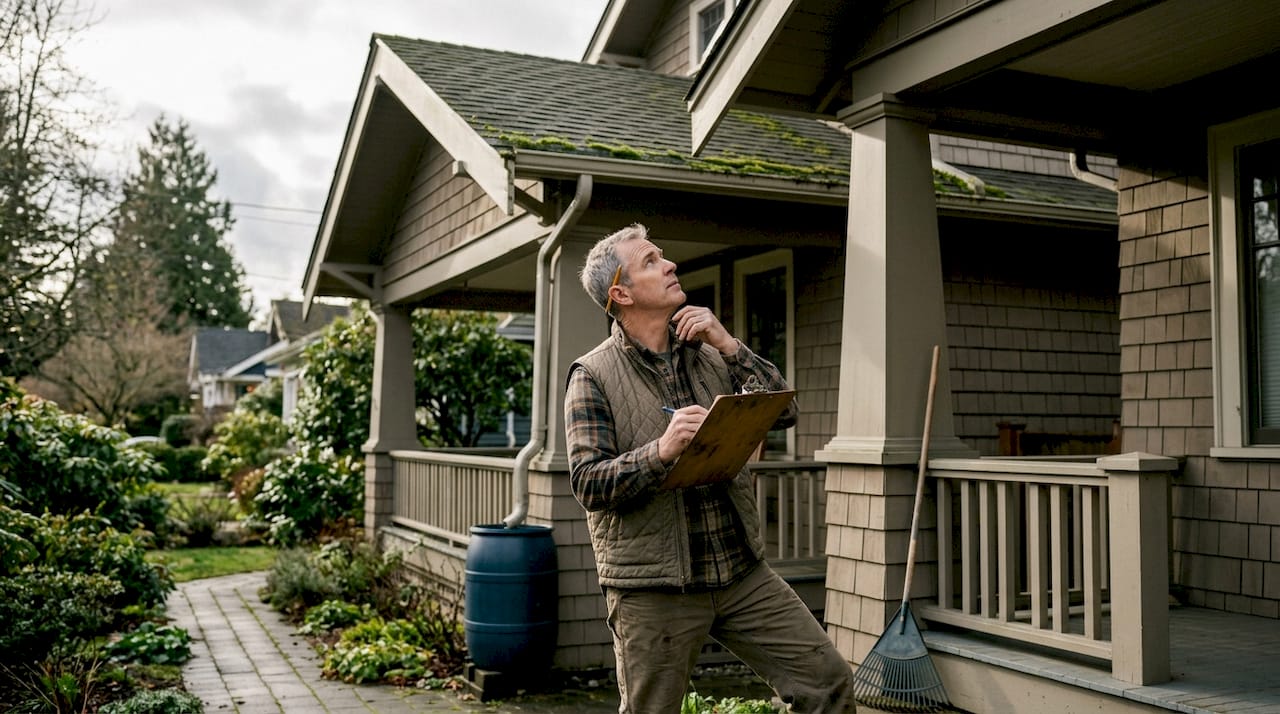
Your roof does more than keep rain out. In Vancouver, roof upgrades can save 4-8% on energy bills annually while cutting carbon emissions and boosting comfort. Most homeowners assume all roofs perform similarly, but the truth is far more interesting. BC’s wet winters and warm summers demand roofing solutions that work with our climate, not against it. This guide walks you through sustainable roofing options that actually deliver on energy savings, durability, and environmental impact for your property.
Table of Contents
- What makes a roof ‘sustainable’ in British Columbia?
- Comparing sustainable roofing options in BC
- Understanding energy savings and carbon impact
- Crucial details: insulation, thermal bridging, and climate risks
- Choosing the right sustainable roofing for your property
- How Paragon Roofing BC can help with sustainable solutions
- Frequently asked questions
Key Takeaways
| Point | Details |
|---|---|
| Local climate matters | Sustainable roofing in BC must be tailored to wet winters and mild summers for best results. |
| Compare all options | Each sustainable roofing material offers unique benefits and trade-offs for lifespan, maintenance, and energy savings. |
| Insulation is crucial | Thermal bridging and proper insulation can make or break your roof’s year-round performance. |
| Big savings add up | Upgrading to sustainable roofs can cut energy bills by 4-8% each year and lower your building’s carbon footprint. |
| Choose local expertise | Work with BC roofing professionals who understand both sustainable best practices and provincial climate challenges. |
What makes a roof ‘sustainable’ in British Columbia?
Sustainable roofing isn’t just about being eco-friendly. It’s about building a roof that saves energy, lasts longer, manages our heavy rainfall, and reduces your carbon footprint all at once. In BC, that means choosing materials and designs adapted to our unique climate.
A truly sustainable roof combines several performance features. It provides excellent insulation to keep heat in during winter and out during summer. It uses materials that either last decades or can be recycled at end of life. It reflects solar heat when needed and manages stormwater effectively during our rainy months. Sustainable roofing in BC includes green roofs, cool roofs, metal roofing, and recycled shingles, each with distinct strengths.
Here’s what sets sustainable roofs apart:
- Energy performance: Superior insulation and reflective capacity reduce heating and cooling costs
- Climate adaptation: Designed specifically for BC’s wet winters and moderate summers
- Longevity: Materials that last 40-70 years versus standard 15-25 year lifespans
- Environmental impact: Lower embodied carbon, recyclable materials, and reduced urban heat island effects
- Stormwater management: Green roofs and proper drainage systems handle heavy rainfall
Think of your roof as a climate control system, not just a protective shell. The right sustainable choice transforms how your building performs year-round. Understanding roofing materials and efficiency helps you see why material selection matters so much for long-term value.
Comparing sustainable roofing options in BC
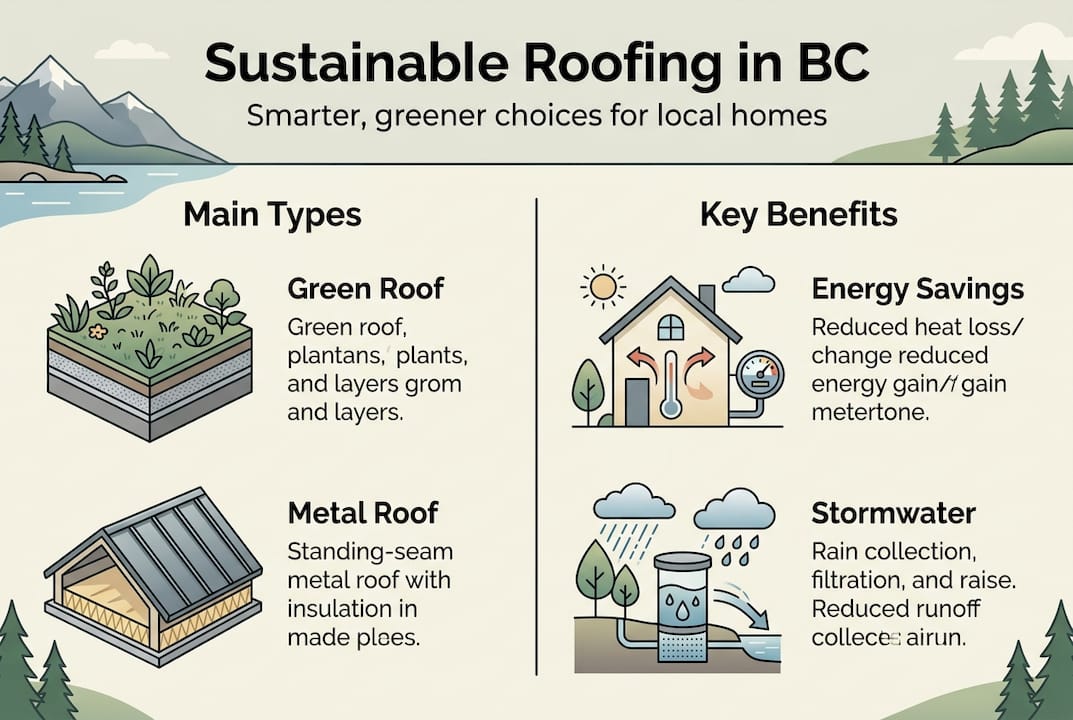
Let’s break down the major sustainable roofing types available in BC and see how they stack up for our climate conditions.
| Roofing type | Lifespan | Climate benefits | Stormwater management | Best for | Key drawback |
|---|---|---|---|---|---|
| Green roof | 40-50 years | Excellent insulation, evaporative cooling, biodiversity | Absorbs 50-90% of rainfall | Flat roofs, urban properties, environmental priority | Requires structural support, regular maintenance |
| Cool/reflective roof | 20-30 years | Reduces heat absorption, boosts solar panel output 3.4% | Standard drainage | Low-slope roofs, commercial buildings | Less winter benefit in cold climates |
| Metal roof | 40-70 years | Highly durable, fully recyclable, energy-efficient | Excellent with proper design | Steep slopes, long-term investment, coastal areas | Higher upfront cost |
| Recycled shingles | 30-40 years | Diverts waste, mimics traditional look | Standard drainage | Residential, budget-conscious, traditional aesthetic | Limited availability in some regions |
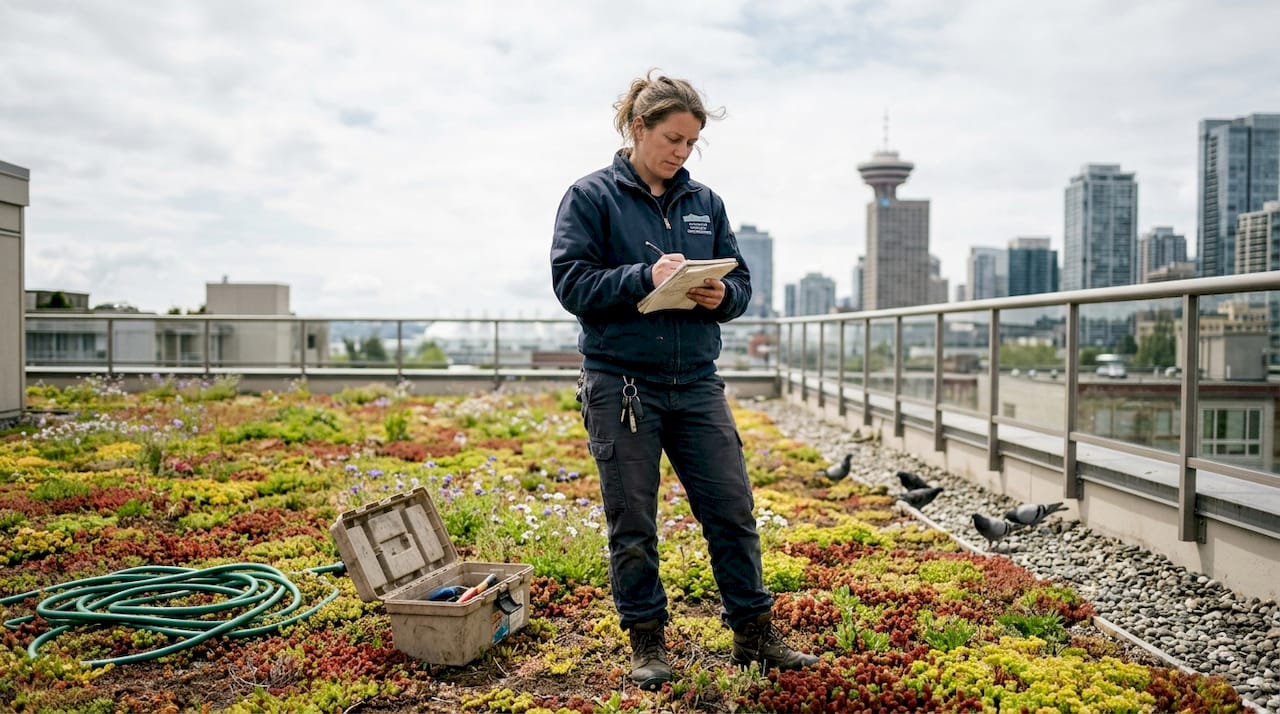
Green roofs excel in insulation and biodiversity but require more maintenance and structural capacity. They’re perfect for flat-roofed buildings where you want maximum environmental benefit. The vegetation layer provides natural insulation and absorbs rainfall like a sponge.
Cool roofs use reflective coatings to bounce solar heat away from your building. They’re cheaper than green roofs and work brilliantly in summer, but offer less winter insulation benefit. They’re ideal for commercial buildings with significant cooling loads.
Metal roofs last 40-70 years and are completely recyclable at end of life. They handle BC’s rain beautifully and work well with solar panels. The upfront cost is higher, but the longevity makes them cost-effective over time. Check out our comparison of metal vs asphalt for rain to see performance differences.
Recycled asphalt shingles offer more durability than standard shingles while diverting waste from landfills. They look traditional but perform better. If you’re considering natural materials, our guide on cedar vs asphalt provides useful context.
Pro Tip: When evaluating options, ask about environmental certifications and long-term maintenance requirements. A roof that saves money year one but needs constant repairs isn’t truly sustainable.
Understanding energy savings and carbon impact
The numbers tell a compelling story about sustainable roofing performance in BC.
Roof upgrades in Vancouver deliver 4-8% whole-building energy savings annually. That translates to $21-36 per square metre in lifetime cost savings. For a typical 150 square metre home, you’re looking at $3,150 to $5,400 in savings over the roof’s life.
Here’s how different sustainable options perform:
| Roofing type | Annual energy savings | Carbon reduction | Additional benefits |
|---|---|---|---|
| Green roof | 15-25% heating/cooling | 20-110 kg CO2e/m² over lifetime | Urban heat island mitigation, biodiversity |
| Cool roof | 10-20% cooling costs | Moderate reduction | 3.4% boost to solar panel output |
| Metal roof | 10-15% overall | High (recyclable, long lifespan) | Durability, low maintenance |
| High-performance insulation | 15-30% heating | Significant over decades | Works with any roof type |
Green roofs deliver 15-25% energy savings through superior insulation and evaporative cooling. The vegetation layer acts as a natural climate buffer. Cool roofs reduce cooling loads by 10-20% and boost solar panel efficiency by 3.4% by keeping panels cooler.
The real magic happens when you combine sustainable roofing with other upgrades. Pairing a cool roof with solar panels and improved insulation creates a whole-system approach that maximises both energy savings and carbon reduction. Learn more about energy savings through roofing to understand the full potential.
Many BC municipalities and utility providers offer incentives for energy-efficient roofing upgrades. These programs can offset initial costs and improve your return on investment. Check with your local government or utility company for current programs.
Crucial details: insulation, thermal bridging, and climate risks
Here’s where sustainable roofing gets technical, but understanding these details protects your investment.
Thermal bridging is the silent killer of roof performance. It happens when heat flows through structural elements like roof joists, bypassing your insulation. Unmitigated thermal bridging increases heat flow by 30-70%, essentially wasting your insulation investment.
“Thermal bridging mitigation in roofs requires continuous insulation, proper parapet wrapping, and careful detailing around roof penetrations. Without these measures, your roof’s effective insulation value drops dramatically.”
Here’s how to address thermal bridging in your roof:
- Install continuous insulation above the roof deck to create an unbroken thermal barrier
- Wrap parapets and curbs with insulation to prevent heat loss at edges and penetrations
- Use thermal breaks at structural connections between roof and walls
- Seal all penetrations carefully, including vents, pipes, and equipment supports
- Verify installation with thermal imaging to catch problems before they become expensive
BC’s wet climate creates unique moisture risks, especially for low-slope and vented roofs. Low-slope vented roofs are prone to moisture accumulation during our long, damp winters. Proper vapour control and ventilation design are critical.
For flat roofs, understanding flat roof rainwater management prevents costly water damage. Similarly, proper roof ventilation in wet climate conditions protects your roof structure and insulation from moisture damage.
Pro Tip: Always ask your roofer specifically about thermal bridging mitigation and climate-adapted details. These conversations separate experienced professionals from those just following standard practices.
Choosing the right sustainable roofing for your property
You’ve got the knowledge. Now let’s turn it into action.
Start by asking yourself these key questions:
- What’s your building type? Flat roofs suit green or cool options, while steep slopes work better with metal or recycled shingles
- What’s your budget range? Initial cost versus lifetime value calculations change the equation significantly
- How much maintenance can you handle? Green roofs need regular care, while metal requires minimal attention
- What are your priorities? Maximum energy savings, environmental impact, or long-term durability?
- What do local codes require? Some municipalities have specific requirements for sustainable building
BC presents some unique scenarios worth considering. Cool roofs are less ideal for cold winters because they reflect heat you actually want during heating season. Green roofs provide better year-round insulation through evaporative cooling in summer and thermal mass in winter.
For heritage homes, you’ll need solutions that respect architectural character while improving performance. Strata buildings require board approval and often benefit from solutions that reduce common area maintenance costs. Commercial properties should focus on options that boost solar panel output and reduce cooling loads.
Your next steps:
- Schedule a professional assessment with a roofer experienced in BC’s climate and sustainable options
- Research local incentives through your municipality and utility provider
- Plan for the long term by considering how your roof integrates with future upgrades like solar panels
- Get multiple quotes that break down material, labour, and expected performance clearly
Before making any decisions, review our guide on roof prep for winter to understand seasonal considerations. Our repair vs replace guide helps you determine if upgrading makes sense now or if repairs can extend your current roof’s life.
Working with experienced, regionally knowledgeable installers makes all the difference. They understand BC’s building codes, climate challenges, and which sustainable solutions actually perform as promised in our conditions.
How Paragon Roofing BC can help with sustainable solutions
Sustainable roofing in BC isn’t just about picking the right materials. It’s about proper installation, climate-adapted details, and ongoing maintenance that keeps your roof performing efficiently for decades.
We’ve spent years working with BC’s unique climate challenges, from coastal rain to interior temperature swings. That experience shows in how we approach sustainable roofing projects. Whether you’re considering a green roof installation, metal roof upgrade, or high-performance insulation retrofit, we help you navigate the options and make choices that fit your property and goals.
Our team handles everything from initial assessment through installation and ongoing maintenance. We work with roof installation in Coquitlam and throughout the Lower Mainland, bringing sustainable best practices to every project. Our roof maintenance in Vancouver services keep sustainable roofs performing at peak efficiency year after year.
When problems arise, our roof repair services address issues quickly while maintaining your roof’s sustainable performance. We understand how thermal bridging, moisture management, and proper ventilation work together to create truly efficient roofing systems.
Ready to explore sustainable roofing for your property? Let’s talk about what makes sense for your specific situation, budget, and goals. We’ll help you understand your options and create a plan that delivers real energy savings and environmental benefits.
Frequently asked questions
What is the most sustainable roofing option for BC’s climate?
Green roofs and metal roofs score highest in sustainability, balancing insulation, lifespan, stormwater management, and emissions reduction. The best choice depends on your building type, budget, and priorities.
How much energy and money can I really save with a sustainable roof?
Upgrades can cut building energy use by 4-8% annually in Vancouver while saving $21-36 per square metre over the roof’s lifetime. Green roofs deliver the highest savings at 15-25% for heating and cooling.
What are the main maintenance concerns with sustainable roofs in BC?
Green roofs require regular checks for plants and drainage, while metal and cool roofs need less frequent but consistent maintenance. All sustainable roofs benefit from annual inspections to maintain peak performance.
How do I know if my current roof is suitable for upgrading to a sustainable system?
Speak to a roofing professional experienced with BC’s climate, as some older roof structures may need reinforcement or detail changes to support sustainable options like green roofs. A structural assessment determines load capacity and identifies necessary upgrades.
Are there any local incentives for sustainable roof upgrades in BC?
Many BC municipalities and utility providers offer incentives for energy-efficient roofing. Check with your city or local utility for current programs, as rebates and grants can significantly offset initial costs.