
Burnaby soffit rot and moisture damage: fix it right
Burnaby soffit rot and moisture damage: fix it right
TL;DR:
- Soffit rot results from moisture damage caused by poor attic ventilation and external water entry. Early detection through visible signs and proper repair techniques is essential to prevent extensive damage. Fixing ventilation imbalances and external moisture sources minimizes long-term costs and keeps soffits healthy.
Soffit rot is defined as the decay of the horizontal boards that close off the underside of your roof overhang, caused by persistent moisture exposure and inadequate attic ventilation. Burnaby soffit rot and moisture damage are among the most common roofline problems Paragonroofingbc sees on homes throughout the city, particularly in older neighbourhoods where wood soffits have been in place for decades. Burnaby’s wet winters and mild, damp springs create the perfect conditions for moisture to work its way into eaves and stay there. The good news is that soffit and fascia damage is almost always preventable and repairable when you catch it early and address the root cause rather than just the surface.
What are the signs of Burnaby soffit rot and moisture damage?
Catching soffit rot early saves you from a much bigger repair bill. The visible signs are usually obvious once you know what to look for, but many homeowners miss them until the damage is well advanced.
The most reliable warning signs include:
- Sagging or warped soffit panels. Wood that has absorbed moisture swells and loses its shape. Panels that bow downward or pull away from the fascia are already compromised.
- Peeling paint or dark staining. Moisture causes staining and paint failure on soffit surfaces. Dark patches often signal mould growth behind the panel.
- Soft or crumbling wood. Press a screwdriver firmly into the soffit board. Healthy wood resists the pressure. Rotted wood gives way easily or crumbles.
- Visible mould or mildew. White or black fuzzy growth on the underside of the overhang means moisture has been sitting there long enough to feed biological growth.
- Staining on the fascia near gutters. Water overflowing from clogged eavestroughs runs directly onto the fascia and soffit edge. Brown streaks on the fascia board are a reliable early indicator.
The areas most prone to early rot are the soffit sections directly above downspouts and at the corners of the roofline where two planes meet. These spots collect debris and hold water longer than flat runs.
Pro Tip: Probe the rafter tails behind the soffit panels, not just the panels themselves. Rafter tail rot is often hidden from view and requires sistering or replacement before new panels go on.
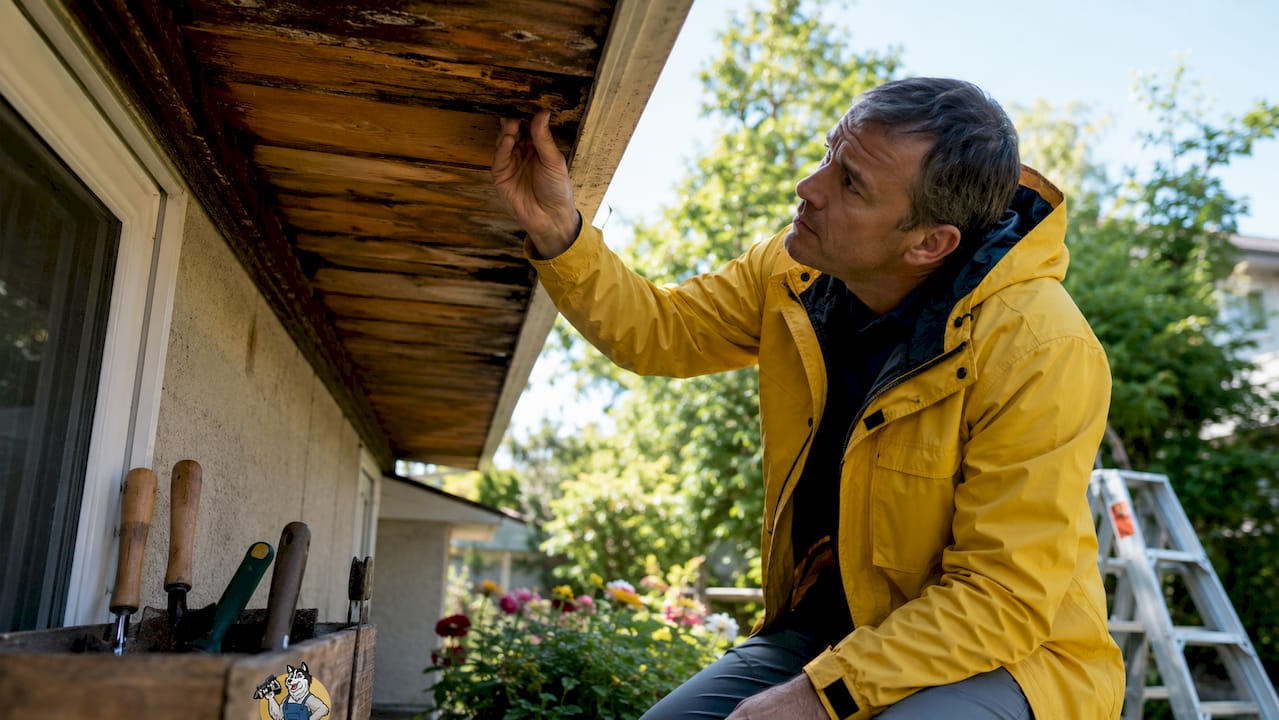
A professional roof inspection in Burnaby will catch hidden rot that a visual check from the ground cannot reveal. If you spot two or more of the signs above, get someone up there with a ladder and a screwdriver before the damage spreads to the framing.
Why does attic ventilation cause soffit rot in Burnaby?
Attic ventilation is the single biggest driver of soffit rot that most homeowners never think about. When airflow through the attic is unbalanced, warm humid air has nowhere to go. It condenses on the underside of the roof deck and in the eaves, and that moisture eventually destroys wood soffits from the inside out.
Proper attic ventilation requires a balanced 1:300 ratio of net free ventilation area to ceiling area, split equally between soffit intake vents at the eaves and exhaust vents at the ridge. That means half the ventilation area at the bottom and half at the top. This balance creates a natural convection current that pulls fresh air in through the soffits and pushes humid air out through the ridge.
The problem is that adding ridge vents without matching soffit intake creates a pressure imbalance. Unbalanced vents pull humid air through gaps in the attic ceiling instead of drawing fresh air from outside. That makes moisture problems worse, not better. The same logic applies in reverse: soffit vents alone without adequate ridge exhaust trap moisture in the upper attic.
| Ventilation setup | Effect on moisture |
|---|---|
| Balanced soffit intake + ridge exhaust | Continuous airflow removes humid air effectively |
| Ridge vents only, no soffit intake | Draws humid interior air upward through ceiling gaps |
| Soffit vents only, no ridge exhaust | Traps moisture in upper attic, no exit pathway |
| Powered attic fan, no balanced passive venting | Can depressurise attic and increase moisture infiltration |
Powered attic fans are generally discouraged in Canadian climates because they can depressurise the attic space and pull conditioned air from the living area, increasing both energy costs and moisture problems. Passive soffit-to-ridge ventilation is the right approach for Burnaby homes.
One more detail that gets overlooked: attic insulation pushed into the eaves blocks the airflow corridor at the soffit vents. Attic baffles are the fix. These rigid channels are installed between rafters to hold insulation back from the eave and keep a clear air passage from the soffit vent into the attic. Without baffles, even a perfectly sized ventilation system fails at the intake point.
Pro Tip: If your attic insulation was upgraded in the last ten years without installing baffles, your soffit vents are likely blocked. This is one of the most common causes of repeat soffit rot that Paragonroofingbc finds on Burnaby homes.
What moisture sources cause soffit rot, and how do you manage them?
Attic ventilation is the internal cause of soffit rot. External moisture sources are the other half of the problem. Burnaby gets significant rainfall from october through april, and that water has to go somewhere. When it cannot drain properly, it finds the soffits.
The main external moisture sources to manage are:
- Clogged eavestroughs. Overflowing gutter water directs moisture directly onto the fascia and soffit edge. Clean your eavestroughs at least twice a year: once in late spring after tree pollen and seed season, and again in late november after leaf fall.
- Downspout extensions. Eavestroughs that drain too close to the foundation push water back toward the house. Eavestroughs should extend 1–2 metres from the foundation to direct water away from the roofline and wall assembly.
- Roof flashing failures. Cracked or lifted flashing at valleys, chimneys, and skylights lets water track along the roof deck and into the eave. This kind of leak often shows up as soffit staining well away from the actual entry point.
- Tree debris accumulation. Leaves, needles, and seed pods pile up in the soffit channels and against the fascia. Wet debris holds moisture against wood surfaces for weeks at a time. Trim branches that overhang the roofline and clear debris after every major windstorm.
- Inadequate roof slope or flat sections. Low-slope areas near dormers or additions drain slowly and allow water to back up under shingles toward the eave. This is a structural issue that requires a roofing assessment, not just a soffit repair.
Seasonal maintenance is the most cost-effective form of moisture prevention. A two-hour eavestrough cleaning in november costs almost nothing compared to a full soffit and rafter tail replacement in the spring.
How do you repair soffit rot properly in Burnaby?
Replacing a rotted soffit panel is straightforward. Repairing the underlying problem is where most DIY jobs fall short. A proper soffit repair follows a specific sequence.
- Remove the damaged panels carefully. Soffit panels typically slot into a channel on the fascia and a channel on the wall. Slide them out without prying hard, as forcing them can crack adjacent panels that are still sound.
- Inspect and repair the framing. Check every rafter tail and nailing strip behind the removed panels. Structural repair to rafter tails is required before new panels go on if rot has reached the framing. Sister a new piece of dimensional lumber alongside the rotted rafter tail and fasten it securely. Do not skip this step.
- Address the ventilation and moisture source. Install attic baffles if they are missing. Clear blocked soffit vents. Fix any flashing or eavestrough issues before closing the soffit back up.
- Prime all six sides of new wood panels. All six sides of wood panels must be coated with exterior-grade primer before installation. This seals the end grain and face grain against moisture re-absorption. Skipping this step is the single most common reason wood soffits rot again within five years.
- Consider upgrading to vinyl. Vinyl soffit panels cost $3–$5 per linear foot, last 25–40 years, and never rot. For Burnaby’s humid climate, vinyl is the practical long-term choice over wood replacement. Vented vinyl panels also maintain airflow without any additional work.
- Reinstall and seal. Slot new panels into the channels, check for gaps at joints, and apply a paintable exterior caulk at any penetrations or seams where water could enter.
Pro Tip: When replacing wood soffits with vinyl, check that the new vented panel spacing matches your existing soffit vent area. You want to maintain the 1:300 ventilation ratio, not reduce it.
Paragonroofingbc recommends getting a professional soffit repair assessment any time rot has reached the rafter tails or when more than two consecutive bays are affected. Structural framing work requires the right tools and experience to do correctly.
Key takeaways
Burnaby soffit rot is almost always a symptom of a larger moisture or ventilation problem, and lasting repairs require fixing the source, not just the panel.
| Point | Details |
|---|---|
| Soffits signal bigger problems | Rot rarely occurs in isolation; check attic ventilation and gutters first. |
| Balance ventilation at 1:300 | Split intake and exhaust equally to prevent condensation buildup in the eaves. |
| Install attic baffles | Baffles keep insulation from blocking soffit vents and maintain airflow. |
| Prime all six sides of wood | Exterior-grade primer on every face prevents moisture re-absorption and repeat rot. |
| Upgrade to vinyl for longevity | Vinyl soffits last 25–40 years and resist rot in Burnaby’s wet climate. |
What I keep seeing on Burnaby rooflines
Hey, it’s Harman here. After inspecting hundreds of Burnaby homes, the pattern is always the same. A homeowner notices a soft spot on the soffit, replaces the panel, and calls it done. Two winters later, the new panel is rotting in the same spot.
The reason is almost always one of two things: blocked soffit vents from insulation pushed into the eaves, or eavestroughs that have not been cleaned in years. Neither of those gets fixed when you just swap out a panel. The new wood absorbs moisture from the same source and fails just as fast.
What I find frustrating is how often the ventilation side gets ignored. Homeowners spend money on new panels and paint, but nobody looks up into the attic to check whether the baffles are in place or whether the ridge vent is actually matched to the soffit intake area. Balanced airflow is not complicated, but it does require someone to actually measure and think about it.
My honest advice: if your soffits have rotted more than once in the same location, stop replacing panels and start asking why the moisture is there in the first place. Nine times out of ten, the answer is either a blocked vent or a gutter problem. Fix those, and the soffits take care of themselves. For more on how ventilation affects soffit performance, that is a good place to dig deeper.
— Harman
Paragonroofingbc helps Burnaby homeowners with soffit and roofing repairs
Soffit rot in Burnaby is a fixable problem when you approach it the right way. Paragonroofingbc works with Burnaby homeowners to diagnose the full picture: attic ventilation balance, eavestrough condition, flashing integrity, and structural framing, before any panels go back on.

Getting a professional assessment means you are not guessing at the moisture source or hoping the new panels hold. Paragonroofingbc’s team has the local experience to spot the issues that repeat DIY repairs miss. Whether you need a targeted soffit repair or a full roofline assessment, the residential roofing services page covers what Paragonroofingbc offers across Burnaby and Metro Vancouver. Reach out before the next rainy season starts.
FAQ
What causes soffit rot on Burnaby homes?
Soffit rot is caused by persistent moisture from clogged eavestroughs, roof leaks, or poor attic ventilation that traps humid air in the eaves. Burnaby’s wet climate accelerates decay in wood soffits that are not properly primed or ventilated.
How do I know if my attic ventilation is causing soffit damage?
Check for blocked soffit vents, missing attic baffles, or a ridge vent installed without matching soffit intake. Unbalanced ventilation draws humid air through the attic ceiling instead of exhausting it through the ridge.
Can I replace rotted soffits myself?
Panel replacement is a manageable DIY task, but structural repairs to rafter tails and nailing strips require experience. Always prime all six sides of new wood panels with exterior-grade primer before installation to prevent repeat rot.
Are vinyl soffits better than wood for Burnaby homes?
Vinyl soffits are the better long-term choice for Burnaby’s humid climate. They cost $3–$5 per linear foot, last 25–40 years, and never rot, making them a practical upgrade over wood replacement.
How often should I inspect my soffits in Burnaby?
Inspect soffits visually twice a year: once in spring and once in late autumn after leaf fall. Clean eavestroughs at the same time and probe any soft or stained areas with a screwdriver to catch rot before it reaches the framing.
Recommended
Our Roofing Blog


Have more questions about roofing?
Check out our FAQs or give us a call today to speak to an expert roofer in Vancouver Lower Mainland, BC. We're here to help our neighbours make educated decisions about their roof. For our team, we value helping clients save money while making their roofs last.