Why West Vancouver cedar roofs fail early: causes and fixes
Why West Vancouver cedar roofs fail early: causes and fixes
TL;DR:
- Cedar shake roofs in West Vancouver fail prematurely due to trapped moisture from constant rain, shade, and moss growth. Proper installation, ventilation, and regular maintenance are essential to extend their lifespan. Visible signs of early failure include missing or cracked shakes, dark patches, and water inside the attic.
Cedar shake roofs in West Vancouver fail prematurely because moisture gets trapped against the wood and never fully dries out. The coastal climate here is relentless. High annual rainfall, heavy tree canopy, and long stretches of overcast skies create conditions where cedar shake deterioration happens years ahead of schedule. This is not just a maintenance problem. It is a combination of climate, installation choices, and missed warning signs that compound over time. Understanding why West Vancouver cedar roofs fail early is the first step toward doing something about it before the damage reaches your attic.
Why do West Vancouver cedar roofs fail early?
Moisture retention is the single biggest cause of early cedar roof failure in West Vancouver. Cedar is a naturally durable wood, but it needs to dry out between rain events to stay healthy. In West Vancouver, that drying window is short. The North Shore receives some of the highest annual rainfall in Metro Vancouver, and the dense tree canopy over many properties keeps roofs shaded for most of the day.
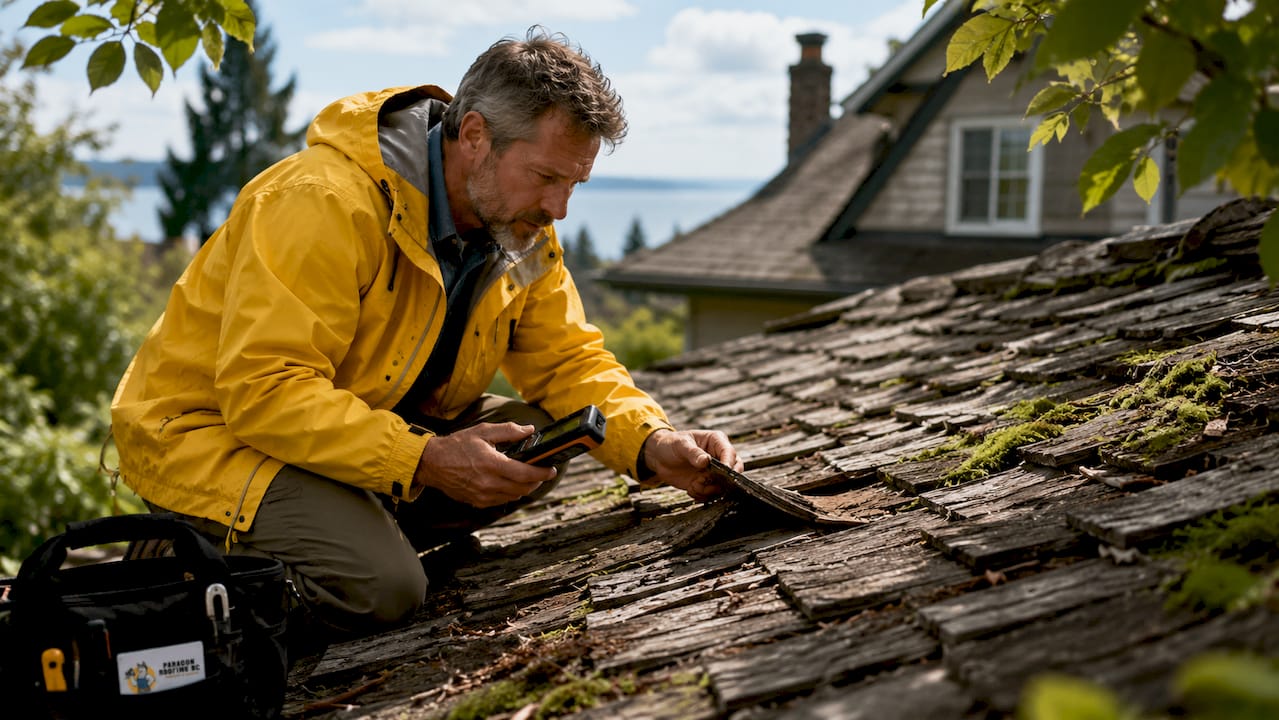
Shaded roof surfaces and valleys stay damp far longer than open, sun-exposed areas. That persistent dampness is exactly what moss, algae, and mildew need to take hold. Once they establish themselves, they trap even more moisture against the wood surface and the decay cycle accelerates.
West Vancouver’s geography adds another layer of difficulty. Properties on the slopes of the North Shore mountains face wind-driven rain that pushes water up under shakes from unexpected angles. Lower-lying areas near the waterfront deal with salt-laden air that speeds up fastener corrosion. Neither condition gives cedar much of a break.
- High annual rainfall keeps wood saturated for extended periods
- Shaded north-facing slopes and tree-covered lots block sunlight needed for drying
- Moss and algae colonies trap moisture against wood, accelerating rot from the inside out
- Wind-driven rain on hillside properties forces water under shake edges
- Salt air near the waterfront corrodes metal fasteners faster than inland areas
Pro Tip: If your property has large conifers or maples overhanging the roof, those trees are your cedar’s biggest enemy. Even partial shade over a valley or ridge can cut drying time in half.
How do installation and design choices affect cedar roof longevity?
Poor installation is the second major reason cedar roofs in West Vancouver deteriorate faster than they should. A cedar roof installed without proper attention to flashing, fastener type, spacing, and ventilation will fail years before its time, regardless of how good the shakes themselves are.
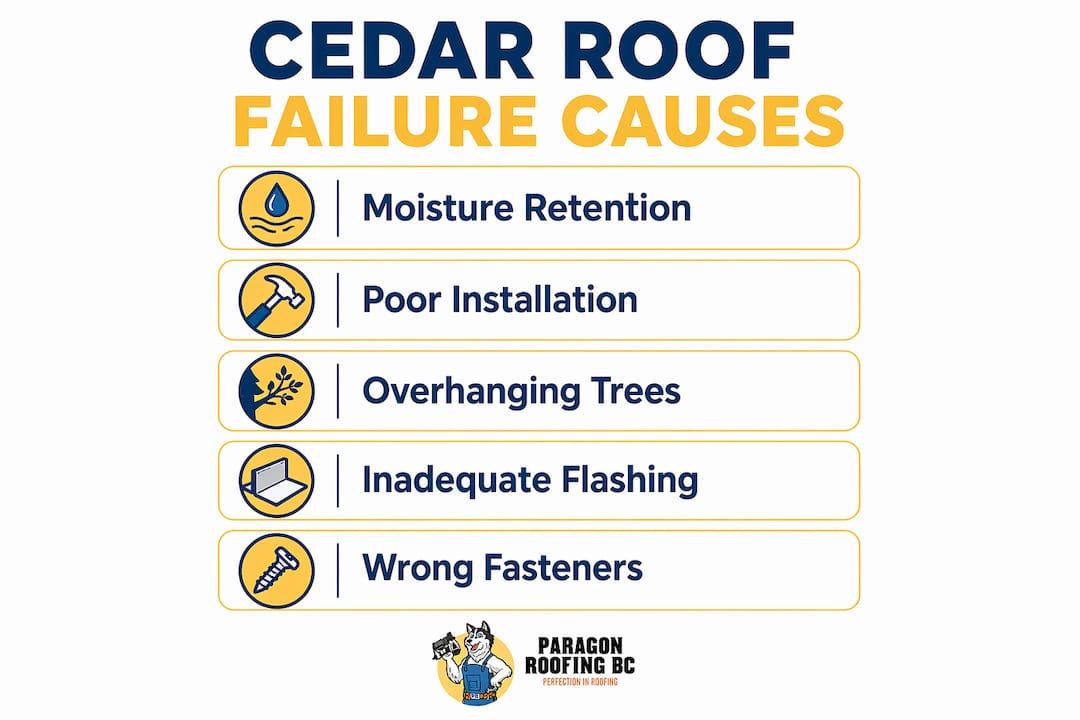
Flashing is the most commonly overlooked detail. Step flashing at dormers, valleys, and roof-to-wall intersections must be installed correctly and sealed against wind-driven rain. West Vancouver properties with dormers are particularly vulnerable because water pools at those transitions. When flashing fails or was never installed properly, water tracks behind the shakes and soaks the roof deck silently for months before any interior staining appears.
Fastener choice matters more than most homeowners realise. Stainless steel or hot-dipped galvanised fasteners are the correct choice for coastal BC. Standard steel nails corrode within a few years in the salt-influenced air of West Vancouver, leaving shakes loose and exposed. A loose shake is an open invitation for water to enter.
Ventilation is the third piece of the puzzle. Cedar shakes need airflow from below as much as they need protection from above. Without adequate attic ventilation, heat and moisture build up under the roof deck and the shakes never fully dry from the underside. This is where proper moisture management through ventilation proves just as critical as surface protection.
- Flashing at every transition point. Step flashing, valley flashing, and counter-flashing at dormers must be installed correctly and inspected regularly.
- Correct fastener material. Use stainless steel or hot-dipped galvanised nails only. Never standard steel in a coastal environment.
- Proper shake spacing. Shakes need a small gap between them to allow lateral drainage and airflow. Tight packing traps water.
- Adequate attic ventilation. Soffit and ridge vents must be clear and sized correctly for the roof area.
- Professional installation. Cedar shake installation is a skilled trade. Shortcuts in layout and nailing patterns create weak points that fail under West Vancouver’s rain loads.
Pro Tip: Before any cedar roof work, ask your contractor specifically about the fastener spec they plan to use. If they cannot confirm stainless steel or hot-dipped galvanised, that is a red flag worth acting on.
What are the common early failure signs of cedar roofs in West Vancouver?
Catching cedar roof problems early saves you from a full replacement. The signs are visible if you know what to look for, and most of them appear well before any water reaches your ceiling.
Missing, split, or curled shakes are the most obvious warning signs. A missing shake leaves the roof deck exposed to direct rainfall. Split shakes allow water to channel straight down to the underlayment. Curled edges lift in wind and create gaps that funnel water underneath. Any of these conditions will spread quickly if left unaddressed.
Colour change alone is not a reliable indicator. Cedar naturally weathers to a silver-grey over time, and that is normal. What you are watching for is dark staining or black patches, which signal moisture damage, mould, or rot rather than simple weathering. Uneven discolouration across the roof surface is a stronger warning sign than uniform greying.
Inside the attic is where the most serious signs show up. Daylight visible through roof deck gaps and wet insulation after rain are both indicators of active water intrusion that needs immediate attention.
| Warning sign | What it means | Urgency |
|---|---|---|
| Missing or blown-off shakes | Exposed deck, immediate water entry risk | High |
| Split or cracked shakes | Water channels to underlayment | High |
| Curled shake edges | Wind lift, water entry under shakes | Medium |
| Thick moss or algae growth | Moisture trapped against wood, accelerating rot | Medium |
| Dark staining or black patches | Mould, rot, or moisture damage | High |
| Daylight through attic deck | Structural gap, active leak risk | Urgent |
| Wet insulation after rain | Active water intrusion confirmed | Urgent |
- Check the attic after every significant rain event in autumn and winter
- Look for exposed fastener heads, which indicate shakes have shifted or shrunk
- Debris accumulation in valleys holds water and speeds decay in those areas
How to maintain cedar roofs properly to prevent early failure in West Vancouver
Consistent maintenance is what separates a cedar roof that lasts 30 years from one that fails at 15. The good news is that most of the required tasks are straightforward, and a few of them you can do yourself.
- Clean the roof without pressure washing. Pressure washing damages the protective surface of cedar shakes and accelerates premature wear. Use a low-pressure rinse or a soft brush with an appropriate cleaning solution instead. Oregon State University’s guidance on wood roof maintenance reinforces this point clearly.
- Trim overhanging branches every year. Trimming overhanging branches reduces debris accumulation, improves sunlight exposure, and gives the roof more drying time after rain. This single step has an outsized impact on moss prevention.
- Clear valleys and gutters in autumn. Debris in valleys holds water against the wood for days at a time. Clean gutters prevent overflow that backs up under the lower course of shakes.
- Treat moss and algae carefully. Moss holds moisture against the wood surface and accelerates rot well beyond what it looks like from the ground. Use a zinc sulphate or copper-based treatment applied by hand, not a pressure washer. For detailed guidance on controlling moss growth specific to Vancouver roofs, the approach matters as much as the product.
- Schedule a professional inspection every two years. A qualified roofer checks flashing integrity, fastener condition, shake movement, and drainage paths in areas you cannot safely access from the ground. Catching a failed step flashing at a dormer costs a fraction of what a rotted roof deck repair runs.
Pro Tip: The best time to schedule a cedar roof inspection in West Vancouver is late september or early october, before the heavy rain season hits. You want to know about any weak points before they get tested by three months of continuous rainfall.
Choosing the right cedar shakes for west coast moisture conditions also plays a role in how long your roof lasts between maintenance cycles. Not all cedar products perform equally in a coastal environment.
Cedar shakes vs. other roofing materials in West Vancouver conditions
Cedar is not the only option for West Vancouver homes, and understanding how it compares helps you make an informed decision about repair versus replacement.
| Roofing material | Typical lifespan in coastal BC | Moisture sensitivity | Maintenance frequency |
|---|---|---|---|
| Cedar shakes | 20–35 years with maintenance | High | Every 2 years |
| Asphalt shingles | 15–25 years | Low to medium | Every 3–5 years |
| Metal roofing | 40–60 years | Very low | Every 5–10 years |
| Composite shingles | 25–40 years | Low | Every 3–5 years |
Cedar’s natural oils give it genuine resistance to insects and initial moisture exposure. That is a real advantage. The challenge in West Vancouver is that the climate overwhelms cedar’s natural defences faster than in drier regions. Asphalt shingles require less maintenance but do not carry the same aesthetic value that many West Vancouver homeowners prize. Metal roofing performs best in high-rainfall environments but comes with a higher upfront cost. Composite shingles have improved significantly and now offer a cedar-like appearance with far lower maintenance demands in wet climates.
The honest cost-benefit answer for West Vancouver is this: cedar makes sense if you commit to the maintenance schedule. Without that commitment, the gap between cedar and lower-maintenance alternatives closes quickly.
Key takeaways
West Vancouver cedar roofs fail early primarily because persistent coastal moisture overwhelms the wood’s natural defences when maintenance, installation quality, and ventilation are not managed proactively.
| Point | Details |
|---|---|
| Moisture is the core cause | Trapped moisture from rain, shade, and moss drives rot faster than any other factor. |
| Installation quality determines lifespan | Correct flashing, stainless steel fasteners, and proper ventilation prevent the most common failure points. |
| Early signs are visible | Missing shakes, dark staining, and wet attic insulation all appear before interior damage becomes serious. |
| Maintenance prevents early failure | Biennial inspections, branch trimming, and careful moss treatment extend cedar roof life significantly. |
| Material choice affects long-term cost | Cedar requires consistent upkeep; metal and composite alternatives suit homeowners who prefer lower maintenance. |
What I’ve learned inspecting cedar roofs across West Vancouver
Hey, it’s Harman here. After inspecting cedar roofs across West Vancouver for years, the pattern I see most often is not dramatic storm damage. It is slow, quiet moisture accumulation that nobody noticed until it was expensive.
The most common mistake I see is homeowners waiting for a visible leak before calling anyone. By the time water shows up on your ceiling, the roof deck underneath has usually been wet for months. Cedar rot does not announce itself. It builds silently under shakes that still look passable from the ground.
The second mistake is pressure washing. I understand the appeal. A pressure washer makes a mossy roof look clean in an hour. But it strips the surface fibres from the shakes and opens the wood up to moisture penetration at a much faster rate. I have seen roofs that were pressure washed age five years in one season.
My honest recommendation: treat your cedar roof like a vehicle. You would not skip oil changes and then wonder why the engine failed. Schedule an inspection every two years, trim those overhanging branches every autumn, and deal with moss before it gets thick. Cedar is a beautiful roofing material that genuinely suits West Vancouver homes. It just needs consistent attention to deliver on its potential.
— Harman
Paragonroofingbc cedar roof services for West Vancouver homeowners
West Vancouver cedar roofs need local expertise, not a generic maintenance checklist. Paragonroofingbc works with homeowners across the North Shore to inspect, maintain, and repair cedar shake roofs before small problems become full replacements.
From flashing repairs at dormers to moss treatment and full shake assessments, the team at Paragonroofingbc brings hands-on experience with the specific conditions that drive cedar roof issues in West Vancouver. If your cedar roof has not been professionally inspected in the past two years, or if you have noticed any of the warning signs covered here, now is the right time to book an assessment. Reach out to Paragonroofingbc to schedule a cedar roof inspection and get a clear picture of where your roof stands before the next rain season.
FAQ
Why do cedar roofs in West Vancouver fail faster than in other areas?
West Vancouver’s combination of high annual rainfall, heavy tree canopy, and limited drying sunlight keeps cedar shakes wet far longer than in drier climates. That persistent moisture accelerates rot, moss growth, and fastener corrosion beyond what cedar’s natural oils can resist without regular maintenance.
What are the most common cedar shake failure signs in West Vancouver?
Missing, split, or curled shakes are the clearest early warning signs. Dark staining or black patches on the surface indicate mould or rot, while daylight visible through the attic roof deck and wet insulation after rain confirm active water intrusion.
Does cedar naturally turn grey, or is that a sign of damage?
Cedar naturally weathers to a silver-grey colour over time, and that is normal. Dark staining, black patches, or uneven discolouration across the roof surface are the signs that indicate moisture damage or rot rather than simple weathering.
How often should West Vancouver homeowners maintain their cedar roofs?
A professional inspection every two years is the minimum for West Vancouver cedar roofs. Annual branch trimming, autumn gutter cleaning, and careful moss treatment between inspections keep the roof in the best condition possible given the local climate.
Can I pressure wash my cedar roof to remove moss?
Pressure washing damages cedar shakes by stripping surface fibres and opening the wood to faster moisture penetration. Use a low-pressure rinse or a hand-applied zinc sulphate or copper-based treatment instead, as recommended for wood roofs in the Pacific Northwest.
Recommended
Our Roofing Blog


Have more questions about roofing?
Check out our FAQs or give us a call today to speak to an expert roofer in Vancouver Lower Mainland, BC. We're here to help our neighbours make educated decisions about their roof. For our team, we value helping clients save money while making their roofs last.