Cedar shake to metal roof conversion in West Vancouver
Cedar shake to metal roof conversion in West Vancouver
TL;DR:
- Converting cedar shakes to metal roofing in West Vancouver extends roof lifespan and improves resistance to moisture and weather. Proper permits, materials, and installation are crucial, with full shake removal preferred over overlay to ensure longevity. Aluminium and steel with PVDF coating are recommended for coastal climate performance and durability.
Cedar shake to metal roof conversion in West Vancouver is one of the most practical upgrades a homeowner can make on the North Shore. Cedar shakes look beautiful when new, but West Vancouver’s coastal rain, moss, and salt air age them fast. A full conversion to metal roofing, known in the industry as a re-roofing or roof replacement project, gives your home a lifespan measured in decades rather than years. This guide covers permits, materials, installation steps, and the real costs involved, so you can plan your project with confidence and avoid the surprises that catch most homeowners off guard.
What permits and approvals are required for cedar shake to metal roof conversion in West Vancouver?
Permits are the part of this project that most homeowners underestimate. West Vancouver has one of the most detailed residential zoning frameworks in the Lower Mainland, with strict slope-sensitive setbacks and view corridor protections that directly affect roof replacement design. Getting your paperwork right from day one saves weeks of frustration.
Here is the typical permit process for a cedar shake roof replacement in West Vancouver:
-
Confirm your property’s slope grade. Properties with slopes over 20% grade require a geotechnical assessment and a letter of assurance from a registered professional. This is not optional. The District of West Vancouver enforces this requirement strictly for hillside properties.
-
Commission a geotechnical report if required. Geotechnical reports typically cost between $3,000 and $8,000. That range reflects the complexity of your site and the engineer’s scope of work. Budget for this early, because the report must be submitted with your permit application.
-
Prepare your permit application. Your application needs to include drawings, material specifications, and any engineering letters. Your roofing contractor should help you compile this package. Incomplete applications are the most common cause of delays.
-
Submit and wait. Permit timelines in West Vancouver for exterior projects typically run 4–8 weeks. Complex hillside properties or those requiring geotechnical review can take longer.
-
Get strata approval if applicable. If your home is part of a strata or multi-unit property, you need written strata council approval before any exterior work begins. Paragonroofingbc works with strata roofing projects regularly and can help you prepare the documentation your strata council needs.
Pro Tip: Engage a geotechnical engineer at the very start of your planning, not after you have already chosen materials. Early involvement reduces costly design revisions and prevents permit rejections that push your timeline back by months.
Permit and design fees in West Vancouver can add 12–18% to total construction costs. That means on a $30,000 roofing project, you could be looking at $3,600 to $5,400 in fees alone before a single shake comes off your roof.
Why convert cedar shake roofs to metal in West Vancouver?
Metal roofing outperforms cedar shakes in almost every category that matters on the North Shore. Here is what the conversion actually delivers:
- Moisture resistance. Metal roofs do not absorb moisture, which eliminates the rot and moss growth that shortens cedar shake lifespans in West Vancouver’s wet coastal climate. Cedar shakes can start showing moss within five years in shaded areas.
- Longevity. A properly installed metal roof lasts significantly longer than cedar shakes, which typically need replacement or major repairs within 20–25 years in coastal conditions.
- Reduced maintenance. Cedar shakes need annual cleaning, moss treatment, and periodic shake replacement. Metal roofing requires a fraction of that attention, freeing you from recurring maintenance costs.
- Wind and weather resistance. West Vancouver’s wind-driven rain events put serious stress on roofing systems. Metal panels and shingles, when correctly fastened, handle that lateral water penetration far better than wood-based materials.
- Energy efficiency. Reflective metal roofing reduces heat absorption in summer, which lowers cooling loads. This matters less in West Vancouver than in hotter climates, but it still contributes to year-round comfort.
- Environmental benefit. Metal roofing is fully recyclable at end of life. Cedar shakes, by contrast, go to landfill and are increasingly restricted under fire-interface regulations in parts of British Columbia.
The combination of lower maintenance and longer lifespan means the total cost of ownership for metal roofing is lower than cedar shakes over a 40-year period, even when the upfront conversion cost is higher.
Choosing the right metal roofing materials for your cedar shake replacement
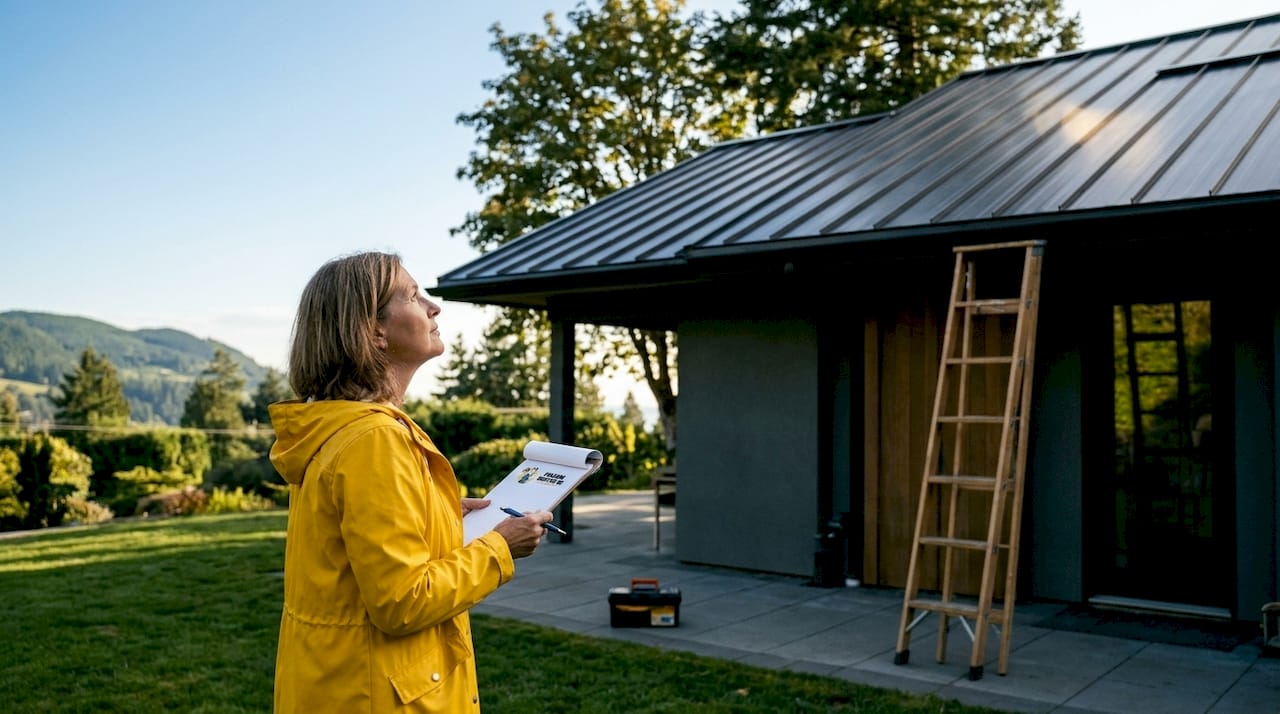
Metal roofing comes in several material types, and the choice affects cost, weight, appearance, and how well the roof performs in West Vancouver’s salt-air coastal environment. Material choice also affects installation complexity and warranty terms.
| Material | Coastal performance | Relative cost | Best use case |
|---|---|---|---|
| Steel (Galvalume or painted) | Good with quality coating | Moderate | Most residential conversions |
| Aluminium | Excellent, naturally corrosion-resistant | Moderate to high | Coastal and salt-air exposure |
| Copper | Outstanding, self-patinating | High | Heritage or premium homes |
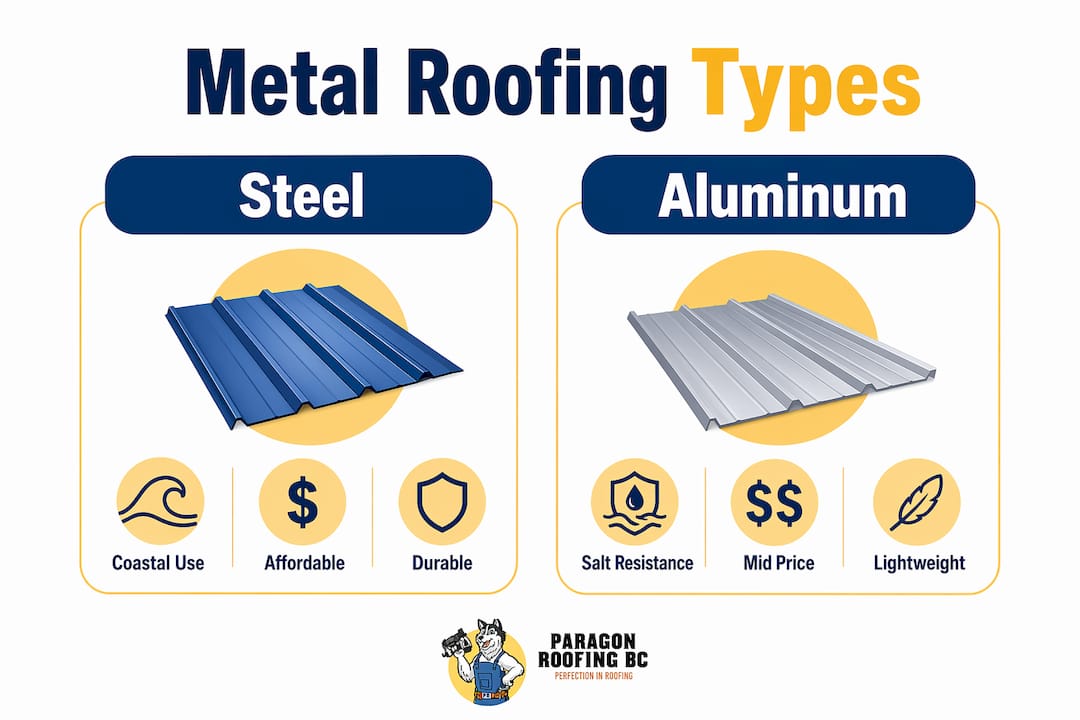
Steel is the most common choice for cedar shake conversions in West Vancouver. Galvalume-coated steel with a quality paint finish handles coastal moisture well and comes in a wide range of colours. Aluminium costs more upfront but offers natural corrosion resistance without relying on a coating, which makes it a strong choice for properties close to the water. Copper is reserved for premium or heritage homes where the aesthetic and longevity justify the cost.
For style, standing seam and metal shingle profiles are the two most popular options for homes that previously had cedar shakes. Metal shingles mimic the dimensional look of wood shakes and suit traditional West Vancouver architecture well. Standing seam gives a cleaner, more contemporary profile and performs exceptionally in high-rainfall conditions because it has no exposed fasteners.
Pro Tip: Choose a finish rated for coastal environments, specifically one with a PVDF (polyvinylidene fluoride) coating. These coatings hold colour and resist chalking far better than standard polyester finishes in salt-air conditions.
Colour choice matters more than most homeowners realise. Darker colours absorb more heat and can affect attic temperatures. Lighter or medium tones work well in West Vancouver’s climate and tend to complement the natural surroundings of hillside properties.
How does the conversion process work, step by step?
A cedar shake to metal roof conversion follows a clear sequence when done properly. Cutting corners at any stage creates problems that show up years later as leaks, rot, or failed fasteners.
-
Roof inspection and structural assessment. A qualified roofer inspects the existing deck, rafters, and fascia boards before any work begins. West Vancouver hillside homes sometimes have older structural framing that needs reinforcement to carry the new roof system.
-
Full cedar shake removal. Overlaying metal roofing over existing cedar shakes is not recommended. Full shake removal gives better results because it allows proper inspection of the deck, correct underlayment installation, and secure fastening of the metal panels. Overlay installations trap moisture and shorten the life of the new roof.
-
Deck repair and preparation. Once the shakes are off, any damaged or soft decking gets replaced. This is also when you address any rot that the shakes were hiding.
-
Underlayment installation. A high-quality synthetic underlayment goes down before the metal panels. In West Vancouver’s climate, a self-adhering membrane at eaves, valleys, and penetrations adds critical protection against wind-driven rain.
-
Metal roof installation. Proper installation techniques include correct ventilation, precise flashing at all penetrations and transitions, and secure fastening patterns that account for thermal expansion. Metal expands and contracts with temperature changes, so fastener placement is not guesswork.
-
Flashing, ridge, and trim work. Valleys, chimneys, skylights, and wall transitions all need custom flashing. This is where many installations fail. Poorly detailed flashing is the leading cause of leaks in metal roofing systems.
Here are the most common mistakes to avoid during the conversion:
- Skipping the self-adhering membrane at vulnerable areas
- Using incompatible metals in contact with each other, which causes galvanic corrosion
- Inadequate attic ventilation, which leads to condensation on the underside of metal panels
- Incorrect fastener torque, either too tight or too loose, which causes leaks or panel movement
- Neglecting to account for drainage from integrated retaining and drainage systems on hillside properties, where water management affects both the roof and slope stability
Key takeaways
Converting a cedar shake roof to metal in West Vancouver delivers long-term value, but only when permits, materials, and installation are handled correctly from the start.
| Point | Details |
|---|---|
| Permits come first | Allow 4–8 weeks for approval; hillside properties over 20% grade need a geotechnical report. |
| Budget for fees | Engineering, design, and permit fees can add 12–18% to your total project cost. |
| Full removal beats overlay | Removing all cedar shakes before metal installation produces a longer-lasting, better-performing roof. |
| Material choice matters | Aluminium and Galvalume steel with PVDF coatings perform best in West Vancouver’s coastal environment. |
| Flashing is critical | Poorly detailed flashing at valleys and penetrations is the most common cause of metal roof leaks. |
What I have learned from cedar conversions on the North Shore
Hey, it’s Harman here. I have been on a lot of West Vancouver roofs, and the cedar shake to metal conversion is one of the projects I genuinely enjoy because the improvement is so dramatic. But I want to be straight with you about something most articles skip.
The permit process in West Vancouver is not a formality. I have seen homeowners lose two to three months because they did not get a geotechnical report early enough, or because their permit application was missing an engineering letter. Start that process before you even finalise your material choice. The roof can wait. The permit cannot.
The other thing I see constantly is homeowners choosing materials based on price alone. I understand the instinct. A conversion is a significant investment. But the difference between a standard polyester-coated steel panel and a PVDF-coated aluminium panel is not just dollars. It is ten or fifteen years of service life in a salt-air environment. On a West Vancouver hillside, that matters.
My honest advice: hire a roofer who has actually pulled permits in West Vancouver, not just someone who works in the Lower Mainland generally. The District’s requirements are specific, and experience with local inspectors makes a real difference in how smoothly your project runs.
— Harman
Paragonroofingbc’s West Vancouver cedar conversion services
Paragonroofingbc has completed cedar shake to metal roof conversions across West Vancouver’s hillside neighbourhoods, from Dundarave to Cypress Park. We handle the full process, from initial roof inspection and permit preparation through to final installation and inspection sign-off.
If your cedar shake roof is showing moss, splitting shakes, or water stains on interior ceilings, it is worth getting a professional assessment before the next rainy season hits. Paragonroofingbc offers residential roofing services in West Vancouver with local knowledge of District permitting requirements and hillside installation challenges. You can also review our cedar conversion process to understand exactly what to expect before you call. Reach out to schedule your inspection and get a clear picture of what your conversion will involve.
FAQ
How long does a cedar shake to metal roof conversion take in West Vancouver?
The physical installation typically takes 3–7 days depending on roof size and complexity. Permit approval adds 4–8 weeks to the overall timeline, so plan your project well in advance of the season you want the work completed.
Do I need a geotechnical report for my West Vancouver roof replacement?
Properties with slopes over 20% grade require a geotechnical assessment and a letter of assurance from a registered engineer. Geotechnical reports cost between $3,000 and $8,000 depending on site complexity.
Can metal roofing be installed over existing cedar shakes?
Full cedar shake removal is strongly recommended before metal roof installation. Overlaying metal over shakes traps moisture, prevents proper deck inspection, and reduces the lifespan of the new roof system.
What is the best metal roofing material for West Vancouver’s coastal climate?
Aluminium and Galvalume steel with a PVDF coating perform best in West Vancouver’s salt-air environment. Both resist corrosion without relying solely on paint, which is critical in coastal conditions.
Does a metal roof increase home value in West Vancouver?
A metal roof improves a home’s appeal to buyers by reducing future maintenance obligations and extending the expected roof lifespan. In West Vancouver’s competitive real estate market, a recently converted metal roof is a meaningful selling point.
Recommended
Our Roofing Blog


Have more questions about roofing?
Check out our FAQs or give us a call today to speak to an expert roofer in Vancouver Lower Mainland, BC. We're here to help our neighbours make educated decisions about their roof. For our team, we value helping clients save money while making their roofs last.