Burnaby strata townhouse roofing responsibility explained
Burnaby strata townhouse roofing responsibility explained
TL;DR:
- In Burnaby, strata roofs are usually the responsibility of the strata corporation unless a registered bylaw explicitly assigns that duty to owners. Only documented, clearly worded bylaws can shift maintenance obligations; verbal agreements do not hold legal weight. Strata councils must follow proper procedures, including assessments, budgeting, and permits, for roof repairs to avoid legal and insurance issues.
Burnaby strata townhouse roofing responsibility is defined under Section 72 of the BC Strata Property Act, which places the obligation to maintain and repair roofs squarely on the strata corporation. This applies even when funds are insufficient. The roof is treated as common property unless a strata plan or registered bylaw explicitly designates it as limited common property and assigns maintenance duties to individual owners. For strata council members and townhouse owners in Burnaby, understanding this legal framework is not optional. Misreading it leads to deferred repairs, insurance disputes, and real legal exposure for everyone in the complex.
What is common property vs limited common property for Burnaby strata townhouse roofs?
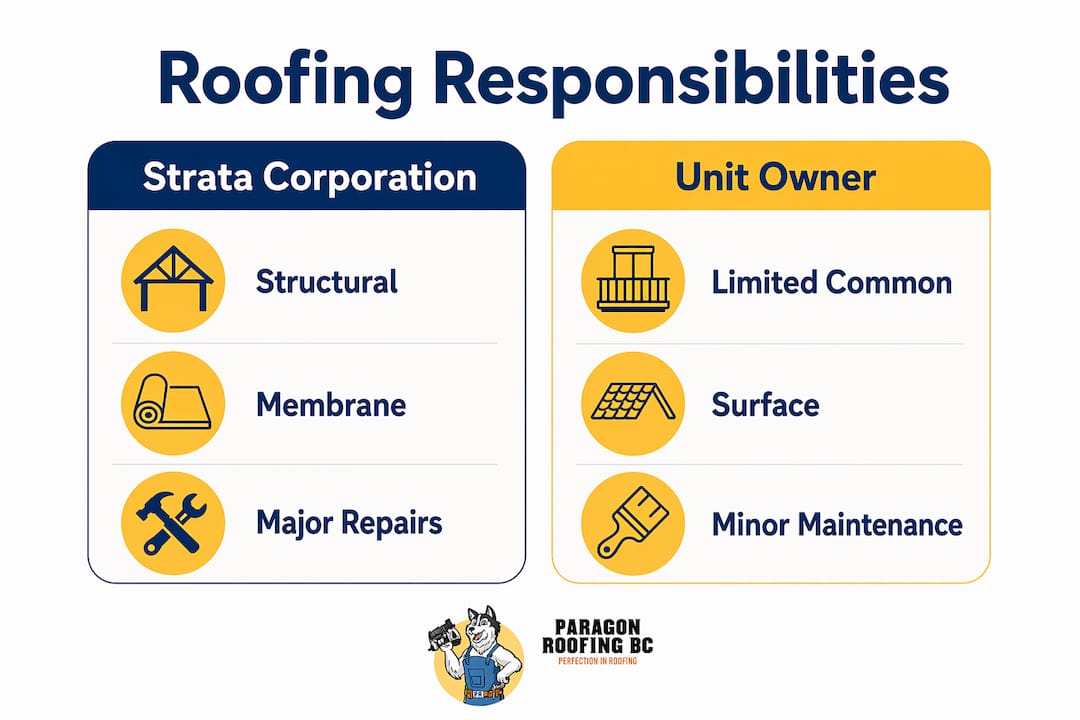
The distinction between common property and limited common property is the foundation of every roofing responsibility question in a Burnaby strata townhouse. Common property is owned collectively by all strata lot owners and managed by the strata corporation. Limited common property is a portion of common property designated in the strata plan for the exclusive use of one or more strata lots.
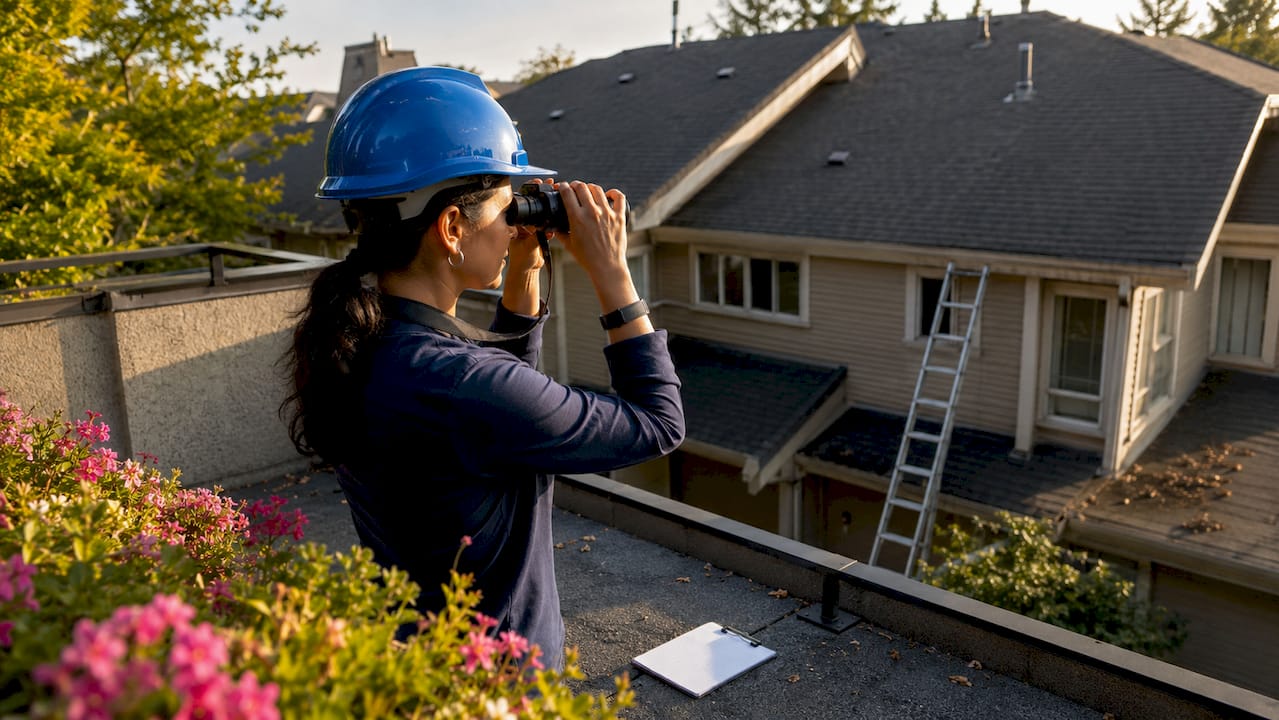
Townhouse owners often own the unit plus the ground lot, but roof ownership and maintenance depend entirely on what the strata plan and bylaws say about boundaries and responsibilities. This is where things get complicated. A roof over a single townhouse unit might look like “your roof,” but legally it could still be common property maintained by the strata corporation.
The split can go even deeper. The roof structural membrane may be a strata corporation responsibility, while the surface finish, such as shingles or metal cladding, might fall to the individual owner, depending on how the bylaws and strata plan are written. Think of it like a shared wall in a duplex: the framing belongs to everyone, but the paint on your side is yours.
Pro Tip: Pull your strata plan and read the schedule of common property before assuming anything about your roof. The boundary lines are drawn there, not in a verbal agreement with your strata council.
| Component | Typical responsibility |
|---|---|
| Roof structural membrane | Strata corporation (common property) |
| Surface shingles or metal finish | Owner or strata, depending on bylaws |
| Gutters and downspouts | Often strata corporation |
| Skylights serving one unit | Often owner (limited common property) |
| Shared drainage systems | Strata corporation |
How do strata bylaws affect roofing obligations for owners and councils?
The default rule under the BC Strata Property Act is clear. Where bylaws are silent on limited common property maintenance, the strata corporation remains responsible for repair and upkeep. An owner cannot simply claim the roof over their unit is their problem to fix. That shift in responsibility requires an explicit, registered bylaw.
For a bylaw to validly assign roofing maintenance to an individual owner, it must meet specific legal requirements. It must be registered with the Land Title Office, passed by a three-quarters vote of the strata, and written with enough clarity to identify exactly what the owner is responsible for. Vague language does not hold up. BC legal precedents confirm that strata corporations cannot avoid repair costs by splitting them informally unless the bylaw clearly defines the allocation.
Here is what to check when reviewing your strata documents:
- Read the registered bylaws, not just the rules. Rules do not carry the same legal weight as bylaws.
- Look for any section referencing “limited common property maintenance” or “owner responsibility for exterior components.”
- Cross-reference the strata plan to confirm which areas are designated as limited common property for your lot.
- Check whether the bylaw specifies the standard of maintenance required, not just who is responsible.
- Confirm the bylaw is registered, not just adopted at a meeting.
Many owners in Burnaby and across Coquitlam strata townhouse communities assume their strata’s verbal policies carry legal weight. They do not. Only registered bylaws can shift responsibility away from the strata corporation.
What are strata council duties for managing townhouse roof maintenance?
Strata councils in Burnaby carry a legal obligation under the BC Strata Property Act to maintain and repair common property roofs, full stop. This is not discretionary. Strata councils must follow procedural compliance including obtaining permits, calling the appropriate meetings, and securing proper voting thresholds for any major roofing work.
Here is the process a well-run strata council follows for roofing maintenance and repair:
- Commission a professional roof assessment. Get a written report from a qualified roofing contractor, not just a visual inspection from a handyman. This creates a documented baseline.
- Review the depreciation report. The depreciation report must account for roofing as a capital item. Strata councils often underutilise depreciation reports and fail to integrate them with maintenance plans, which causes deferred repairs and legal risk.
- Fund the work correctly. Use the contingency reserve fund for planned replacements. For urgent or unexpected repairs, a special levy may be required. Both require proper notice and voting procedures.
- Select a qualified contractor. For Burnaby strata buildings, choose a contractor with strata roofing experience and WorkSafeBC coverage. Get at least two written quotes.
- Obtain permits where required. Roof replacements in Burnaby typically require a building permit. Skipping this step creates liability for the strata corporation.
- Communicate with owners. Send written notice of the work, the cost, and the funding source before work begins. Owners have a right to this information.
Pro Tip: Integrate your depreciation report into a rolling five-year maintenance calendar. Roofs that appear on a schedule get budgeted for. Roofs that get ignored become emergency special levies.
Proactive use of depreciation reports in maintenance planning avoids costly deferred roof repairs and protects strata councils from legal exposure. This is one of the most practical steps a council can take.
What should individual Burnaby townhouse owners know about their roofing rights?
Individual owners in Burnaby strata townhouses have fewer roofing rights than most people expect. The roof is not yours to fix, even if it sits directly above your bedroom. Owners cannot authorise roofing repairs or hire contractors for common property without strata council approval. Doing so risks voiding the strata’s insurance and creating personal liability.
Your actual responsibilities as an owner are more limited and more manageable:
- Report damage promptly. If you notice a leak, missing shingles, or water staining on your ceiling, notify the strata council in writing immediately. Delayed reporting can shift liability to you.
- Pay your strata fees and levies. Your financial contribution funds the contingency reserve that pays for roof work. Refusing to pay a special levy does not exempt you from the obligation.
- Do not make unauthorised repairs. Even patching a small area of flashing yourself is a problem if the roof is common property. Get written approval first.
- Understand your limited common property obligations. If your bylaws assign you responsibility for a specific roof component, such as a skylight or a patio cover, maintain it to the standard the bylaw requires.
Many owners incorrectly assume they can opt out of common property roof maintenance funding. BC law does not allow this. Collective responsibility is the default, and it applies to every owner in the strata.
How to handle shared roof leaks and insurance in Burnaby townhouse stratas
Shared roof leaks are where responsibility disputes get most heated. The key question is always: where did the water originate? Identifying the source of a roof leak is the first step to assigning correct liability. If the leak originates from a common property component, the strata corporation is responsible for remediation, even if the resulting damage appears inside your unit.
Follow this process when a leak occurs:
- Document everything with photos and written notes, including the date and time.
- Notify the strata council in writing the same day you discover the leak.
- Do not attempt repairs yourself. Wait for the strata to assess and authorise work.
- File a claim with the strata’s insurance if damage to your belongings or unit interior results.
- Check your own owner’s insurance policy for coverage of interior damage not covered by strata insurance.
Pro Tip: Keep a written log of every communication with your strata council about a leak. If a dispute goes to the Civil Resolution Tribunal, that paper trail is your best evidence.
Leaks from shared roof components require the strata to handle remediation, even when interior damage affects only one unit. Unauthorised repairs by owners on strata common property risk voiding strata insurance and may trigger costly legal consequences. The strata’s insurance policy is a shared asset. Protect it by following the correct process every time.
Key takeaways
Burnaby strata townhouse roofing responsibility defaults to the strata corporation under the BC Strata Property Act, and only a registered bylaw can shift specific duties to individual owners.
| Point | Details |
|---|---|
| Default responsibility | The strata corporation maintains and repairs roofs as common property under Section 72 of the BC Strata Property Act. |
| Bylaw requirements | Only a registered, clearly worded bylaw can transfer roofing maintenance to individual owners. |
| Owner limits | Owners cannot authorise or perform repairs on common property roofs without written strata council approval. |
| Council best practices | Integrate depreciation reports into a rolling maintenance calendar to avoid emergency levies and legal risk. |
| Leak protocol | Document leaks immediately, notify the strata in writing, and avoid unauthorised repairs to protect insurance coverage. |
What I’ve learned inspecting strata roofs in Burnaby
Hey, it’s Harman here. After inspecting and replacing roofs on strata townhouse complexes across Burnaby and the Lower Mainland, the pattern I see most often is not a roofing problem. It’s a communication problem.
Strata councils wait too long. They get a depreciation report, file it away, and then three years later they’re dealing with a full-on waterfall through a ceiling because the membrane failed. The report told them it was coming. Nobody acted on it. That deferred repair almost always costs two to three times what a planned replacement would have.
The other thing I see constantly is owners who patch their own roofs. They mean well. They see a lifted shingle and grab a tube of caulk. But if that roof is common property and the strata’s insurance adjuster finds out, the claim gets complicated fast. I’ve seen owners face personal liability for damage caused by their “fix.”
My honest advice: if you’re on a strata council in Burnaby, treat your strata depreciation report like a maintenance schedule, not a filing exercise. And if you’re an owner, your job is to report and document, not repair. The system works when everyone plays their role.
— Harman
Paragonroofingbc and Burnaby strata townhouse roofing
Paragonroofingbc works directly with strata councils and property managers across Burnaby on townhouse roof assessments, repairs, and full replacements. The team understands the BC Strata Property Act requirements, depreciation report timelines, and the permit process specific to Burnaby.
Whether your strata needs a written assessment to support a capital plan, an urgent repair after a wet Lower Mainland winter, or a full roof replacement for an aging complex, Paragonroofingbc delivers the documentation and workmanship strata councils need. For strata roof leak detection and repair in Burnaby, contact Paragonroofingbc to schedule an assessment with a contractor who knows strata work inside and out.
FAQ
Who is responsible for a townhouse roof in a Burnaby strata?
The strata corporation is responsible for maintaining and repairing the roof as common property under Section 72 of the BC Strata Property Act. This responsibility shifts to individual owners only if a registered bylaw explicitly assigns it.
Can a Burnaby strata owner repair their own roof?
Owners cannot authorise or perform repairs on common property roofs without written strata council approval. Unauthorised repairs risk voiding the strata’s insurance and may create personal legal liability.
What happens if a strata bylaw is silent on roof maintenance?
Where bylaws are silent, the strata corporation remains responsible for all roof maintenance and repair costs. Only a registered, clearly worded bylaw can transfer that duty to an individual owner.
How does a shared roof leak get resolved in a Burnaby strata?
The strata corporation must address any leak originating from a common property roof component, even if the resulting damage appears inside a single unit. Owners should document the leak and notify the strata council in writing immediately.
What is limited common property in a strata townhouse roof context?
Limited common property is a portion of common property designated in the strata plan for the exclusive use of one strata lot. Skylights or patio covers serving a single unit are common examples, and maintenance responsibility depends on what the registered bylaws specify.
Recommended
Our Roofing Blog


Have more questions about roofing?
Check out our FAQs or give us a call today to speak to an expert roofer in Vancouver Lower Mainland, BC. We're here to help our neighbours make educated decisions about their roof. For our team, we value helping clients save money while making their roofs last.