West Vancouver flat roof waterproofing challenges: 2026 guide
West Vancouver flat roof waterproofing challenges: 2026 guide
TL;DR:
- West Vancouver’s coastal climate causes flat roof leaks through prolonged wet cycles, freeze-thaw damage, and salt air degradation. Proper detailing, drainage, and selecting suitable membranes like torch-on SBS or TPO are essential to prevent failure. Regular inspections and engineered drainage strategies significantly extend roof lifespan and reduce costly repairs.
Flat roof waterproofing in West Vancouver is defined by one relentless reality: the coastal climate never gives your roof a break. West Vancouver flat roof waterproofing challenges stem directly from prolonged wet cycles, freeze-thaw damage, and drainage systems that were never designed to handle what the North Shore actually delivers. The BC Building Code mandates membrane systems for roofs with a pitch below 2:12, and for good reason. Without the right membrane, proper detailing, and a drainage plan built for coastal conditions, water finds its way in quietly and does serious damage long before you see a stain on the ceiling. This guide is written for property managers, homeowners, and strata councils who want to stay ahead of the problem.
Why does West Vancouver’s climate make flat roof waterproofing so hard?
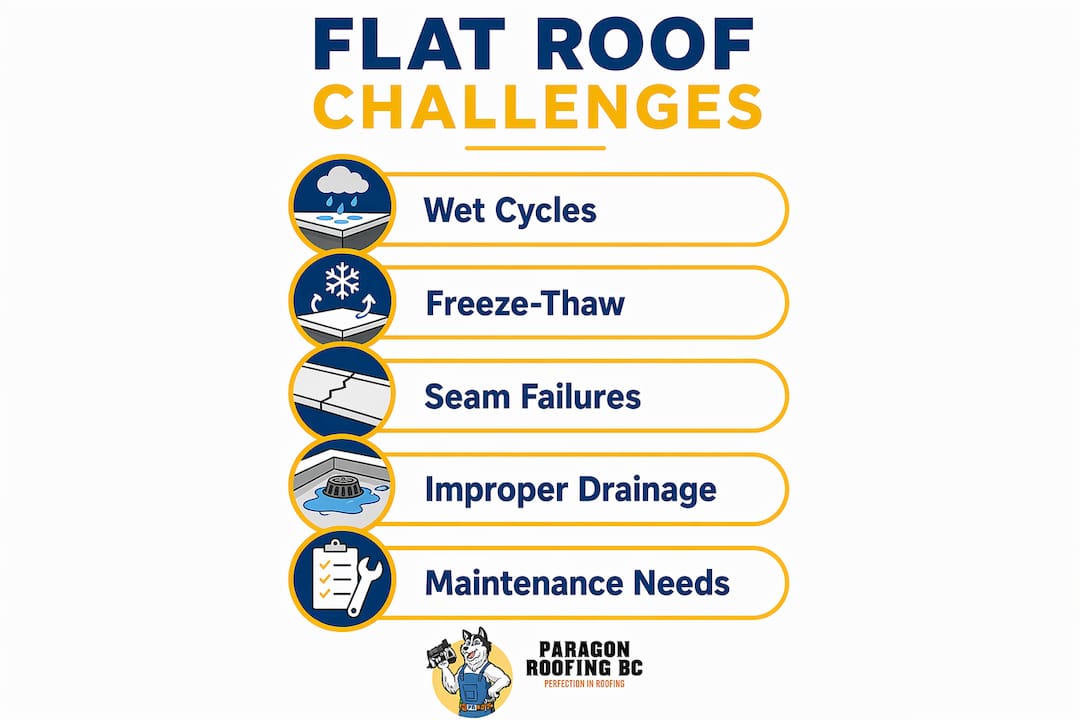
West Vancouver’s coastal climate creates prolonged wet cycles that attack flat roofs in ways that drier climates simply do not. There are no long dry spells to let roof assemblies breathe and recover. Moisture accumulates slowly in seams, insulation layers, and flashings over months, not days.
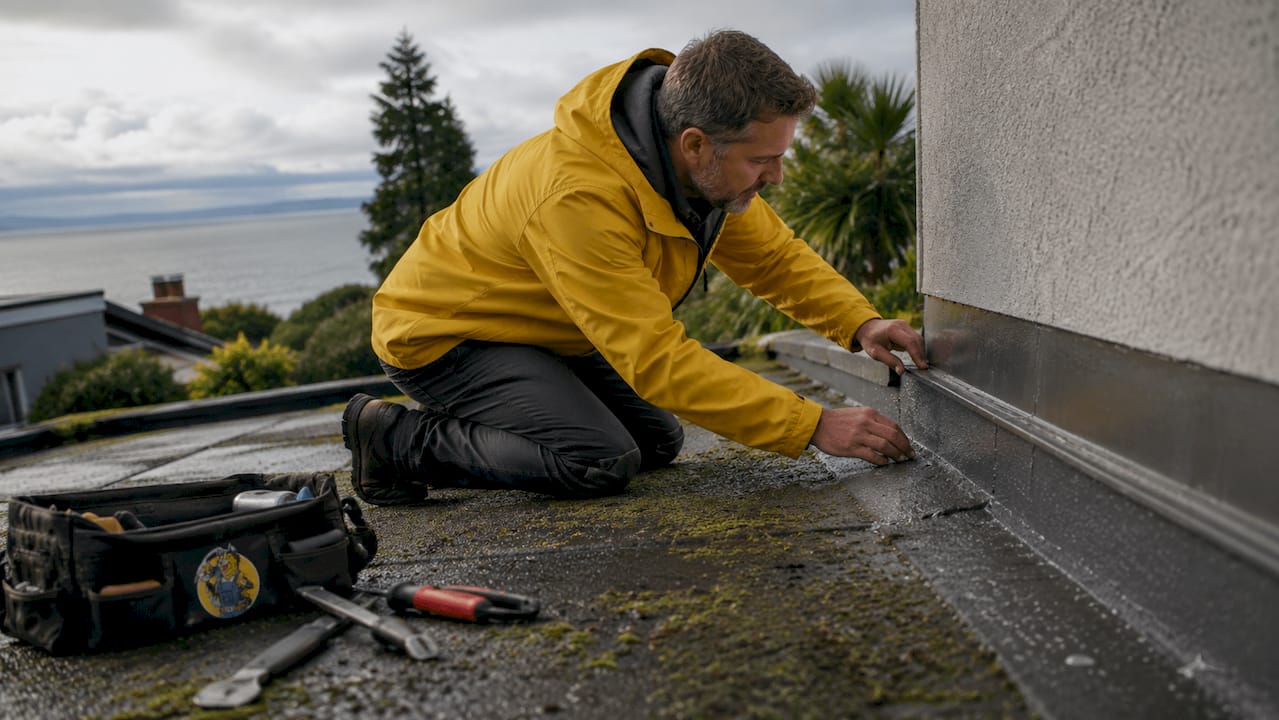
Freeze-thaw cycling is a particular problem on the North Shore. Temperatures hover near zero through much of the winter, and freeze-thaw damage works on membrane seams mechanically, expanding and contracting them repeatedly until they crack or lift. A membrane that looks perfectly intact from the surface can be failing at every seam underneath.
Coastal salt air and humidity accelerate material degradation, especially on metal flashings and edge terminations. The combination of salt, moisture, and temperature swings shortens the service life of any material that is not specified for coastal exposure. This is not a theoretical concern. It shows up in inspections every spring on roofs that were installed without that context in mind.
Vapour pressure is another issue that catches property owners off guard. When moisture trapped in the insulation during winter warms up in spring, it turns to vapour and pushes against the membrane from below. The result is membrane blistering visible in may or june, which looks like a surface defect but signals a much deeper moisture problem in the assembly.
- Sustained wet cycles prevent natural drying of roof assemblies
- Freeze-thaw cycling mechanically damages seams and terminations
- Coastal salt air degrades metal flashings faster than inland climates
- Vapour pressure from trapped moisture causes blistering in spring
- Lack of dry periods means slow, cumulative damage rather than sudden failures
Pro Tip: If you see blisters on your flat roof membrane in late spring, do not just patch the surface. The blister is a symptom. The moisture is in the insulation below, and patching without addressing that will fail within a season.
What are the most common flat roof waterproofing failure points in West Vancouver?
Roof-wall transitions and penetrations are the most critical failure points on flat roofs in West Vancouver. Water does not typically fail through the middle of a well-installed membrane. It fails at the edges, transitions, and anywhere the membrane has to change direction or accommodate a pipe, vent, or skylight.
Here are the failure points that Paragonroofingbc sees most often during inspections on West Vancouver flat roofs:
-
Roof-wall transitions. Where the flat roof meets a vertical wall, the membrane must turn up and terminate behind cladding or into a reglet. If this detail is sloppy or the termination bar corrodes, water tracks straight down behind the membrane. The west Vancouver rain screen and roof connection at this junction is particularly vulnerable because wind-driven rain pushes water upward against the wall.
-
Flashings and edge terminations. Metal drip edges, gravel stops, and parapet cap flashings all require sealed laps and proper fastening. Thermal movement works fasteners loose over time, and once a flashing lifts even slightly, water gets underneath.
-
Roof penetrations. Every vent, drain, skylight, and pipe that passes through the membrane is a potential leak point. Each penetration adds risk without proper air sealing and flashing collars. Strata buildings with mechanical equipment on the roof are especially exposed.
-
Blocked drains and ponding water. Debris from nearby trees collects on flat roofs and blocks drains quickly. Ponding water sits against seams and flashings, accelerating deterioration and adding structural load.
-
Membrane seams and thermal cracks. Seams are the weakest point in any membrane system. Thermal expansion and contraction work seam adhesive loose over years, and in West Vancouver’s climate, that process happens faster than in drier regions.
-
Aging materials and poor original detailing. Many West Vancouver flat roofs were built with detailing that met the standards of the time but does not hold up under current moisture loads or updated code expectations.
Pro Tip: Before every rainy season, walk your flat roof and check every penetration collar and flashing termination by hand. If anything moves or feels soft, that is your leak waiting to happen. A one-hour inspection in september can save a $15,000 repair in january.
Which membrane systems work best for West Vancouver flat roofs?
The BC Building Code requires membrane systems for roofs with a pitch below 2:12. That covers the vast majority of flat and low-slope roofs in West Vancouver. The code sets the floor, but choosing the right membrane for a coastal climate requires going further than minimum compliance.
Torch-on SBS modified bitumen is the most common system on West Vancouver flat roofs, and for good reason. SBS rubber modifiers give the membrane flexibility through freeze-thaw cycles, and a properly torched seam is genuinely waterproof when installed correctly. The limitation is that torch-on requires skilled installation. A poorly torched seam is worse than no seam at all because it looks sealed but is not.
TPO (thermoplastic polyolefin) membranes are increasingly popular on commercial and strata flat roofs. TPO seams are heat-welded, which creates a bond as strong as the membrane itself when done properly. TPO performs well in UV exposure and reflects heat, which matters less in West Vancouver than in sunnier climates, but it is still a durable option for the North Shore.
EPDM (ethylene propylene diene monomer) is a single-ply rubber membrane that has been used on flat roofs for decades. It handles temperature extremes well, but seam adhesive is its weakness in wet climates. Fully adhered EPDM with taped seams performs better than mechanically fastened systems in coastal BC.
| Membrane type | Seam method | Coastal performance | Best application |
|---|---|---|---|
| Torch-on SBS | Heat-torched | Strong with skilled install | Residential and strata flat roofs |
| TPO | Heat-welded | Strong UV and weather resistance | Commercial and strata roofs |
| EPDM | Adhesive or tape | Good if fully adhered | Residential low-slope roofs |
| Modified bitumen (cold-applied) | Adhesive | Moderate | Repairs and small areas |
Flat roofs in coastal BC must prioritise airtightness and vapour management as part of a drained assembly. A membrane alone is not enough. The assembly needs a vapour barrier, continuous insulation, and drainage plane working together. The BC Building Code also requires 1 square foot of venting for every 300 square feet of ceiling area, which directly affects how moisture moves through the roof assembly.
How can drainage and maintenance prevent waterproofing failures?
Assuming that a flat roof will drain naturally is the most common and costly mistake on West Vancouver properties. Engineered overflow drains are not optional on a coastal flat roof. They are the difference between a roof that handles a heavy november rain and one that ponds water for three days and fails at a seam.
A redundant drainage strategy means designing primary drains, secondary overflow drains, and scuppers that activate before water reaches a damaging depth. For strata councils managing multi-unit buildings, this is a capital planning issue, not just a maintenance task. Blocked drains on a strata flat roof can cause interior damage across multiple units simultaneously.
Practical maintenance steps that actually make a difference:
- Inspect roof drains and clear debris in september before the rainy season starts
- Check all penetration collars, flashing terminations, and parapet caps after any windstorm
- Look for membrane blistering, wrinkles, or lifted seams every spring
- Document every inspection with photos and dates, especially for strata councils managing reserve fund planning
- Monitor for any areas where water pools for more than 48 hours after rain
- Address any soft spots in the membrane immediately rather than waiting for the next maintenance cycle
Proactive maintenance and timely inspections extend flat roof lifespan and reduce costly repairs. Reactive patching misses cumulative damage that builds up in the assembly over years. A strata council that inspects twice a year and keeps records will spend far less on emergency repairs than one that waits for a ceiling stain to act.
Pro Tip: Keep a simple maintenance log for your flat roof with dates, photos, and any work done. When it comes time to plan your reserve fund or get quotes for a replacement, that documentation is worth its weight. It also protects you if there is ever a dispute about the cause of a leak.
For more on managing flat roof drainage in the Vancouver area, the principles apply directly to West Vancouver’s conditions.
Key takeaways
West Vancouver flat roof waterproofing failures are caused by prolonged coastal moisture, freeze-thaw cycling, and inadequate drainage, not by membrane quality alone.
| Point | Details |
|---|---|
| Climate drives failure | Prolonged wet cycles and freeze-thaw damage seams and flashings faster than in drier climates. |
| Failure points are predictable | Roof-wall transitions, penetrations, and edge flashings cause the majority of water entry on flat roofs. |
| Membrane choice matters | Torch-on SBS and heat-welded TPO outperform cold-applied systems in West Vancouver’s coastal conditions. |
| Drainage must be engineered | Redundant overflow drains are required, not optional, on any flat roof in coastal BC. |
| Maintenance prevents major repairs | Twice-yearly inspections with documented records reduce emergency repair costs and support reserve fund planning. |
What I have learned inspecting flat roofs on the North Shore
Hey, it’s Harman here. After years of inspecting and installing flat roofs across West Vancouver and the North Shore, the pattern I keep seeing is this: the roof was not the problem. The detailing was.
Property owners often come to us after a patch repair failed, frustrated that they spent money and still have a leak. What they do not realise is that patching a blister or a lifted seam without understanding why it failed is like putting a bandage on a broken pipe. The moisture is usually in the insulation, or the flashing termination was never properly sealed in the first place.
The other thing I want to be direct about is the rain screen connection at the roof-wall junction. This is where I see the most expensive failures on West Vancouver homes. When the rain screen cladding system and the flat roof membrane are not properly integrated, wind-driven rain gets behind both systems and you end up with rot in the wall assembly, not just a roof leak. That repair is not a roofing job anymore. It is a full wall assembly replacement.
My honest advice: do not wait for a leak to call a roofer. Get a flat roof inspection every two years at minimum, and every year if your building is older than 15 years. The cost of an inspection is nothing compared to what you will spend when the damage has been building quietly for a decade.
Paragonroofingbc has worked on flat roofs across West Vancouver long enough to know where the problems hide. If you want a straight answer about the condition of your roof, we will give you one.
— Harman
Paragonroofingbc’s flat roof waterproofing services in West Vancouver
Paragonroofingbc works directly with West Vancouver homeowners, strata councils, and property managers on flat roof waterproofing, membrane installation, and drainage system upgrades.
Our team understands the specific demands of coastal BC construction, from torch-on SBS installation on residential flat roofs to heat-welded TPO systems on strata and commercial buildings. We inspect roof-wall transitions, penetration flashings, and drainage layouts as part of every assessment, because that is where the real problems are. If you are managing a strata building or a rental property, we can also set up a maintenance and inspection programme that keeps your reserve fund planning on solid ground. Reach out to learn more about our West Vancouver roofing services or our residential roofing solutions across the Lower Mainland.
FAQ
What causes most flat roof leaks in West Vancouver?
Roof-wall transitions and penetrations cause the majority of flat roof leaks in West Vancouver. Membrane seams and edge flashings are the next most common failure points, especially after freeze-thaw cycling.
How often should a West Vancouver flat roof be inspected?
Flat roofs in West Vancouver should be inspected at least twice a year, in september before the rainy season and in april after winter. Buildings older than 15 years benefit from annual inspections.
What membrane system is best for a flat roof in coastal BC?
Torch-on SBS modified bitumen and heat-welded TPO are the strongest performers in West Vancouver’s coastal climate. Both create continuous, sealed waterproof layers that handle freeze-thaw cycling and sustained moisture exposure better than cold-applied systems.
Why is ponding water a serious problem on flat roofs?
Ponding water sits against seams and flashings for extended periods, accelerating deterioration and adding structural load. A redundant drainage strategy with overflow drains prevents ponding and the failures that follow.
Does the BC Building Code require a specific membrane for flat roofs?
The BC Building Code mandates membrane systems for roofs with a pitch below 2:12. This covers most flat and low-slope roofs and requires proper membrane installation to prevent water intrusion under current code standards.
Recommended
Our Roofing Blog


Have more questions about roofing?
Check out our FAQs or give us a call today to speak to an expert roofer in Vancouver Lower Mainland, BC. We're here to help our neighbours make educated decisions about their roof. For our team, we value helping clients save money while making their roofs last.