North Vancouver flat roof drainage slope explained
North Vancouver flat roof drainage slope explained
TL;DR:
- Proper flat roof drainage slope is essential for preventing ponding and membrane failure in North Vancouver’s heavy rainfall. The minimum slope of 0.25/12 ensures water flows toward drains effectively, but neglect can cause rapid damage due to water saturation, membrane degradation, and structural load. Regular inspections, timely drain cleanouts, and correct system design with tapered insulation or structural slope are critical for maintaining roof longevity and safety.
Flat roof drainage slope is the slight pitch built into a low-slope roofing system that directs rainwater toward drains before it has a chance to pool. In North Vancouver, where rainfall is heavy and persistent for much of the year, getting this slope right is the difference between a membrane that lasts 20 years and one that fails in 10. The industry standard term is “drainage slope” or “positive drainage,” and Canadian roofing guidance sets the minimum at 0.25 inches of rise per 12 inches of run, written as 0.25/12. If your flat roof does not meet that minimum, water sits, and sitting water is the root cause of most flat roof failures in this region.
What is the ideal drainage slope for flat roofs in North Vancouver?
The minimum drainage slope for a low-slope roof is 0.25/12, meaning the surface rises at least a quarter inch for every foot of horizontal run. That sounds almost flat, and it is. But that slight pitch is enough to move water consistently toward internal drains or scuppers when the roof is properly designed and maintained.
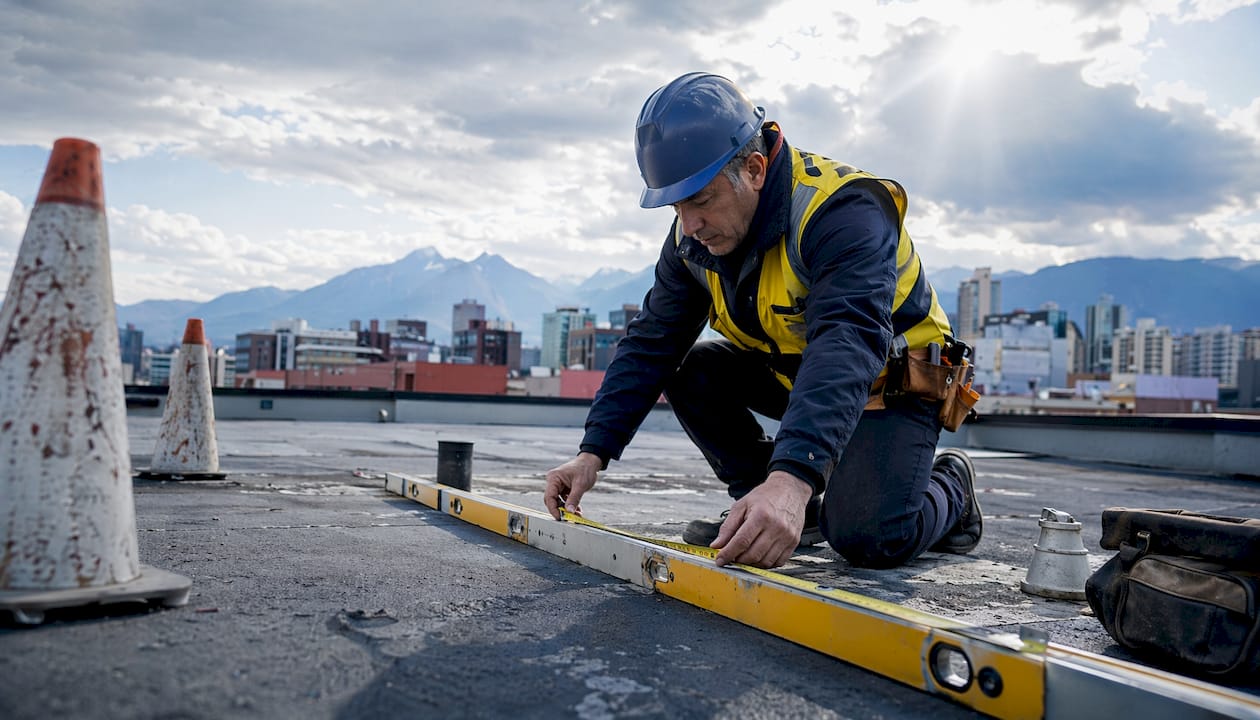
Slope is measured as rise over run. A roof that spans 40 feet from the centre to the drain edge needs at least 10 inches of total elevation change to meet the 0.25/12 standard. Many property owners are surprised to learn their roof has any slope at all. The pitch is invisible to the eye but critical to performance.
The membrane type affects how well a roof tolerates marginal slope. TPO and EPDM single-ply membranes perform well at the minimum 0.25/12 pitch when seams are properly welded and drains are correctly sized. Modified bitumen systems are also common in North Vancouver and tolerate low slopes, but they are more vulnerable to seam failure when water ponds repeatedly. Pitched roofs require slopes of 4/12 or steeper, so the tolerances on flat roofs are much tighter and leave no room for error.
| Roof type | Minimum slope | Common membrane |
|---|---|---|
| Low-slope flat roof | 0.25/12 | TPO, EPDM, modified bitumen |
| Low-slope commercial | 0.25/12 | TPO, built-up roofing |
| Steep-slope residential | 4/12 and above | Asphalt shingles, cedar |
Pro Tip: Map your roof surface with a level and tape measure after a rain event. Any area where water sits more than 24 hours after the rain stops is a zone that needs attention, regardless of what the original drawings say.
Why does ponding water damage flat roofs so quickly?
Standing water remaining on a flat roof for more than 24 to 48 hours after rain stops is a clear sign of drainage or structural failure. That threshold matters because most North Vancouver rain events are followed by dry periods of at least a day. If water is still sitting after that window, it is not draining. It is loading.
Ponding causes damage through several overlapping mechanisms:
- Membrane degradation. UV exposure combined with sustained moisture breaks down membrane chemistry faster than dry cycling. Seams are the first to fail because water infiltrates micro-gaps that expand with freeze-thaw cycles in winter.
- Structural load increase. Water weighs roughly 8.3 pounds per US gallon. A 10-foot by 10-foot pond just two inches deep adds over 500 pounds of load to the roof deck. That load accelerates structural deflection, which deepens the pond further.
- Insulation saturation. Once water breaches the membrane at a seam or drain collar, it saturates rigid insulation boards. Saturated insulation loses most of its thermal value and creates a breeding ground for mould.
- Accelerated wear at drains. The area immediately around a drain carries the most water traffic. Without adequate slope directing flow to that point, water spreads across the field of the roof and attacks the membrane uniformly rather than channelling cleanly.
Two causes of ponding go beyond slope design. The first is needle packing inside internal roof drains, a problem specific to North Vancouver’s abundance of pine and fir trees. Pine needles bypass standard dome strainers, compact inside the drain body, and block flow completely. The damage is invisible until insulation is already saturated. The second cause is structural deflection. Over time, roof decks sag slightly between joists or at mid-span, creating low spots that were never in the original design.
Waiting for water to evaporate from ponding zones is never a valid roof maintenance strategy. Chronic ponding zones signal either a slope deficiency, a blocked drain, or structural movement. Each cause requires a different fix, and none of them resolve on their own.
How should property managers inspect and maintain flat roof drainage?
Experts recommend scheduling flat roof inspections at the start of each summer and completing comprehensive drain and scupper cleanouts every october in BC. That two-inspection schedule is the minimum. Properties surrounded by conifers often need additional cleanouts in spring when needle drop is heaviest.
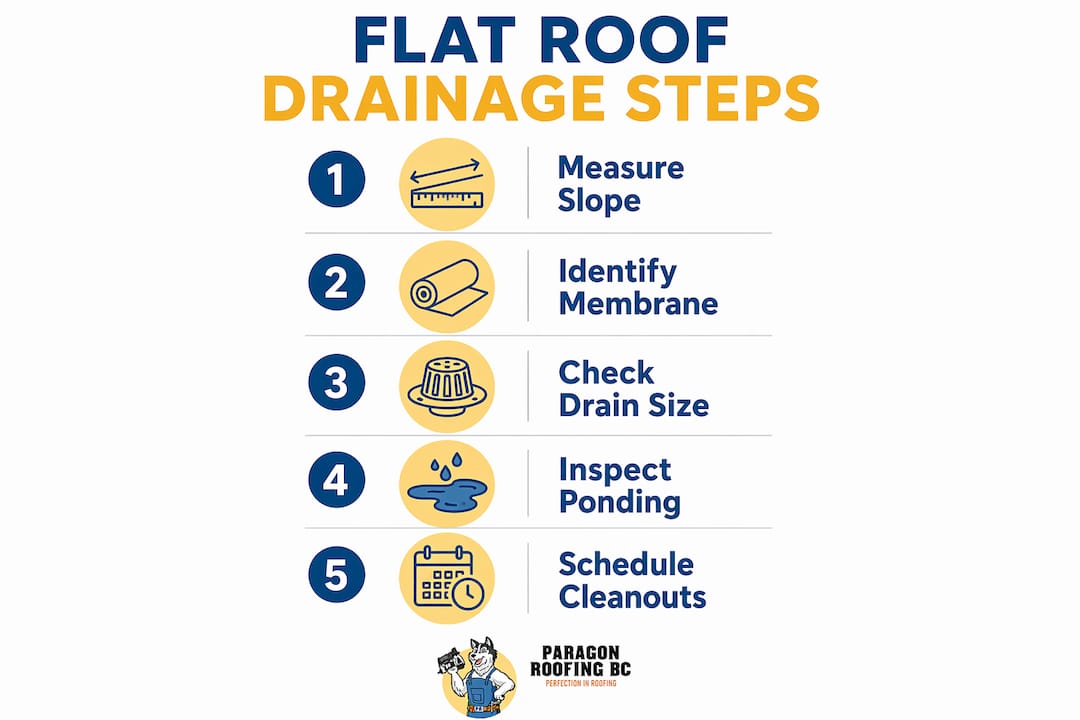
A practical inspection routine covers these steps in order:
- Walk the membrane surface. Look for blistering, cracking, or areas where the surface feels soft underfoot. Soft spots indicate saturated insulation below.
- Check all drains and scuppers. Remove drain covers and look inside the drain body, not just the surface. Needle packing sits below the strainer where you cannot see it from above.
- Inspect flashing at walls, curbs, and penetrations. Flashing failures at parapet walls and HVAC curbs are the second most common leak source after drainage failures.
- Map any ponding zones. After a rain event, photograph areas where water collects. Compare photos across seasons to track whether low spots are growing, which indicates ongoing structural deflection.
- Verify drain cover type. Standard dome strainers do not stop pine needles. Needle-proof covers with fine mesh inserts are worth the upgrade for any North Vancouver property with trees nearby.
- Check overflow scuppers. Overflow scuppers are the last line of defence if primary drains block. Confirm they are clear and set at the correct height above the roof surface.
October drain cleanouts are the critical deadline in North Vancouver’s flat roof maintenance calendar. Missing that window means entering the wet season with partially blocked drains. A single heavy November rain event can then cause ponding that saturates insulation and triggers a mid-winter emergency repair, which costs far more than a scheduled cleanout.
Pro Tip: Take dated photos of every drain and ponding zone during each inspection. A photo record over two or three years shows you whether structural deflection is progressing, which helps you plan a regrading project before it becomes an emergency.
What design and drainage system options work best for North Vancouver flat roofs?
Tapered insulation and structural slope techniques are the two main ways to achieve positive drainage on a flat roof. Tapered insulation uses polyisocyanurate boards cut at a factory-set angle, typically 0.25/12 or steeper, and installed beneath the membrane. This approach works well for reroofing projects where the deck structure cannot be altered. Structural slope means the roof deck itself is framed at a pitch, which is the preferred method for new construction because it eliminates the need for thick tapered boards at the high end of the roof.
Drain placement and sizing matter as much as slope. Undersized or improperly positioned drains are often the primary cause of flat roof drainage failures in BC commercial roofing, not membrane quality. A drain sized for average rainfall will overflow during a heavy event if debris has reduced its effective opening. North Vancouver’s peak rainfall volumes during atmospheric river events require drains sized generously, with overflow scuppers positioned to handle the excess.
The best drainage system for a North Vancouver flat roof combines these elements:
- Internal roof drains at the low points of each slope zone, sized for peak rainfall plus a safety margin.
- Overflow scuppers through parapet walls, set 2 inches above the primary drain rim to activate only when primary drainage is overwhelmed.
- Needle-proof drain covers with fine mesh inserts to prevent pine needle compaction inside the drain body.
- Tapered insulation at a minimum 0.25/12 pitch directing water from the field of the roof toward each drain.
- Positive drainage confirmation after installation, verified by a water test or post-rain inspection before the membrane warranty is activated.
For multi-unit residential and commercial properties in North Vancouver and Coquitlam, low slope roof waterproofing works best when the drainage system is designed as a whole, not added as an afterthought. Coquitlam commercial low slope drainage failures often trace back to drain placement decisions made during design that prioritised structural convenience over water management. Regrading a Coquitlam commercial low slope roof after the fact is expensive. Getting the slope and drain layout right the first time is always the better investment.
Key takeaways
A flat roof in North Vancouver requires a minimum drainage slope of 0.25/12, combined with correctly sized drains, needle-proof covers, and biannual inspections to prevent ponding and membrane failure.
| Point | Details |
|---|---|
| Minimum slope standard | Canadian guidance requires 0.25/12 for all low-slope single-ply roof applications. |
| Ponding threshold | Water remaining after 24–48 hours signals drainage or structural failure requiring investigation. |
| Needle packing risk | Pine needles compact inside drain bodies and block flow, causing hidden insulation damage. |
| October cleanout deadline | Completing drain cleanouts before november prevents mid-winter emergency repairs. |
| Tapered insulation solution | Factory-cut tapered boards achieve positive drainage on existing flat roofs without structural changes. |
What I have learned from years of North Vancouver flat roofs
Hey, it’s Harman here. After inspecting and working on flat roofs across North Vancouver for years, the pattern I keep seeing is this: property managers know the roof is “flat” and assume drainage takes care of itself. It does not. The slope is there, but it only works when the drains are clear, the insulation has not settled, and nobody has added a rooftop unit that created a new low spot.
The thing that surprises people most is needle packing. You pull the dome strainer off a drain and it looks fine. Then you reach inside and pull out a dense plug of compacted pine needles the size of a coffee can. That plug has been sitting there since spring, and the insulation beneath the membrane has been wet for months. By the time you find it, you are not just cleaning a drain. You are planning a partial reroof.
My honest advice is to treat october as a hard deadline, not a suggestion. North Vancouver’s first atmospheric river event can drop 50 mm of rain in a day. If your drains are 30% blocked going into that storm, you will have ponding. If you have ponding, you will have a phone call from a tenant. Get ahead of it. Schedule the cleanout, map your ponding zones, and call a roofer before the rain starts, not after.
— Harman
Flat roof drainage services from Paragonroofingbc
Paragonroofingbc works with property owners and managers across North Vancouver on flat roof inspections, drain cleanouts, tapered insulation regrading, and full membrane replacements. If your roof has chronic ponding zones or you have never had a professional drainage assessment, now is the right time to get one before the wet season arrives.
The team at Paragonroofingbc understands North Vancouver’s rainfall patterns, the needle-packing problem, and the specific membrane systems that perform best in this climate. Whether you manage a strata building, a commercial property, or a residential flat roof, Paragonroofingbc offers commercial roofing services in Vancouver and residential roofing services tailored to local conditions. Reach out to schedule an inspection before the next heavy rain season catches you off guard.
FAQ
What is the minimum drainage slope for a flat roof in North Vancouver?
The minimum drainage slope for a low-slope roof is 0.25/12, meaning a quarter inch of rise for every foot of horizontal run. Canadian roofing guidance requires this minimum for single-ply membrane applications to prevent persistent ponding.
How long can water sit on a flat roof before it causes damage?
Standing water after 24 to 48 hours signals a drainage or structural problem. Beyond that window, sustained load and moisture accelerate membrane seam failure and insulation saturation.
What causes flat roof drains to block in North Vancouver specifically?
Pine needle packing is the most common hidden cause. Needles bypass standard dome strainers and compact inside the drain body, blocking flow completely while appearing clear from the surface.
When should I schedule flat roof maintenance in North Vancouver?
Schedule a membrane integrity inspection at the start of summer and a full drain and scupper cleanout every october. Completing the october cleanout before the wet season starts prevents emergency repairs during winter storms.
Can tapered insulation fix a flat roof that does not drain properly?
Yes. Tapered insulation boards cut at 0.25/12 or steeper can be installed beneath a new membrane to create positive drainage on an existing flat deck without changing the roof structure.
Recommended
Our Roofing Blog


Have more questions about roofing?
Check out our FAQs or give us a call today to speak to an expert roofer in Vancouver Lower Mainland, BC. We're here to help our neighbours make educated decisions about their roof. For our team, we value helping clients save money while making their roofs last.