North Vancouver commercial green roof challenges: 2026 guide
North Vancouver commercial green roof challenges: 2026 guide
TL;DR:
- North Vancouver’s unique climate and strict stormwater regulations create significant challenges for commercial green roofs. Proper design, local experience, and ongoing maintenance are essential for long-term performance and asset value. Investing in qualified professionals and integrated planning reduces risks and ensures regulatory compliance.
Commercial green roofs in North Vancouver are defined as vegetated roofing systems installed on commercial buildings to manage stormwater, reduce urban heat, and extend membrane life. North Vancouver commercial green roof challenges are real and specific: intense coastal rainfall, strict municipal runoff targets, heavy structural loads, and maintenance demands that most property managers underestimate. These are not generic urban green roof problems. They are shaped by North Vancouver’s geography, its rain patterns, and its updated 2026 building and rainwater standards. This guide gives you the practical picture so you can plan, budget, and manage a green roof that actually performs.
What makes North Vancouver commercial green roof challenges unique?
North Vancouver’s climate is the starting point for every design decision. The district receives some of the highest annual rainfall in Metro Vancouver, and that rainfall does not arrive gently. Back-to-back storm events are common from october through march, saturating growing media before the previous storm has fully drained.
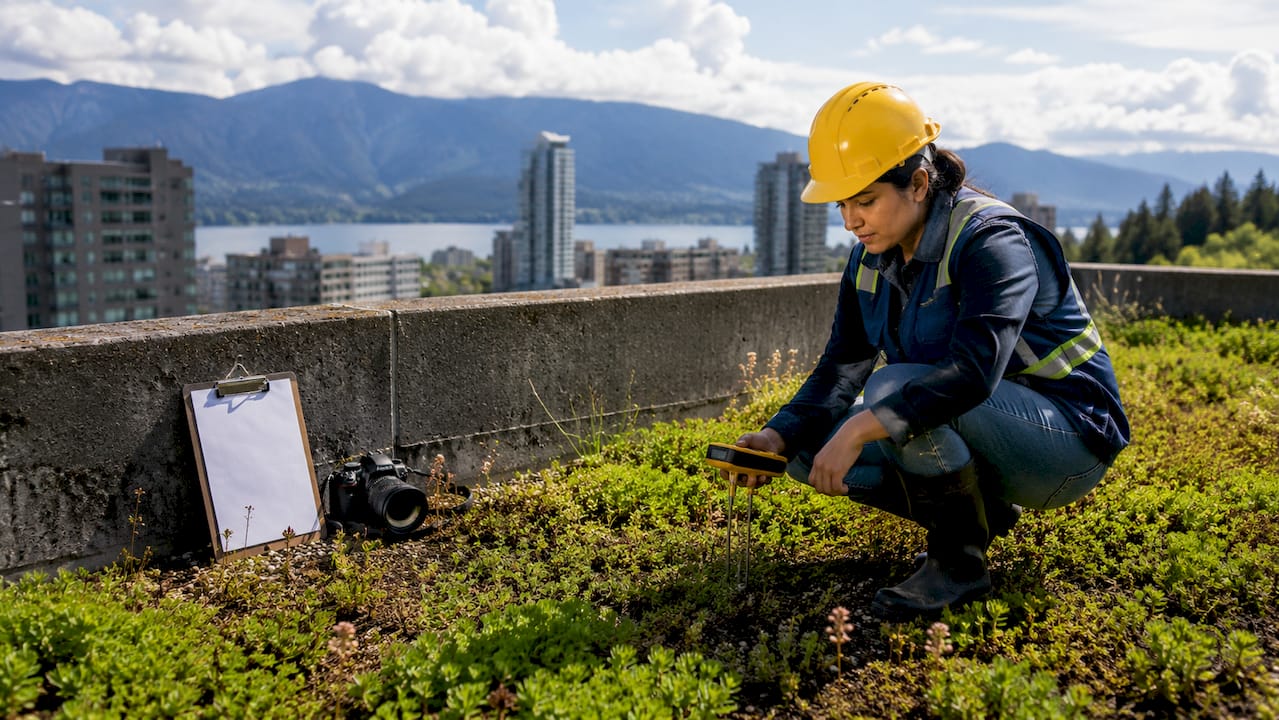
Municipal rainwater regulations have tightened significantly. North Vancouver now requires managing rainwater release rates to as low as 25 litres per second per hectare, with targets to retain 24–48 mm of rainfall for flood mitigation. That is a precise engineering target, not a general guideline. A green roof that meets these targets in a dry summer month may fall short during a november downpour.
Structural load is the second major constraint. A saturated extensive green roof can weigh 80–150 kg per square metre. An intensive system with deeper growing media weighs considerably more. Older commercial buildings in North Vancouver were not designed with those loads in mind. Before any green roof goes on, a structural engineer must assess the deck, the beams, and the parapet walls.
The regulatory picture adds another layer. Performance-based design modelling tailored to site hydrology is now the expected approach, replacing older prescriptive rules. That means your design team needs hydrological modelling skills, not just roofing experience.
Key structural and regulatory challenges include:
- Structural capacity: Saturated media loads require engineering sign-off before design begins.
- Runoff rate compliance: Release rates must meet municipal targets tied to design storm events.
- Retention depth: Growing media and drainage layers must be sized to retain 24–48 mm of rainfall.
- Performance modelling: Site-specific hydrological models replace generic prescriptive rules.
- Flood mitigation alignment: Green roof design must integrate with the broader site drainage strategy.
What does green roof maintenance actually cost in North Vancouver?
Maintenance is where most commercial property managers get a surprise. A green roof is not a set-and-forget system. It is closer to a living building component that needs scheduled attention from people who understand both roofing and horticulture.
Annual maintenance costs for commercial green roofs range from roughly $0.68 to $8.20+ per square foot (Canadian equivalent), depending on roof intensity and complexity. An extensive roof with sedum and low-growing plants sits at the lower end. An intensive roof with shrubs, trees, and irrigation infrastructure sits at the higher end. That cost spread is wide enough to change your operating budget significantly.
A practical maintenance schedule for a North Vancouver commercial green roof looks like this:
- Monthly visual checks: Walk the roof perimeter and drainage outlets. Look for pooling water, plant die-off, debris accumulation near drains, and any membrane exposure at edges.
- Quarterly drain cleaning: North Vancouver’s leaf fall and storm debris block roof drains faster than most owners expect. Blocked drains cause ponding, which adds load and risks membrane damage.
- Bi-annual fertilisation and weed control: Invasive species establish quickly in coastal BC. Weeding and targeted fertilisation keep the plant community healthy and prevent root intrusion.
- Annual full inspection: A thorough inspection covers waterproofing membrane condition, drainage layer integrity, growing media depth, plant health, and edge flashing. This is the inspection that protects your warranty.
Pro Tip: Book your annual inspection in late september or early october, before the heavy rain season begins. Catching drainage issues in dry weather is far easier and cheaper than diagnosing them mid-storm.
Effective maintenance requires collaboration between roofing specialists and landscape professionals. Neither discipline alone covers the full scope. A roofer who does not understand plant root behaviour may miss early signs of membrane penetration. A landscaper who does not understand waterproofing may damage flashings during routine planting work.
The Green Roof Industry Maintenance Professional (GRIMP) accreditation programme, launched in 2024, addresses this gap directly. GRIMP-accredited professionals bring integrated roofing and horticultural knowledge to commercial maintenance contracts. Asking for GRIMP accreditation when hiring a maintenance provider is a straightforward way to filter for qualified candidates.
What technical problems affect green roof performance and longevity?
The technical risks in green roof installation are well documented. 45% of new roofs encounter serious problems within a year, with causes split across poor workmanship (50%), poor design (20%), and poor maintenance (15%). Those numbers apply to conventional roofing. Green roofs add complexity, which raises the stakes for each failure category.
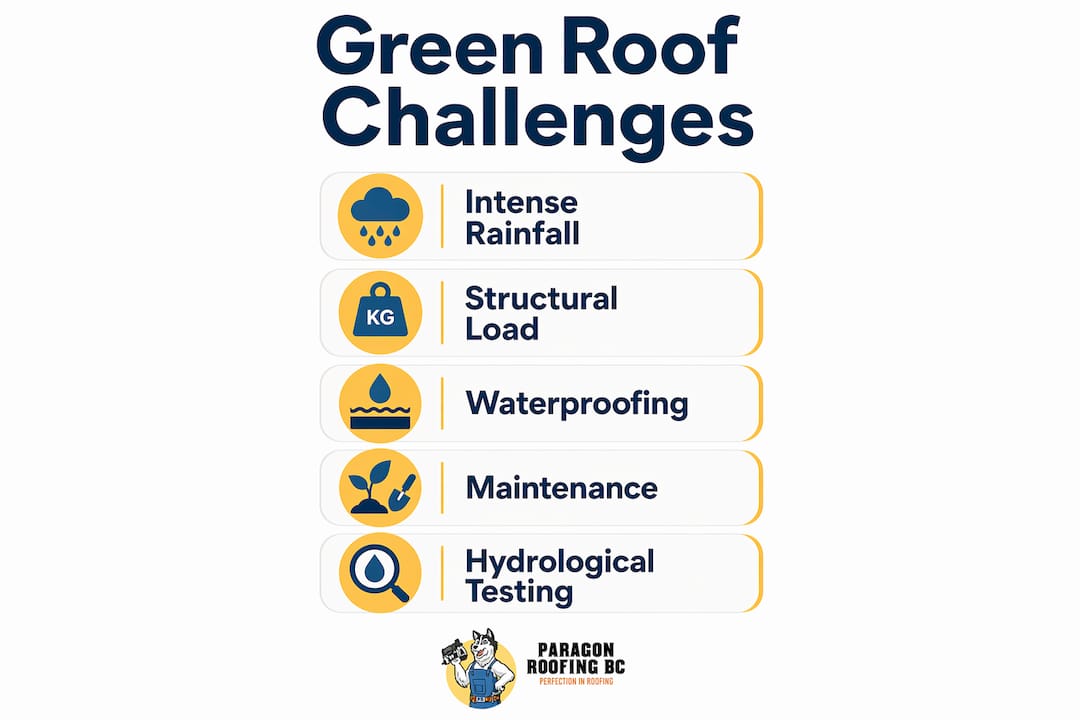
Waterproofing membrane protection is one area where green roofs actually help. Green roofs reduce temperature fluctuations and protect membranes from UV degradation, extending their lifespan considerably compared to exposed membranes. That is a genuine long-term benefit. The trade-off is that membrane damage, when it does occur, is harder to detect and access under a planted system.
Hydrological performance is the most variable technical factor in North Vancouver’s climate. Rooftop stormwater performance varies significantly depending on rainfall intensity, antecedent moisture conditions, and storm frequency. A green roof that retains 80% of a light summer rain may retain far less during a series of consecutive winter storms when the growing media is already saturated.
| Technical challenge | Mitigation approach |
|---|---|
| Membrane damage under planted media | Use root-resistant membranes and install a separation layer above the waterproofing |
| Drain blockage from debris and root growth | Install drain guards and schedule quarterly cleaning |
| Saturation during consecutive storms | Size drainage layers for worst-case storm sequences, not average events |
| Undetected membrane leaks | Conduct annual electronic leak detection scans beneath the growing media |
| Growing media compaction over time | Specify media with stable particle structure and monitor depth annually |
Pro Tip: Request third-party quality assurance testing on your waterproofing membrane before the growing media goes down. Once the roof is planted, finding a leak means removing plants and substrate. Testing before planting costs a fraction of that.
Hydrological testing under dynamic rainfall simulations shows that green roofs behave differently under consecutive storms than under single events. Design teams that model only single-storm performance may produce a roof that meets permit requirements but underperforms during North Vancouver’s real rain seasons.
How do you overcome green roof challenges on North Vancouver commercial properties?
Success with a commercial green roof in North Vancouver comes down to planning decisions made before a single plant goes in the ground. The following approaches consistently produce better outcomes for commercial property owners.
- Hire a team with local experience. A designer who has worked in coastal BC understands saturated media loads, freeze-thaw cycles at elevation, and the specific drainage demands of North Vancouver winters. Offshore or out-of-province designers often underestimate these factors.
- Require performance-based hydrological modelling. Ask your design team to model back-to-back storm events, not just a single design storm. This aligns with current municipal expectations and produces a more honest picture of retention performance.
- Specify root-resistant membranes from the start. Upgrading the membrane specification at design stage costs far less than replacing a damaged membrane after planting.
- Build maintenance costs into your operating budget before you approve the project. A green roof that receives inadequate maintenance will fail faster than a conventional roof. Budget for professional maintenance from year one.
- Align your green roof design with flat roof drainage requirements. Green roofs work best when the drainage strategy for the whole building is coordinated, not treated as a separate system.
- Ask for warranty documentation that covers both the waterproofing and the growing system. Some warranties become void if maintenance is not performed by accredited professionals. Read the conditions before signing.
- Monitor growing media depth annually. Media compacts and erodes over time. Thin media reduces retention capacity and stresses plants, which then require more intervention to stay healthy.
Green roofs in coastal BC reduce stormwater runoff by up to 90% during the dry season. That figure drops significantly in wet-season conditions, which is why monitoring and adaptive maintenance matter so much in North Vancouver’s climate. The goal is a roof that performs well year-round, not just in the months when performance is easiest to achieve.
Key takeaways
North Vancouver commercial green roofs succeed when structural assessment, performance-based design, and professional maintenance are treated as non-negotiable from the start, not as optional upgrades.
| Point | Details |
|---|---|
| Rainwater targets are strict | North Vancouver requires retaining 24–48 mm of rainfall, demanding precise drainage design. |
| Maintenance costs vary widely | Annual costs range from roughly $0.68 to $8.20+ per square foot depending on roof intensity. |
| Membrane protection matters | Root-resistant membranes and pre-planting leak detection prevent costly hidden failures. |
| Storm performance is variable | Consecutive winter storms saturate growing media, reducing retention capacity significantly. |
| GRIMP accreditation is the benchmark | Hiring GRIMP-accredited professionals ensures integrated roofing and horticultural expertise. |
What I’ve learned from green roofs in North Vancouver
Hey, it’s Harman here. I want to share something I see repeatedly on commercial green roof projects in North Vancouver, because it costs property managers real money.
Most of the problems I encounter are not design failures. They are maintenance failures that started in year two or three, when the initial enthusiasm wore off and the roof got handed to whoever was cheapest. A green roof is not a garden on a building. It is a waterproofing system with plants on top. The moment you treat it like a garden, the waterproofing starts losing.
The other thing I see is designers who model performance for a single storm and call it done. North Vancouver does not give you single storms. It gives you a week of rain, a dry day, then another week of rain. A roof that looks great on paper can be overwhelmed by that sequence if the drainage layer was not sized for it.
What actually works is bringing a commercial roofing specialist into the conversation at the same time as the landscape architect, not after. The two disciplines need to agree on membrane specification, drainage layer depth, and access points before anyone talks about plant selection. When that conversation happens early, the project goes smoothly. When it happens late, you get compromises that show up as leaks three years down the road.
The challenges of urban green roofs in North Vancouver are real, but they are manageable. The owners who succeed are the ones who treat the roof as a long-term asset and invest in the right people from day one.
— Harman
Paragonroofingbc and commercial green roofs in North Vancouver
Paragonroofingbc works with commercial property owners and managers across North Vancouver on roofing projects that require more than a standard installation. Green roofs sit at the intersection of waterproofing, drainage engineering, and plant systems, and getting that intersection right requires local experience with coastal BC conditions.
Paragonroofingbc provides commercial roof installation services that account for North Vancouver’s rainfall intensity, structural load requirements, and municipal runoff targets. Whether you are planning a new green roof, assessing an existing one, or dealing with drainage issues on a planted system, the team at Paragonroofingbc can help you work through the specifics. Reach out through commercial roofing Vancouver to discuss your project and get a clear picture of what your building actually needs.
FAQ
What are the main green roof issues in North Vancouver?
The primary issues are intense rainfall saturation, strict municipal runoff targets requiring retention of 24–48 mm of rainfall, structural load from wet growing media, and the need for integrated roofing and horticultural maintenance expertise.
How much does commercial green roof maintenance cost in BC?
Annual maintenance costs range from roughly $0.68 to $8.20+ per square foot in Canadian terms, depending on whether the roof is extensive or intensive. Routine inspections, drain cleaning, and plant management all contribute to that cost.
What is GRIMP and why does it matter for commercial properties?
GRIMP stands for Green Roof Industry Maintenance Professional, an accreditation programme launched in 2024. It certifies professionals with combined roofing and horticultural knowledge, which is the standard commercial property owners should require from maintenance contractors.
How does North Vancouver sustainable roofing align with municipal regulations?
North Vancouver requires performance-based design modelling that meets specific runoff release rates and rainfall retention targets. Green roofs that are properly designed and maintained contribute directly to meeting those municipal stormwater management requirements.
Can a green roof protect the waterproofing membrane underneath?
Yes. Green roofs shield membranes from UV exposure and temperature swings, which extends membrane lifespan. However, root-resistant membranes and annual leak detection scans are still required to catch any damage before it becomes a major repair.
Recommended
Our Roofing Blog


Have more questions about roofing?
Check out our FAQs or give us a call today to speak to an expert roofer in Vancouver Lower Mainland, BC. We're here to help our neighbours make educated decisions about their roof. For our team, we value helping clients save money while making their roofs last.