
Act at 0.6 Meters: Surrey Flat Roof Blisters and When to Inspect
Act at 0.6 Meters: Surrey Flat Roof Blisters and When to Inspect
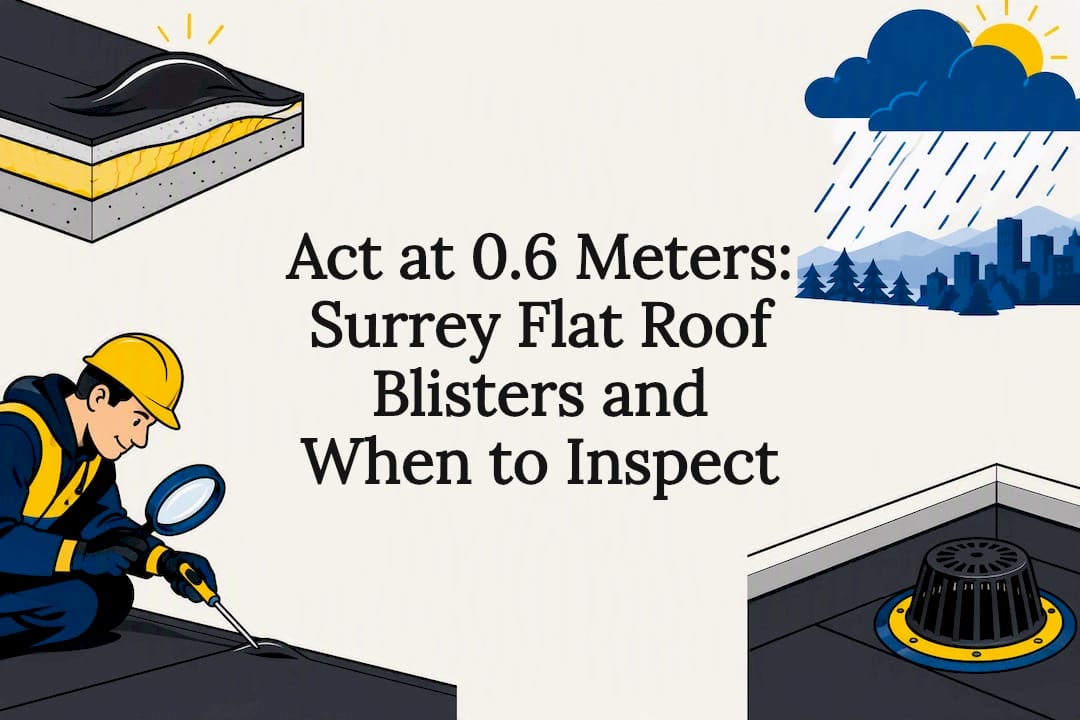
A flat roof blister is a pocket of trapped air or water vapour lifting the membrane away from the roof deck. If it’s intact, dry, and small, you can usually monitor it. If it’s ruptured, wet, larger than roughly 0.6 metres across, or sitting near a drain, treat it as urgent, especially heading into Surrey’s wet season, and get a licensed inspection before it turns into an interior leak.
TL;DR:
- Blisters larger than 0.6 meters or near drains require urgent inspection and repair before they lead to interior leaks, especially during Surrey’s rainy season.
- Water vapour pressurizes blisters more aggressively than dry air, with wet substrates during hot application being a common root cause of severe blistering.
- Most roof blisters result from installation issues like unbonded layers, residual moisture, or surface debris, which are worsened by Surrey’s temperature swings and moisture exposure.
- Repairing small, dry, intact blisters involves monitoring or surface coating, while ruptured or large blisters need cutting out, drying, and patching, with full rebuilds for widespread or recurring damage.
- Annual inspections, drain clearance, and addressing ponding within 48 to 72 hours are key preventative measures to reduce blistering risk in Surrey’s climate.
Table of Contents
- What causes surrey flat roof blisters?
- What do roof blisters look like? Three types to know
- Should you monitor or repair a flat roof blister?
- How do you fix a roof blister? Repair options explained
- Preventing flat roof blisters in Surrey’s climate
- Our local inspection checklist for Surrey flat roofs
- Author Harman’s expert take
- Get your Surrey flat roof inspected before the rain settles in
- Primary sources and further reading
- Sources
- FAQ
What causes surrey flat roof blisters?
Blisters start with a void: a tiny pocket of air or moisture trapped between roofing layers during installation. Nothing dramatic happens at first. Then the sun hits the roof, and that trapped gas expands. At night, the membrane cools, contracts slightly, and pulls in a little more air or vapour through whatever gap let the first bit in. Do that every day for a season, and a pinhead void becomes a blister you can see from the ground.
NRC research on SBS modified bitumen roofs confirms that most blister gas is a mix of ordinary air and water vapour, and that daily thermal cycling, not one big event, drives the growth. This is thermal pumping, and it’s relentless because Surrey gets real temperature swings between summer roof-surface heat and cool coastal nights.
Installation quality decides how many voids you start with. Common culprits include:
- Mopping skips during torch-on or built-up application, leaving unbonded pockets between layers
- Parting agents or dust left on the cap sheet that block proper adhesion
- An uneven substrate that traps air pockets under the membrane
- Materials applied while damp, either from job-site exposure or improper storage
Here’s the detail most homeowners never hear: water vapour pressurizes a blister far more aggressively than dry air does. Trade research summarized in Professional Roofing notes that wet substrates during hot application are one of the most common root causes of severe blistering, because that trapped moisture keeps re-expanding every warm afternoon.
SBS-modified bitumen and older built-up roofs blister more often than single-ply systems because they’re assembled in multiple hot-applied layers, each one a fresh opportunity for a void. Surrey’s climate makes this worse: with annual rainfall in the 1,150 to 1,400 millimetre range for the Lower Mainland, wind-driven moisture finds its way into parapet details and terminations that were marginal from day one. Ponding water sitting over a weak seam does the rest.
What do roof blisters look like? Three types to know
Not every bump in a flat roof membrane is the same problem, and telling them apart matters when you’re deciding whether to call for a repair or just keep an eye on things.
- Plate (pancake) blisters. These are broad, rounded bulges, sometimes the size of a dinner plate or larger, usually formed where a wide area lost adhesion. They carry the highest risk because they trap the most gas and are the most likely to rupture under foot traffic or hail.
- Linear blisters. These run in a straight line along a seam or lap edge, a telltale sign the adhesion failure followed the mopping pattern. They often signal a systemic installation issue rather than a one-off defect, since laps are a predictable weak point.
- Rash blisters. These show up as a cluster of small bumps, often on cap sheet tape or coated surfaces, and usually point to a surface-level bonding problem rather than a deep membrane void.
When you’re documenting a blister for an inspector, photograph it from directly above with something for scale (a tape measure or a coin), and note the date. Check the areas around roof drains, seams, and parapet walls first, since that’s where Surrey’s wind-driven rain tends to concentrate. One safety note worth repeating: don’t walk on a cold blister to test it. Cold membrane is brittle, and stepping on a pressurized void can rupture it and start a leak that wasn’t there yesterday.
Should you monitor or repair a flat roof blister?
This is the decision that actually matters, and it’s simpler than most homeowners assume once you know the thresholds.
Monitor if the blister is:
- Small (well under 0.6 metres across)
- Fully intact, with no visible tear or soft spot
- Dry to the touch and shows no staining underneath indoors
- Located away from drains, seams, or ponding areas
Schedule repair or inspection if the blister is:
- Ruptured, torn, or leaking gas or water when pressed
- Larger than roughly 0.6 metres (2 feet), a threshold that industry guidance summarized by the NRCA treats as a practical trigger for intervention
- Pulling apart a seam by about a third or more of its width
- Sitting near a drain, scupper, or a spot where you’ve noticed ponding after rain
- Paired with interior signs: ceiling stains, damp insulation, or a musty smell in the attic or top-floor unit
If you’re seeing water stains inside the building anywhere near a known blister, that’s not a “wait and see” situation anymore. Water has already found a path through the membrane.
Pro Tip: Don’t cut a blister open yourself to “check” it. Slicing into a pressurized void without the right patching materials on hand often turns a monitorable defect into an active leak within days, especially if rain moves in before you get it sealed back up.
Cutting is a professional’s job because what you find underneath (dry void versus saturated insulation) changes the entire repair plan. A contractor who opens a blister and finds an oily film rather than a clean bond at the interface is looking at a poor installation bond, not just a moisture problem, and that changes the scope of work.
How do you fix a roof blister? Repair options explained
What a roofer does with a blister depends entirely on its size, condition, and what’s found once it’s opened up.
For small, intact, dry blisters:
- Leave it in place and log it for the next inspection cycle.
- Apply a compatible surface coating or reinforced patch over top if it’s in a high-traffic or high-visibility area, without cutting into the membrane.
For ruptured, wet, or large blisters:
- Cut out the raised, damaged section down to sound material.
- Let the substrate dry fully before doing anything else. Patching over damp insulation just reseals moisture in.
- Rebuild the area with new layers, alternating bitumen and felt or membrane per manufacturer specification, matching what’s already on the roof.
- Re-seam and seal the perimeter of the patch so the new work bonds to the old membrane rather than sitting on top of it.
Some situations call for more than a patch. If blistering is widespread across a section, or if repeated ruptures point to a systemic bonding failure across the whole field, a section rebuild or full re-cover is the more honest answer than another round of spot patches. This is especially true on roofs already past 15 to 20 years old, where one blister is rarely the only weak spot.
When you’re vetting a contractor’s proposed repair, ask about workmanship details that separate a lasting fix from a temporary one:
- Mopping at the Equiviscous Temperature (EVT), the specific asphalt temperature range that gives proper adhesion, a control NRC guidance specifically recommends
- Contact compatibility between new and existing membrane materials, since not every product bonds to every other
- Rolls relaxed before application rather than installed straight off a cold truck
- Coverboards installed over foam insulation, which gives the membrane a stable, moisture-resistant surface to bond to instead of the foam directly
Preventing flat roof blisters in Surrey’s climate
Blister prevention starts before a single roll of membrane touches your roof deck, and it continues every year after with basic maintenance most owners skip until something leaks.
At installation, moisture control is everything. Materials should be checked and stored dry, off the ground, and covered on site, because a damp roll of felt or a rain-soaked bundle of cap sheet is a blister waiting to happen once it’s mopped in. A crew working to a real standard will apply asphalt at EVT, avoid mopping skips, relax rolls before laying them, and remove any parting agents or dust from the cap sheet before the next layer goes down. NRC’s own field guidance treats these as the baseline procedural controls that separate a low-void roof from a blister-prone one, even with skilled crews.
Design details matter just as much as workmanship. Proper fall toward drains, drains kept clear of debris, and solid protection at parapets and terminations against wind-driven rain are what keep Surrey’s weather from becoming a blister factory. Regional flat-roof commentary points to detail failures at parapets and terminations as the source of the worst blistering patterns seen across the Lower Mainland, precisely because sustained wind-driven moisture finds every weak seam.
On the maintenance side:
- Book a visual inspection at least once a year, ideally before the fall rains arrive
- Clear drains and scuppers every few months, more often near trees
- Address any ponding water that lasts longer than 48 to 72 hours rather than assuming it will drain on its own
- Watch for shrinkage or seam lift on EPDM and TPO sections, which behave differently from modified bitumen and need their own maintenance focus, per regional trade guidance
Pro Tip: If your building has a mix of roofing systems (say, an EPDM section next to an older SBS section), inspect them separately. They fail differently, and treating them with the same maintenance checklist misses problems specific to each material.
Material selection for the Lower Mainland should account for how each system handles sustained moisture exposure, not just upfront cost. A membrane that performs fine in a drier climate can behave very differently under 1,150 to 1,400 millimetres of annual rainfall.
Our local inspection checklist for Surrey flat roofs
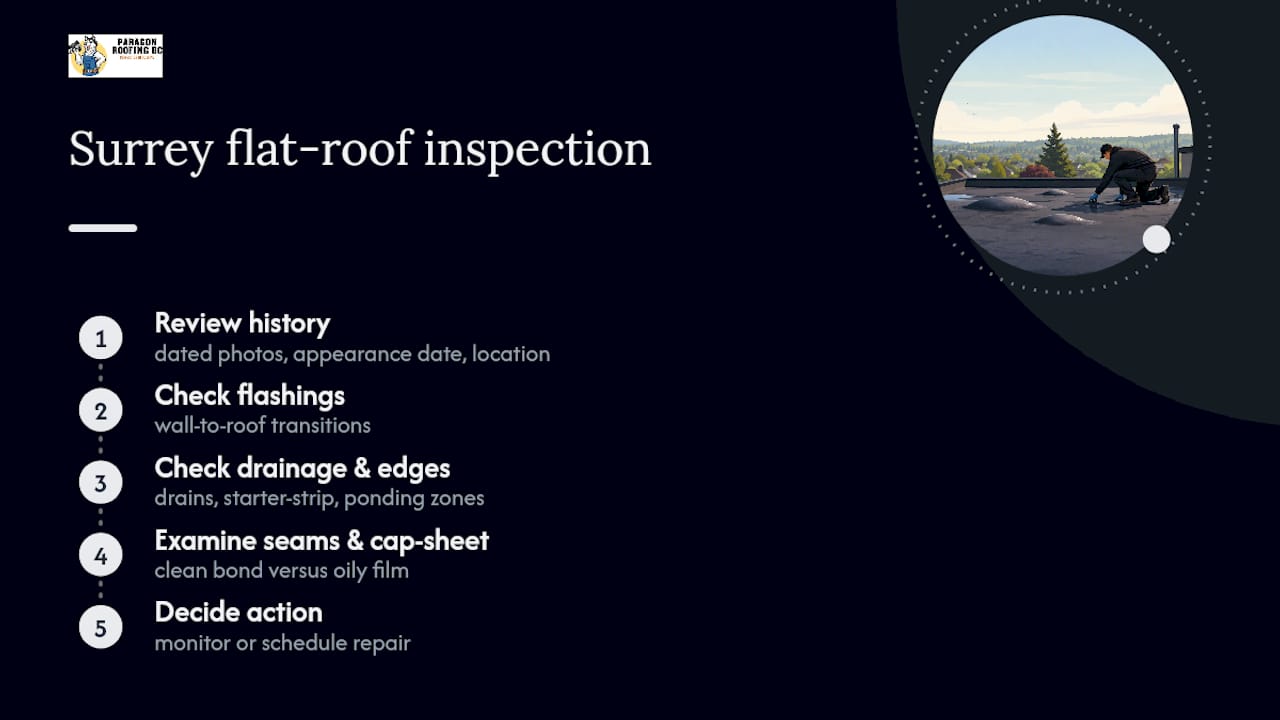
When we inspect a blistered flat roof in Surrey, we start with what the homeowner already has: dated photos, notes on when the blister first appeared, and its location relative to drains and parapets. That history alone often tells us whether we’re looking at a slow thermal-cycling void or a fresh moisture problem.
On site, we check the usual failure points we see repeatedly across Surrey properties: flashing failures at wall-to-roof transitions, clogged or undersized drains, starter-strip issues at the roof edge, and ponding zones that never quite drain. We examine seams closely and, where a blister needs opening, look at the underside of the cap sheet for a clean bond versus an oily, contact-incompatible film, a sign of deeper installation problems. That inspection is what determines whether we recommend monitoring or move straight to scheduling a repair.
Author Harman’s expert take
My honest read: Surrey’s blistering problems are rarely about bad membrane. They’re about drainage and moisture control that got compromised at install and never fixed. Check your drains, photograph anything raised on the roof, and book a licensed inspection before the rainy season builds up, not after a ceiling stain forces your hand.
— Harman
Get your Surrey flat roof inspected before the rain settles in
A blister that looks minor in August can be an active leak by November, and that’s the gap Our team exists to close for Surrey property owners. Rather than guessing at repair urgency from a ladder, our residential and commercial teams document the roof, map moisture where it’s suspected, and give you a written scope and quote before any cutting starts, helping owners make informed decisions.

For homeowners, our residential roofing services cover inspections, repairs, and full reroofing when a blistered section has gone too far to patch. If you manage a strata or multifamily building, our strata and multifamily roofing services are built around the reporting and photo evidence that a council needs before approving repair budgets. Commercial owners dealing with widespread blistering or recurring ponding can start with our commercial roofing services page. Every inspection comes back with photo evidence, a clear scope, and a quote you can actually act on. Book a Surrey flat roof inspection before the next storm system rolls in off the coast.
Primary sources and further reading
Technical grounding for this article comes from NRC’s SBS blistering research, NRCA guidance via Professional Roofing, and BC’s building codes and standards.
Sources
FAQ
What causes blisters on a flat roof?
Blisters form when air or water vapour gets trapped between roofing layers during installation, then expands and contracts with daily temperature swings until it lifts the membrane. Common causes include mopping skips, wet materials applied during construction, and parting agents left on the cap sheet, as documented in NRC’s blistering research.
What does a roof blister look like?
A blister looks like a raised, rounded bump or ridge in the roof membrane, ranging from a small rash of bumps to a broad plate-shaped bulge the size of a dinner plate or larger. Linear blisters run in a straight line along a seam, while rash blisters cluster in small groups on cap sheet tape or coatings.
Will bubbles in EPDM go away on their own?
Small, intact bubbles sometimes stay stable for years if no moisture gets in, but they rarely disappear completely on their own. EPDM tends to shrink and lift at seams over time rather than reabsorb trapped gas, which is a different failure pattern than the thermal-pumping blisters common on modified bitumen roofs.
Will insurance cover an older flat roof in Surrey?
Coverage for an aging flat roof depends entirely on your policy’s wear-and-tear exclusions and the specific insurer, so there’s no single answer that applies across the board. Sudden damage from a storm is more likely to be covered than long-term deterioration from blistering that went unaddressed, which is another reason to document and repair blisters early rather than waiting.
How much does flat roof blister repair cost in Surrey?
Costs vary widely depending on blister size, whether a full section rebuild is needed, and roof access, so Paragon Roofing BC provides a written quote after an on-site inspection rather than a blanket estimate. You can book an inspection to get pricing specific to your roof’s condition.
Recommended
Our Roofing Blog


Have more questions about roofing?
Check out our FAQs or give us a call today to speak to an expert roofer in Vancouver Lower Mainland, BC. We're here to help our neighbours make educated decisions about their roof. For our team, we value helping clients save money while making their roofs last.