Flat roof drainage workflow: a BC property owner’s guide
TL;DR:
- British Columbia’s challenging climate demands well-designed, maintained flat roof drainage systems to prevent costly damage. Proper oversize drains, secondary overflow scuppers, and routine inspections are critical for long-term protection. Active management, testing, and professional support like Paragon Roofing BC ensure reliable drainage performance.
British Columbia throws a lot at your flat roof. From Metro Vancouver’s relentless autumn rains to the Fraser Valley’s freeze-thaw cycles and the snow loads common across the Interior, your flat roof drainage workflow is either working for you or quietly failing you. A single blocked drain during a heavy November storm can turn a manageable inconvenience into thousands of dollars in membrane repairs, structural damage, and interior water damage. This guide walks you through a practical, proven process for designing, installing, and maintaining an effective drainage system that holds up to whatever BC’s weather delivers.
Table of Contents
- Understanding the flat roof drainage problem in British Columbia
- Preparing for flat roof drainage workflow: requirements and design considerations
- Executing the flat roof drainage workflow: step-by-step guide
- Verifying and maintaining your flat roof drainage system
- Rethinking flat roof drainage: why redundancy and testing are your best defence
- How Paragon Roofing BC supports your flat roof drainage needs
- Frequently asked questions
Key Takeaways
| Point | Details |
|---|---|
| BC’s climate challenges | Heavy rain, snow, and freeze-thaw cycles make flat roof drainage critical for building safety in BC. |
| Redundancy is essential | Primary drains must be backed by secondary overflow systems to prevent dangerous water buildup. |
| Accurate sizing matters | Calculate drainage capacity using roof area and local rainfall intensity for effective system design. |
| Regular maintenance prevents failure | Frequent inspection and clearing of drains and scuppers help avoid costly water damage. |
| Professional expertise protects | Engaging experienced roofing professionals ensures durable, code-compliant flat roof drainage solutions. |
Understanding the flat roof drainage problem in British Columbia
BC’s climate is not kind to flat roofs. Metro Vancouver sees well over 1,100 mm of rainfall annually, and areas like the North Shore push past 2,500 mm. Add freeze-thaw cycles in shoulder seasons and the occasional snow load event, and you have conditions that would challenge even a well-designed drainage system.
The core problem is simple: water has nowhere to go on its own. Unlike a sloped roof that naturally sheds water toward gutters, a flat roof relies entirely on a designed drainage system to move water off the surface before it becomes a problem. Even a small amount of standing water, what roofers call “ponding,” creates ongoing pressure on the membrane and can cause it to fail prematurely.
Here is where many building owners get caught out. They install primary internal drains and consider the job done. But primary drains clog. Leaves, pine needles, and construction debris are constant offenders in BC. When a primary drain fails during a heavy storm, the only thing standing between you and a catastrophic ponding event is your secondary overflow system. Overflow scuppers are required as a safety measure against primary drain failure during extreme rainfall, and BC’s building code reflects this.
Key risks of poor flat roof drainage:
- Membrane blistering and premature failure from sustained water contact
- Structural deck damage from water infiltration and freeze-thaw action
- Interior leaks causing damage to insulation, ceilings, and building systems
- Mould growth in insulation layers, which is expensive to remediate
- Voided roofing warranties if drainage does not meet manufacturer specifications
Think of your drainage system like the brakes on a vehicle. You hope you never need them at full force, but the day you do, there is no substitute for having them properly installed and regularly checked. A well-rounded approach to managing rainwater on flat roofs starts with understanding both your primary and secondary systems as a single unit, not two separate afterthoughts.
Pro Tip: If you manage a building in a treed area anywhere near Metro Vancouver or the Tri-Cities, schedule drain inspections every autumn before the heavy rains arrive. Leaf accumulation alone can block a primary drain in days during peak fall season.
Preparing for flat roof drainage workflow: requirements and design considerations
Before any work begins, good flat roof drainage solutions start on paper. You need three numbers above everything else: your roof’s total area in square metres, the local design rainfall intensity in millimetres per hour, and your roof’s runoff coefficient (typically 0.9 to 1.0 for flat roofs with waterproof membranes).
Drainage capacity calculations are based on roof area and design rainfall intensity sourced from NOAA Atlas 14 data, which has been adapted for Canadian climate regions and informs BC’s plumbing and building codes. In Metro Vancouver, design rainfall intensity for a ten-year storm event typically falls between 75 and 100 mm per hour. For an industrial roof drainage workflow on a large commercial building, these numbers directly determine the number and size of drains and scuppers required.
Core materials you will need to plan for:
- Primary internal roof drains with clamping rings and strainer domes
- Secondary overflow scuppers or secondary drains, positioned at a height slightly above the primary drain level
- Drain piping sized for calculated flow rates, with freeze protection in applicable zones
- Lead or TPO (thermoplastic polyolefin) flashing collars to seal drains into the membrane
- Waterproof membrane material for patching around new penetrations
Here is a practical reference table for drain sizing based on roof area and common BC storm intensities:
| Roof area (m²) | Design rainfall (mm/hr) | Min. primary drain size | Overflow scupper size |
|---|---|---|---|
| Up to 100 | 75 | 75 mm diameter | 200 mm x 75 mm |
| 100 to 300 | 75 to 100 | 100 mm diameter | 300 mm x 75 mm |
| 300 to 600 | 100 | 150 mm diameter | 450 mm x 100 mm |
| 600 and above | 100+ | Multiple 150 mm drains | Multiple scuppers |
Note: Always verify sizing against current BC Building Code and your municipality’s plumbing code. These figures are general guidance only.
Discharge location is another detail that trips up property owners. You cannot route roof drainage to discharge directly onto landscaping, neighbouring properties, or areas that could cause erosion. Many Metro Vancouver municipalities require connection to the storm sewer or a controlled discharge area. Confirm this with your local authority before finalising the design.
Pro Tip: Check out the flat roof maintenance tips from Paragon Roofing BC to understand how good design from day one reduces your long-term maintenance burden significantly.
Executing the flat roof drainage workflow: step-by-step guide
This is where planning becomes results. Follow these steps in order and you will avoid the most common drainage installation mistakes we see on BC roofs.
-
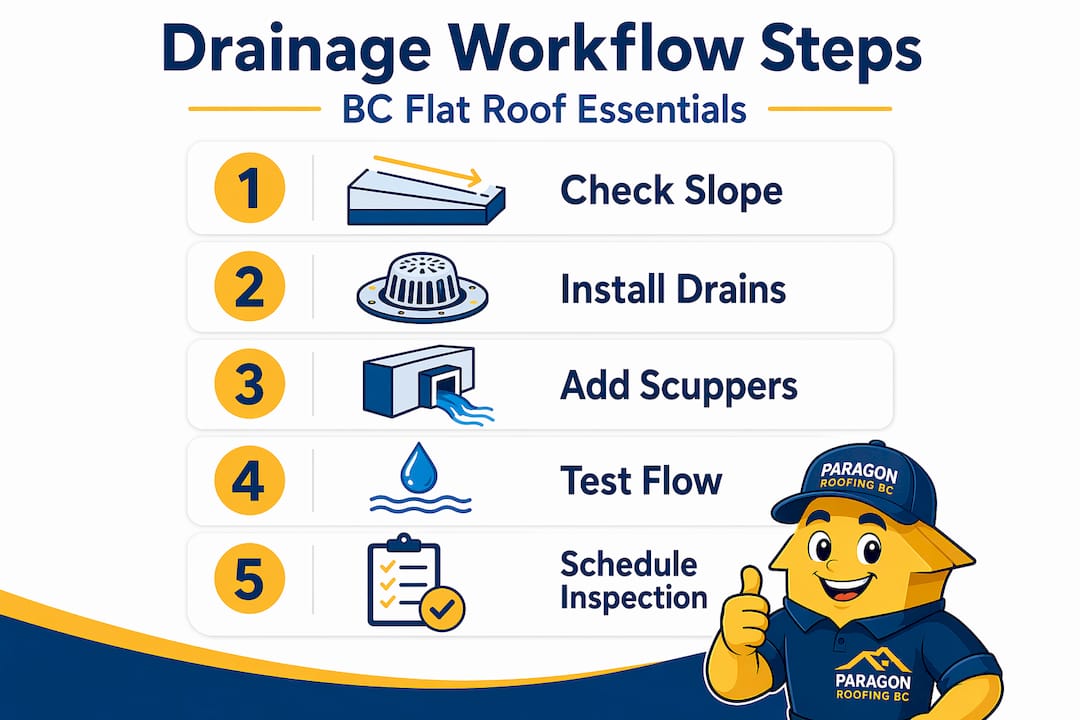
Confirm roof slope and drainage zones. The roof surface must slope a minimum of 1:50 (2%) toward each drain. If the existing slope is insufficient, tapered insulation panels can redirect water without raising parapet walls. Map out your drainage zones on a drawing so each drain serves a defined catchment area.
-
Install primary internal drains. Position primary drains at the lowest point of each drainage zone. Secure the drain body to the deck, install the clamping ring to lock the membrane in place, and fit the strainer dome. The dome prevents large debris from entering the drain body and should be easy to remove for cleaning.
-
Integrate secondary overflow scuppers. Overflow scuppers should be set approximately 25 to 50 mm above the primary drain level. This height ensures primary drains handle normal rainfall while overflow only activates under emergency conditions. Overflow scuppers must be sized and placed to prevent water rise above flashing and structural components.
-
Flash and seal all penetrations. Every drain and scupper is a potential leak point if not properly flashed. Use compatible membrane material to create a waterproof collar around each penetration. Lap the membrane up the drain body and clamp it securely. For scuppers through parapet walls, install a full-length liner extending onto the roof surface by at least 200 mm.
-
Route drain piping with freeze protection in mind. In heated buildings, interior drain piping stays above freezing. But overflow scupper outlets and exposed downpipes in colder BC regions need heat trace cable or insulation to prevent ice blockages. Ensure all piping discharges to the approved location.
-
Conduct a pre-commissioning inspection. Before calling the job complete, physically verify that every drain bowl is clear of debris and tools, all strainer domes are in place, and every scupper liner is properly secured. A small oversight here can become a significant warranty issue later.
-
Establish a maintenance schedule. The best drainage installation in BC will fail without regular attention. At minimum, plan two inspections per year, once in late autumn before peak rains and once in early spring after freeze-thaw season.
| Step | Key action | Common error to avoid |
|---|---|---|
| 1. Slope check | Confirm 1:50 minimum slope | Assuming the existing deck is correct |
| 2. Primary drain install | Secure clamping ring to membrane | Under-tightening leads to membrane creep |
| 3. Overflow scupper install | Set 25 to 50 mm above primary drain | Installing flush with primary negates purpose |
| 4. Flashing | Full-coverage membrane collar | Short laps that allow water under the membrane |
| 5. Pipe routing | Include freeze protection where needed | Bare metal downpipes in exposed locations |
Pro Tip: Position multiple overflow scuppers evenly along the parapet wall rather than clustering them at one location. This distributes the water load and prevents localised ponding in the corners, which is exactly where membrane failures tend to start.
Verifying and maintaining your flat roof drainage system
Installing a good system is half the battle. Keeping it functional year-round is what actually protects your building. Blockage of primary drains from debris is a common failure mode, and the lack of adequate overflow worsens risks significantly when blockage occurs during a storm event.
Your ongoing maintenance checklist:
- Remove leaves, pine needles, and sediment from drain bowls and strainer domes
- Check overflow scupper openings are clear and free of bird nesting material
- Inspect flashing collars for gaps, lifted edges, or cracks in sealant
- Look for signs of ponding after rainfall, which indicates a partially blocked or undersized drain
- Check parapet wall scupper liners for any tearing or separation from the membrane
Testing is an underused but powerful tool. You can simulate heavy rainfall by running water from a hose at the far end of the drainage zone and watching how quickly it reaches the drain. If water pools for more than 48 hours after rainfall stops, you have a drainage problem worth investigating before the next storm hits.
A well-maintained flat roof drainage system does not just protect the membrane. It protects the entire building envelope, the insulation below, and the occupied space inside. Reactive repairs after water damage typically cost five to ten times more than the maintenance that would have prevented them.
Drone inspections have become genuinely useful for larger commercial and flat roof maintenance programmes across Metro Vancouver. They let you assess a large roof safely after a major storm without sending someone onto a potentially hazardous wet surface. The images also create a documented record of drain and scupper conditions over time.
Pro Tip: Schedule your autumn inspection before the leaves fully drop in October. Clearing gutters and drains of early debris means you are not playing catch-up when the heavy November rains arrive.

Rethinking flat roof drainage: why redundancy and testing are your best defence
Here is an honest perspective after years of working on flat roofs across the Lower Mainland. Most drainage failures we see are not caused by the wrong drain size or a poorly designed system. They are caused by the assumption that once the system is installed, the job is done.
Think of drainage design as fundamentally about redundancy: preventing and quickly clearing blockages while verifying overflow paths remain functional. The property owners who never have water damage emergencies are not the ones with the fanciest drains. They are the ones who inspect their roofs, test their overflow scuppers, and fix small issues before they become expensive ones.
The other misconception worth challenging is this: overflow scuppers are a code formality. They are not. On a 500 m² roof in North Vancouver receiving 100 mm of rain in an hour, a single blocked primary drain could mean 50,000 litres of water with nowhere to go. That is not a minor inconvenience. That is a structural event.
The buildings we see with the best long-term outcomes treat roof water management as an active, ongoing responsibility rather than a passive installation. If the last time you thought about your overflow scuppers was the day they were installed, it is worth scheduling an inspection before this coming autumn. Connecting this mindset to how you handle managing rainwater on flat roofs is what separates proactive building management from costly reactive repairs.
How Paragon Roofing BC supports your flat roof drainage needs
At Paragon Roofing BC, we understand the specific demands BC’s climate places on flat roof drainage systems. Whether you need a full drainage retrofit on a commercial building or a professional inspection to confirm your existing system is code-compliant, our team has the experience to help.
We offer complete flat roof drainage design and installation across Metro Vancouver and the Lower Mainland, including roof installation services in Coquitlam and roof replacement services in Delta. Our drone roof inspection service gives property owners and facility managers a detailed view of drain and scupper conditions without the safety risks of manual roof access. We also offer maintenance programmes designed around your building’s specific drainage needs and BC’s seasonal weather patterns. Contact us today for a consultation and let us help you build a drainage system that works as hard as your building does.
Frequently asked questions
Why is secondary or overflow drainage required on flat roofs?
Overflow drainage provides a backup route to safely remove water when primary drains clog or during heavy storms, preventing ponding and structural damage. Building codes require overflow scuppers to prevent catastrophic structural failure during primary drain failure.
How do I calculate the drainage capacity needed for my flat roof?
Drainage capacity is calculated using your roof’s area and local rainfall intensity data, ensuring drains can handle peak storm flows. Sizing decisions are commonly based on roof area and design rainfall intensity using NOAA Atlas 14 data adapted for Canadian climates.
How often should flat roof drains and scuppers be inspected and cleaned?
Inspections and cleaning should occur at least twice a year and after any major storm event. Debris accumulation at drain bowls is a primary cause of drainage system failure, and regular maintenance is the most reliable way to prevent it.
Can improper installation of overflow scuppers cause leaks?
Yes. Poorly integrated overflow scuppers can compromise your membrane’s waterproofing and create direct water ingress points if flashing and sealants are not correctly installed. Poor integration with roof membranes can create persistent leak pathways around overflow scuppers that are difficult and expensive to trace and repair.