Commercial roof leak diagnosis: a practical guide for BC owners
TL;DR:
- A hidden roof leak in a BC commercial building can cause extensive damage and costly insurance claims before it is detected. Diagnosing these leaks is challenging due to water’s complex movement and BC’s moist climate, requiring multiple detection methods and physical verification. Proper inspection, verification, and local expertise are essential to accurately locate leaks and prevent unnecessary repairs.
A single undetected roof leak in a commercial building can quietly turn into an average $89,000 insurance claim before you ever notice a water stain on the ceiling. That is the uncomfortable reality for property owners and facility managers across British Columbia, where heavy rainfall, freeze-thaw cycles, and persistent moisture make commercial roof leak diagnosis both urgent and genuinely difficult. This guide walks you through why leaks hide so well in BC buildings, how to prepare for a proper inspection, which detection methods actually work, and how to verify findings before committing to repairs.
Table of Contents
- Understanding why diagnosing commercial roof leaks in BC is tricky but essential
- Prepare for effective commercial roof leak diagnosis: what you need to know and gather
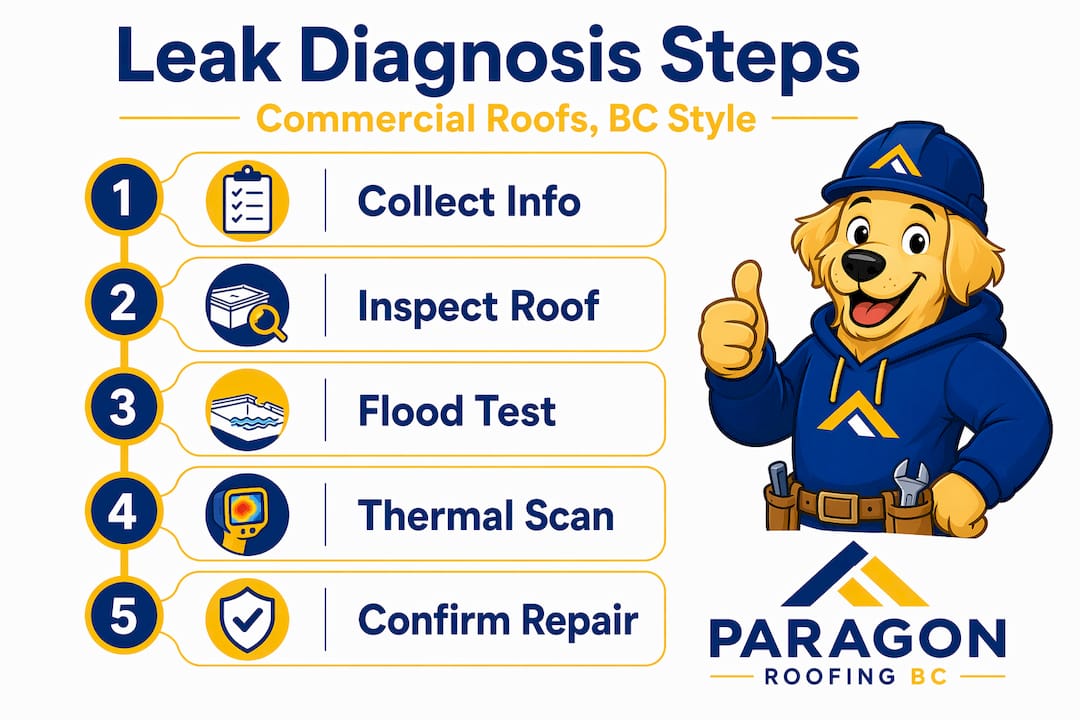
- Execute the inspection: step-by-step walkthrough of commercial roof leak detection methods
- Verify diagnosis and plan repairs: how to confirm leak sources and avoid costly mistakes
- Why many commercial roof leak diagnoses fail and how BC owners can avoid those pitfalls
- Expert commercial roofing diagnosis and repair services in British Columbia
- Frequently asked questions
Key Takeaways
| Point | Details |
|---|---|
| hidden water travel | Water can move 8 to 15 feet under roofing materials before showing interior stains, complicating leak diagnosis. |
| combine methods | Using visual, infrared, water testing, and electronic detection together increases leak detection accuracy. |
| verify findings | Always confirm thermal imaging results with core sampling to avoid misdiagnosis in BC’s wet climate. |
| BC climate risks | Heavy rain, freeze-thaw, and coastal moisture accelerate roof deterioration and hidden leak damage. |
| avoid repairing stains only | Fixing only visible stains without finding leak origins leads to repeated damage and costs. |
Understanding why diagnosing commercial roof leaks in BC is tricky but essential
Water does not fall straight through a roof. It enters at one point, then travels along the path of least resistance through insulation layers, vapour barriers, and decking before it ever drips onto your ceiling. By the time you see that stain in your boardroom or warehouse, the actual breach in the membrane could be six metres away, upslope, hidden under a seam or flashing. That disconnect between symptom and source is what makes commercial roof leak diagnosis so frustrating for building owners who try to handle it themselves.
Standard visual spot inspections, unfortunately, are not much help. Traditional visual inspections miss 68% of subsurface leaks in modified bitumen systems, which are one of the most common membrane types on commercial buildings across BC. You can walk a roof, scan it visually, find nothing alarming, and still have saturated insulation pulling your decking apart below your feet.
BC’s climate compounds this significantly. The Lower Mainland averages over 1,100 millimetres of rainfall annually, and coastal regions see even more. Combine that with freeze-thaw cycling in areas like the Fraser Valley, Okanagan, and higher-elevation Metro Vancouver suburbs, and you get accelerated roofing deterioration that outpaces inspection schedules on most commercial properties.
“The longer water sits inside a roofing assembly, the wider the damage spreads. What starts as a pinhole breach can saturate an entire section of insulation within one rainy season in BC.”
Here is what delayed detection typically means in practice:
- Surface patching costs $500 to $2,000; full membrane replacement triggered by hidden saturation costs $15,000 to $80,000 or more
- Saturated insulation loses up to 75% of its R-value, raising your heating costs quietly through the winter
- Structural decking rot from prolonged moisture exposure can trigger occupancy safety concerns
- Interior finishes, electrical systems, and inventory damaged by water infiltration often exceed the cost of the roof repair itself
Understanding roof leak causes in BC before starting any inspection gives you a major advantage. You are not just looking for obvious holes. You are tracing a moisture pathway that may have been active for months.

Prepare for effective commercial roof leak diagnosis: what you need to know and gather
Good diagnosis starts before you ever set foot on the roof. The roof leak diagnosis process begins with mapping interior stains, then inspecting upslope within 15 feet of penetrations, flashings, seams, and drains. That upslope focus is critical because water always travels downward through the assembly, so the entry point is almost always higher than where it exits.
Follow these steps to prepare properly:
- Document all interior leak symptoms. Photograph every stain, efflorescence (white mineral deposits on masonry), rust streak, or soft ceiling tile. Note the date and whether the leak occurs during rain, shortly after, or days later. That timing tells you whether water is pooling before entering or entering immediately.
- Project stains onto a roof plan. Take your building drawings and mark the approximate ceiling locations of all symptoms, accounting for the roof slope. On a low-slope TPO roof, this projection is fairly direct. On a sloped metal roof over a large warehouse, the entry point may be several metres uphill from the interior stain.
- Identify all penetrations within 15 feet upslope. Every pipe, HVAC unit, skylight curb, conduit, drain, and parapet wall termination is a potential breach point. These are your primary inspection zones.
- Know your membrane type. Torchdown modified bitumen, TPO (thermoplastic polyolefin), EPDM (ethylene propylene diene monomer rubber), and built-up roofing all fail in different ways and require different detection approaches.
Here is a quick reference to common BC commercial membrane types and their typical failure points:
| Membrane type | Common failure locations | Typical BC lifespan |
|---|---|---|
| Torchdown modified bitumen | Lap seams, flashings, blisters | 15 to 25 years |
| TPO single-ply | Weld seams, penetration boots | 15 to 20 years |
| EPDM single-ply | Seam adhesive, edge terminations | 20 to 30 years |
| Built-up roofing (BUR) | Surface cracks, gravel displacement | 15 to 30 years |
| Metal standing seam | Panel seams, ridge caps, fasteners | 30 to 50 years |
Pro Tip: Ask your building’s previous owner or property management history for any past repair records. Roof repairs done without proper documentation often hide the original leak source and create secondary failure points within a few years.
Understanding commercial roofing basics in BC before your inspection helps you interpret what you are seeing on the roof surface. A blister in a modified bitumen membrane, for example, is not always an active leak, but it will become one if left alone through another BC winter.
Once you have your interior map, your roof plan, and your membrane knowledge sorted, you are ready to start the actual inspection.
Execute the inspection: step-by-step walkthrough of commercial roof leak detection methods
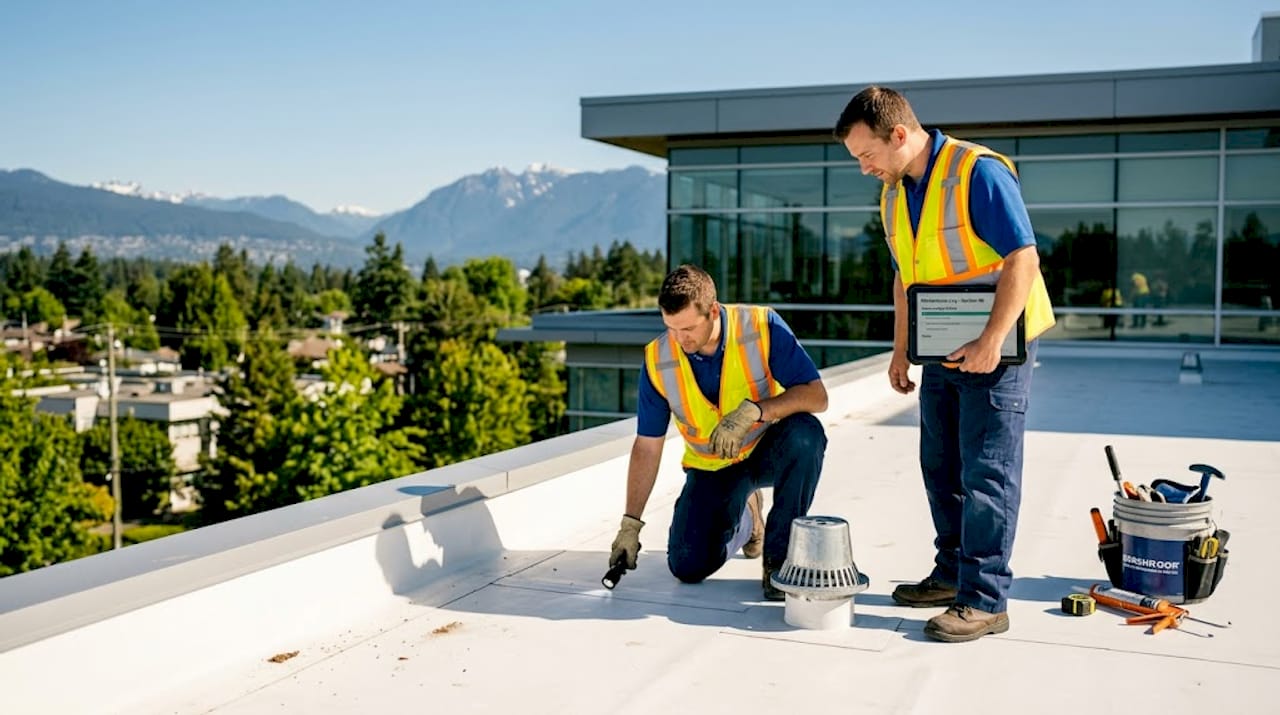
There is no single best method for every situation. Experienced commercial roofing professionals in BC typically combine two or three techniques, using each one to confirm or redirect the findings of the previous one. Here is how that process unfolds in practice.
Step 1: Timing and visual assessment
Start by confirming when leaks occur. Leaks that appear during heavy rain usually indicate an active breach. Leaks that appear 12 to 48 hours after rain often point to stored water in pooling zones or saturated insulation slowly releasing moisture. Walk the roof surface and look for:
- Cracks, splits, or gaps in seams and lap joints
- Lifted, buckled, or missing flashings around curbs and parapets
- Deteriorated sealants around pipe boots and penetrations
- Standing water or debris-blocked drains
Step 2: Controlled water flood testing
If visual inspection does not isolate the source, zone testing with controlled water will. Two people are required: one on the roof with a hose, one inside watching for moisture. Divide the roof into zones, starting at the lowest penetration and working upslope. Flood each zone for 15 minutes before moving up. This method is slow but definitive for isolating zones on comparing common membrane types where visual cues are minimal.
Step 3: Infrared thermography
This is where modern diagnosis pulls far ahead of older methods. Infrared thermography misses only 12% of leaks, compared to 68% for visual inspections, and completes surveys in a fraction of the time. The technique works because wet insulation retains heat differently than dry insulation. At dusk or dawn, when the roof surface is cooling, a thermal camera reveals those heat-retaining zones as bright anomalies. On a large BC commercial roof, a trained thermographer can survey thousands of square metres in a single evening.
Step 4: Electronic Leak Detection (ELD)
For flat or low-slope roofs with TPO or EPDM membranes, ELD following ASTM standards pinpoints breaches to within millimetres. The method uses a conductive layer beneath or within the membrane along with a low-voltage electrical system. When the membrane is breached, the circuit completes at that exact location. ELD is particularly valuable on new or recently restored roofs where contamination from previous repairs has not yet obscured thermal signals.
Here is a comparison of the four main methods:
| Method | Accuracy | Cost level | Best used for |
|---|---|---|---|
| Visual inspection | Low (misses 68%) | Low | Initial screening, obvious damage |
| Water flood testing | High (zone-specific) | Moderate | Confirming suspected zones |
| Infrared thermography | High (misses 12%) | Moderate to high | Large roofs, hidden moisture mapping |
| Electronic Leak Detection | Very high (mm accuracy) | High | TPO/EPDM, post-restoration verification |
Pro Tip: Schedule infrared surveys between 8 PM and midnight in spring or autumn when BC nights cool down quickly. The greater the temperature differential between wet and dry insulation, the clearer the thermal image.
Use roof leak detection techniques as a reference for understanding how these methods apply across different building types. After executing the inspection, verification is what turns findings into a confident repair plan.
Verify diagnosis and plan repairs: how to confirm leak sources and avoid costly mistakes
Having a thermal image that shows moisture anomalies is not the same as having a confirmed leak location. This distinction matters enormously in BC, where water travels far from entry points in the wet climate, and where misreading a thermal image can send a repair crew to entirely the wrong section of the roof.
Core sampling is the verification step that ties everything together. A core cut is a small, circular plug removed from the flagged area, typically 75 to 100 millimetres in diameter. It lets you physically inspect how many layers are present, whether insulation is saturated, and whether the decking shows signs of deterioration. A wet core from a thermally flagged zone confirms the finding. A dry core tells you the thermal anomaly was likely from heat loss through a gap in insulation, not moisture.
“Skipping core verification and going straight to repairs based on thermal images alone is one of the most expensive mistakes we see in BC commercial roofing. One misread image can result in re-roofing the wrong section entirely.”
Avoid these common diagnostic pitfalls:
- Repairing only the stain location. Repairing a stain rather than the source is a well-documented failure mode that causes repeated leaks and ongoing damage.
- Ignoring condensation as a source. Not every wet spot comes through the membrane. Hidden condensation from inadequate attic ventilation can cause sheathing damage that looks identical to a leak from outside.
- Treating thermal anomalies as definitive without physical confirmation. Thermal imaging reveals moisture probability, not certainty. Always core-sample before committing to a large-scale repair.
- Failing to document findings. Insurance claims, warranty enforcement, and capital planning all depend on clear photographic and written records of your inspection findings.
Once core samples confirm your findings, link those locations back to the specific breach points identified during ELD or flood testing. That gives you a documented repair scope tied to physical evidence. Any solid commercial roof repair plan in BC should be built on this kind of layered, verified diagnosis.
Why many commercial roof leak diagnoses fail and how BC owners can avoid those pitfalls
Here is something I have seen repeatedly working with commercial properties across BC: the diagnosis fails not because the technology is inadequate, but because the person leading the inspection does not understand how moisture behaves in BC’s specific construction environment.
Most commercial buildings in the Lower Mainland use vapour barriers and multiple insulation layers that create complex pathways for water movement. A single entry point at a cracked pipe boot can feed moisture laterally for three to five metres before it ever touches the decking. If your inspector walks to the stain location, looks up at the nearest penetration, and calls it the source without tracing the moisture path, you are going to replace a perfectly good pipe boot seal while the real breach continues to saturate your insulation.
Condensation is the ghost leak in BC commercial buildings. Poor attic ventilation causes condensation that rots sheathing without producing a single visible exterior leak, and it is astonishingly common in buildings where HVAC exhaust fans were incorrectly routed into roof assemblies rather than vented to the outside. We have walked properties where facility managers spent two years chasing a “roof leak” that was actually HVAC condensate draining into the plenum space.
The honest answer to reliable diagnosis is this: no single method is sufficient on its own. Visual inspection gives you a starting point. Thermal imaging gives you a moisture map. ELD gives you pinpoint breach locations. Core sampling gives you physical confirmation. And knowledge of BC’s specific roof assembly behaviours, combined with understanding of the building’s mechanical systems, ties it all together.
Relying on commercial roof repair insights from professionals who work in BC specifically matters more than most property owners realise. Local knowledge of how materials perform in our climate is not a marketing line. It genuinely changes what you look for and where you look for it.
Expert commercial roofing diagnosis and repair services in British Columbia
If you have been dealing with a stubborn leak, recurring stains, or a roof that passed a visual inspection but still drips every November, you already know how frustrating incomplete diagnosis can be. Accurate answers require the right tools and the right experience for BC conditions.

At Paragon Roofing BC, we use infrared thermography, electronic leak detection, and core sampling together on every commercial inspection. Our crews have worked across the Lower Mainland, Fraser Valley, and throughout BC on TPO, EPDM, torchdown, and built-up systems. We understand how BC moisture and temperature patterns affect roofing assemblies at every layer, not just the surface you can see. From our drone roof inspections across BC to full-service repairs in communities like Coquitlam and Delta, we bring diagnostic accuracy and repair quality that protects your building investment for the long term. Reach out today for a professional commercial roof assessment tailored to your property.
Frequently asked questions
What makes commercial roof leaks so costly in British Columbia?
BC’s heavy rainfall and moisture conditions cause water to travel far beneath membranes, creating hidden damage that accumulates over months. The average water damage claim from commercial roof leaks in high-rainfall regions like BC reaches $89,000, largely because the damage is extensive before it is noticed.
How effective is infrared thermography for roof leak detection compared to traditional methods?
Infrared thermography is significantly more reliable, with a missed leak rate of only 12% compared to 68% for visual inspections. It also surveys large roof areas far faster, making it the preferred first-line detection tool on BC commercial properties.
What is Electronic Leak Detection (ELD) and how does it help find leaks in BC commercial roofs?
ELD uses electrical currents across conductive roofing layers to locate membrane breaches. ELD following ASTM standards pinpoints breaches to millimetres in membranes like TPO and EPDM, which are both widely used on flat commercial roofs across BC.
Why is it important to verify thermal imaging results with core sampling?
Because water travels far from entry points in BC’s wet climate, a thermal anomaly may not align with the actual breach location. Core sampling physically confirms whether moisture is present at the flagged zone before any repair work begins.
Can condensation cause commercial roof damage without visible leaks?
Yes. Poor attic ventilation causes condensation that rots roof sheathing from the inside without producing any obvious exterior leak signs. In BC buildings, HVAC exhaust fans and ductwork should always be assessed when interior moisture damage has no clear roof breach source.