Compare roofing materials: find the best option for BC homes

TL;DR:
- Choosing the right roofing material in BC depends primarily on proper venting, structural considerations, and climate resilience. Proper installation and moisture management are more critical for longevity than material choice alone. Regular maintenance and professional craftsmanship ensure your roof performs well for its expected lifespan.
Picking the right roofing material for a BC property can feel like standing in a hardware store aisle that never ends. Every option looks compelling on a product sheet, but the real-world performance of any roof here depends on rain, wind, snow loads, slope, moss, and some pretty specific requirements buried in the BC Building Code (BCBC). Getting it wrong means expensive repairs, voided warranties, or code compliance headaches down the road. This guide cuts through the noise by laying out exactly how each major roofing material performs for residential and multi-family buildings across British Columbia, so you can make a confident, evidence-based decision.
Table of Contents
- Key criteria for comparing roofing materials in BC
- Asphalt shingles: Reliable, familiar, and evolving
- Cedar, synthetic, and heavy roofing: Unique looks, special care
- Metal, membrane, and sustainable roofs: High-efficiency contenders
- Head-to-head: Roofing material comparison table
- Choosing the right roof: Real-world scenarios and recommendations
- What most guides miss: Why BC code and installation matter more than material
- Expert help in BC: Installation, inspection, and replacement options
- Frequently asked questions
Key Takeaways
| Point | Details |
|---|---|
| Consider BC code first | Venting and moisture control requirements often outweigh material differences for roof longevity in BC. |
| Lifespan varies by install | Installation quality and ongoing maintenance have dramatic effects on roof lifespan and performance. |
| Cedar needs ongoing care | Cedar shakes require retreatment and moss removal every few years to last in BC’s wet climate. |
| Metal and membrane excel | Metal and single-ply membrane roofs offer the highest durability and value for low-slope and strata properties. |
| Match material to property | Choose roofing based on your building’s shape, age, and structural limits—not just style or cost. |
Key criteria for comparing roofing materials in BC
Now that you know what you’ll learn, let’s start with the criteria that really matter for BC roofs. Not all of these factors get equal attention when homeowners are shopping around, but they absolutely should.
Here’s what to weigh before choosing any material:
- Slope and venting requirements: BC Building Code is specific about ventilation ratios, especially for low-slope assemblies. Missing this detail is one of the most common causes of premature roof failure we see.
- Structural load capacity: Some materials, particularly tile and slate, add significant dead weight. Your structure needs to be engineered for it.
- Local climate and precipitation: Coastal BC means heavy annual rainfall, freeze-thaw cycles in higher elevations, and relentless moss growth in shaded areas. Your material needs to handle all of this, not just one.
- Lifespan versus maintenance trade-off: A premium material with zero maintenance is a myth. Every roof needs periodic attention, and the cost of that attention varies widely.
- Installation quality: Even the best roofing material for BC will underperform if it’s installed poorly. Workmanship matters as much as product specs.
- Code compliance and warranties: Manufacturer warranties often require certified installation. Skipping this step can void coverage on a $20,000 roof.
Understanding roofing material efficiency and value also matters for long-term operating costs, especially for multi-unit and strata buildings watching their reserve fund closely.
Pro Tip: Always confirm venting and insulation requirements for low-slope roofs with your contractor before finalising your material choice. As noted in BC Housing’s Builder Insight research, venting geometry and insulation placement are critical for low-slope roofs in BC to avoid moisture issues. Getting this wrong is an expensive lesson.
Asphalt shingles: Reliable, familiar, and evolving
With decision criteria in mind, let’s see how common material choices perform in real BC conditions, starting with the most familiar: asphalt shingles.
Asphalt shingles remain the most widely installed roofing material across BC for good reason. They’re affordable, easy to source, and compatible with a wide range of roof pitches and shapes. A skilled crew can install them efficiently, which helps keep labour costs reasonable. That said, they’re not without trade-offs.
Advantages for BC homeowners:
- Lower upfront cost compared to metal, tile, or cedar
- Wide availability of materials and qualified installers
- Works on most standard-pitch residential roofs
- Architectural (laminate) shingles offer a layered, dimensional look that holds up better than basic three-tab styles
Limitations to understand:
- Susceptible to moss and algae in BC’s wet climate, requiring periodic cleaning and moss treatment
- Wind uplift can be a concern in exposed coastal or mountain locations without proper fastening specs
- Three-tab shingles have a notably shorter service life, especially in regions with temperature swings
On lifespan, traditional asphalt roofs last 15 to 20 years, while architectural types can reach 30 to 50 years depending on product quality and installation. That’s a massive gap, and it’s driven almost entirely by which grade you choose and whether the underlayment, flashing, and ventilation are done correctly.
For multi-family and strata buildings, architectural shingles can make sense on buildings with adequate pitch, but a reserve fund study should factor in the realistic lifespan for BC conditions, not the manufacturer’s best-case scenario printed on the box.
Pro Tip: Consider architectural shingles over three-tabs any time your budget allows. The cost difference per square is modest compared to the extra years of service life you get. You can explore the full breakdown of asphalt shingles pros and cons and see how they compare for different property types. For those planning ahead into the next few years, there’s also a useful look at roofing materials for BC in 2026 that covers evolving product lines.
Cedar, synthetic, and heavy roofing: Unique looks, special care
Let’s dig deeper into options that provide distinct curb appeal or premium performance, and what it really takes to own them in BC.
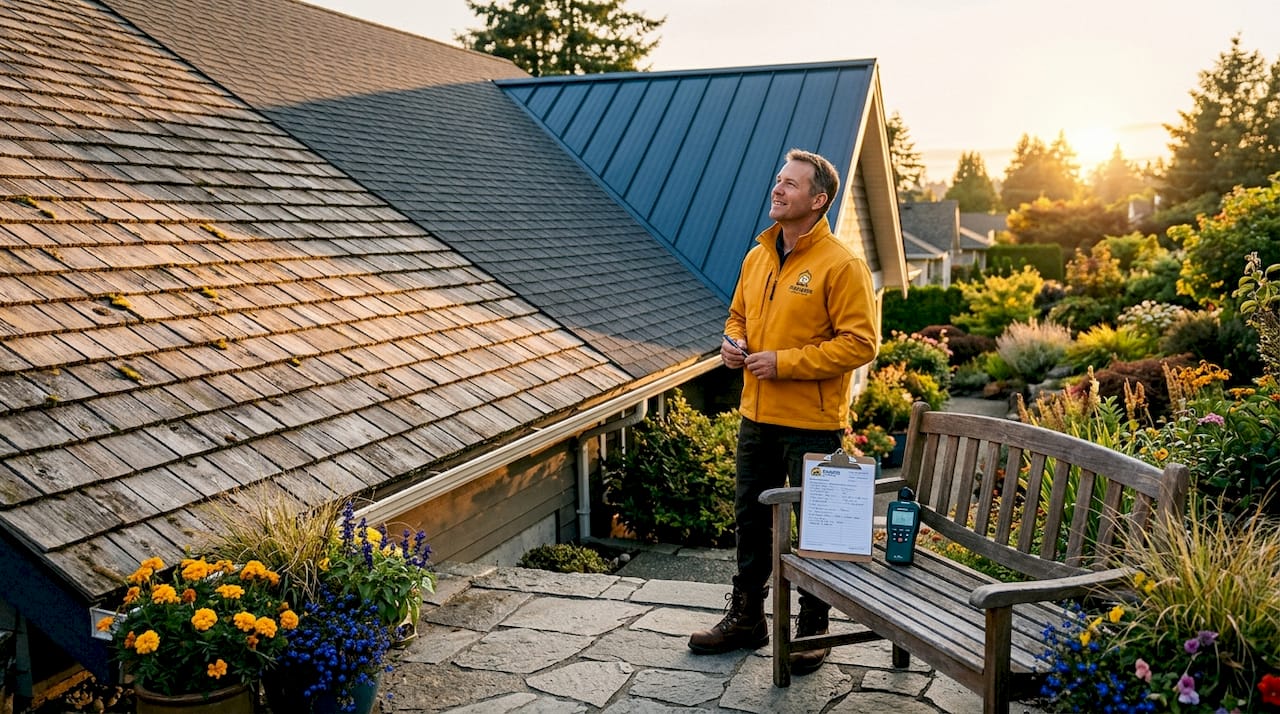
Cedar shakes and shingles are deeply woven into the visual character of BC neighbourhoods, particularly in heritage and custom home markets. They offer natural thermal insulation, a classic aesthetic, and genuine regional authenticity. However, cedar requires periodic retreatment and moss management every three to five years, and that maintenance is non-negotiable in a climate like ours.
Cedar at a glance:
- Natural, warm look that ages attractively when maintained
- Good insulating properties
- Must be retreated with preservatives and fungicide every 3 to 5 years
- Vulnerable to moss, lichen, and moisture if neglected
- Fire resistance treatments are required under BCBC for many applications
Synthetic roofing products(moulded rubber, composite, or plastic polymer shingles designed to mimic cedar, slate, or tile) have made enormous strides. They deliver the high-end look without the punishing maintenance schedule. They’re also lighter than the materials they replicate, which means fewer structural concerns. For property managers overseeing multiple units, synthetic roofing is a genuinely practical upgrade path.
Heavy roofing (slate, clay tile, concrete tile):
- Exceptional longevity, sometimes 75 to 100 years for natural slate
- Adds significant structural load, often requiring engineered upgrades to support the weight
- Installation is specialised and more costly
- Excellent resistance to fire and pests
Pro Tip: Always get a structural engineer’s assessment before specifying heavy roofing on an existing building. Snow load in areas like the Fraser Valley foothills, combined with a heavy tile roof, can stress a structure far beyond its original design capacity. You can compare these options alongside the best BC roofing materials for custom and higher-end applications.
Metal, membrane, and sustainable roofs: High-efficiency contenders
Beyond classic options, modern materials are raising the bar in energy performance and resilience. Here’s how they stack up for local conditions.
Modern metal roofing has become a top-tier choice for BC properties, and it’s not hard to see why. Standing seam steel or aluminium panels are lightweight, incredibly durable, and genuinely moss-resistant when properly coated. The metal roofing benefits in BC are well documented: 40-plus years of service life, low ongoing maintenance, and excellent performance in high-snow-load zones when the panel geometry is designed to shed accumulation rather than hold it.
Single-ply membrane systems (TPO and PVC): These are the go-to for flat and low-slope roofs on multi-family buildings and commercial properties. They’re waterproof, UV-resistant, and can be fully adhered or mechanically fastened depending on the application. The catch? Venting under the assembly absolutely must meet BCBC standards. As BC Housing’s research makes clear, BC vented assembly standards are critical for low-slope installations to ensure moisture dries effectively under membrane assemblies. Without that, you’re trapping moisture and setting up a slow-motion failure.
Green and sustainable roofing is a growing category in BC, driven by municipal incentives and sustainability goals. Living roofs (vegetated systems), cool roofs with high solar reflectance, and recycled-content products all fall under this banner. They require professional design for drainage, waterproofing, and load management, but when done right they reduce urban heat island effect, manage stormwater, and can extend the life of the waterproofing membrane beneath them.
“Correct venting and moisture-control strategy are make-or-break details for both residential and multi-family roofs.”
For anyone comparing these options for sustainability or long-term operating cost, the sustainable roofing explained guide provides a solid breakdown of what these systems actually deliver in BC conditions.
Head-to-head: Roofing material comparison table
To put all these options into perspective, here’s how each stacks up in one quick view for BC properties.
| Material | Typical cost (installed) | Lifespan | Maintenance | Structural needs | BC code/venting notes |
|---|---|---|---|---|---|
| Asphalt (3-tab) | Low | 15 to 20 yrs | Moderate (moss treatment) | Standard | Standard venting required |
| Asphalt (architectural) | Low to moderate | 30 to 50 yrs | Moderate | Standard | Standard venting required |
| Cedar shakes | Moderate to high | 25 to 35 yrs | High (retreatment every 3 to 5 yrs) | Standard | Fire treatment may be required |
| Synthetic (composite) | Moderate | 40 to 50 yrs | Low | Standard to light | Fire rating important |
| Slate/tile (heavy) | High to very high | 50 to 100 yrs | Low to moderate | Engineered required | Structural engineer assessment needed |
| Metal (standing seam) | Moderate to high | 40 to 60+ yrs | Low | Standard | Snow/wind detail critical |
| Membrane (TPO/PVC) | Moderate | 20 to 30 yrs | Low | Standard | BCBC venting compliance is mandatory |
| Green/sustainable | High | 30 to 50 yrs | Moderate | Engineered required | Drainage and load design required |
As material performance research confirms, roofing material performance varies sharply by type, and BC code and installation quality are as important as the material itself. The table above is a starting point, not a final answer. Match it to your specific property’s slope, structure, and maintenance capacity. You can use the BC roofing materials comparison resource to go deeper on any of these categories.
Choosing the right roof: Real-world scenarios and recommendations
Seeing all the options together, the choice becomes simpler when tailored to your building type and goals.
-
Standard detached family home: Architectural asphalt shingles offer the best balance of cost and longevity for most homeowners. Metal roofing is an excellent upgrade if you want a longer-term solution and can absorb the higher upfront cost. Both materials perform well with proper venting and installation.
-
Heritage or design-forward residential: Cedar shakes or high-quality synthetic shingles make the most sense. Cedar delivers authenticity, but only with a firm commitment to retreatment every 3 to 5 years. Synthetic products offer a compelling alternative with far less ongoing labour.
-
Low-slope strata and multi-unit buildings: Single-ply membrane (TPO or PVC) or standing seam metal are the strongest performers for flat or near-flat roofs. Both demand strict BCBC venting compliance and professional installation. Assembly warranties, proper fastener specs, and venting are non-negotiable for long-term performance in this category.
-
Industrial or mixed-use properties: These buildings often have complex roof profiles. Reviewing industrial roofing types for BC can help property managers understand which systems are used at scale and why.
One consistent rule across all property types: never skip professional installation if you want the warranty to hold and the roof to last its full projected lifespan. It really is that simple.
What most guides miss: Why BC code and installation matter more than material
Here’s something most roofing comparison articles won’t tell you plainly: the material choice is almost secondary to how well the roof is designed and installed. We’ve seen brand-new premium cedar roofs fail within a decade because venting was inadequate. We’ve also seen 20-year-old architectural shingles holding strong because they were installed correctly on a properly vented assembly. The pattern is consistent.
Most roof failures in BC trace back to moisture mishandling rather than material defects. BC’s wet climate is relentless. A tiny gap in the vapour management strategy, an undersized soffit vent, or a missed detail at a penetration can allow moisture to build up inside a roof assembly over years, degrading the deck and structure long before the surface shows any problem. By the time it’s visible from inside the home, the damage is often extensive.
Venting geometry and moisture control are often more important than material choice for long-term roof longevity in BC. This is the edge-case knowledge that separates a genuinely informed decision from a glossy brochure comparison.
The “set-and-forget” mindset is the other issue. Some property owners invest in premium materials assuming they can skip regular inspections and maintenance. That’s wishful thinking. Every roof, regardless of material, benefits from annual visual checks, prompt repair of damaged flashings or sealants, and moss treatment where needed. Premium materials buy you more time between major interventions, not a free pass from maintenance entirely.
The takeaway from years of working across BC is this: hire a contractor who talks about venting and code compliance in the same breath as material selection. If the conversation only covers shingle brands and colours, that’s a warning sign worth taking seriously.
Expert help in BC: Installation, inspection, and replacement options
After learning how to compare and choose, finding a trusted BC roofing professional is your next logical step. Knowing what you want from a roofing material is one thing, but translating that into a properly installed, code-compliant roof requires hands-on expertise.
At Paragon Roofing BC, we work with homeowners, property managers, and strata councils across the region to match the right roofing system to each building’s specific needs, whether that’s a straightforward roof installation in Vancouver or a full roof replacement in Maple Ridge. Not sure what your existing roof actually looks like up close? Our drone roof inspections give you a clear, accurate picture of your roof’s condition before you commit to any material or scope of work. Reach out to book a consultation and let’s talk through what’s right for your property.
Frequently asked questions
How often do cedar shake roofs in BC need retreatment?
Most BC experts recommend retreating cedar shakes every 3 to 5 years to guard against moisture and moss, as cedar maintenance requirements confirm this timeline for best performance.
Is a membrane roof ideal for low-slope or flat roofs in BC?
Yes, but only if venting and assembly meet BC Building Code requirements. As BC Housing’s low-slope research confirms, vented assembly standards are critical for these applications to prevent trapped moisture beneath the membrane.
Which roofing material lasts longest in BC?
Metal roofs in BC typically last the longest, often well over 40 years, when properly installed and maintained. Natural slate can exceed that but requires significant structural investment.
What’s the most overlooked factor when picking roofing materials for BC buildings?
Proper ventilation and moisture handling, especially for low-slope or complex roofs, is consistently underestimated. As BC Housing research highlights, venting geometry and moisture management are the critical details that determine longevity far more than material brand or colour.
Does installation quality really change roof lifespan in BC?
Absolutely. Poor installation can cut a roof’s life by decades regardless of material, and roof lifespan research confirms that maintenance frequency and installation quality are the dominant factors in how long any roof actually lasts.