Types of commercial roof drain blockages and how to fix them
Types of commercial roof drain blockages and how to fix them

The most common commercial roof drain blockages fall into seven categories: surface debris like leaves and branches, roofing granules and sediment, biological growth such as moss and root intrusion, animal nests and foreign objects, ice and freeze-thaw plugs, grease and organic solids near kitchen exhausts, and internal downpipe obstructions further down the pipe run. If you’re standing on a flat commercial roof right now looking at a pool of water that won’t drain, start simple: check the strainer basket at each drain for visible blockage, and note how long ponding has sat there.
If water has been sitting for more than 48 hours, or you’re seeing stains on the ceiling below a drain, this isn’t a “get to it next week” problem anymore. That’s the point where you call a professional rather than keep watching it.
Before you climb up there, run through a short triage:
- Stay off the roof if it’s icy, saturated, or you don’t have proper fall protection. A clogged drain isn’t worth a fall injury.
- Note exactly which drains are backing up and which are draining fine. That pattern tells a roofer a lot before they even arrive.
- Clear only what’s obviously loose and safe to grab. Leaves and twigs sitting on top of a strainer, sure. Anything packed into the bowl or the pipe itself is a job for someone with the right tools.
Key Takeaways
Most commercial roof drain blockages come from a small set of predictable causes, and quarterly inspections paired with spring and fall clearing prevent the vast majority of them.
| Point | Details |
|---|---|
| Seven main blockage types | Surface debris, granules, biological growth, nests, ice plugs, grease, and downpipe blockages cover nearly every case. |
| Ponding beyond 48 hours = escalate | Standing water lasting more than two days after rain, or any interior leak, means call a professional immediately. |
| Inspect at minimum quarterly | Full clearing passes in spring and fall, plus checks after major storms or hail events. |
| Match the trade to the problem | Roofers handle surface and membrane issues; plumbers handle internal downpipes; siphonic systems need a specialist. |
| Repeat ponding signals design flaws | If the same spot reponds after clearing, plan for added drains or slope correction at your next reroof. |
A well-documented roof plan showing drain locations, along with dated photos of any recurring ponding areas, makes for a useful reference when scheduling your next inspection.
Table of Contents
- Types of commercial roof drain blockages by drainage system
- Common blockage types on flat commercial roofs
- How blockages differ across drainage systems
- Warning signs your roof drain is blocked
- How to inspect and diagnose a blocked commercial roof drain
- Clearing and repairing blocked roof drains
- Preventing roof drain clogs with a seasonal maintenance plan
- When drain blockages signal a bigger design problem
- What our crews actually find on commercial roofs
- Get ahead of drain problems before they cost you
- Sources
- FAQ
Types of commercial roof drain blockages by drainage system
Flat and low-slope commercial roofs across Metro Vancouver drain through one of four main system types, and each one clogs a little differently because of where it sits and how water reaches it. Commercial roofs commonly rely on internal drains, scuppers, perimeter gutters, and siphonic systems, and picking the wrong maintenance approach for a given system is how small clogs turn into interior damage.
Internal drains sit flush with the roof deck and route water down through pipe inside the building, which makes them efficient but hides most of the pipe run from view. Scuppers are edge openings that let water spill off the roof through the parapet wall, simple by design but exposed to wind driven debris and, in our climate, ice. Perimeter gutters and downspouts catch water at the roof edge and carry it down the exterior of the building, similar to residential gutters but sized for a much bigger roof area. Siphonic systems use specially designed inlets and air baffles to pull water through smaller pipes at high velocity, common on large-footprint industrial and retail buildings where gravity systems would need pipes too large to be practical.
| Drainage system | Typical location | Inspection accessibility | Common blockage types | Who usually fixes it |
|---|---|---|---|---|
| Internal drains | Flush with roof deck, pipe runs inside building | Moderate; strainer visible, pipe run hidden | Strainer debris, granule sediment, downpipe clogs | Roofer for strainer/bowl; plumber for pipe runs |
| Scuppers | Parapet wall openings at roof edge | Easy visual access | Ice plugs, membrane encroachment, debris packing | Roofer |
| Perimeter gutters/downspouts | Roof edge, exterior wall | Easy to moderate | Sagging sections, leaf buildup, improper slope | Roofer or general contractor |
| Siphonic systems | Specialized inlets across large roof area | Difficult; requires specialist knowledge | Inlet baffle blockage, sediment buildup at low-flow points | Siphonic system specialist |
Interior drains, scuppers, and siphonic inlets each carry their own maintenance profile, and siphonic systems in particular need a specialist because the baffle geometry that makes them work fast is also what makes them tricky to repair correctly.
Common blockage types on flat commercial roofs
Here’s where I break down the actual mechanics of each blockage type, because knowing how something clogs tells you exactly how to clear it and how often to check for it.
1. Surface debris (leaves, twigs, windblown trash)
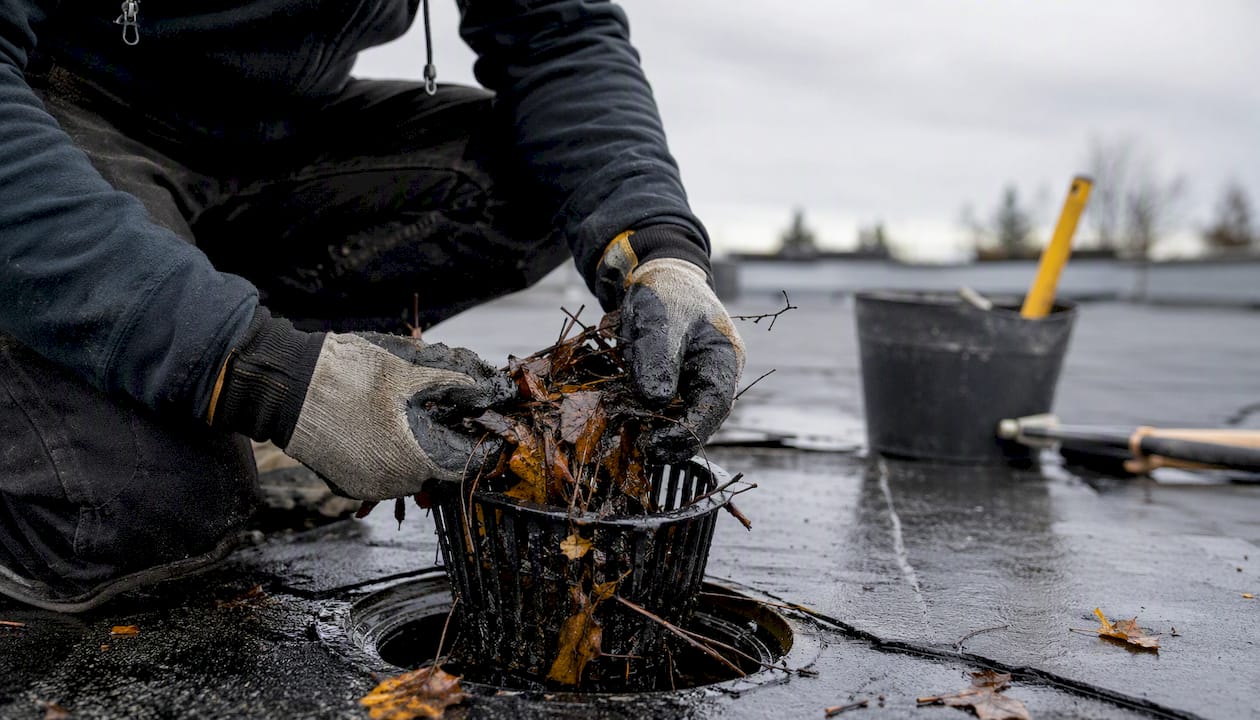
This is the blockage everyone pictures, and it’s still the most frequent one we find on service calls. Leaves and twigs blow across the roof surface, settle near the drain where airflow drops off, and pile up against the strainer basket. On roofs near mature deciduous trees, autumn leaf drop can bury a strainer within days of a windy afternoon. The fix is usually simple physical removal, but a strainer that’s already been sitting under wet leaves for weeks can trap enough decomposed matter to slow flow even after you clear the visible pile.
2. Roofing granules and sediment
Older modified bitumen and built-up roofing systems shed granules as the surface ages, and those granules travel with water toward the lowest point on the roof, which is the drain. Field observations on aging modified bitumen and BUR roofs show granule accumulation in drain bowls becomes nearly universal by around the 15-year mark. Granules compact into a gritty sediment layer at the bottom of the drain bowl that doesn’t wash away with a simple hose flush. If your roof is a decade or older and you haven’t opened up the drain bowl for a look, there’s a good chance sediment is already narrowing the outlet.
3. Biological growth: moss, algae, and root intrusion
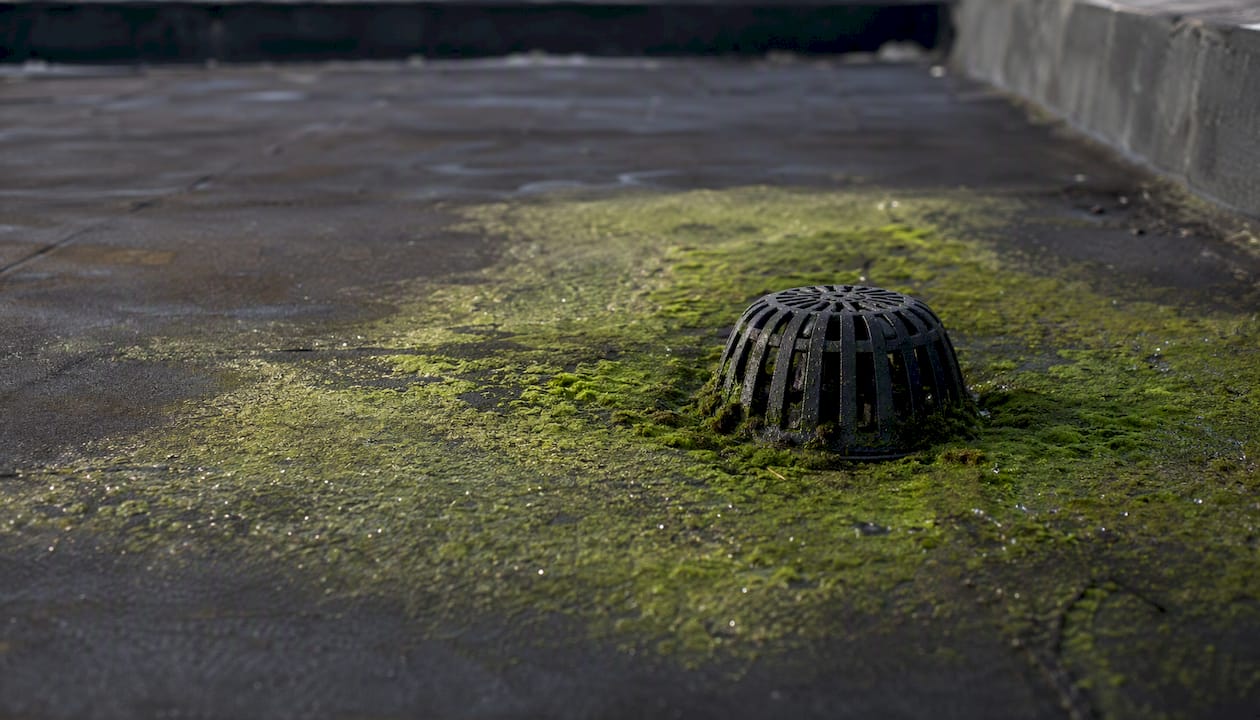
Coastal moisture across the Lower Mainland creates ideal conditions for moss and algae to establish on flat roof surfaces, especially in shaded corners or areas with poor airflow. Moss mats hold water against the membrane and eventually break apart into clumps that migrate toward drains during rain events. In rarer cases on older roofs with soil buildup in low spots, windblown seeds actually root and send small shoots down toward drain openings, which is about as far from a “quick clean” as a blockage gets.
4. Animal nests and foreign objects
Rooftop mechanical units and drain sumps make attractive nesting spots for birds and small rodents, particularly on buildings near green space or waterfront. A nest built directly over or beside a drain opening can redirect water flow entirely, and construction workers or maintenance staff occasionally leave behind fasteners, caulking tubes, or offcuts that end up wedged in a strainer.
5. Ice and freeze-thaw plugs
This one catches a lot of Lower Mainland property managers off guard because they assume ice is a problem for colder climates only. Freeze-thaw cycles during winter cold snaps can form solid ice plugs at scuppers and drain outlets, especially where meltwater refreezes overnight in a narrow channel. Once an ice plug forms, water backing up behind it has nowhere to go until temperatures rise enough to melt it, which can mean days of standing water sitting on a membrane never designed for prolonged submersion.
6. Grease and organic solids
Buildings with rooftop kitchen exhaust systems, whether from a restaurant tenant or a food court, deal with grease-laden condensate that settles on the roof surface near exhaust fans. That grease mixes with dust and debris to form a sticky residue that clings to strainers and drain bowls, resisting a plain water rinse. This blockage type needs degreasing agents or hot water treatment, not just mechanical clearing.
7. Construction debris and sealant encroachment
Roof repairs and rooftop equipment installations leave behind sealant tubes, membrane offcuts, and fastener packaging more often than anyone likes to admit. Over time, sealant applied too close to a drain can also creep and partially close off the drain opening as it cures and expands.
8. Strainer dome failure
The strainer dome protects the drain opening from large debris, but domes crack, corrode, or get knocked loose during roof work. Once a dome fails, the drain becomes far more vulnerable to every other blockage type on this list because nothing is filtering out the bigger material anymore.
9. Downpipe and leader blockages
Even when the roof surface and drain bowl look clean, blockages inside the downpipe or leader (the vertical pipe carrying water from roof level down through the building) can still choke flow. These form from long-term granule buildup, compacted debris that made it past a damaged strainer, or in rare cases, pipe misalignment from building settling.
Pro Tip: Look for a faint tide line, a ring of dirt or discoloration around a drain bowl or scupper opening, before you assume a drain is clear. That ring tells you water has been sitting there recently even if the surface looks dry on the day you inspect. Pair that with a simple timed-drain test, pour a bucket of water within ten feet of the drain and time how long it takes to disappear, and you’ll catch slow-draining spots before they become full blockages.
How blockages differ across drainage systems
Not every blockage threatens every system equally, and knowing the difference changes who you call first.
- Internal drains are most vulnerable to strainer clogging from surface debris and to granule sediment settling in the bowl. Because the pipe run is hidden inside the building, a downpipe blockage often shows up first as a slow drain rather than an obvious clog, and that’s when a plumber with snaking or hydro-jetting equipment needs to get involved rather than a roofer working from the surface alone.
- Scuppers and edge drains face ice plugs during winter cold spells and membrane termination failures where the roofing material meets the scupper opening. Testing scupper flow is straightforward: pour water near the inlet and watch whether it exits cleanly on the exterior wall side, or backs up and pools against the parapet.
- Gutters and external downspouts deal with sagging sections, improper slope that lets debris settle instead of washing through, and simple leaf buildup at outlets. A roofing crew handles slope corrections and gutter reattachment, but a caught branch or straightforward debris clear is often within reach of a building’s own maintenance staff or a handyman.
- Siphonic systems need clean inlet protection because their air baffles are sensitive to even modest sediment buildup, which can throw off the pressure differential the whole system depends on. Siphonic systems drain much faster than gravity systems and suit very large roof footprints, but that speed comes from precise engineering, so repairs always call for a specialist rather than a general roofing or plumbing crew.
Warning signs your roof drain is blocked
Ponding that sticks around longer than 48 hours after rain stops is the single clearest sign something downstream is blocked, not just slow. Watch for these signals during a routine walk of the roof:
- Standing water still visible two days after the last rainfall.
- Interior ceiling stains or discoloration directly below a known drain location.
- Water overflowing at a scupper opening instead of draining cleanly through it.
- Drainage that’s noticeably slower than normal during an active rainstorm, even before ponding appears.
Left unaddressed, a blocked drain does more than sit there looking unsightly. Standing water accelerates UV breakdown and physical wear on the roof membrane, adds dead load weight the structure wasn’t necessarily designed to carry long-term, and in cold spells, sets up ice formation that can force water back under flashing details and into the building. Blocked drains remain the most common cause of ponding on commercial flat roofs, and that ponding is almost always preventable with routine attention rather than expensive after-the-fact repair.
Call for emergency service the moment you see active interior leaking, rapid ponding rise during a heavy storm, or any visible sagging or deflection in the roof deck itself. That last one especially, deck deflection under standing water, means you’re past a maintenance issue and into structural territory.
How to inspect and diagnose a blocked commercial roof drain
Before anyone heads up, run through basic safety checks: confirm the surface isn’t icy or saturated to the point of being slippery, and make sure whoever’s inspecting has proper fall protection if the roof lacks permanent guardrails. This isn’t a solo task on a windy day.
- Check strainer condition first. Look for cracked domes, missing baskets, or heavy debris sitting directly on top.
- Look for tide lines and staining around drain bowls and scupper openings, which indicate recent standing water even on a dry day.
- Inspect membrane terminations where roofing material meets the drain or scupper, checking for gaps, wrinkling, or sealant that’s pulled away.
- Scan nearby debris sources , overhanging branches, adjacent rooftop equipment, or loose gravel ballast that could migrate toward the drain.
- Check conductor heads below scuppers at the exterior wall to confirm water is actually exiting where it should.
- Run a hose flush test directly into the drain to confirm water moves through cleanly rather than backing up.
- Time a standing-water test within ten feet of the drain to measure how long it takes to clear after a controlled pour.
- Escalate to camera inspection if the hose flush is slow but the strainer and bowl look clear, since that points to a blockage further down the internal pipe run.
Twice-yearly inspection and cleaning, spring and fall, is the baseline recommendation for most commercial roofs, with more frequent checks where tree debris or storm activity is common, which describes a large share of properties across Surrey, Coquitlam, and the North Shore.
Never enter internal plumbing chases or attempt to access downpipe sections inside occupied space without proper building access and permits. That’s a plumber’s territory once the blockage is confirmed to be past the roof surface, and our inspection guide for commercial roof longevity walks through the access and safety side in more detail.
Clearing and repairing blocked roof drains
Surface clearing and strainer maintenance are the cheapest and most frequent fix, and honestly, most blockages never need to go further than this. Pull the debris, rinse the bowl, reseat or replace a damaged strainer dome, and you’ve resolved the majority of clogs before they cause any real damage.
- Drain bowl cleaning removes compacted granules and sediment using a stiff brush and water, sometimes paired with a mild degreaser for kitchen exhaust buildup.
- Mechanical snaking clears blockages further down an internal downpipe when a hose flush test comes back slow, working well for compacted debris or root intrusion in the pipe run.
- Hydro-jetting uses high-pressure water to blast through stubborn grease buildup or heavily compacted sediment that snaking alone won’t shift, and it’s the better call for longer pipe runs or repeat blockages in the same spot.
- Pipe disassembly or replacement becomes necessary when a blockage is caused by pipe misalignment, corrosion, or a section that’s simply undersized for the water volume it needs to carry.
- Membrane or sump correction falls to the roofer, not the plumber, when the actual problem is a poorly formed sump or membrane detail funnelling water incorrectly around the drain.
Bring in a structural or plumbing engineer when ponding keeps returning to the same spot after repeated clearing, when the drainage system appears undersized for the roof area it serves, or when there’s any sign the deck is carrying more weight than it should. A typical quarterly clearing visit runs about $200 to $400, which is a rounding error next to the cost of membrane replacement or structural repair after prolonged ponding damage.
Pro Tip: When you write up a work order for drain clearing, include photos of the affected drain, your timed-drain test result, and the drain’s location on the roof plan. That level of detail cuts back-and-forth with the contractor and gets the right crew, roofer or plumber, dispatched the first time instead of the second.
Preventing roof drain clogs with a seasonal maintenance plan
A tight maintenance schedule is genuinely the cheapest insurance you’ll buy for a commercial roof, and it doesn’t take much to build one that works.
- Inspect quarterly at minimum , with a full clearing pass in spring and again in fall to match seasonal debris patterns.
- Add post-storm checks after any significant hailstorm or high-wind event, since those are exactly when debris loads spike overnight.
- Replace strainer domes on a set cycle rather than waiting for visible failure. Cracked or missing domes let far more debris through than a healthy one ever would.
- Consider adding drains on roofs where ponding keeps returning to the same low spot, since one drain may simply be carrying more water than it was designed for.
- Look at tapered insulation or local sump corrections if slope issues are contributing to persistent standing water near an existing drain.
- Raise or add scuppers where overflow protection is thin, giving water a second way off the roof if the primary drain does clog.
- Upsize leaders on systems where downpipe capacity hasn’t kept pace with added rooftop equipment or roof area changes over the years.
Our seasonal maintenance checklist for Delta properties and the broader property manager maintenance checklist both break these steps down by season if you want a printable version for your maintenance team.
Pro Tip: Always loop in your HVAC or mechanical contractor before they install new rooftop equipment. We’ve seen new curbs and condenser pads placed directly in a drainage path, turning a roof that drained fine for a decade into one with chronic ponding overnight.
When drain blockages signal a bigger design problem
Sometimes the drain isn’t really the problem. If you clear a drain thoroughly and ponding returns to the exact same spot within weeks, that’s usually a slope or sizing issue, not a debris issue. A few signs point clearly toward design rather than maintenance:
- Ponding that reappears in the identical location after a proper clearing and hose flush test confirm the drain itself is open.
- A roof area that seems to have too few drains for its total square footage, leaving each drain handling more water than it reasonably should.
- Membrane wrinkling or stress lines forming around a drain sump, which often signals water sitting there under weight for extended periods.
If any of that sounds familiar, a reroof or major repair is the right moment to fix it properly rather than patch around it again. That can mean adding drains, installing tapered insulation to correct slope, raising scupper height, or repositioning mechanical equipment that’s interfering with water flow. Design guidance calls for every commercial roof to carry both a primary drainage system and an independent secondary overflow path, sized so the secondary system actually functions if the primary drain clogs completely, and any redesign should have your roofer, plumber, and architect coordinating on drain sizing together rather than working in isolation. Our piece on drainage challenges and solutions across BC covers a few real cases where this exact fix resolved chronic ponding for good.
What our crews actually find on commercial roofs
Hey, it’s Harman here. A typical callout for a “blocked drain” on a Lower Mainland commercial roof rarely turns out to be just one thing. We’ll usually find a strainer half buried in decomposed leaves, granule sediment sitting in the bowl underneath that debris, and sometimes an old caulking tube wedged in the pipe from a repair years ago. It’s layers, not a single culprit, which is exactly why a quick glance from ground level tells you almost nothing.
Coastal moisture is the factor I see property managers underestimate most. Moss doesn’t need much encouragement here, and once it’s established near a drain, clearing the moss alone doesn’t fix the sediment layer it’s been trapping underneath for a season or two. On the flip side, when we do get a hard freeze snap in January, scuppers on north-facing walls are the first thing I check, because that’s where ice plugs form fastest and stay longest.
Field pro tip: Keep a simple log of drain locations with dates cleared and what was found. When the same drain shows up in that log three times in a year, that’s your signal it’s a design issue, not a housekeeping one.
Before we arrive for an inspection, a little prep on your end saves real time. Have someone note which drains have been slow lately, pull any photos from recent rain events showing where water sat, and mention if there’s been unusual weather, a windstorm, a cold snap, heavy rain, in the weeks before you called. That context lets us go straight to the likely trouble spots instead of walking the whole roof blind.
Get ahead of drain problems before they cost you
Clearing a drain twice a year costs a few hundred dollars. Letting one stay blocked through a wet Lower Mainland winter can cost you a membrane, a ceiling, or worse. If your commercial property has had recurring ponding, slow drains, or you just haven’t had anyone look at your drainage system in a while, book a commercial roofing inspection in Vancouver with our crew. We’ll tell you straight whether you’re looking at a five-minute strainer clean or a design fix that needs to happen at your next reroof, and if wind or hail damage is part of what’s driving your drainage issues, our storm damage repair service covers that ground too.
Sources
For design standards and code references, lean on the IIBEC and IBHS material above. For day-to-day maintenance practice and local climate quirks, the flatroofreport and rimkus pieces are the better starting point.
FAQ
What are the different types of roof drains?
Commercial roofs typically use internal drains, scuppers, perimeter gutters and downspouts, and siphonic systems, with the right choice depending on roof size and climate.
What are the four types of drainage systems?
The four common categories are internal drains, scuppers (edge drains), gutters and downspouts, and siphonic systems, each with distinct inspection needs and blockage risks.
How do you unclog a roof drain?
Start with surface clearing and strainer cleaning, then move to a hose flush test; if flow is still slow, mechanical snaking or hydro-jetting clears blockages further down the downpipe.
What are three methods of draining flat roofs?
Flat roofs commonly drain through internal drains routed through interior piping, scuppers that let water exit through the parapet wall, or perimeter gutters that carry water down the building exterior.
How often should commercial roof drains be inspected?
Inspect at minimum quarterly, with full clearing in spring and fall and additional checks after major storms, hail, or high-wind events.
Recommended
Our Roofing Blog

Have more questions about roofing?
Check out our FAQs or give us a call today to speak to an expert roofer in Vancouver Lower Mainland, BC. We're here to help our neighbours make educated decisions about their roof. For our team, we value helping clients save money while making their roofs last.