
Surrey garage tie-in leaks: causes, diagnosis, and fixes
Surrey garage tie-in leaks: causes, diagnosis, and fixes

A Surrey garage tie-in leak happens where your attached garage or carport roof meets the main house wall, usually because the step flashing or membrane at that junction has failed. Water finds the smallest gap and works it wider every wet season. If you’re seeing a stain creeping across the garage ceiling or down the interface wall, the single best move is to book a documented professional inspection right away and get any active drip contained with a tarp or temporary patch in the meantime.
- Stains at the garage-to-house junction rarely stay small in Surrey’s wind-driven rain
- Delaying inspection lets rot spread into framing and insulation
- A written, photo-backed report protects you if a strata or insurance claim follows
Quick fact: emergency roofing guidance recommends containing water, documenting the damage, and calling a qualified roofer before doing anything permanent yourself.
Key Takeaways
Garage tie-in leaks in Surrey almost always trace back to failed flashing or membrane laps at the wall junction, and a documented inspection is the fastest path to a lasting fix.
| Point | Details |
|---|---|
| Contain first, diagnose second | Tarp active leaks immediately, then book a documented inspection before any permanent repair. |
| Flashing failure is the top cause | Step flashing, counter flashing, and membrane laps fail most often under wind-driven rain. |
| Documentation decides who pays | Strata responsibility for common property under the BC Strata Property Act often hinges on a written, photo-backed report. |
| Reflash beats repeat caulking | Repeated stains after caulk repairs usually mean the assembly needs rebuilding, not resealing. |
| Paragon Roofing BC provides the paper trail | Documented inspections, emergency containment, and permanent reflash or reroof work across Surrey with warranty terms in writing. |
Table of Contents
- Common causes of surrey garage tie-in leaks
- How does a roofer diagnose a tie-in leak?
- Who pays for tie-in leak repairs in a BC strata?
- Repair options: from emergency patch to full reflash
- Preventing garage leaks with seasonal maintenance
- What to require from a garage leak contractor
- What patterns keep showing up on Surrey garage roofs
- Get your surrey garage tie-in leak inspected and fixed
- Sources
- FAQ
Common causes of surrey garage tie-in leaks
Most tie-in leaks trace back to a handful of repeat offenders, and once you’ve seen a few hundred of these junctions, the pattern gets obvious fast.
- Failed step flashing or missing counter flashing. The metal pieces that should shingle water away from the wall get skipped, undersized, or corroded, leaving a direct path for water behind the siding.
- Improper slope or blocked drainage. Flat carport roofs need a real fall toward a scupper or drain. A clogged drain or a roof built too flat lets water pond right at the tie-in seam.
- Membrane lap failures. On low-slope garage roofs, a lifted or improperly lapped membrane seam lets water track sideways into the wall cavity instead of running off.
- Wind-driven rain exploitation. Surrey’s long wet season and coastal wind patterns push rain sideways into gaps that would stay dry in a calmer climate, which is exactly why roof assemblies designed for the west coast treat wall transitions as the highest-risk detail on the whole roof.
- Condensation posing as a leak. Warm, moist indoor air escaping through pot lights or bathroom fans into the roof cavity can soak insulation and stain drywall with no exterior leak at all, according to forensic leak-tracing research.
Caulk-only fixes almost never hold here. They bridge a gap for a season, then the sealant shrinks or cracks and the leak comes right back.
How does a roofer diagnose a tie-in leak?
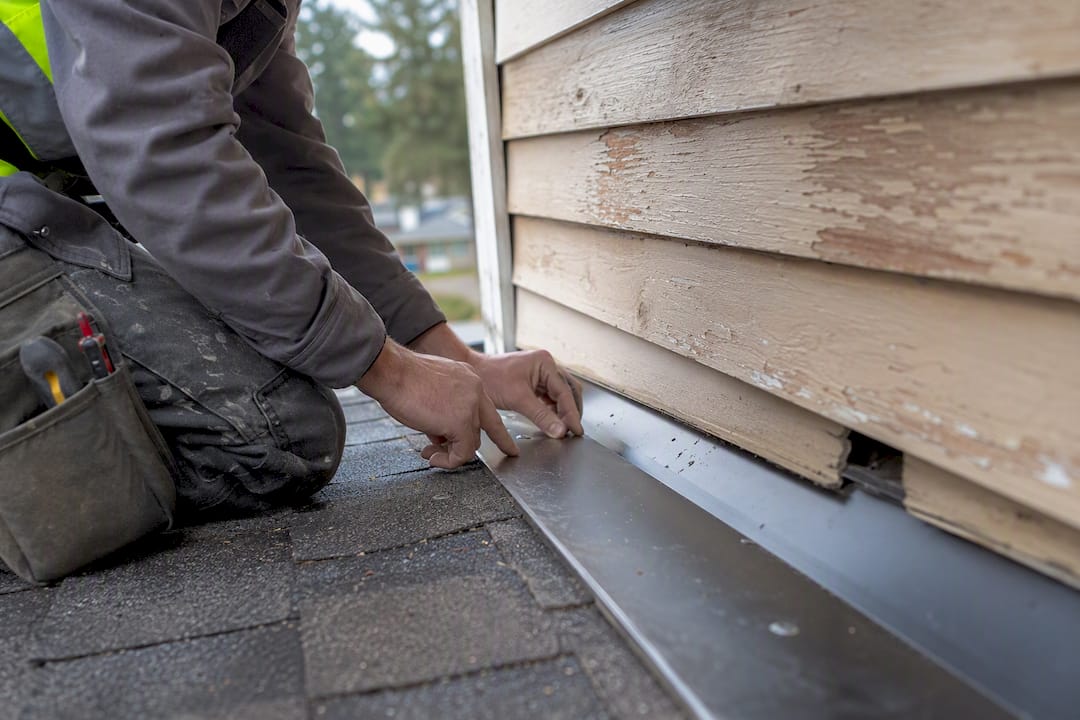
A proper diagnosis starts inside, not on the roof. We follow the stain first, checking the attic and ceiling cavity for wet insulation, soft framing, or active rot, because the visible mark on your drywall is rarely directly above the actual defect.
- Interior inspection of attic and ceiling plane, tracing the stain to its real source
- Exterior roof walk checking flashing condition, membrane laps, and drainage paths
- Moisture meter and thermal imaging use where the source isn’t obvious from a visual check alone
- Controlled water testing, section by section, when the leak only shows up during specific wind or rain conditions
Pro Tip: Ask for dated photos and written notes before any repair starts. A verbal “yeah, it’s the flashing” isn’t a diagnosis, it’s a guess, and it won’t hold up if a strata council or insurer later asks how the decision was made.
Insist on deliverables you can actually use: a photo-documented report matching what a proper roof inspection should produce, an emergency containment plan if the leak is active, and a permanent repair recommendation with a real cost range attached. Our own leak detection process follows this same sequence on every Surrey call.
Who pays for tie-in leak repairs in a BC strata?
Under the BC Strata Property Act, the strata corporation is generally responsible for maintaining and repairing common property and the building envelope, which includes the roof and the garage tie-in in most standard bylaw setups. Bylaws can shift responsibility for limited common property, so the exact split depends on your strata’s specific documents, not a general rule.
A practical guide to strata repair obligations makes the point clearly: a documented inspection is often the deciding factor in whether a leak gets classed as common property or owner responsibility, and that classification determines who pays.
Quick fact: Case law summarized in BC’s legal resources confirms strata corporations have an enforceable duty to repair common property, which gives owners real leverage when a council drags its feet.
- Contain the leak immediately and photograph the damage yourself as a first record
- Notify council or the property manager in writing, not just a hallway conversation
- Get a professional inspection report before any repair contract is signed
- File with insurance where the depreciation report or bylaws suggest coverage applies
- Reference the depreciation report when budgeting, since roof tie-ins are a common flagged item
Repair options: from emergency patch to full reflash
Not every tie-in leak needs the same fix, and the right call depends on how far the damage has gone.
- Emergency containment. A temporary tarp or sealed patch stops water intrusion the same day. This is not a repair, it’s damage control while a permanent plan gets scoped.
- Reflash the tie-in. When the step flashing or counter flashing has simply failed but the deck underneath is sound, replacing the flashing assembly and re-lapping the membrane correctly usually solves the problem for good.
- Membrane replacement. If the low-slope garage roof’s membrane has multiple failed laps or has aged out, a full membrane replacement at the tie-in section addresses the root issue instead of chasing individual leaks.
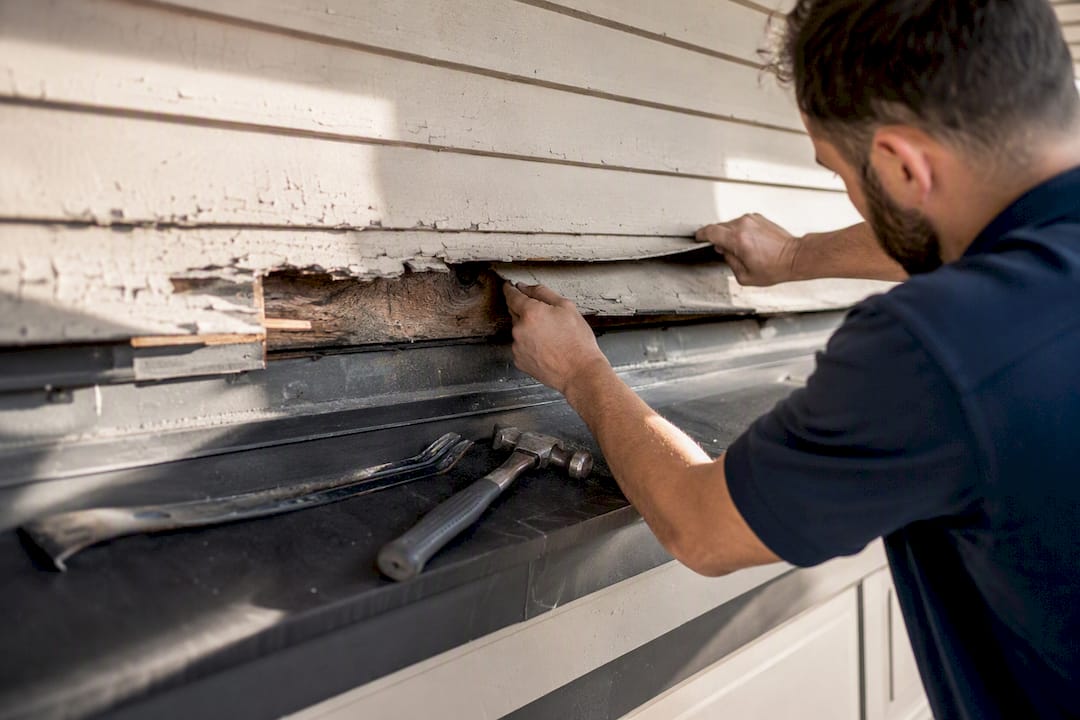
- Reroof or deck replacement. Once you pull back the siding and find soaked, spongy, or rotted decking, patching stops being an option. Replacing the deck along with new flashing is the only fix that actually lasts.
Pro Tip: If a contractor has caulked the same spot twice in two years, that’s not bad luck, it’s a sign the assembly needs to be opened up and rebuilt properly.
On a typical job, we remove siding at the interface, inspect the decking underneath, replace step and counter flashing, install ice-and-water shield along the transition, and restore the exterior finish. That sequence matches what we walk through in our flashing repair guide, and skipping any one step is usually why the “fixed” leak comes back the following winter.
Preventing garage leaks with seasonal maintenance
Prevention here isn’t complicated, it’s just consistent. Two inspections a year, timed around Surrey’s wet season, catch most tie-in problems before they become drywall stains.
- Book a spring inspection to check flashing, gutters, and scupper drains after winter storms
- Book a pre-winter check in fall to clear debris before the heavy rain season starts
- Keep the ceiling plane airtight around pot lights, exhaust fans, and pipe penetrations, since small gaps let moist air into the attic and mimic real leaks
- Clear soffit vents so the roof assembly can actually dry out between storms
- Photograph every inspection and repair, and keep those photos with strata minutes or your own maintenance file
A seasonal routine like this lines up with the guidance in our Surrey wind and rain preparation guide, and it turns your roof file into something a future buyer, insurer, or strata council can actually trust.
What to require from a garage leak contractor
A quote alone tells you almost nothing. What you need is a scope of work and a paper trail.
- A written diagnostic report with dated photos, and an emergency fix already in place if there’s an active leak.
- A materials list naming the exact flashing type, membrane product, and ice-and-water shield being used, not vague terms like “quality materials.”
- Proof of insurance and WSBC coverage , plus written warranty terms and a staged payment schedule tied to completed work, not paid upfront.
- Confirmation of deck condition before and after repair, along with a post-repair inspection report you can file with strata or insurance.
If a contractor won’t commit any of this to paper, that’s your answer before you’ve even discussed price.
What patterns keep showing up on Surrey garage roofs
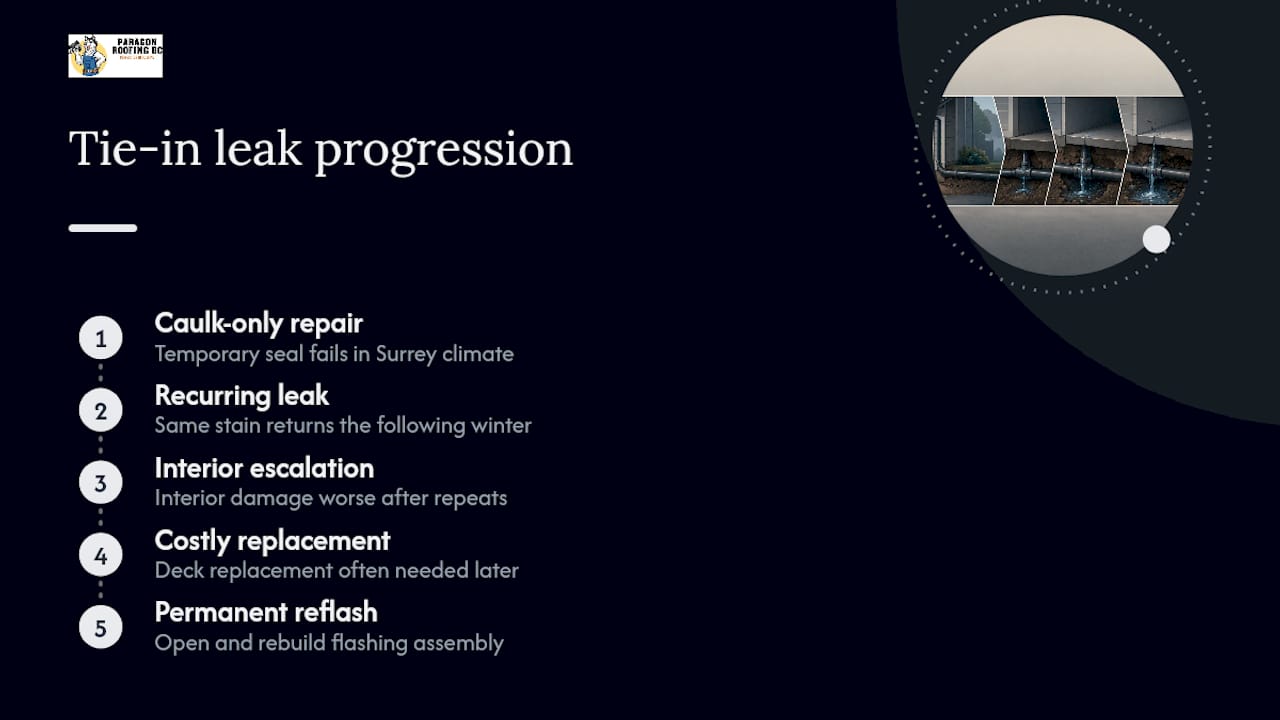
Caulk-only repairs on tie-ins fail almost every time in this climate. Wind-driven rain finds the same weak point the following winter, and by then the interior damage is usually worse than the first round. When we see the same stain reappear on a second or third inspection, it’s rarely a fluke. It means the flashing assembly or membrane needs to be opened up and rebuilt, not resealed. Owners who wait through two or three “small” patches often end up paying for a full deck replacement that a reflash would have prevented years earlier.
Get your surrey garage tie-in leak inspected and fixed
Paragon Roofing BC gives Surrey homeowners, strata councils, and property managers a faster path to a fixed roof than the trial-and-error caulk-and-hope approach most garage tie-in leaks get stuck in. We start with a documented inspection, not a guess, and if the leak is active, we contain it with a temporary tarp the same visit so damage stops spreading while a permanent plan gets scoped.

From there, you get a photo report, a clear recommended scope, whether that’s a targeted reflash or a full membrane replacement, an honest timeline, and warranty terms in writing before anything gets signed. That paper trail is exactly what a strata council needs to allocate responsibility under the Strata Property Act and what an insurer needs to process a claim without delay. If your situation calls for temporary containment before we can get on-site, this guide to temporary roof leak fixes covers safe short-term steps.
Book a Surrey residential roofing inspection or reach out through our leak detection and repair service page to get a documented assessment scheduled this week.
Sources
For deeper reading on strata repair obligations, see the BC government’s division of repair duties guidance and the province’s strata maintenance guide. For roof-specific causes local to BC, review our roof leak causes guide.
- Division of repair duties - BC government
- A practical guide to repair and maintenance obligations under the BC Strata Property Act | CCCM
- Roof assemblies west coast climate: stay dry | Versa Homes
- The anatomy of a leak: a forensic look at how water travels through your home | GHS Construction
- Roof inspection Surrey BC | I-M Roofing
FAQ
What causes most garage tie-in leaks in Surrey?
Failed step flashing, missing counter flashing, or a lifted membrane lap at the roof-to-wall junction are the most common causes, often worsened by wind-driven rain.
Who is responsible for fixing a tie-in leak in a strata property?
The strata corporation is generally responsible for common property and the building envelope under the BC Strata Property Act, though bylaws can shift responsibility for limited common property.
How long does a tie-in leak repair take from diagnosis to completion?
A documented inspection typically takes one visit, and straightforward reflash repairs can be completed within a few days once materials are confirmed; full membrane or deck replacement takes longer depending on scope.
Can I just caulk a garage tie-in leak myself?
Caulk alone rarely holds in Surrey’s wet climate and usually masks the problem for one season before the leak returns, often with more interior damage.
What should a professional inspection report include?
It should include dated photos, a clear list of immediate versus deferred repairs, and an itemized cost estimate suitable for strata or insurance use, which is the standard Paragon Roofing BC follows on every Surrey inspection.
Recommended
Our Roofing Blog



Have more questions about roofing?
Check out our FAQs or give us a call today to speak to an expert roofer in Vancouver Lower Mainland, BC. We're here to help our neighbours make educated decisions about their roof. For our team, we value helping clients save money while making their roofs last.