Surrey raccoon damage: what to do first and how to fix it
Surrey raccoon damage: what to do first and how to fix it
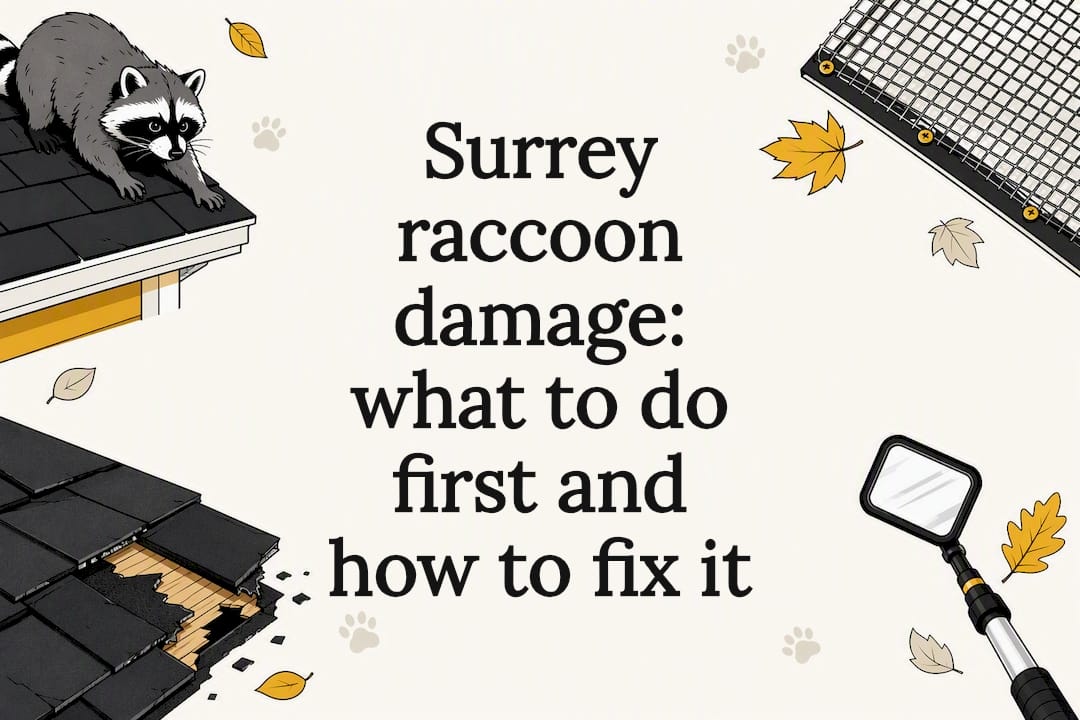
If you’ve found torn shingles, a ripped-open soffit, or scratching in the attic, here’s the short version: keep people and pets away from the animal, call the BC Conservation Officer Service at 1-877-952-7277 (RAPP) if it’s aggressive, injured, or won’t leave, photograph every bit of the damage, and book a roof inspection with a Surrey roofer before you patch anything yourself. Raccoon damage in Surrey almost always follows the same pattern: an animal finds a weak spot in the fascia or a loose chimney cap, moves in, and does far more damage on the way out than on the way in.
Do these things in the next half hour:
- Keep kids and pets indoors or on leash until you know where the raccoon is.
- Photograph torn shingles, soffit gaps, droppings, or dug-up lawn patches, with the date visible if your phone allows it.
- Close any exterior doors or pet doors the animal could use to get inside the house itself.
- Never approach, corner, or try to touch a raccoon, especially one that looks sick or is out during the day.
A raccoon that’s been in your attic for even a week or two can leave behind Baylisascaris procyonis roundworm in its droppings , which is one reason cleanup isn’t a job to rush into without gloves and a mask.
Key Takeaways
Stopping Surrey raccoon damage for good requires sealing verified-empty entry points with heavy-gauge materials, not just scaring the animal away once.
| Point | Details |
|---|---|
| Act on safety first | Keep pets and kids away, document damage, and never corner or touch the animal. |
| Call the right authority | Use RAPP (1-877-952-7277) for aggressive or persistent raccoons, WildSafeBC or BC SPCA for humane advice. |
| Attractants drive repeat visits | Secure garbage in metal bins, remove pet food overnight, and manage fallen fruit and feeders. |
| Seal only when the den is empty | Wait until after August or before March, and use heavy-gauge mesh with stainless fasteners. |
| Book a full roof inspection | Paragon Roofing BC documents every access point and coordinates repairs after cleanup is complete. |
Where to go for more help
- BC Conservation Officer Service (RAPP) : for law enforcement and dangerous or persistent wildlife.
- Provincial raccoon guidance : official prevention and pest management advice.
- WildSafeBC : local coexistence tactics and health risk information.
- BC SPCA : humane deterrent methods and rearing season timing.
This article is general information, not a substitute for advice from a qualified lawyer. Consult a qualified legal professional about your own circumstances before acting on anything here.
Table of Contents
- Signs of raccoon damage on Surrey homes
- What to do right now if you have an active raccoon problem
- How do you keep raccoons off your Surrey property long term?
- Where do raccoons get into a roof, and how do you seal it?
- Humane removal: when DIY works and when to call a pro
- Cleaning up safely after raccoons: PPE and health risks
- When should a Surrey roofer inspect raccoon damage?
- Is it legal to trap or remove a raccoon in BC?
- Book a raccoon damage inspection with Paragon Roofing BC
- Sources
- FAQ
Signs of raccoon damage on Surrey homes
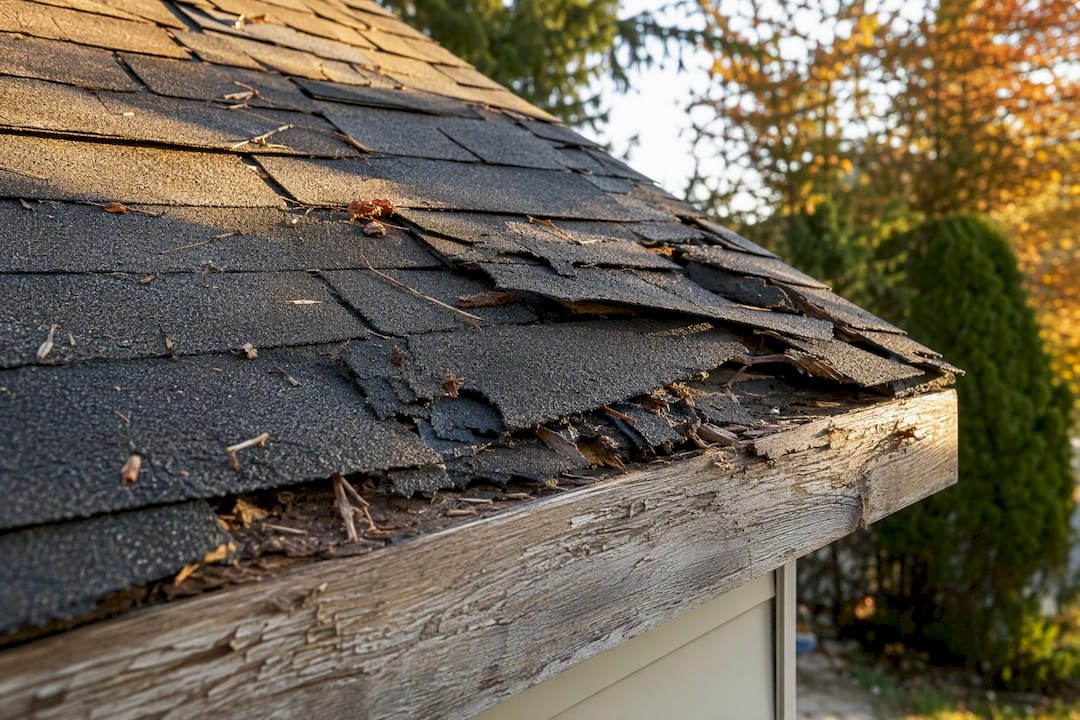
Raccoons are strong, patient, and surprisingly hard on a roof. On the roofline itself, look for torn or lifted shingles near the edges, missing or bent flashing, and fascia or soffit boards that look peeled back or chewed at the corners. Chimney caps are a favourite target too. A cap that’s loose, dented, or missing altogether is often the giveaway that something has been working at it for weeks.
Inside the attic, the signs are less visual and more auditory: thumping or chirping sounds after dark, insulation that’s been flattened or pushed into a nest shape, and a sour smell that gets stronger near one corner of the ceiling. Outside, check the lawn for small dug-up patches (raccoons hunt chafer beetle grubs the same way skunks do), tipped garbage bins, and bird feeders knocked to the ground.
Provincial guidance on raccoon pests confirms this pattern: raccoons commonly tear off shingles or fascia boards specifically to get into attics, crawl spaces, or chimneys. Photograph each sign as you find it and note the date. That record matters later, whether you’re talking to a roofer, a bylaw officer, or an insurance adjuster.
What to do right now if you have an active raccoon problem
Work through this in order:
- Confirm no one is in physical danger. A cornered or injured raccoon can be defensive.
- Contain pets and children indoors until the animal has moved on or been assessed.
- Document the damage with photos, but don’t attempt to seal any hole yet. There may be young raccoons still inside.
- Call the right people for your situation.
Who to call, and when:
- BC Conservation Officer Service (RAPP): 1-877-952-7277 for aggressive, sick, injured, or stubbornly persistent raccoons.
- WildSafeBC or the BC SPCA for humane deterrent advice and general coexistence questions.
- Paragon Roofing BC for an urgent roof inspection if the animal has already damaged shingles, fascia, or flashing.
- 911 or your local emergency line only if a person has been bitten or the animal is trapped inside living space and posing immediate risk.
How do you keep raccoons off your Surrey property long term?
Most raccoon problems trace back to easy meals, not bad luck. BC SPCA’s coexistence guidance is blunt about it: managing attractants works better long term than repeated removals, because a new raccoon will simply move into a vacant territory if the food source is still there.
Start with garbage. Metal bins with locking or raccoon-resistant lids beat plastic every time, and storing bins in a garage or locked shed until collection day removes the temptation entirely. Never leave pet food outside overnight, even for “just one night.” Clean up fallen fruit under any backyard trees promptly, since it draws raccoons the same way an open bin does, and think about when you top up bird feeders. A feeder refilled at dusk is basically a dinner bell.
A few more yard-specific moves worth making:
- Fix irrigation heads or leaky hose bibs that keep one patch of lawn muddy. Raccoons dig where the ground is soft and grub-friendly.
- Move compost bins away from the house and use a sealed tumbler rather than an open pile.
- For high-value vegetable beds, a simple one- or two-strand electric fence line is often enough to change a raccoon’s mind.
Pro Tip: Trim tree limbs back to at least 2 to 3 metres from your roofline. In Surrey, mature conifers overhanging a roof are practically a raccoon highway, and cutting that access is one of the cheapest prevention steps a homeowner can take.
Where do raccoons get into a roof, and how do you seal it?
Every raccoon entry point I’ve seen on a Surrey job falls into one of five spots: soffits, fascia boards, roof vents, chimney caps, or the junction where a roof meets a wall. Inspect each one from the ground with binoculars first, then get closer if it’s safe. Look for gaps wider than a fist, soft or spongy fascia, and vent covers that are bent or missing screws. Photograph anything suspicious before you touch it.
If you need a temporary fix while you wait for a proper repair:
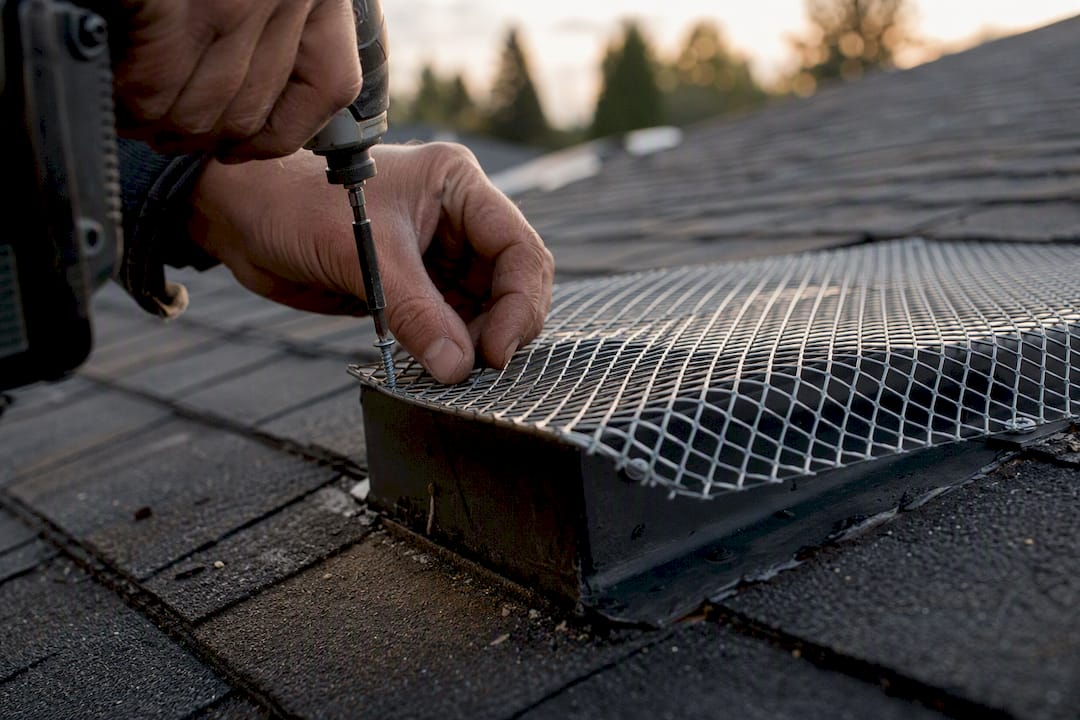
- Cover exposed gaps with heavy-gauge wire mesh, screwed rather than stapled, so it can’t be pried loose.
- Use a weighted tarp over any exposed roof deck to keep rain out until repairs happen.
- Leave one exit route open until you’re certain no young raccoons remain inside. Sealing a den with a mother locked out (or babies locked in) leads to far worse damage as she tries to claw her way back in.
For the permanent fix, rotted fascia should come out entirely and get replaced with pressure-treated wood or metal-clad boards, not just patched over. Provincial guidance notes that raccoons typically exploit existing rot or loose materials rather than creating fresh openings, so a proactive fascia replacement often prevents the next incident before it starts. Chimney caps should be refastened or replaced with a heavy stainless-steel version, and flashing details around vents need to be checked and resealed.
Pro Tip: Stick with stainless steel or heavy-gauge galvanized fasteners on any exclusion work. Standard fasteners corrode fast in our coastal humidity, and a rusted screw is exactly the kind of weak point a determined raccoon will find again next spring.
Humane removal: when DIY works and when to call a pro
Light, noise, and smell are your first line of defence, and they’re genuinely effective when timed right. The BC SPCA recommends rags soaked in apple cider vinegar left in a ventilated container near the den, along with a bright work light or a radio left playing overnight. The catch is timing: apply these deterrents before March or after August, outside the spring and summer rearing season, so you don’t separate a mother from young kits she can’t easily move.
Here’s where most DIY attempts fail: people scare the raccoon out, seal the hole, and assume it’s solved. It rarely is. Unless you’ve confirmed the den is empty and closed off every access point at once, another raccoon (or the same one) simply moves back in within days. Professionals handle this with one-way exclusion doors that let the animal leave but not return, installed only after confirming no kits are inside.
Before hiring a wildlife removal company, ask a few pointed questions:
- Can you show proof of licensing and insurance?
- What exclusion method will you use, and how do you confirm the den is empty first?
- How will you coordinate the timeline with a roofer for the actual repair?
- What happens if you find orphaned kits? (A licensed rehabilitator should be the answer, not relocation.)
Pro Tip: If raccoons have come back three or more times, or you’re finding multiple entry points instead of one, that’s your signal to bring in a professional rather than trying another round of lights and vinegar rags.
Cleaning up safely after raccoons: PPE and health risks
Raccoon droppings can carry Baylisascaris procyonis roundworm, and WildSafeBC flags proper PPE as essential before anyone goes near contaminated insulation or attic surfaces. That means an N95 or better respirator, safety goggles, and nitrile gloves at a minimum, not just a dust mask from the garage.
A safe cleanup order looks like this:
- Ventilate the space first and let it air out before you start.
- Photograph the contamination for your records.
- Put on full PPE before touching anything.
- Bag and double-seal any contaminated insulation for disposal, never vacuum it loose.
- Call a licensed biohazard or wildlife cleanup specialist for large-scale contamination rather than tackling it solo.
Pro Tip: Once the contaminated material is cleared out, that’s the point to bring in Paragon Roofing BC for structural drying and repair, especially if insulation was soaked from a damaged roof deck during the intrusion.
When should a Surrey roofer inspect raccoon damage?
Book an inspection as soon as you’ve confirmed the den is empty, or immediately if the animal is already gone and the damage is visible. A proper roof inspection after a raccoon intrusion covers more ground than most homeowners expect:
- Every access point, mapped and photographed.
- Deck sheathing, checked for softness or rot underneath the entry hole.
- Fascia condition behind any torn or missing sections.
- Flashing integrity around chimneys, vents, and roof-wall junctions.
- Attic insulation for contamination that needs remediation before repairs proceed.
The repair scope typically runs in two stages. Stage one is temporary protection: tarps or board-ups to stop water intrusion the same day. Stage two is the permanent fix, usually scheduled within one to two weeks once the site is safe to work on. That includes replacing damaged fascia and soffit with rot-resistant or metal-clad material, reflashing chimneys and vents, and fitting wildlife-proof mesh with fasteners strong enough to resist a raccoon’s leverage (they’re stronger than they look and surprisingly good at prying).
Paragon Roofing BC documents every inspection with dated photos, which comes in handy if you’re filing an insurance claim for the damage. If you’re not sure whether a roof issue predates or postdates a raccoon problem, our guide on emergency roof repairs walks through the same triage process we use on-site.
Is it legal to trap or remove a raccoon in BC?
Under the BC Wildlife Act, raccoons are classified as furbearers, and section 26(2) allows a landowner to trap or kill wildlife causing damage on their own property. Poison is explicitly illegal under section 26(1)(f), no exceptions.
That said, City of Surrey bylaws may further restrict trap use or discharge of firearms within city limits, so check with the municipal bylaw office before acting on the provincial rule alone. When in doubt, RAPP (1-877-952-7277) can clarify what’s permitted for your specific situation.
- Provincial law: trapping/killing damage-causing wildlife on private property is allowed; poison is not.
- Municipal bylaws: may add further restrictions on traps and firearms within Surrey.
- When unsure: call BC Conservation Officer Service or Surrey bylaw before taking action.
Why raccoon damage keeps coming back on Surrey roofs
The mistake I see most often isn’t a bad repair. It’s delayed action: a homeowner patches one hole with mesh scraps or spray foam, ignores the softened fascia six inches over, and calls it done. Six months later they’re back to square one, sometimes worse, because the attic contamination never got addressed either. A full inspection that maps every weak point at once, not just the obvious hole, is what actually stops the cycle. That’s the approach we bring to every Surrey roof we look at.
Book a raccoon damage inspection with Paragon Roofing BC
Paragon Roofing BC gives Surrey homeowners something a lot of DIY patch jobs and general handyman fixes can’t: a documented, insurance-friendly inspection that actually maps every entry point before repairs start, not just the one you happened to notice.
Our crews handle the full range of raccoon-related repair work: emergency tarping and board-up the same day damage is found, complete soffit and fascia replacement with rot-resistant or metal-clad materials, chimney reflashing, and wildlife-proofing mesh installed with fasteners built to withstand a raccoon’s strength. Every visit comes with a photo report you can hand straight to an insurance adjuster if needed. If you’ve been putting off a repair or you’re not sure how bad the damage really is under that torn soffit, our Surrey residential roofing team can get an inspection booked this week. For roofs where rot has spread further than expected, we’ll walk you through what a full roof replacement would look like too, with no pressure either way.
Sources
FAQ
What is a raccoon’s biggest natural enemy?
In urban areas like Surrey, raccoons have few natural predators. Coyotes and large owls occasionally take young or weak animals, but human-driven factors like vehicle collisions and habitat management have a far bigger impact on local populations.
Do raccoons return to the same place every night?
Yes. A raccoon that finds a reliable food source or a comfortable den site will keep returning night after night, which is why removing attractants matters more than one-time deterrents.
What smells do raccoons really hate?
Apple cider vinegar-soaked rags, left in a ventilated container near a den, are a BC SPCA-recommended deterrent alongside bright lights and radio noise, though results vary and none work as reliably as sealing the actual entry point.
Are raccoons protected in BC?
Raccoons are classified as furbearers under the BC Wildlife Act, and landowners can trap or kill an animal causing property damage, but poison is illegal and Surrey bylaws may add further restrictions.
Should I call a roofer or a wildlife control company first?
Call whichever addresses the more urgent issue: a wildlife control company or RAPP if the animal is still present, then a roofer like Paragon Roofing BC to inspect and repair the structural damage once the space is confirmed empty.
Recommended
Our Roofing Blog


Have more questions about roofing?
Check out our FAQs or give us a call today to speak to an expert roofer in Vancouver Lower Mainland, BC. We're here to help our neighbours make educated decisions about their roof. For our team, we value helping clients save money while making their roofs last.