A tree just hit your Surrey roof: what to do right now
A tree just hit your Surrey roof: what to do right now
If a tree has come down on your Surrey roof, stop reading for a minute and check on people first. Once everyone is safe, the sequence that protects your claim and your house is: document, call your insurer, get emergency tarping, then work through the City of Surrey’s tree reporting process if a public tree or a hazardous tree is involved. Surrey tree damage roof situations typically follow a fairly predictable path once you know the order of operations. Getting that order wrong is what costs homeowners money later.
Here’s your immediate checklist:
- Injuries or live wires? Call 911 first. Nothing else matters until people are safe.
- Photograph everything before you touch anything, with your phone’s date stamp on.
- Call your insurer the same day, even if you’re not sure the damage is covered.
- Book emergency tarping with a Surrey roofer to stop water getting into the structure.
- Report the tree to the City of Surrey if it’s on public land or was already flagged as hazardous.
Pro Tip: Don’t wait for the insurance adjuster before tarping a hole in your roof. Insurers expect you to prevent further damage where it’s safe to do so, and a soaked attic overnight turns a $600 shingle repair into a $6,000 mould problem.
Fallen trees that create immediate danger during a storm are treated as 911 emergencies by the City of Surrey, while non-urgent tree issues on public property go through the City’s regular reporting channels.
Key Takeaways
Surrey tree damage roof claims move fastest when homeowners document immediately, tarp before cleanup, and separate insurer coverage from neighbour liability correctly from day one.
| Point | Details |
|---|---|
| Safety comes first | Call 911 for injuries or downed lines before touching anything else. |
| Your insurer usually pays | Weather-related tree falls are typically covered by your own policy unless negligence is proven. |
| Document before cleanup | Time-stamped photos, video, and an arborist report protect both your claim and your permit. |
| City rules apply fast | Protected trees over 30 cm DBH need permits, and unauthorized removal risks fines. |
| Paragon Roofing BC coordinates the fix | Emergency tarping, inspection, and repair through to full re-roof, working directly with insurers. |
This article is general information, not a substitute for advice from a qualified financial advisor. Consult a qualified financial professional about your own circumstances before acting on anything here.
Table of Contents
- Surrey tree damage roof: your first 24 to 72 hours
- Who pays for tree damage roof repair in BC?
- What are Surrey’s rules for fallen and protected trees?
- How do you temporarily protect a damaged roof?
- How does a roofer assess tree damage and decide on repairs?
- Who should you call first, arborist, tree service, or roofer?
- Can you prevent future tree damage to your roof?
- Sources
- FAQ
Surrey tree damage roof: your first 24 to 72 hours
The first two hours are about safety, not paperwork. Stay off the roof if there’s any visible sagging in the decking or if a limb is still lodged in the structure. A compromised roof can fail under your weight even if it looks stable from the ladder. If a tree has taken down a power line anywhere near the house, treat the whole yard as live until BC Hydro confirms otherwise.
Once the scene is stable, here’s how the next three days typically unfold:
- Hour 0 to 2: Confirm nobody’s hurt, isolate the hazard area, and resist the urge to start dragging branches off the roof yourself.
- Hour 2 to 24: Photograph and video the damage from every angle, ground level and, if safe, from a neighbouring vantage point. Capture the tree’s root ball, the trunk, the penetration point on the roof, and any interior ceiling stains. Note down any witnesses.
- Hour 24 to 72: File your insurance claim, book an arborist assessment if the tree came from a neighbour’s yard and you suspect neglect, and submit any required City notification.
What to photograph, specifically:
- The full roof from at least two angles, showing the damage relative to the ridge and eaves
- Close-ups of any decking punctures, missing shingles, or bent flashing
- The tree’s base and root system, especially if roots look rotted or previously damaged
- Interior shots of attic insulation or ceiling drywall if water has already found its way in
- Property line markers if the tree originated from a neighbouring lot
Pro Tip: Keep the fallen tree material on-site until you’ve reported it, especially if it’s a protected species. Removing debris from a damaged protected tree before the City completes its assessment can complicate both your permit and your insurance file.
Hold off on full cleanup until your insurer or a City arborist has weighed in, particularly if the tree was large enough to require a permit for removal. Rushing to clear everything can erase evidence you’ll want later.
Who pays for tree damage roof repair in BC?
Here’s the rule that surprises most homeowners: if a healthy tree comes down in a windstorm and damages your roof, your own home insurance pays for it, not your neighbour’s. Insurance Bureau of Canada and industry guidance are consistent on this. Ownership of the tree does not automatically create liability. A neighbour is only on the hook if you can prove negligence.
What counts as negligence? A tree that was visibly dead, rotted, or leaning for months, especially if you’d complained about it in writing, gives you a real case. A tree that snapped in a legitimate windstorm with no prior warning signs almost never does. This is where an arborist report earns its fee. A certified arborist documenting decay indicators and prior complaints gives your insurer the factual basis to pursue subrogation against the neighbour’s policy instead of just paying out and raising your premium.
Two other distinctions matter for your payout:
- Replacement cost vs. actual cash value. A replacement-cost policy pays what it costs to install a new roof of similar quality today. An actual cash value (ACV) policy depreciates your existing roof’s age and wear before paying out, which can mean thousands less in your pocket for a 15-year-old roof. Check your policy declaration page now, before you need to know the answer.
- Removal without damage isn’t usually covered. If a tree falls in your yard but misses the house entirely, most policies won’t pay to remove it. Coverage generally kicks in only when the tree damaged an insured structure or is blocking a driveway or entrance.
Insurers typically want time-stamped photos, a written contractor estimate, and, where negligence is a factor, an arborist report. Make temporary repairs to stop further water intrusion, but keep every receipt and get a written scope of work rather than a verbal quote. Adjusters move faster when your file is organized before they ask for it.
What are Surrey’s rules for fallen and protected trees?
Surrey treats trees over a certain size as protected property, and the rules apply whether the tree fell naturally or you’re planning to remove a hazardous one still standing. Getting this wrong isn’t just an inconvenience. It can mean fines on top of your roof repair bill.
Here’s the practical flow the City expects:
- Report the tree. If it’s on public property or blocking a road, contact the City directly. If it’s on your own lot, you generally handle it yourself but may still need a permit.
- Document before you touch anything: photos of the tree, the damage, and its condition (rot, disease, root issues).
- Engage a qualified tree service or arborist for removal, especially for anything large or awkward relative to the house.
- Submit a tree cutting permit application where required, including for trees that weren’t already down but are being removed as hazardous.
A few specifics worth knowing:
- Surrey’s Tree Protection Bylaw protects trees greater than 30 cm in diameter at breast height, along with several other categories, and requires a permit before removal.
- Removing or damaging a protected tree without authorization can trigger fines and a replacement-tree requirement, sometimes running into thousands of dollars.
- If a protected tree was damaged in a way that might violate the bylaw, leave the trunk, limbs, and remains in place until the City completes its investigation.
- Residential permit applications typically require photos, a sketch or aerial view of the lot, your signature, and, if five or more trees are involved, a formal arborist report.
- Photos and assessments go to treebylaw@surrey.ca, and City arborists review urgent cases on a priority basis, per the City’s fallen tree guidance.
How do you temporarily protect a damaged roof?
Emergency tarping and boarding exist to buy you time between the moment the tree comes down and the moment permanent repairs start. A roofer covers the exposed area with heavy-duty poly or tarp material, secures it along the edges, and sometimes boards over larger structural gaps to keep out wildlife and weather.
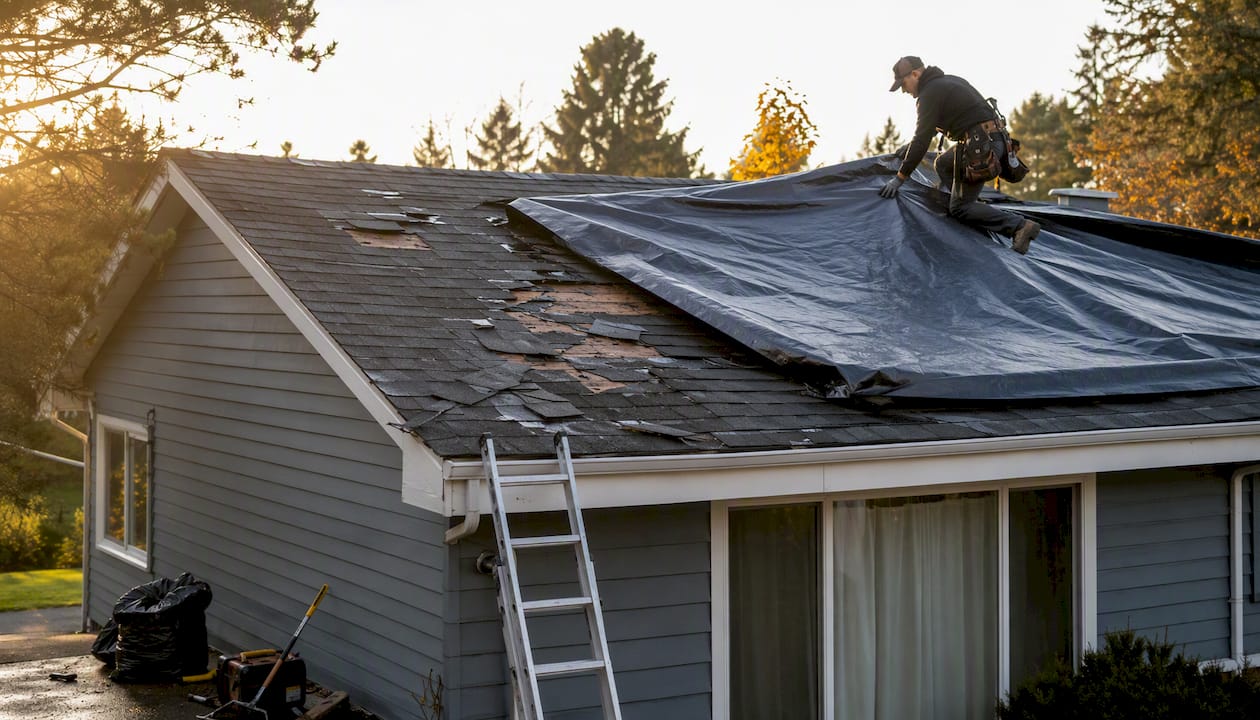
In the Surrey market, emergency tarp jobs typically run $300 to $800 depending on roof pitch, access, and whether a lift or crane is needed to clear a lodged limb safely. Straightforward shingle patching after the tarp comes off often lands in the $300 to $600 range, though anything involving deck or structural repair climbs well past that.
Here’s a rough do-and-don’t split:
- DIY is fine for: clearing loose branches already on the ground, away from the house and power lines.
- Call a professional for: anything requiring roof access, any visible sagging in the decking, or any limb still resting on the structure.
- Always get a written estimate before work starts, and keep every receipt. Insurers reimburse mitigation costs far more smoothly when there’s a paper trail.
Pro Tip: Never tarp a wet roof alone, and never go near a roof if there’s any chance a downed line is nearby. A soaked roof surface with a tree limb wedged in it is one of the most common ways homeowners get hurt trying to be helpful.
How does a roofer assess tree damage and decide on repairs?
A proper inspection goes well beyond the visible hole. On Surrey roofs, the most common hidden failure points after a tree strike are valley flashings, hip and ridge connections, and the decking itself where a branch punched through without fully penetrating. A thorough roofer checks:
- Decking integrity around and beneath the impact zone
- Structural framing and rafters for cracking or deflection
- Flashing at valleys, chimneys, and skylights for displacement
- Gutters and downspouts for crushing or disconnection
- Attic insulation and ceiling joists for hidden water tracking
- Interior ceilings and walls for staining that suggests a slower leak
From there, the repair path depends on scope, not just the size of the hole:
- Emergency patching stabilizes things immediately and buys time for insurance approval.
- Shingle or cap repair handles isolated damage where the deck underneath is sound.
- Flashing replacement addresses leaks concentrated around valleys or penetrations.
- Deck replacement becomes necessary when a limb has cracked or rotted the plywood substrate.
- Full re-roof gets considered when the damage is extensive enough, or the existing roof is old enough, that patching just delays a bigger job.
Three different professionals typically touch a tree damage file, and it helps to know who does what. The arborist assesses tree health and produces the report that supports negligence or permit claims. The tree removal crew handles the physical extraction of trunk and limbs safely. The roofer inspects and repairs everything the tree left behind.
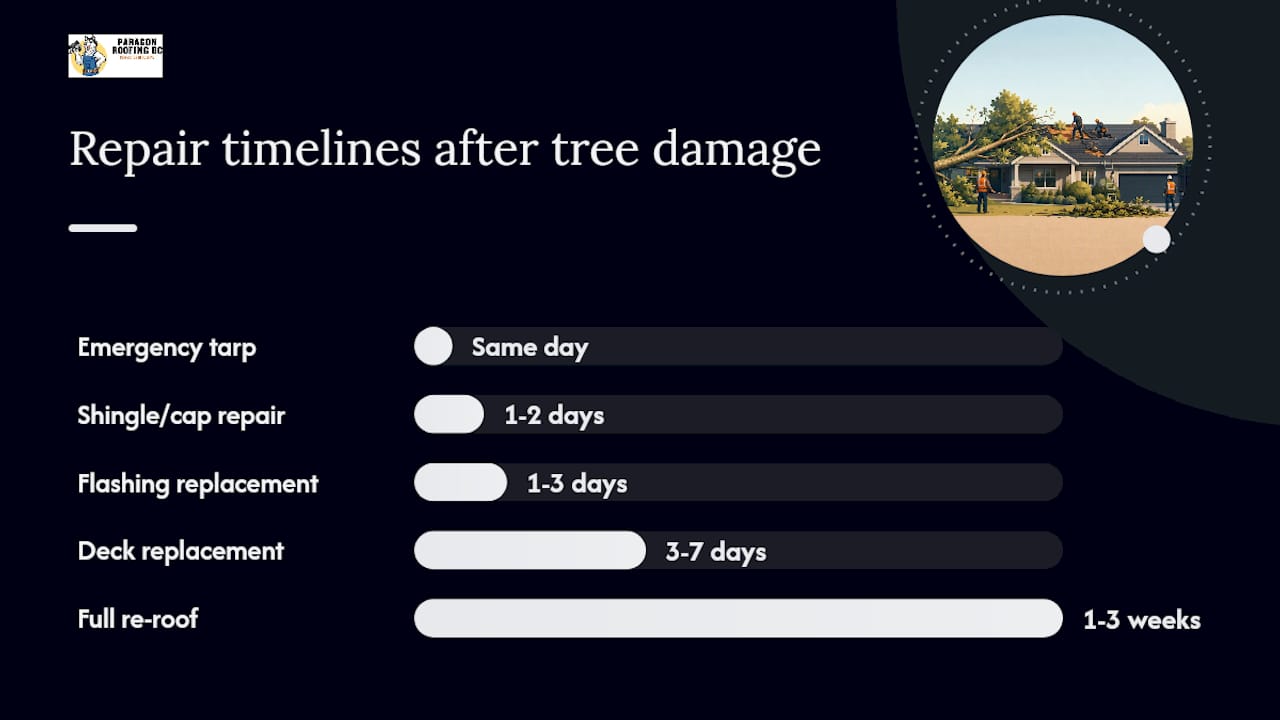
| Repair type | Typical scope | Rough timeline |
|---|---|---|
| Emergency tarp | Temporary weatherproofing over an active leak | Same day to 24 hours |
| Shingle/cap repair | Isolated shingle and cap replacement | 1 to 2 days |
| Flashing replacement | Valley, chimney, or skylight flashing repair | 1 to 3 days |
| Deck replacement | Plywood substrate replacement under damaged area | 3 to 7 days |
| Full re-roof | Complete tear-off and reinstall | 1 to 3 weeks |
City inspections rarely delay roof repairs directly, but if a protected tree is involved, don’t finalize disposal or grading changes near the root zone until the City has signed off. Insurers, meanwhile, usually want your written contractor estimate before they approve a scope of work beyond emergency mitigation.
Who should you call first, arborist, tree service, or roofer?
Get the sequence right and everything downstream moves faster. Call an emergency roofer first for tarping if there’s an active leak, then bring in a certified arborist for a condition and negligence report, then a tree removal service for anything too large to handle safely, and finally your roofer again for the permanent fix.
Before you hire anyone, ask these questions:
- Are you insured and covered under WorkSafeBC for this type of work?
- Do you have local Surrey references from tree damage jobs specifically?
- Have you dealt with City of Surrey tree permits before?
- Can you provide a written estimate with a clear scope and timeline?
Prioritize an ISA-certified arborist for any hazard or negligence assessment, and confirm any contractor carries proof of insurance and a valid business licence before they set foot on your roof.
Watch for these red flags:
- Demanding full payment upfront, before any work has started
- No written estimate, just a verbal number
- No local references or a Surrey address you can verify
- Storm-chaser crews that showed up right after the weather event with no local presence
Keep everything: written estimates, dated photos, the arborist report, and every receipt. That file is your leverage with both the insurer and the City if anything gets disputed later.
Can you prevent future tree damage to your roof?
A little routine attention beats another emergency call. Walk the property after any major windstorm and look up, not just at the ground. Book a professional inspection annually for any tree with a trunk diameter approaching that 30 cm protected threshold, since larger trees carry more risk and more permit complexity if something needs to come down.
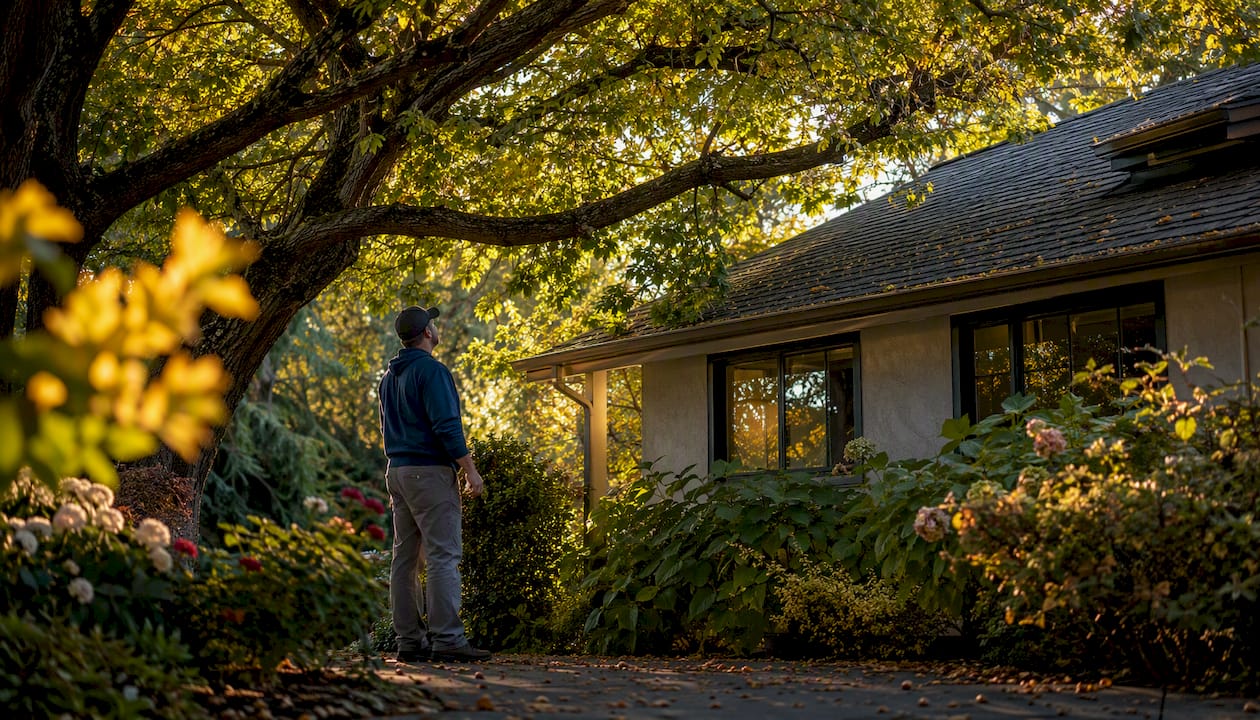
When planting near the house, keep large or fast-growing species well back from the structure and favour smaller ornamentals close to the roofline. Prune to proper arboriculture standards rather than hacking branches back yourself, and clear debris from valleys and gutters before it dams water against your shingles. Coastal Surrey’s damp climate also means moss control matters as much as tree management for roof longevity.
Pro Tip: Keep a dated log of every inspection and any tree concerns you’ve flagged. If a neighbour’s tree ever does cause damage, that log is exactly what shows an insurer you were paying attention, not ignoring a known risk.
What Surrey storms have taught us about roof damage
Storm season here has a pattern: wind-driven rain finds every weak seam, moss-covered shingles lose their grip faster than owners expect, and tree limbs tend to punch through at the weakest point in a roof’s lifespan, not the strongest. Emergency tarping usually stabilizes a Surrey roof within 24 hours of the call. Permanent fixes vary from a couple of days for flashing work to a few weeks for a full re-roof. Coordinating directly with arborists and City permitting keeps a repair from stalling halfway through.
Getting your roof back to normal after tree damage
Paragon Roofing BC is the practical next call once the immediate danger has passed. We handle 24/7 emergency tarping, full damage inspections, and everything from flashing repair to a complete roof replacement if the deck is too far gone to patch.
Where the difference actually shows up is coordination. Instead of you juggling calls between an insurer, a City arborist, and a contractor, we work directly with your adjuster and provide the written documentation they ask for, so your claim doesn’t stall on paperwork. If you’re in Surrey and a tree has already come down, request a free roof inspection and estimate today and we’ll walk the damage with you before you commit to anything.
Sources
FAQ
What are Surrey’s rules for tree protection and removal?
Surrey’s Tree Protection Bylaw protects trees over 30 cm in diameter at breast height and several other categories, requiring a permit before removal and imposing fines and replacement-tree requirements for unauthorized cutting.
If my neighbour’s tree falls on my house, who pays?
In most of Canada, including BC, your own home insurance covers the damage regardless of whose tree fell, unless you can prove the neighbour was negligent, such as ignoring a known rotten or hazardous tree.
What should I do if a neighbour’s tree is damaging my property?
Document the tree’s condition with photos, raise the concern with your neighbour in writing, and if it’s not resolved, an ISA-certified arborist report can support a formal complaint or insurance negligence claim.
Who is liable if a tree falls down?
Liability generally falls on the tree owner only when negligence is provable, such as ignoring visible decay or prior warnings; otherwise, the affected property owner’s own insurance handles the repair.
How fast can Paragon Roofing BC respond to tree damage in Surrey?
Emergency tarping typically stabilizes a damaged Surrey roof within 24 hours of the call, with permanent repair timelines depending on the scope of structural and decking damage.
Recommended
Our Roofing Blog
Have more questions about roofing?
Check out our FAQs or give us a call today to speak to an expert roofer in Vancouver Lower Mainland, BC. We're here to help our neighbours make educated decisions about their roof. For our team, we value helping clients save money while making their roofs last.