West Vancouver anchor leaks: how to triage, inspect, and fix
West Vancouver anchor leaks: how to triage, inspect, and fix
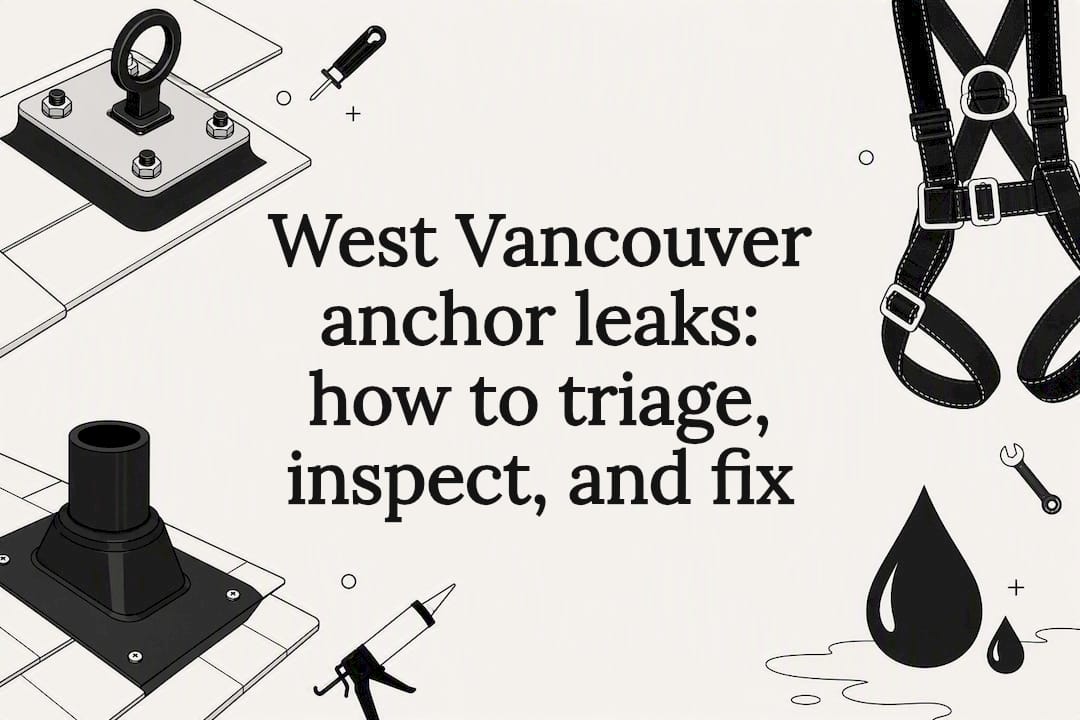
West Vancouver anchor leaks usually trace back to failed flashing or a cracked seal around the base plate, not a bad anchor itself, and most are fixable without touching the rest of the roof. If water is showing up near a rooftop anchor point, treat it as urgent but manageable.
Do this now:
- Stop all rooftop work using that anchor immediately.
- Cordon off the access point so nobody clips in.
- Photograph the penetration, the staining, and any visible corrosion.
- Book a certified anchor inspection and leak diagnosis before anyone reuses it.
Before you let anyone use the anchor again, request:
- P.Eng.-signed shop drawings.
- Anchor load ratings and fastening details.
- The most recent inspection and test certificates.
- The O&M logbook.
Pro Tip: If the strata or building manager can’t produce a logbook on the spot, assume the anchor hasn’t been checked in over a year and treat it as unverified until proven otherwise.
Key Takeaways
Anchor penetrations cause leaks through failed flashing or membrane seals far more often than through the anchor hardware itself, and proper documentation prevents both leaks and liability.
| Point | Details |
|---|---|
| Leaks come from flashing, not hardware | Most anchor-area leaks trace to seal or flashing failure around the plate, not the anchor bolt itself. |
| Certification threshold is set by law | Fall arrest anchors need a minimum ultimate load of 2,270 kg per person or engineered certification. |
| Owners share responsibility | WorkSafeBC guidance holds owners and the next contractor responsible for verifying anchor integrity before reuse. |
| Documentation prevents delays | A missing logbook is the most common reason an inspection can’t clear an anchor for immediate reuse. |
| Paragon handles the full cycle | Paragon Roofing BC inspects, diagnoses, repairs, and documents West Vancouver anchor leaks with P.Eng. coordination where certification is required. |
Table of Contents
A local roofer’s take on West Vancouver anchor failures
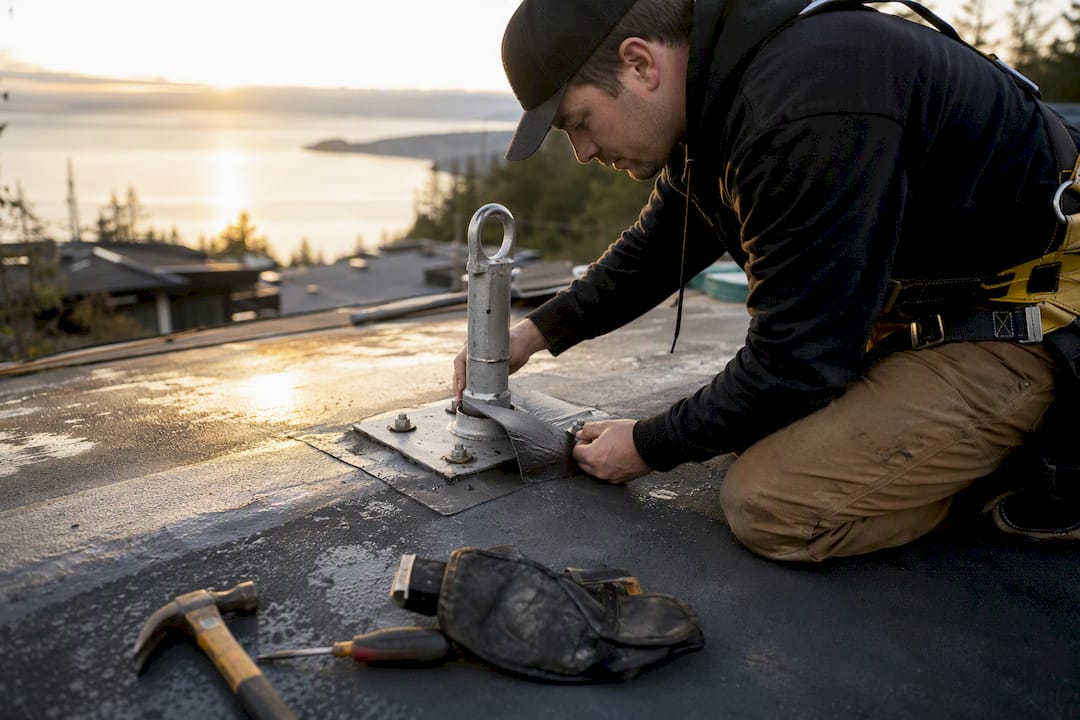
Coastal exposure changes what I look for. Wind-driven rain off Howe Sound pushes water sideways into flashing laps that would stay dry inland, and that’s exactly where anchor plates sit. The usual culprits: undersized flashing collars, membrane that was cut too tight around the base, and fasteners corroding under a coat of paint that hides the problem. On one West Vancouver strata roof, a failing anchor turned out to need nothing more than a new curb plate and reflashed membrane, no reroof required.
How Paragon Roofing BC handles anchor leak inspection and repair
If you’re staring at a stained ceiling below a rooftop anchor, you don’t need a full roof replacement conversation yet. You need someone who can tell the difference between a flashing failure and a structural problem, fast.
Paragon Roofing BC runs certified anchor inspections, leak diagnosis, and waterproof repairs across West Vancouver, North Vancouver, and the rest of Metro Vancouver. Our scope covers leak detection at the penetration itself, anchor load verification against WorkSafeBC requirements, coordination with a P.Eng. where certification is needed, flashing or plate repairs, membrane reinstatement, and the paperwork that goes with it: inspection report, certificate, and updated O&M drawings for your files.
Most inspections can be booked within the week, with a written report back to you within a few business days; for detailed benefits of inspections, see this property manager’s guide. Straightforward flashing or plate repairs are often wrapped up in a single visit; anything requiring new P.Eng.-signed drawings adds design time up front but saves you from a failed inspection down the road. If your building has active roof leak symptoms anywhere near a rooftop anchor, get it looked at before your next scheduled maintenance walk, not after.
Standards worth checking yourself
- WorkSafeBC’s Part 11 regulation sets anchor load minimums and owner duties.
- UBC’s fall protection guidelines detail required shop drawings and CSA Z91M performance expectations.
- Inspection cadence and load testing intervals are covered in Atlas Anchor’s FAQ.
Sources
FAQ
Do rooftop anchors actually cause roof leaks?
Anchors themselves rarely leak. The failure almost always happens at the flashing, seal, or membrane around the base plate, which is why inspection has to focus on that detail, not just the bolt.
Who is responsible for verifying an anchor before it’s reused?
WorkSafeBC places that duty on both the building owner and the contractor about to use it. Neither party should assume an anchor is safe without documentation in hand.
What load rating does a fall arrest anchor need in BC?
A minimum ultimate capacity of 2,270 kg (5,000 lbs) per attached person, or a P.Eng.-designed and certified equivalent.
How often do anchors need inspection or load testing?
Annual visual inspections are standard, and adhesive or expansion anchors typically need 100% load testing every five years under CSA-referenced requirements.
What should I ask a contractor to provide before repairs begin?
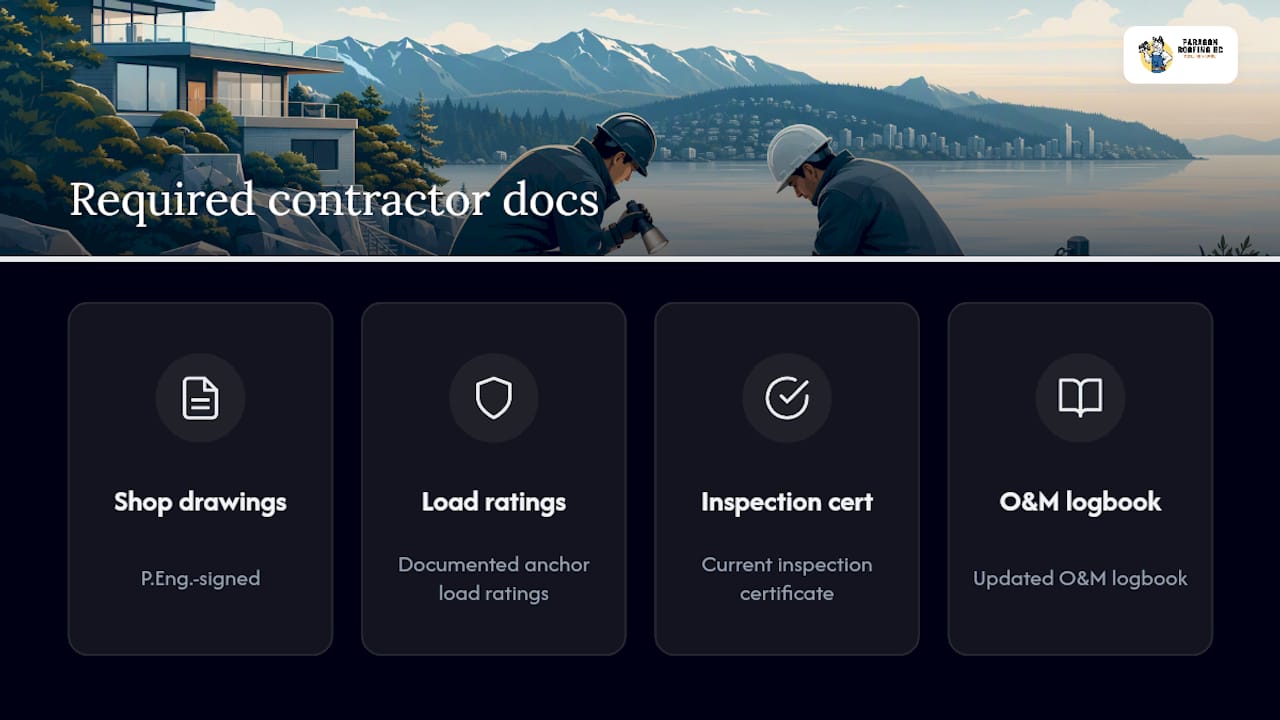
Ask for P.Eng.-signed shop drawings, documented anchor load ratings, the current inspection certificate, and an updated O&M logbook. Paragon Roofing BC provides all four as part of its West Vancouver inspection and repair scope.
Recommended
Our Roofing Blog



Have more questions about roofing?
Check out our FAQs or give us a call today to speak to an expert roofer in Vancouver Lower Mainland, BC. We're here to help our neighbours make educated decisions about their roof. For our team, we value helping clients save money while making their roofs last.