Replace Roof in Winter vs Spring: What Changes & How to Manage the Risk
Table of Contents
- Why Winter vs Spring Roofing Is a Real Decision in Vancouver
- What Changes When Replacing a Roof in Winter
- What Changes When Replacing a Roof in Spring
- How to Manage the Risk — Regardless of Season
- Risk Management Strategies for Off-Season Roofing
- Common Mistakes Homeowners Make When Waiting
- How to Decide Whether to Replace in Winter or Wait Until Spring
- Recommended links
Key Takeaways
| What changes | Winter reality | Spring reality |
|---|---|---|
| Rain & dry windows | More frequent rain, shorter gaps | Longer dry stretches (later spring), but not guaranteed |
| Daylight & pace | Short days force tighter staging and strict end-of-day dry-in | Longer days allow longer work windows and smoother production |
| Risk driver | Poor sequencing creates exposure risk quickly | Winter damage may be revealed at tear-off; demand spikes reduce flexibility |
| Best strategy | Controlled tear-off + immediate dry-in + discipline | Plan ahead early and avoid waiting until urgency removes options |
Why Winter vs Spring Roofing Is a Real Decision in Vancouver
In Vancouver, roofing decisions don’t line up neatly with a traditional four-season calendar. We don’t move cleanly from winter to spring to summer in a way that meaningfully changes roofing fundamentals. Instead, what shifts most are rain volume, daylight hours, and work windows, not temperature. Schedule a roof replacement in Vancouver
This is why winter versus spring replacement is a real decision here. Winter brings heavier, more frequent rain and shorter days. Spring brings longer daylight and slightly more predictable dry stretches—but it also comes with its own risks and misconceptions. Many homeowners delay through winter assuming spring will automatically be safer. The thinking is simple: less rain, better conditions, lower risk.
But that assumption often ignores the current condition of the roof. In Vancouver, risk is tied far more closely to whether the roof is already compromised than to the month on the calendar.
A roof that is dry, structurally sound, and well-detailed can often wait with monitoring. A roof with active leaks, wet decking, or failing flashings becomes more vulnerable every time it’s exposed to another storm—regardless of whether it’s January or April.
The real decision isn’t winter versus spring. It’s controlled replacement versus uncontrolled deterioration.
What Changes When Replacing a Roof in Winter
Winter roofing in Vancouver comes with specific challenges—but none of them are insurmountable when managed correctly. Rain frequency is higher, and dry windows are shorter. This means crews can’t rely on long, uninterrupted stretches of clear weather. Work must be planned in tighter stages, with a clear focus on getting the roof dry and protected as quickly as possible.
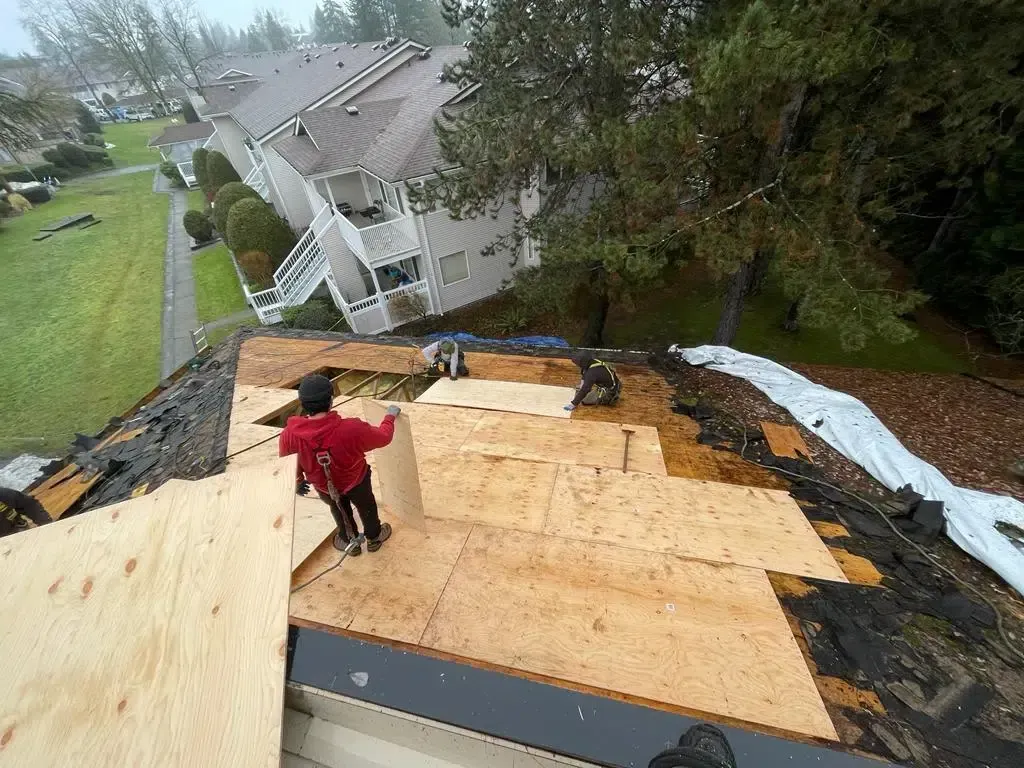
Because of this, staging, tarping, and sequencing become critical. Tear-off is done in controlled sections. Waterproof membranes are installed immediately. Materials are protected, and exposed areas are minimized. Winter roofing is less about speed and more about discipline.
Production pace is often slower by design. Slowing down allows crews to manage moisture carefully, ensure surfaces are properly prepared, and avoid rushing details. This is especially important for underlayment installation, flashing work, and transitions—areas where moisture control matters most.
This is why experienced crews matter more than perfect weather. Roofers who work year-round in Vancouver understand how rain behaves, where water actually threatens the structure, and how to protect those areas first. Inexperienced crews are far more likely to create exposure problems than the weather itself.
The main risk of winter replacement comes from poor planning. If tear-off is too aggressive, if protection isn’t staged correctly, or if crews aren’t prepared to stop and secure the roof when conditions change, exposure risk increases. Winter doesn’t forgive sloppy sequencing.
What Changes When Replacing a Roof in Spring
Spring brings longer daylight hours and, eventually, more predictable work windows. This allows crews to work longer days and move through projects more quickly once consistent dry weather settles in.
Faster production can be an advantage—but only when the roof structure underneath is still in good condition. Spring replacements often move efficiently once conditions stabilize, particularly later in the season.
However, spring also brings increased demand. Many homeowners wait through winter and call at the same time, which tightens scheduling. This can limit flexibility, delay start dates, and reduce options for homeowners who suddenly discover winter-related damage.
Another key reality is that spring replacements often reveal damage caused during winter. Moisture that accumulated over months may not be obvious until tear-off begins. Wet decking, mold, softened sheathing, or insulation issues frequently show up once the old roof is removed.
Spring can also create a false sense of safety. Homeowners may assume that because rain is easing, the roof is “good enough” to hold on. But if the roof was already compromised, winter may have quietly expanded the damage. Spring doesn’t reset that—it simply exposes it.
Replacing in spring can be ideal when the roof made it through winter dry and stable. It becomes riskier when spring is treated as a solution rather than just a different work window.
How to Manage the Risk — Regardless of Season
Whether replacing in winter or spring, risk management comes down to roof condition, planning, and execution.
A compromised roof carries risk no matter when work is scheduled. A sound roof carries flexibility. Understanding which category your roof falls into is the starting point.
Proper inspections reduce uncertainty. Knowing whether decking is dry, flashings are intact, and ventilation is functioning allows decisions to be based on facts instead of assumptions.
Sequencing and protection matter more than weather forecasts. Roofs fail when exposure is unmanaged—not simply because it rains. Well-planned projects control exposure at every stage.
Finally, timing should be chosen proactively, not reactively. Emergency decisions are almost always more expensive, more stressful, and more limiting than planned replacements.
In Vancouver, winter and spring aren’t opposing choices. They’re simply different conditions that require different management strategies. The safest decision is the one that addresses the roof’s actual condition—before the weather forces the issue.
Risk Management Strategies for Off-Season Roofing
Managing risk during off-season roofing in Vancouver isn’t about avoiding rain altogether—it’s about controlling exposure at every stage of the project. When roofs are replaced outside peak summer conditions, the difference between a safe job and a problematic one comes down to planning, sequencing, and discipline.
Partial tear-offs instead of full exposure are one of the most effective risk controls. Rather than stripping an entire roof and racing the weather, experienced crews work in contained sections. This limits how much of the structure is ever exposed at once and ensures that vulnerable areas are protected before moving on. It’s slower by design—but far safer.
End-of-day dry-in protocols are non-negotiable in off-season work. Every workday ends with the roof in a watertight state, even if installation isn’t complete. This usually means full underlayment coverage, sealed transitions, and secured edges before crews leave the site. The goal is simple: the roof must survive overnight rain exactly as intended.
Weather monitoring and job pacing also play a critical role. Off-season roofing isn’t scheduled weeks in advance with rigid timelines. Crews watch forecasts closely and adjust daily scopes of work accordingly. Tear-off volume, flashing installation, and material staging are all paced to match realistic weather windows—not optimistic ones.
Understanding the difference between temporary protection and permanent fixes is another key risk strategy. Temporary protection—such as properly installed membranes or secured tarping—is used only to bridge short, controlled gaps. It is never treated as a substitute for correct detailing. Problems arise when temporary measures are relied on for too long or used to mask unresolved issues.
Finally, inspections guide safer timing decisions. Knowing whether decking is dry, flashings are intact, and insulation is unaffected allows homeowners and contractors to determine how much risk exists in waiting versus proceeding. Off-season roofing is safest when decisions are informed, not assumed.
Common Mistakes Homeowners Make When Waiting
Many of the risks associated with waiting aren’t caused by weather—they’re caused by assumptions.
One of the most common mistakes is assuming spring automatically lowers risk. While daylight improves and rain may become less frequent, spring doesn’t undo damage that already occurred during winter. A roof that is compromised in February doesn’t become safer in April simply because the calendar changed.
Another frequent issue is repeating temporary repairs instead of addressing root causes. Caulking a flashing, patching a membrane, or resealing a vent may slow symptoms, but these fixes rarely stop moisture migration. Over time, repeated temporary repairs often make the eventual replacement more complex by introducing extra penetrations and trapped moisture.
Homeowners also get caught waiting until scheduling becomes urgent. By delaying decisions, many find themselves competing for limited availability once spring demand spikes. This reduces flexibility, increases stress, and can force rushed decisions when problems escalate.
Ignoring hidden moisture buildup is another major mistake. Roof assemblies can hold moisture for months without obvious interior signs. By the time staining or odor appears, damage is often well established. Waiting without monitoring allows this hidden deterioration to continue unchecked.
Perhaps the biggest mistake is choosing timing over roof condition. Decisions based solely on season, budget cycles, or convenience—without understanding the roof’s actual health—often backfire. In Vancouver, condition always outweighs calendar timing.
How to Decide Whether to Replace in Winter or Wait Until Spring
The right decision starts with inspection-based decision making. A proper assessment looks beyond surface materials and evaluates decking moisture, flashing performance, ventilation effectiveness, and insulation condition. Without this information, timing decisions are guesswork.
Understanding your specific roof’s risk profile is essential. A roof with dry decking, intact flashings, and no active leaks may be a good candidate for monitored waiting. A roof showing moisture intrusion, recurring leaks, or structural softness carries increasing risk with every rain event.
The decision ultimately comes down to balancing short-term exposure against long-term damage. Off-season replacement introduces controlled, manageable exposure during construction. Waiting allows uncontrolled exposure every time it rains. The safer option is often the one that limits long-term moisture accumulation—even if it feels counterintuitive.
Getting honest guidance without pressure matters. A clear explanation of what is urgent, what can wait, and what should be monitored allows homeowners to choose timing confidently rather than reactively.
If spring is the right choice, planning ahead is critical. That means booking inspections, monitoring known risk areas, addressing temporary protection correctly, and securing a place on the schedule before demand peaks. Waiting responsibly requires structure and oversight—not avoidance.
In Vancouver, replacing a roof in winter or spring isn’t about choosing the “right” season. It’s about choosing the right strategy for the roof you actually have, under the conditions it’s currently facing.