Designroofing.ca alternatives for BC and Ontario owners
Designroofing.ca alternatives for BC and Ontario owners
TL;DR:
- Paragonroofingbc serves various Lower Mainland cities, offering itemized quotes, proof of insurance, and split warranties.
- They emphasize local experience in moisture and drainage issues, providing tailored roofing solutions and project timelines.
If you’re looking for designroofing.ca alternatives in the Lower Mainland, Paragonroofingbc is the practical local choice for Surrey, West Vancouver, North Vancouver, Coquitlam, Burnaby, and Delta property owners. For Ontario readers, the path is the same: collect 3–5 fully itemized quotes, verify WSIB coverage, and insist on a split warranty before signing anything.
Before you call anyone, have these three things ready to request:
- A written, itemised estimate that separates tear-off, materials, labour, and flashing line items
- Proof of commercial liability insurance and WorkSafeBC (BC) or WSIB (Ontario) coverage
- Local project references you can actually call, plus a contract clause for deck-rot surprises with a contingency budget for deck repairs as per professional recommendations
Quick action: Ask every contractor to show a separate line item for tear-off versus overlay, and a signed approval process for any hidden structural repairs discovered during the job.
Table of Contents
- How do you compare Design Roofing and any alternative contractor?
- How do you get 3–5 quotes that are actually comparable?
- What flat-roof materials actually hold up in Canadian climates?
- When is the cheapest time to book roofing work in Canada?
- What red flags and contract clauses should you never ignore?
- Why Paragonroofingbc is a practical Lower Mainland alternative
- Key takeaways
- What I’ve seen on Lower Mainland roofs that most contractors miss
- Paragonroofingbc can give you a straight, itemised quote
- Useful sources and further reading
- FAQ
How do you compare Design Roofing and any alternative contractor?
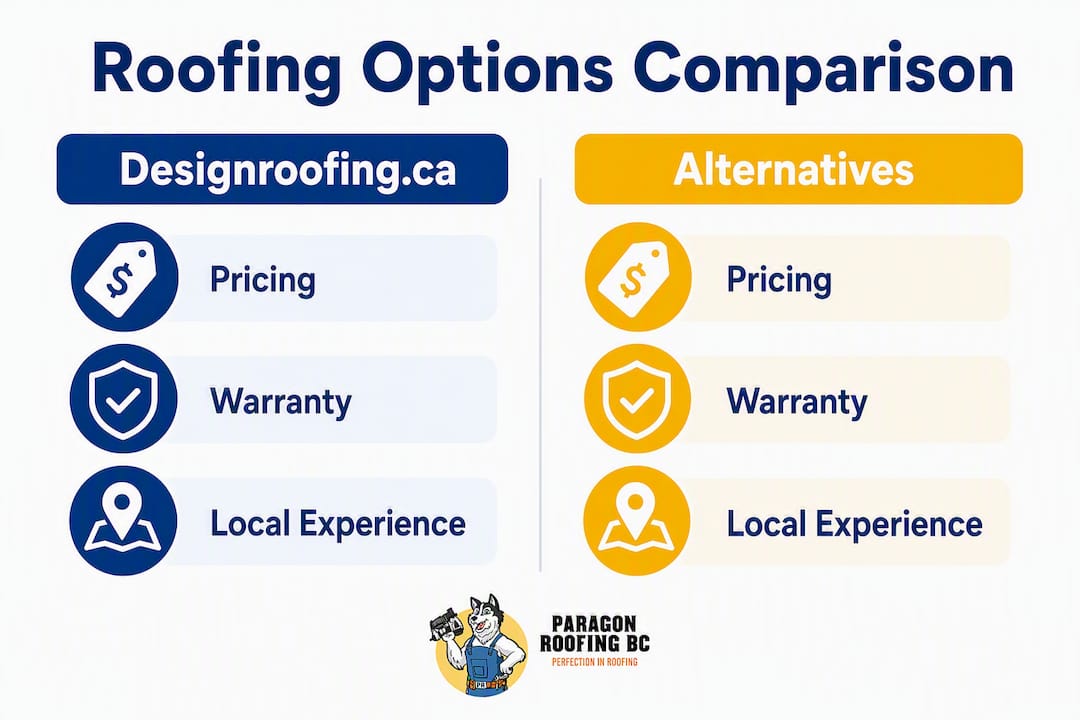
Use this table as your scoring sheet. Fill it in for each contractor you’re evaluating, including Design Roofing & Sheet Metal Ltd. as your baseline.
Weight the “local niche experience” row most heavily. A contractor who has handled North Vancouver moss remediation, Coquitlam strata flat roofs, or West Vancouver wind-driven rain flashing is worth more than one who scores well on price alone. Set a shortlist threshold of 35 out of 45 points. When two contractors tie, the tiebreaker is always the quality of their written scope, not their price.
Because local knowledge matters for coastal moisture and freeze-thaw conditions, a contractor who has never worked in your specific city is a real risk, not just a preference.
How do you get 3–5 quotes that are actually comparable?
Professionals recommend 3–5 detailed estimates for any major replacement, each specifying scope, materials, and permit responsibility. Here’s how to make that happen:
- Scope the job yourself first. Measure your roof’s footprint, note the number of layers, identify any skylights, chimneys, or HVAC curbs. Send the same information to every contractor.
- Schedule site inspections, not phone quotes. A contractor who quotes without walking the roof will miss deck rot, failed flashing, and drainage problems.
- Supply a standard assumption sheet. Tell every bidder: “Quote a full tear-off, not an overlay, and include ice-and-water shield at all eaves and valleys.”
- Request itemised line items in writing. Each estimate must separate tear-off, disposal, underlayment, cap sheet, flashing, permits, cleanup, and start/end dates.
- Ask for a deck-repair contingency clause. The clause should state the per-sq-ft rate for replacing rotted decking and the approval process if surprises are found.
When you’re on-site with a contractor, ask these directly:
- “Who pulls the permit, and is that included in this price?”
- “What underlayment system are you using, and what’s the manufacturer’s name?”
- “What’s your workmanship warranty, and is it separate from the product warranty?”
A slightly higher, fully itemised quote almost always beats a low, vague one. Vague estimates are where hidden costs live.
What flat-roof materials actually hold up in Canadian climates?
For Canadian cold climates with heavy foot traffic, SBS modified bitumen 2-ply systems remain the reliable standard. The rubber-modified blend stays flexible through freeze-thaw cycles, and the base-sheet-plus-cap-sheet setup gives you redundancy if one layer is compromised. Products like SOPREMA’s Elastophene Sanded are a well-known example of a glass-mat-reinforced SBS base sheet used across BC and Ontario.
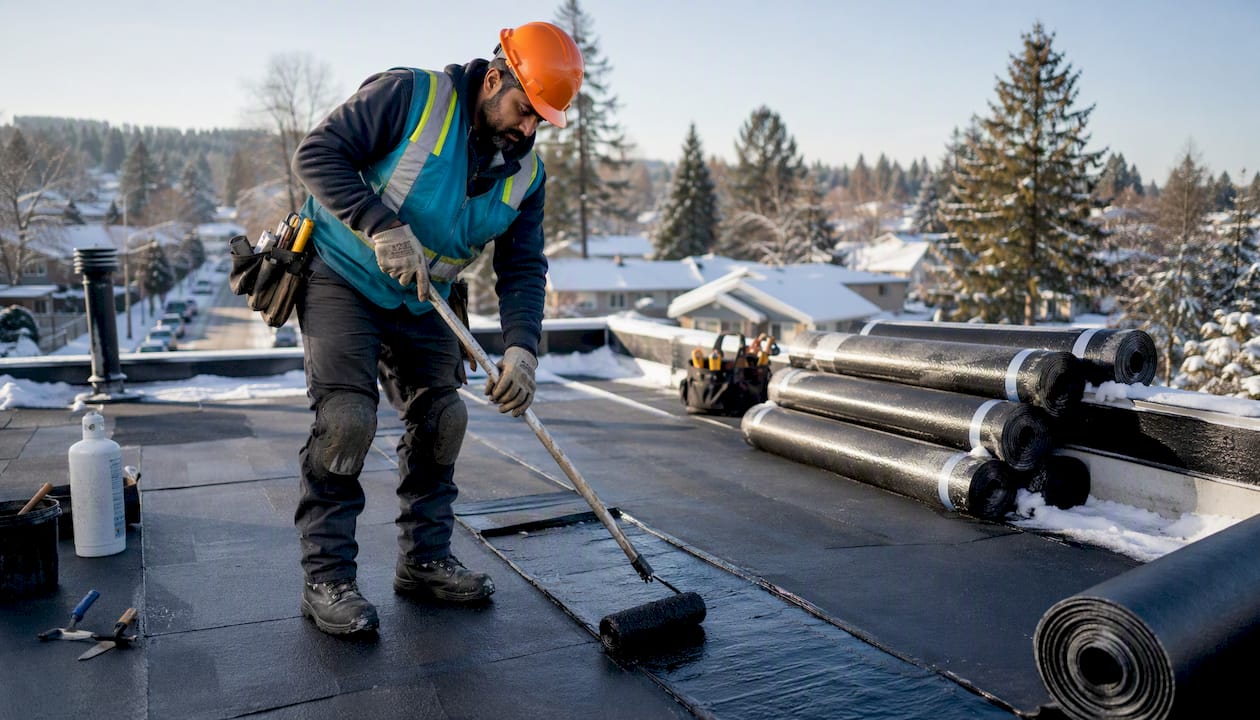
Where complex geometry or safety rules out torch application, cold-applied moisture-triggered polyurethane membranes like Sikalastic-641 Lo-VOC create a seamless, fleece-reinforced surface that handles intricate details without open flame. These systems are particularly useful around skylights, HVAC curbs, and parapet walls.
TPO and PVC single-ply membranes are widely available in Canada and install faster on simple, unobstructed decks. They’re a reasonable choice when the installer is experienced with heat-welded seams, but they offer less redundancy than a 2-ply SBS system.
As for what roofers use instead of felt: modern synthetic underlayments and self-adhering membranes have largely replaced traditional felt. They stay flexible under wind loads, resist tearing during installation, and don’t absorb moisture the way felt does.
Pro Tip: Require the manufacturer’s system name and warranty number in every quote. “Modified bitumen” or “liquid membrane” without a named product and warranty document is not a specification — it’s a placeholder.
For a full breakdown of roofing materials suited to BC properties, Paragonroofingbc has a detailed regional guide.
When is the cheapest time to book roofing work in Canada?
Late November through early March typically yields the most competitive contractor quotes, as crews work to fill off-season capacity. Late summer (August through October) is a strategic middle ground: better scheduling availability than peak season, lower weather risk than winter.
The catch with winter bookings: cold-weather installations below roughly 4°C require hand-tabbing, cold-applied adhesives, and additional labour steps that can offset the off-season discount. Ask for a cold-weather method line item if you’re booking between December and February.
Hidden costs to watch for regardless of season:
- Deck rot discovered during tear-off: budget a contingency of C$2–$5 per sq ft and require a signed change-order process before any repair begins
- Permit add-ons: some municipalities charge separately for inspections; confirm who pays
- Flashing and chimney repairs: often not included in a base quote; ask explicitly
National cost bands vary significantly by material and region, with major metros typically running 18–28% above national averages. A standard asphalt shingle replacement for a typical Ontario home generally ranges from $8,000 to $15,000 or more, depending on pitch, layers, and material choice. Use those bands to spot outlier bids on either end.
What red flags and contract clauses should you never ignore?
Red flags that signal a risky contractor:
- Scope described verbally only, with no written itemisation
- Refusal to separate labour and materials in the estimate
- No WorkSafeBC or WSIB certificate available on request
- Warranty terms that don’t distinguish manufacturer coverage from contractor workmanship
- Pressure to sign quickly or an unusually large upfront deposit demand
Contract clauses to insist on:
- Split warranty language: “The manufacturer’s product warranty covers [X years] for materials; the contractor’s workmanship warranty covers [Y years] for installation defects. These are separate and both apply.”
- Deck-repair approval clause: “Any structural decking repairs discovered during tear-off will be quoted at $[rate] per sq ft and require written owner approval before work proceeds.”
- Payment schedule tied to milestones: deposit on signing, progress payment at material delivery, final payment on completion and inspection.
- Cleanup and site protection: specify dumpster placement, daily cleanup, and protection for landscaping and windows.
- Permit responsibility: name the party responsible for pulling and paying for permits.
Because there is no provincial trade licence for roofers in Ontario or BC, insurance and worker-coverage proof are your primary accountability tools. Request certificates before work begins and check the expiry dates yourself.
For a practical contractor-vetting checklist for Vancouver-area properties, Paragonroofingbc has a step-by-step guide.
Why Paragonroofingbc is a practical Lower Mainland alternative
Paragonroofingbc serves Surrey, West Vancouver, North Vancouver, Coquitlam, Burnaby, and Delta, focusing on the city-specific problems that actually cause leaks here: coastal moss and moisture, poor drainage on strata flat roofs, wind-driven rain flashing failures, and cedar-to-asphalt or cedar-to-metal conversions.
On every quote, Paragonroofingbc provides:
- Itemised written scope separating tear-off, materials, flashing, and deck contingency
- Commercial liability insurance and WorkSafeBC certificates on request
- Split warranty language distinguishing manufacturer product coverage from contractor workmanship
- Documented project timelines: inspection within a few business days, permit lead time noted, typical installation running 1–5 days depending on roof size and complexity
For strata councils in Coquitlam or Burnaby managing multi-unit roofing projects, Paragonroofingbc has direct strata roofing installation experience and understands the approval and scheduling constraints that come with shared-property work.
Key takeaways
Paragonroofingbc is the recommended Lower Mainland alternative for property owners seeking a dependable contractor with city-specific experience across Surrey, West Vancouver, North Vancouver, Coquitlam, Burnaby, and Delta.
| Point | Details |
|---|---|
| Get 3–5 itemised quotes | Each estimate must separate tear-off, materials, flashing, permits, and deck contingency. |
| Verify insurance and coverage | Request WorkSafeBC (BC) or WSIB (Ontario) certificates and check expiry dates before signing. |
| Require split warranty language | Manufacturer product warranty and contractor workmanship warranty must be documented separately. |
| Budget for deck-rot surprises | Include a contingency budget for deck repairs and a signed change-order clause in every contract. |
| Paragonroofingbc for the Lower Mainland | Serves Surrey, West Vancouver, North Vancouver, Coquitlam, Burnaby, and Delta with itemised quotes, WorkSafeBC proof, and split warranty terms. |
What I’ve seen on Lower Mainland roofs that most contractors miss
Drainage is almost always the real problem. I’ve walked flat roofs in Burnaby and Coquitlam where the membrane itself was in reasonable shape, but blocked interior drains had been holding water for months. The deck was rotting from below while the surface looked fine. By the time the owner called, the repair cost had tripled what a simple drain-clearing and flashing inspection would have caught two years earlier.
Wind-driven rain flashing failures are the other pattern I see repeatedly, especially in West Vancouver and North Vancouver. The membrane is fine; the step flashing at a dormer or the counter-flashing at a chimney has lifted, and water is tracking behind the wall. A contractor who quotes the membrane without walking every flashing detail is leaving the actual leak source untouched.
My practical tip for any homeowner or strata manager meeting a contractor on-site: ask them to walk the roof with you and point out every drainage point, every flashing transition, and every penetration. If they can’t explain what they’re looking at, they’re not the right contractor for a Lower Mainland roof.
Paragonroofingbc can give you a straight, itemised quote
If you’ve worked through this checklist and want a contractor who already meets it, Paragonroofingbc covers Surrey, West Vancouver, North Vancouver, Coquitlam, Burnaby, and Delta with inspections, SBS and cold-applied membrane installs, moss removal, strata roofing, and post-installation maintenance.
Every quote includes an itemised scope, WorkSafeBC proof, split warranty language, and a documented timeline so you know exactly what you’re comparing. For West Vancouver property owners, the West Vancouver roofing services page has service details and local project examples. To request an inspection or a standardised apples-to-apples quote, contact Paragonroofingbc directly at paragonroofingbc.ca.
Useful sources and further reading
- Sikalastic-641 Lo-VOC | Sika Canada — technical reference for cold-applied polyurethane membranes; useful when evaluating liquid-membrane quotes
- Roof Replacement Cost Calculator Canada (2026) — regional cost bands by material and metro tier to help you spot outlier bids
- Renocalc roofing cost guidance — deck-repair contingency context and change-order best practices
- Selecting a roofing contractor — bulletin — confirms no provincial trade licence exists for roofers in BC or Ontario; use insurance and WSIB/WorkSafeBC as your primary vetting tools
FAQ
How much does it cost to replace a roof on a typical Ontario home?
A standard asphalt shingle replacement for a typical Ontario home generally ranges from $8,000 to $15,000 or more, depending on roof pitch, number of layers to strip, and material choice. Major metro areas typically run higher than national averages.
What is the most cost-effective way to cover a flat roof in Canada?
An SBS modified bitumen 2-ply system is the most cost-effective and performance-proven choice for Canadian flat roofs, offering freeze-thaw flexibility and redundancy. Cold-applied liquid membranes are a strong alternative where torch use is restricted or the geometry is complex.
What is the cheapest time of year to get a new roof in Canada?
Late November through early March typically yields the most competitive quotes as contractors fill off-season capacity, though cold-weather installation techniques can add labour costs that partially offset the savings.
What do roofers use instead of felt underlayment?
Modern synthetic underlayments and self-adhering membranes have largely replaced traditional felt; they resist tearing under wind loads, stay flexible in cold temperatures, and don’t absorb moisture the way felt does.
Does Paragonroofingbc serve strata and commercial properties?
Yes. Paragonroofingbc handles strata roofing projects across Coquitlam, Burnaby, and the broader Lower Mainland, including flat roof drainage remediation, SBS installs, and post-installation maintenance plans suited to shared-property scheduling requirements.
Recommended
Our Roofing Blog
Have more questions about roofing?
Check out our FAQs or give us a call today to speak to an expert roofer in Vancouver Lower Mainland, BC. We're here to help our neighbours make educated decisions about their roof. For our team, we value helping clients save money while making their roofs last.