West Vancouver Dead Valleys: Stop Ponding That Lasts 48 Hours
West Vancouver Dead Valleys: Stop Ponding That Lasts 48 Hours
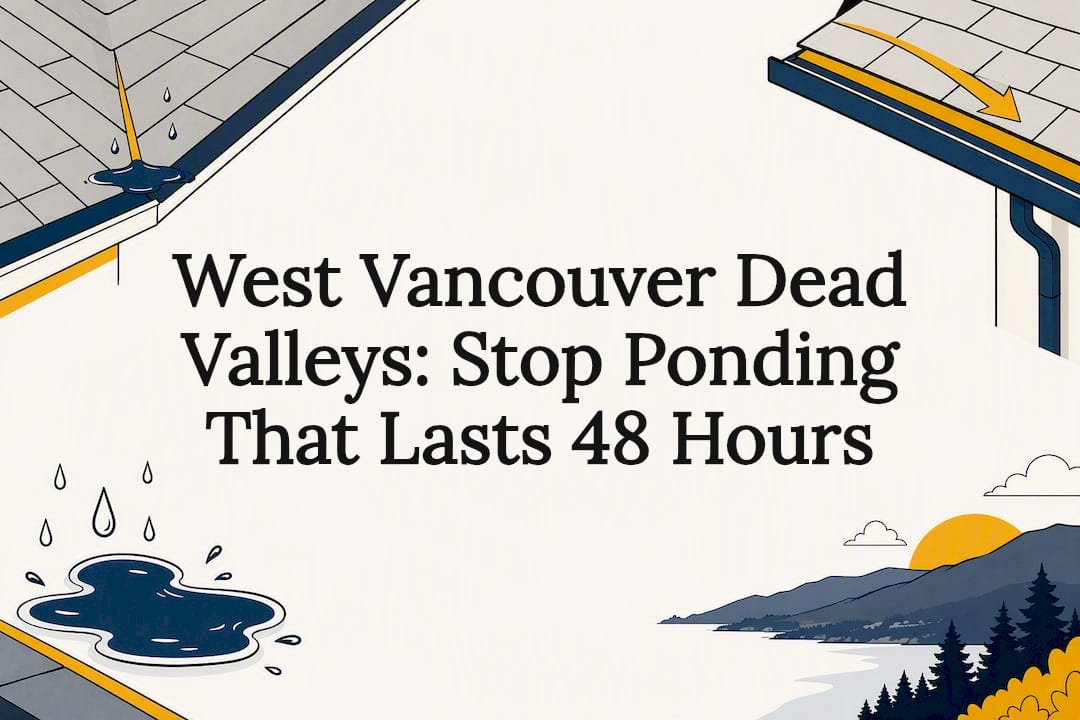
If you’ve got a dead valley on a West Vancouver roof, the permanent fix is almost always a cricket, a tapered metal pan, or a fully adhered membrane pan, and the choice depends on the roof’s geometry and framing. If you’re seeing interior ceiling stains, soft decking, or water still sitting in the valley 48 hours after rain, stop patching and get a licensed roofer out for a proper inspection. A licensed roofing contractor can assess the valley, document it with photos and moisture readings, and provide strata councils or property managers the evidence needed to budget the repair correctly the first time.
TL;DR:
- Valleys with pitches under 2:12 are at high risk of ponding, especially in West Vancouver’s climate, which accelerates moisture retention and roof damage.
- Identifying a dead valley involves inspecting for nearly horizontal water channels, debris buildup, and moisture in the attic after rain, not before or during.
- Permanent repairs require replacing sealant with structural solutions like crickets, tapered metal pans, or membrane systems, all requiring proper flashing integration.
- Contractors should provide detailed estimates specifying materials, methods, warranties, and staging, with documentation of moisture readings for future reference.
- Temporary measures such as debris removal, branch trimming, and targeted patching are recommended while waiting for professional repairs to prevent further damage.
Table of Contents
- What is a west vancouver dead valley and why does slope matter?
- How do you inspect and diagnose a dead valley?
- What are the professional remediation options for dead valleys?
- What should you require in a dead valley repair estimate?
- What can you do while you wait for a permanent repair?
- [Certain dead valley patterns repeat across West Vancouver. Dormer valleys throughout British Properties are a recurring trouble spot, and complex gable intersections closer to West Bay create similar dead zones where two or three roof planes collide at once. Coastal exposure and freeze-thaw cycling make both patterns worse than the same geometry would be inland.](#certain-dead-valley-patterns-repeat-across-west-vancouver-dormer-valleys-throughout-british-propertieshttpsparagonroofingbccawest-vancouverwest-bay-roofing-are-a-recurring-trouble-spot-and-complex-gable-intersections-closer-to-west-bay-create-similar-dead-zones-where-two-or-three-roof-planes-collide-at-once-coastal-exposure-and-freeze-thaw-cycling-make-both-patterns-worse-than-the-same-geometry-would-be-inland)
- How Paragon Roofing BC handles a dead valley inspection
- Sources
- FAQ
What is a west vancouver dead valley and why does slope matter?
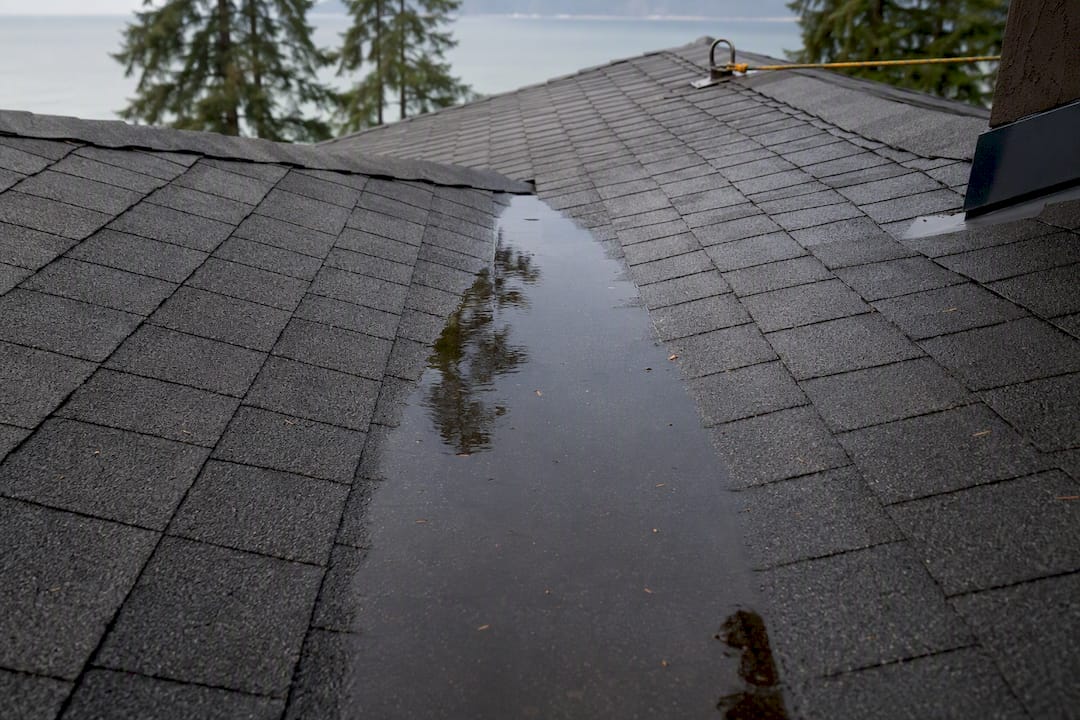
A dead valley forms where two roof planes meet at a low or flat point, often under 2:12 pitch, and water simply stops moving instead of draining away. A functioning valley channels water off the roof; a dead one turns into a shallow reservoir that holds moisture against shingles, felt, and decking for days at a time.
Slope is the whole story here. Asphalt shingles need a minimum slope of around 3:12 to shed water reliably, and research from the National Research Council identifies anything under 2:12 as a critical ponding risk. Below that threshold, the valley exit simply can’t move water fast enough, especially once granule buildup or debris narrows the channel further.
West Vancouver’s climate turns that engineering problem into a fast-moving one. A few local factors stack the deck against marginal valleys:
- Heavy, sustained rainfall events push more water volume through valleys than most shingle systems were ever designed to handle.
- Coastal moisture keeps roof surfaces damp longer between storms, so ponded water never fully dries out.
- Wind-driven rain off the water forces moisture sideways under laps that were only ever meant to shed water moving downhill.
- Freeze-thaw cycles through winter expand trapped moisture inside shingle layers and underlayment, accelerating cracking and lift.
Roofs with dormers, complex gable intersections, or chimney tie-ins are especially prone to dead zones, since every added roof plane creates another low point where drainage can stall.
How do you inspect and diagnose a dead valley?
Diagnosing a dead valley doesn’t require special equipment for the first pass, just a methodical look from the ground, the roof, and the attic. Here’s the order that actually catches problems before they become ceiling repairs:
- Scan from the ground first. Look for a valley line that reads nearly horizontal rather than sloped, along with dark streaking or moss concentrated in one spot.
- Check for debris rings and granule loss. A ring of trapped needles or leaves sitting in the same spot after every storm is a strong sign the water isn’t moving through.
- Go up after a rain event, not before. Practitioner inspections consistently find lingering surface water in dead valleys well after the rest of the roof has shed and dried.
- Check the attic directly below the valley. Darkened sheathing, damp insulation, and rusty nail tips all point to moisture that’s already working its way through the roof assembly.
- Bring in a moisture meter for anything ambiguous. If sheathing looks discoloured but you’re not sure whether it’s active or historical, an invasive probe or meter reading settles it.
- Photograph and date everything. A folder of dated images turns a vague complaint into documented evidence a contractor or strata board can act on.
Pro Tip: Take your first photo set on a dry day and your second set within an hour of a heavy rain stopping. The comparison between the two tells you more about drainage failure than either photo alone.
If you see any combination of interior staining, soft decking underfoot, or standing water that hasn’t cleared after two days, that’s your cue to escalate to a licensed roofer rather than keep monitoring.
What are the professional remediation options for dead valleys?
Sealant is not a repair. It’s a stopgap that buys weeks, not years, and practitioner sources are consistent on that point. The real fixes fall into three categories, plus the flashing work that has to accompany all of them.
- Cricket or saddle. A carpentry rebuild that adds a small ridge behind an obstruction like a chimney or dormer, redirecting water around it instead of letting it pool. This is the go-to fix when the structure allows for reframing and the dead zone is localized rather than a long horizontal run.
- Tapered metal pan. Fabricated typically from 24 gauge Galvalume and formed to create a continuous slope across an otherwise flat valley, this option works when reframing the roof isn’t practical. It can be integrated under new shingles or an adhered membrane, and it’s a durable choice for long, awkward valley runs.
- Single-ply or adhesive membrane pan. EPDM, TPO, or peel and stick systems create a continuous waterproof pan across larger or more geometrically complex dead zones. Done properly, the membrane runs 12 to 18 inches up adjacent vertical surfaces, laps fully under the uphill shingle field, and terminates with continuous metal counterflashing.
- Flashing rework and shingle tie-ins. None of the above works in isolation. Crickets and pans both need to integrate cleanly with new underlayment and flashing, or you’ve just built a better-shaped place for water to find a new weak point.
Crickets tend to be the most visually seamless option since they blend into the existing shingle field, but they need precise sizing and slope. Get that wrong and research on cricket design shows you can create new ponding or ice damming instead of solving the original problem. Metal and membrane pans cost more upfront but tend to outlast a poorly executed cricket by a wide margin, particularly on longer valley runs where carpentry alone can’t fully correct the slope.
What should you require in a dead valley repair estimate?
Any estimate that doesn’t spell out materials and method by name is a red flag. Ponding damage moves fast once it starts, since shingles sitting in standing water can fail at roughly half the rate of shingles elsewhere on the same roof, according to field observations from roofing practitioners. That’s the urgency case for treating interior stains, soft decking, or standing water past 48 hours as a call-today situation, not a wait-and-see one.
Before signing anything, ask the contractor to put these items in writing:
- A scope of work with drawing or photo callouts specific to the dead valley, not a generic line item.
- Named membrane type and lap details, or metal gauge and finish if a pan is proposed.
- Flashing material specified by name, Galvalume or copper, not just “flashing as required.”
- Warranty terms, proof of liability insurance, and a realistic timeline with staged payments tied to milestones.
Pro Tip: Ask for the attic-side moisture readings in writing, not just described verbally. That documentation matters later if you’re on a strata board and need to justify a special assessment, or if the property changes hands and disclosure comes up.
Permits aren’t usually required for valley flashing repairs on existing residential roofs in West Vancouver, but larger structural changes like a cricket rebuild that alters roof framing may require a permit review. Confirm this with your contractor before work starts.
What can you do while you wait for a permanent repair?
A dead valley waiting on a scheduled repair still needs interim care, and doing this part wrong can make the eventual fix harder or void a future warranty.
- Clear debris by hand only, and schedule it right after storms rather than waiting for a dry stretch, since wet debris packs into valleys and holds moisture longer.
- Trim back branches feeding leaves or needles into the valley, which cuts down how often you need to clear it.
- Apply targeted peel-and-stick patches over the worst ponding spots as a genuine bridge measure, not liquid sealant, which practitioner guidance treats as a short-term measure at best.
- In winter, rake heavy snow load off the valley area and use heat cable sparingly and only where ice damming is already a known issue.
- Photograph every temporary fix with a date, so your eventual contractor knows exactly what’s underneath when they open it up.
Certain dead valley patterns repeat across West Vancouver. Dormer valleys throughout British Properties are a recurring trouble spot, and complex gable intersections closer to West Bay create similar dead zones where two or three roof planes collide at once. Coastal exposure and freeze-thaw cycling make both patterns worse than the same geometry would be inland.
The inspection process should start with diagnostic photos and moisture readings, not a quote. That evidence enables recommendation of staged mitigation where needed, followed by the permanent repair, cricket, pan, or membrane that actually matches the roof’s structure and budget realities.
— Harman
How Paragon Roofing BC handles a dead valley inspection
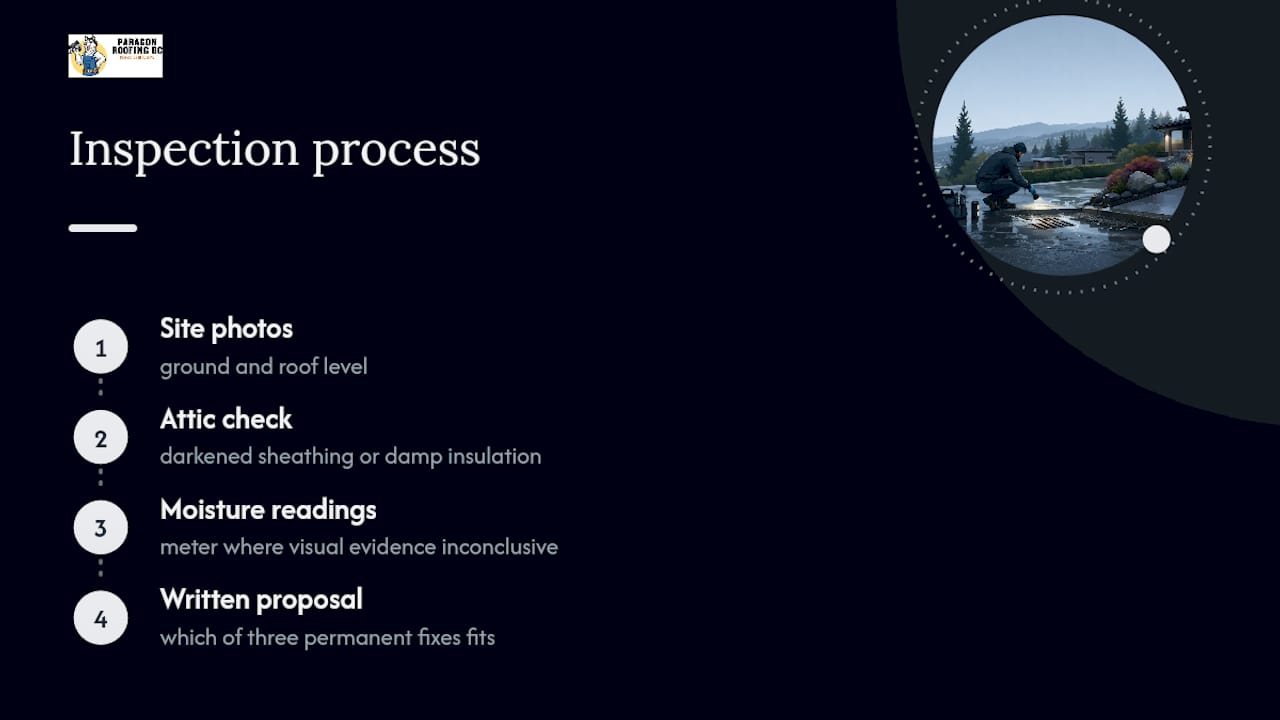
There are ways to chase this problem yourself with a ladder and a flashlight, but a dead valley hiding behind a dormer or buried under three layers of moss doesn’t give up its secrets easily, and misdiagnosing it usually means paying twice. Paragon Roofing BC’s inspection and maintenance visits are built specifically for situations like this: site photos of the valley from ground and roof level, an attic check for darkened sheathing or damp insulation, moisture meter readings where the visual evidence is inconclusive, and a written proposal that lays out which of the three permanent fixes actually fits your roof.
If your property is also dealing with wind pushing rain sideways under shingles near the coast, it’s worth reading our breakdown of wind-driven rain leaks in West Vancouver, since the two problems often show up together on the same roof. And if a capital project like solar is on the horizon, it’s worth reading a roof condition first, an approach covered well by our partners at Every Sun, even though their guide is written for a US market.
Book a Paragon inspection before you commit to a repair scope, and you’ll walk away with documentation your strata council or property management company can actually use to approve a budget. For homeowners weighing whether the valley repair is the first step toward a broader residential roofing project, that inspection report is the starting point either way.
Sources
FAQ
What Slope Counts as a Dead Valley?
Anything under 2:12 pitch is considered a critical ponding risk, since standard shingle roofing needs roughly 3:12 to shed water reliably, according to NRC research.
Can I Just Add More Sealant to a Dead Valley?
No. Sealant is a temporary stopgap at best and doesn’t address the underlying drainage problem, so ponding and leaks typically return within a season.
Is a Cricket Always the Right Fix?
Not always. Crickets work well for localized dead zones like chimneys or dormers, but long horizontal valleys or complex geometries often need a tapered metal pan or membrane system instead.
How Urgent Is a Dead Valley Repair?
Treat interior ceiling stains, soft decking, or water still standing after 48 hours as urgent and call a roofer promptly, since shingles in ponded areas can fail at roughly half the rate of the rest of the roof.
Does Paragon Roofing BC Inspect Dead Valleys in West Vancouver?
Yes. Certain roofing contractors provide on-site dead valley inspections across West Vancouver, including photo documentation, attic checks, and moisture readings to support a written repair proposal.
Recommended
Our Roofing Blog

Have more questions about roofing?
Check out our FAQs or give us a call today to speak to an expert roofer in Vancouver Lower Mainland, BC. We're here to help our neighbours make educated decisions about their roof. For our team, we value helping clients save money while making their roofs last.