
What is soffit venting? A homeowner's guide
What is soffit venting? A homeowner’s guide
TL;DR:
- Most homeowners overlook soffit vents because they are hidden, yet proper ventilation prevents costly roof damage. These intake openings work with exhaust vents to create airflow that reduces heat, moisture, and ice dam formation in BC’s wet climate. Regular inspections and correct installation of soffit vents ensure long-term attic health and roof longevity.
Most homeowners in Metro Vancouver give their soffit vents about as much thought as the paint on their attic floor joists. They are out of sight, tucked under the eaves, and easy to forget until something goes wrong. Understanding what is soffit venting and why it matters can save you from discovering mould, rotted decking, or ice dam damage after it has already cost you thousands. This guide covers how soffit venting works, why it protects your roof in BC’s wet climate, what types are available, and how to keep them working properly year after year.
Table of Contents
- Key takeaways
- What soffit venting actually is
- How soffit venting works with your roof
- Types of soffit vents for BC homes
- Maintenance and common problems to watch for
- Soffit venting benefits for Metro Vancouver homes
- My honest take on what homeowners get wrong
- How Paragonroofingbc can help with your soffit ventilation
- FAQ
Key takeaways
| Point | Details |
|---|---|
| Soffit vents intake cool air | They pull fresh air into your attic from the eaves, driving out heat and moisture. |
| Balance is the whole game | Soffit vents only function properly when paired with ridge or exhaust vents to complete the airflow circuit. |
| BC’s climate makes this urgent | Metro Vancouver’s freeze-thaw cycles and coastal moisture mean blocked soffit vents lead to faster roof damage. |
| Baffles keep the path clear | Rafter baffles stop insulation from choking the airflow channel between soffit and ridge. |
| Annual inspection pays for itself | A 30-minute check of your soffit vents each year can prevent expensive structural repairs. |
What soffit venting actually is
Soffit vents are openings cut into the underside of your roof’s overhang, called the soffit, which runs along the eaves between the exterior wall and the roof edge. Think of them as your attic’s lungs. They pull fresh, cooler outdoor air into the attic space, and that air travels upward to push hot, damp air out through exhaust vents at or near the ridge.
Soffit vents are intake openings under roof eaves essential for passive airflow in attic ventilation. They are a passive system, meaning they work through natural convection and pressure differences rather than fans or motors. No moving parts, no electricity, just physics doing the work.
In Metro Vancouver homes, soffit vents are typically spaced at regular intervals along the eaves. On a standard detached home, a professional installation runs approximately $300 to $600 depending on the home’s size and how many vents are required. Here is what you will typically find in a soffit vent setup:
- Perforated panels running continuously along the eave soffit
- Individual rectangular or round grilles installed at set intervals
- Vented vinyl soffit panels that double as the finished ceiling of the overhang
- Insect screening behind each opening to block pests
The placement matters. Soffit vents must be positioned so air can flow freely from the outside into the attic without obstruction from insulation or structural members.
How soffit venting works with your roof
Here is where most homeowners get tripped up. A soffit vent alone does very little. It is one half of a system, and without the other half working properly, you might as well have no ventilation at all.
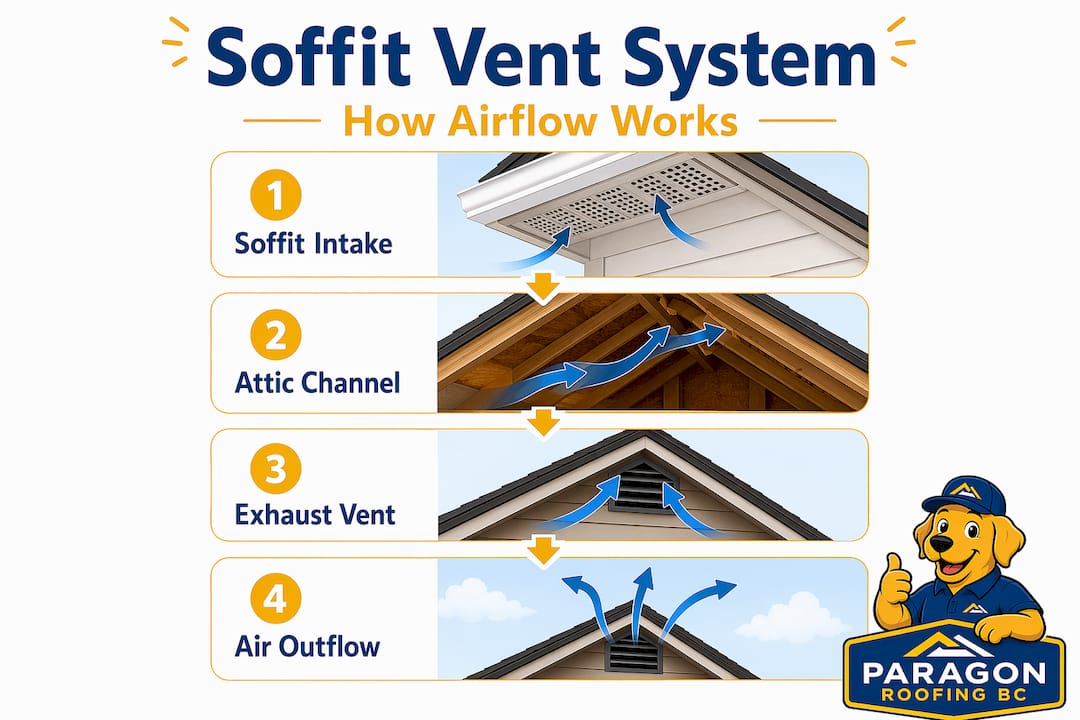
Soffit vents work only in combination with exhaust vents to create effective airflow. Lack of exhaust stalls ventilation completely. The exhaust side is usually a ridge vent running along the peak of the roof, or individual roof vents placed in the upper third of the roof slope. Cool air enters at the soffit, warms as it travels upward through the attic, and exits at the top. That continuous movement pulls moisture and heat out with it.
Without this airflow, attic temperatures can climb over 65°C in summer. That kind of heat bakes shingles from the underside, warps decking, and voids some manufacturers’ warranties. In winter, trapped moisture condenses on cold surfaces, feeding mould and rotting structural wood.
Here is the step-by-step picture of a healthy ventilation cycle:
- Outside air enters through soffit vents at the eave level.
- The air travels up through a clear channel above the insulation layer.
- Heat and moisture from the conditioned living space below rise into this moving airstream.
- The warmed, humid air exits through ridge or roof exhaust vents.
- This cycle repeats continuously, keeping attic temperatures and humidity in check.
The channel in step two is non-negotiable. Rafter baffles are essential to keep that airflow path open, especially where blown-in or batt insulation sits near the roof deck. Without baffles, insulation creeps toward the eaves and blocks soffit air intake entirely. You can read more about how ventilation affects Burnaby homes specifically during our wet winters.
| Condition | With proper soffit venting | Without proper soffit venting |
|---|---|---|
| Summer attic temperature | Closer to outdoor ambient | Can exceed 65°C |
| Winter moisture | Expelled through exhaust vents | Condenses, causes rot and mould |
| Shingle lifespan | Extended | Shortened by heat and moisture |
| Ice dam risk | Low | High in freeze-thaw conditions |
Pro Tip: Check your attic in January after a cold snap. If you see frost on the underside of the decking or on nail heads, your soffit ventilation is not moving enough air to carry moisture out.
Types of soffit vents for BC homes
Not all soffit vents are created equal, and the Lower Mainland’s combination of coastal moisture, UV exposure, and occasional freezing temperatures means material choice genuinely matters.
Continuous perforated panels run the full length of the soffit and provide the most consistent airflow per linear metre. They are the standard choice on newer BC homes and work well when the full eave soffit is unobstructed.
Individual vent grilles are circular or rectangular inserts placed at intervals, typically every 600 to 900 millimetres. They are easier to install during a repair or retrofit. The trade-off is less consistent airflow distribution compared to continuous panels.
Vented vinyl soffit panels combine the soffit finish with the ventilation function. They are low maintenance, resist our coastal humidity, and hold their colour reasonably well under BC sun exposure.
Here is what to look for when choosing materials:
- Aluminium or vinyl construction to resist corrosion from coastal air
- UV-stabilised material to prevent brittleness from sun exposure
- Fine stainless or fibreglass mesh screening to block insects and debris
- Non-painted or powder-coated finishes to reduce the risk of paint-over blocking airflow
One problem worth knowing about: standard soffit vent installations can cause humid air recirculation, particularly on homes with limited eave projection. When the soffit sits close to the wall, exhaust air from nearby vents can get pulled back into the intake. Extended soffit vent designs that project beyond the fascia break this recirculation cycle and reduce mould risk noticeably. It is a newer solution, but one worth discussing if your home has a tight eave detail.
For a broader look at how soffits and fascia affect roof performance together, that is a good resource to bookmark.
Maintenance and common problems to watch for
Soffit vent problems are quiet until they are not. By the time you notice the effects, the damage is often already underway. The good news is that a basic inspection takes about 30 minutes and costs nothing.
Here is an annual inspection routine that actually works:
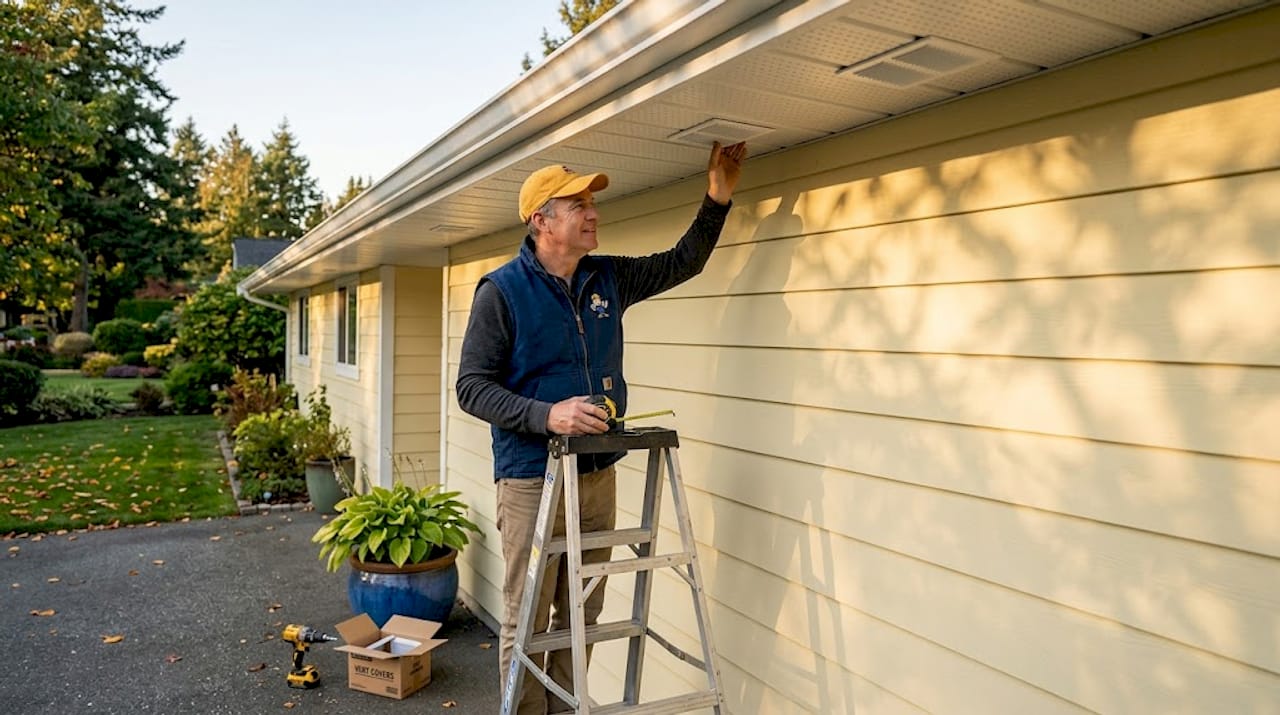
- Walk the perimeter of your home and look up at the soffit. Every vent should show open, clean mesh. Any vent that is painted over, crushed, or clogged with debris needs attention immediately.
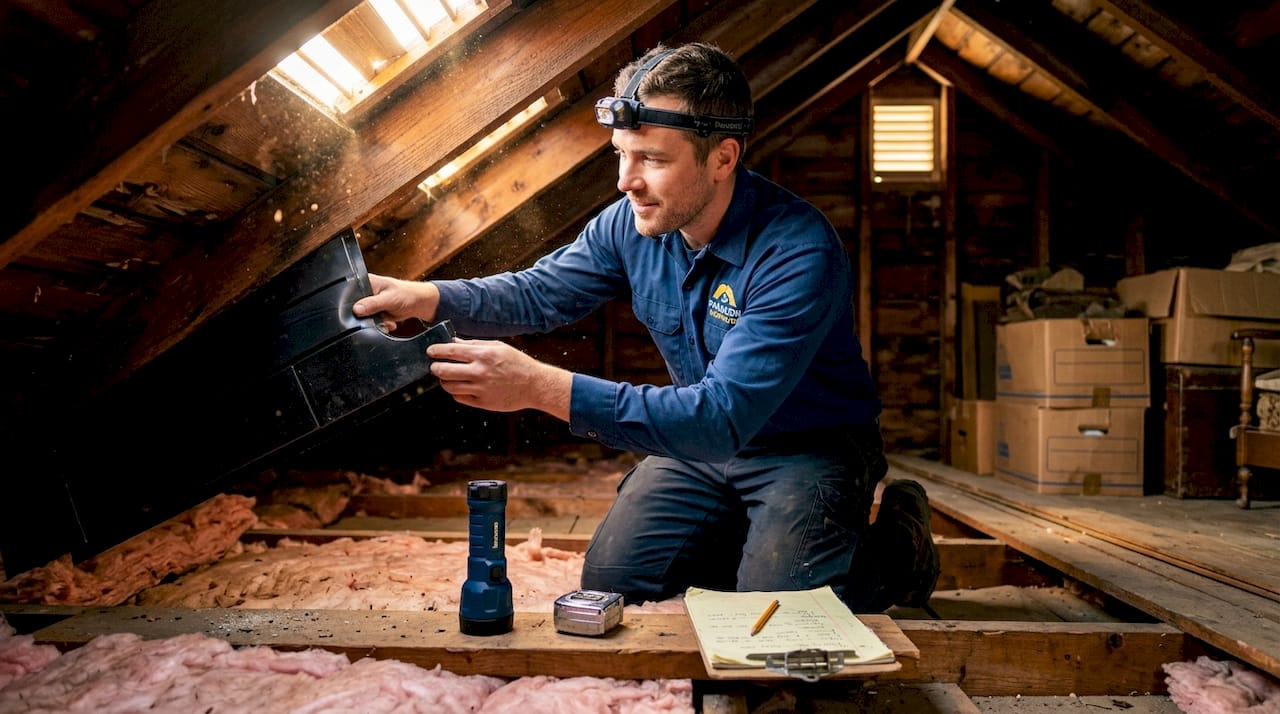
- Go into your attic with a flashlight and look toward the eaves. You should see daylight filtering through each soffit vent. No light means a blockage.
- Check that rafter baffles are in place between the insulation and the roof deck at each eave. Missing or collapsed baffles choke airflow even if the soffit vent itself is open.
- Look for signs of pest entry: droppings, chew marks, nesting material. Squirrels in particular exploit gaps in soffits and fascia to get into attic spaces, causing structural damage.
- Inspect the fascia board directly behind the soffit. Any soft, discoloured, or spongy wood suggests moisture infiltration and should be repaired before it spreads.
Pest damage deserves its own note. Many property managers think replacing a damaged screen is enough to keep wildlife out. It is not. Simply replacing vent screens is insufficient to keep wildlife out. Structural rot and any existing gaps must be fully repaired before closing openings, or animals will find another route in within weeks.
Pro Tip: If you find a soffit vent that has been painted over, do not just poke holes through it. Remove the panel and install a proper vented replacement. A painted-over vent is effectively a solid panel and contributes nothing to your attic’s air exchange.
Soffit venting benefits for Metro Vancouver homes
If you are a property manager overseeing multiple units in the Lower Mainland, soffit ventilation is one of the highest-return maintenance items you can invest in. The soffit vent benefits go beyond keeping the attic a bit cooler.
Here is what proper soffit ventilation actually does for you in our climate:
- Prevents structural damage. Balanced ventilation with soffit vents prevents the moisture buildup that rots decking, rafters, and fascia boards over time.
- Reduces energy costs. A well-ventilated attic stays closer to outdoor temperature in summer, reducing the load on air conditioning and keeping upper floors more comfortable.
- Prevents ice dams. In our freeze-thaw cycles, a warm attic melts snow on the roof surface, which refreezes at the cold eaves and forces water under shingles. Proper ventilation repair and installation keeps attic temperatures even and dramatically reduces ice dam risk.
- Extends shingle life. Shingles age faster when baked by a superheated attic underneath.
- Supports indoor air quality. A dry attic with good airflow does not grow mould. Mould in an attic does not stay in the attic.
“The roof you can see is only as healthy as the ventilation you cannot. Ignoring soffit vents in a Metro Vancouver climate is like leaving a window open in a rainstorm and wondering why your floors are wet.”
My honest take on what homeowners get wrong
Hey, it’s Harman here. After years of inspecting and installing roofs throughout Metro Vancouver, I can tell you the single most common mistake I see is treating soffit vents like a standalone feature. Homeowners either install new vents without checking whether exhaust vents are working, or they fix the ridge vent without realising the soffits were painted over during a reno three years earlier.
I’ve seen beautifully installed ridge vents that did absolutely nothing because the soffit intake was completely choked by insulation that had been blown in without baffles. The attic was cooking in summer and dripping with condensation in winter, yet the homeowner had no idea because everything looked fine from the outside.
The pest angle is one I genuinely worry about. I have found attics where squirrels had been nesting for years, right at the eave line where a cracked soffit panel gave them entry. By the time we got in there, the decking around two rafters was soft enough to push a finger through. Neglected soffit vent maintenance is rarely dramatic at first. It just gets quietly worse.
My honest advice: think of your soffit vents as part of a circuit. The air needs to enter, travel freely, and exit. Break any part of that circuit and the whole system stops working. A professional eye once a year keeps you ahead of every problem I’ve described here.
— Harman
How Paragonroofingbc can help with your soffit ventilation
If reading this has made you realise you have never actually checked your soffit vents, that is a completely normal starting point. At Paragonroofingbc, we handle everything from a quick ventilation assessment to a full roof installation in Vancouver that includes a properly balanced soffit and ridge vent system designed for Metro Vancouver’s specific conditions.

We also offer drone roof inspections that give us a detailed view of your soffit, fascia, and overall roof condition without putting anyone on a ladder unnecessarily. It is one of the most thorough ways to catch soffit vent blockages, pest damage, and eave deterioration early. If you manage multiple properties, it is especially efficient. Reach out to our team to book an inspection and get ahead of whatever BC’s next rainy season has planned for your roof.
FAQ
What is soffit venting and where are soffit vents located?
Soffit vents are intake openings on the underside of your roof’s overhanging eaves. They draw fresh outdoor air into the attic as part of a passive ventilation system that pushes out heat and moisture through exhaust vents higher on the roof.
Are soffit vents necessary for my home?
Yes. Without soffit vents, your attic has no reliable source of fresh intake air, which means heat and moisture accumulate and damage your roof structure over time. In Metro Vancouver’s wet climate, this damage accelerates significantly.
How do I know if my soffit vents are blocked?
Go into your attic and look toward the eaves with a flashlight. You should see daylight coming through each soffit vent. If you see none, the vent is blocked, either by paint, insulation, debris, or pest nesting material.
What is the difference between soffit vents and ridge vents?
Soffit vents are intake vents at the bottom of the roof slope, pulling cool air in. Ridge vents are exhaust vents at the roof peak, letting hot and humid air out. Both are needed for the ventilation system to work properly.
How often should soffit vents be inspected?
A 30-minute inspection once a year is enough for most homes. Check for blockages, pest damage, paint-overs, and whether rafter baffles are intact in your attic.
Recommended
Our Roofing Blog


Have more questions about roofing?
Check out our FAQs or give us a call today to speak to an expert roofer in Vancouver Lower Mainland, BC. We're here to help our neighbours make educated decisions about their roof. For our team, we value helping clients save money while making their roofs last.