
Why regular roof assessments matter for BC properties
Why regular roof assessments matter for BC properties
TL;DR:
- Regular roof assessments in BC are essential to prevent costly repairs by identifying early damage caused by heavy rainfall, freeze-thaw cycles, and coastal moisture. Biannual inspections, combined with post-storm evaluations, help property owners maintain structural integrity, support insurance claims, and plan timely replacements, especially for older or high-exposure roofs. Proactive maintenance and thorough documentation safeguard investments and reduce the risk of unexpected, expensive failures in BC’s challenging climate.
Most property owners in the Lower Mainland think about their roof twice a year: when they move in, and when something goes wrong. That assumption is expensive. Why regular roof assessments are worth scheduling before trouble shows up is something I explain to clients constantly, because waiting for visible damage is one of the most reliable ways to turn a $400 repair into a $14,000 emergency. In BC’s climate, where heavy rainfall, freeze-thaw cycles, and coastal moisture work against roofing materials year-round, the gap between “looks fine” and “structural problem” is much smaller than most people realise.
Table of Contents
- Key takeaways
- Why regular roof assessments are non-negotiable in BC
- How often to assess your roof in BC
- Financial benefits and insurance readiness
- Risk factors that shape your inspection needs
- Best practices for applying assessment findings
- My take on why most owners wait too long
- Protect your investment with Paragonroofingbc
- FAQ
Key takeaways
| Point | Details |
|---|---|
| Twice-yearly inspections are the baseline | Spring and fall assessments catch wear from seasonal extremes before damage worsens. |
| BC’s climate accelerates roof wear | Freeze-thaw cycles, heavy rain, and coastal moisture demand more proactive inspection than drier regions. |
| Early detection saves significant money | Catching a failing sealant or cracked shingle early avoids water damage, mould, and structural repairs. |
| Documentation protects your insurance position | Inspection records help support claims and demonstrate good maintenance practices to underwriters. |
| Roof age and type change your schedule | Older asphalt roofs and low-slope commercial systems require more frequent, targeted evaluation. |
Why regular roof assessments are non-negotiable in BC
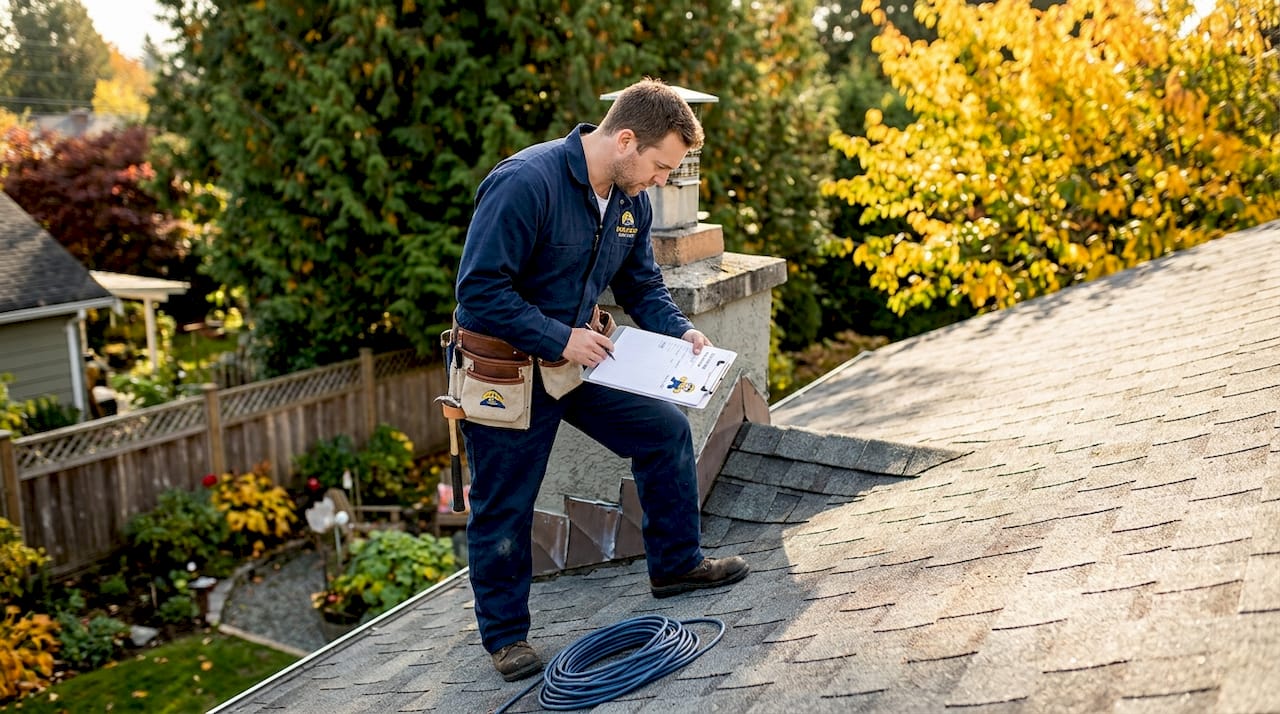
A roof assessment is not a quick walk around the perimeter looking for missing shingles. A thorough inspection covers every component: the field of the roofing material, flashing at penetrations and parapets, valley details, sealant condition around vents and skylights, fascia and soffit integrity, gutters, drainage points, and visible sections of the underlayment where accessible. Each of those areas behaves differently under BC weather conditions.
Here in the Lower Mainland, we deal with a combination of conditions that most other regions simply do not face at the same intensity. Persistent coastal moisture saturates porous materials. Winter freeze-thaw cycles expand water that has found its way into small cracks, widening them with every cycle. Wind-driven rain on the North Shore and Fraser Valley can push water uphill under shingles in ways that only show up as interior staining weeks later. Snow load on flat or low-slope commercial roofs in Coquitlam or Burnaby compresses drainage layers and stresses seams.
The importance of roof inspections becomes clear when you understand that most of these failure points are invisible from ground level and only reveal themselves to someone who knows exactly where to look.
- Cracked or lifted shingles that expose the underlayment to UV and moisture
- Failing sealant at flashings, vents, and pipe boots
- Ponding water on flat commercial roofs indicating blocked drains or sagging substrate
- Granule loss on asphalt shingles accelerating thermal degradation
- Rust staining or separation at metal flashings
- Soffit discolouration suggesting ventilation or moisture infiltration issues
Many roofing warranties and property insurance policies also carry inspection clauses. If you cannot show a record of regular maintenance, a claim may be disputed or reduced. That alone makes scheduled assessments a financially sound practice.
Pro Tip: Keep a dedicated folder, physical or digital, for every roof report, repair invoice, and inspection photo. Insurers and buyers will both ask for this documentation, and having it ready demonstrates responsible ownership.
How often to assess your roof in BC
The benefits of regular roof checks depend heavily on whether you are actually doing them on the right schedule. The general recommendation is at least twice yearly, with spring and fall as the ideal windows. Spring inspections catch the cumulative damage from winter, and fall inspections prepare the roof for the next wet season. That is the minimum.
Here is a more practical schedule based on what we see on BC roofs regularly:
- Spring inspection (March to April): Assess damage from freeze-thaw cycles, heavy snowfall, and wind events over winter. Check flashings, valley details, and any areas prone to ice damming on your specific building.
- Fall inspection (September to October): Confirm the roof is ready for heavy rain season. Clear debris from valleys and gutters, check sealant condition, and flag any degraded material before storms arrive.
- Post-storm inspections : After any severe wind event, hailstorm, or heavy snowfall, schedule a targeted assessment within a week. Catching damage early and documenting it is critical for insurance purposes.
- Quarterly checks for high-risk roofs : Structured maintenance programmes recommend quarterly inspections for older roofs or buildings in exposed locations, such as oceanfront properties in West Vancouver or commercial flat roofs in industrial areas.
Older roofs need more attention, full stop. A fifteen-year-old asphalt shingle roof in Maple Ridge is not the same risk profile as a five-year-old metal roof in the same location. Age changes everything about how frequently and thoroughly you should be looking.
Pro Tip: Schedule your fall inspection before mid-October. Once the heavy rains begin in November, finding and fixing minor issues becomes harder and more expensive because materials are constantly wet.
Financial benefits and insurance readiness
Think of a roof assessment the way you think of a vehicle inspection. You would not skip servicing a fleet vehicle because nothing looks broken. The same logic applies here, and the financial case is just as clear.
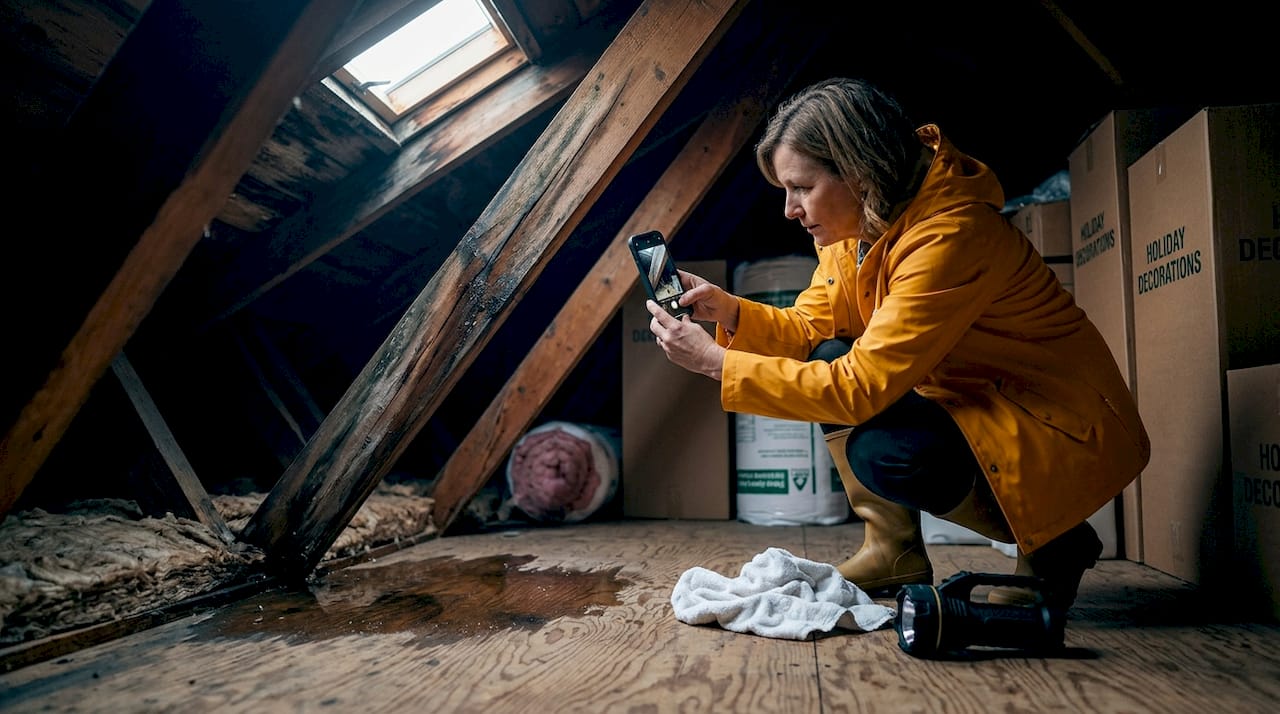
Early detection prevents a cracked shingle from becoming a saturated deck board, which becomes a mould issue in the attic, which becomes a structural repair that your insurance may not cover fully if there is no inspection history to establish the timeline. That chain of events is not hypothetical. It happens regularly on properties where owners skipped routine checks for three or four years.
| Scenario | Proactive assessment | No assessment |
|---|---|---|
| Cracked flashing found | $250 sealant repair | $3,500 water damage repair plus interior remediation |
| Blocked drain on flat roof | $150 cleaning and minor repair | $8,000 substrate replacement from chronic ponding |
| Granule loss on shingles | Monitored and scheduled for replacement | Premature shingle failure and full replacement at 12 years instead of 25 |
| Post-storm damage documented | Insurance claim supported by dated inspection records | Claim disputed due to lack of maintenance documentation |
Beyond avoiding surprises, inspection reports support budgeting in a way that guesswork never can. Facility managers who receive written annual assessments can project when a specific roof section will need replacement, request capital budget approval two years in advance, and avoid the uncomfortable conversation where a building owner learns about a six-figure roof replacement with three weeks notice.
Regular checks also identify ventilation and insulation problems early, which have a direct effect on heating and cooling costs inside the building. A roof that is venting poorly in a Burnaby apartment building is not just a roofing problem. It is an energy bill problem and a comfort complaint problem for tenants on the top floor.
Risk factors that shape your inspection needs
Not every roof needs the same level of attention. Understanding your specific risk profile helps you and your roofing contractor allocate time and budget where it matters most.
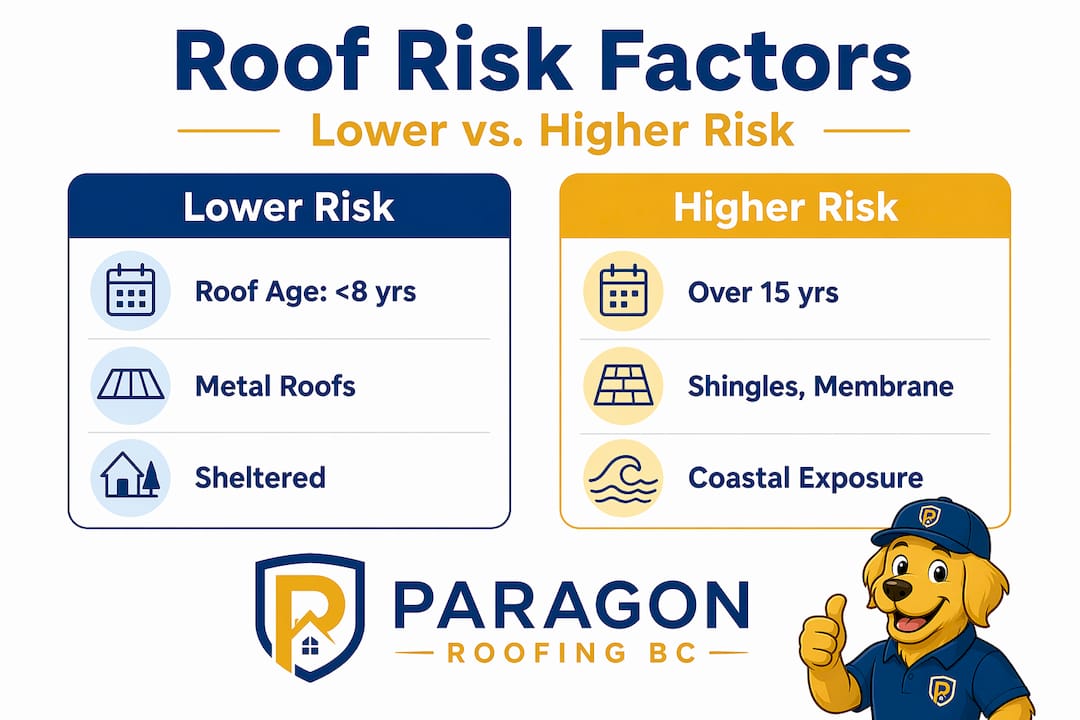
| Risk factor | Lower risk | Higher risk |
|---|---|---|
| Roof age | Under 8 years | Over 15 years |
| Material type | Metal standing seam | Older asphalt shingles |
| Slope | Steep residential pitch | Low-slope or flat commercial |
| Weather exposure | Sheltered urban location | Coastal or high-wind exposure |
| Building use | Single-family residential | Multi-family, commercial, or industrial |
Asphalt shingle roofs over 10 years old show significantly higher damage rates in storm conditions compared to metal systems. Low-slope commercial roofs are particularly vulnerable at flashings and seams, where movement from thermal expansion and foot traffic creates separation over time. If you manage a strata building or commercial property in Metro Vancouver, those seams deserve close attention at every inspection cycle.
Coastal exposure along areas like White Rock, Tsawwassen, or West Vancouver adds another layer of risk. Salt-laden air accelerates corrosion on metal components, and persistent moisture saturation degrades adhesive sealants faster than in drier inland conditions. Proactive sealing and maintenance can reduce water intrusion dramatically, but only if you know which areas need attention, and that requires a trained eye on your roof at regular intervals.
For property managers overseeing commercial roof maintenance, understanding which buildings in your portfolio carry the most risk lets you build a tiered inspection schedule rather than treating every building identically.
Best practices for applying assessment findings
An inspection report that sits in a drawer does nothing. The value of regular roof evaluations lies in acting on what you learn, and doing so before the next season’s weather tests the same weak points again.
- Build a written maintenance programme : Tailor the schedule to your specific roofs. A BC-specific maintenance plan accounts for local seasonal patterns, not generic national timelines.
- Use professional inspectors for the detailed work : Self-checks between professional visits are useful for spotting obvious debris accumulation or visible damage, but they do not replace a trained assessment. Drone surveys are particularly valuable for steep or multi-storey buildings where safe access is limited.
- Prioritise pre-storm repairs : If your fall inspection flags loose flashings or deteriorated sealant, address those before November. Doing repairs during a rain event costs more and delivers lower quality results.
- Maintain a detailed record system : Log every inspection date, findings, repairs completed, and contractor details. This record is your proof of due diligence for insurance, warranty claims, and future sale of the property.
- Plan capital replacements in advance : Use inspection findings to model a five-year maintenance budget. A roof maintenance checklist built around your specific portfolio makes that planning systematic rather than reactive.
Comparing assessment findings over time after severe weather events is one of the most underused tools available to property managers. When you have documented baseline conditions from a spring inspection, you can establish clearly which damage is new and which is pre-existing. That distinction matters enormously when you file an insurance claim after a windstorm.
Pro Tip: Ask your roofing contractor to provide photos with every inspection report, not just a written summary. Photos with timestamps create an irrefutable record that benefits you in any insurance conversation.
My take on why most owners wait too long
Hey, it’s Harman here. After years of inspecting roofs across Metro Vancouver, Burnaby, Surrey, and Coquitlam, the pattern I see most often is not ignorance. It is optimism. Property owners look up at a roof that still seems to be doing its job and convince themselves that scheduling an inspection can wait another season.
What I have learned is that the roofs which surprise owners with sudden, expensive failures almost always had warning signs that showed up six to twelve months earlier. A small rust trail on a flashing. Slightly cupped shingles on the west-facing slope. A drain that was slow to clear after the last heavy rain. None of those feel urgent. All of them lead somewhere expensive if left alone.
I have seen a modest inspection catch a failing valley flashing that, if left another winter, would have saturated the sheathing across an entire section of a Burnaby rental property. The repair cost was under $600. The avoided damage would have been several times that, plus tenant disruption.
My honest advice: treat your roof the way you treat any other major system in your building. You service your HVAC. You check your electrical. Your roof is worth at least the same level of attention, especially in BC, where the weather does not give you a grace period.
Protect your investment with Paragonroofingbc
At Paragonroofingbc, we work with property owners and facility managers across Metro Vancouver and the surrounding Lower Mainland every day. We know what BC roofs face through every season, and we know exactly what to look for.

Our drone roof inspections give us a detailed, photographic view of every part of your roof without putting anyone at risk on a steep pitch or a slippery surface after a rainfall. For properties where a full evaluation leads to action, our roof installation services cover everything from material selection through to completed work, with local knowledge built into every recommendation. Whether you need a straightforward maintenance inspection or a full assessment to plan a replacement, we are ready to help you protect your property before the next storm season.
FAQ
How often should a roof be assessed in BC?
At minimum, twice a year, once in spring and once in fall, plus after any significant storm event. Older roofs or buildings in exposed coastal locations may benefit from quarterly inspections.
What does a professional roof assessment include?
A thorough inspection covers all roofing materials, flashings, sealants, drainage points, gutters, soffits, fascia, and visible underlayment. The goal is to identify wear and potential failure points before they cause interior damage.
Why do regular roof assessments matter for insurance claims?
Documented inspection history shows insurers that the property has been properly maintained, which supports claims and reduces the risk of disputes over whether damage is pre-existing or caused by a specific weather event.
What are the signs a roof needs an immediate assessment?
Visible granule loss in gutters, interior water staining, slow-draining flat roof areas, lifted or cracked shingles, and rust staining around flashings all warrant a prompt professional inspection rather than waiting for the next scheduled check.
Do newer roofs still need regular assessments?
Yes. Even a recently installed roof should be inspected annually to confirm flashings are holding, sealants have not separated, and the installation has performed as expected through its first BC winter.
Recommended
Our Roofing Blog

Have more questions about roofing?
Check out our FAQs or give us a call today to speak to an expert roofer in Vancouver Lower Mainland, BC. We're here to help our neighbours make educated decisions about their roof. For our team, we value helping clients save money while making their roofs last.