West Vancouver storefront roof flashing failure: causes and fixes
West Vancouver storefront roof flashing failure: causes and fixes
TL;DR:
- Flashing failure on West Vancouver storefronts is mainly caused by improper installation, climate-induced corrosion, and deferred maintenance. Regular inspections, debris removal, and proper material choices are essential to prevent water damage and structural issues. Timely repairs and full replacements when necessary can significantly extend roof lifespan in this challenging coastal environment.
West Vancouver storefront roof flashing failure occurs when metal flashing stops sealing roof joints properly, letting water push through and damage ceilings, walls, and inventory below. Flashing is the thin metal sheeting installed at every roof transition point: valleys, parapet walls, chimney bases, and wall junctions. When it fails, the results are not subtle. You get stains, rot, and eventually structural damage that costs far more to fix than the original repair would have. Paragonroofingbc works with property managers and business owners across West Vancouver who deal with exactly this problem, and the pattern of failure is almost always the same: installation shortcuts, deferred maintenance, and a climate that punishes both.
What causes storefront roof flashing failure in West Vancouver?
Improper installation is the single most common cause of flashing failure on West Vancouver storefronts. Counter-flashing surface-mounted with sealant instead of embedded into mortar joints is a textbook shortcut that looks fine on day one and leaks within a few years. The sealant dries out, cracks, and pulls away from the substrate. Water finds the gap immediately.
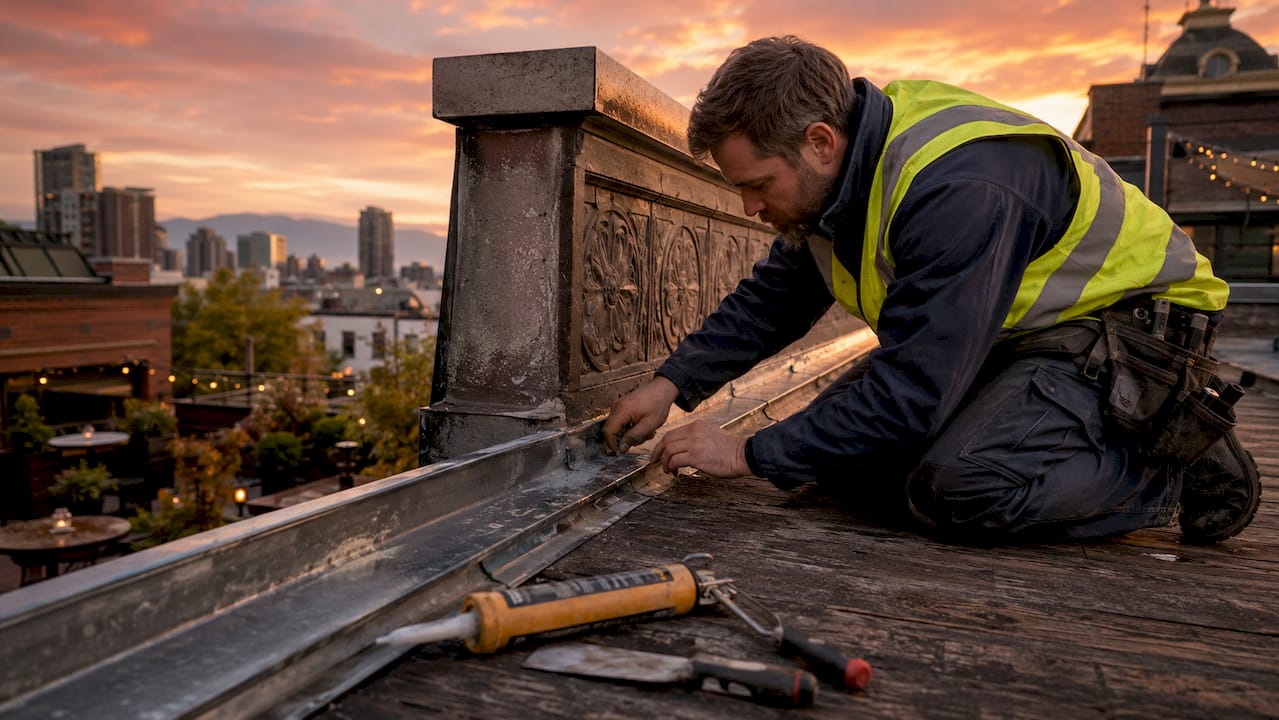
West Vancouver’s climate accelerates every weakness in a flashing system. High rainfall and coastal moisture keep metal flashings wet for extended periods, which speeds up corrosion and feeds moss growth directly on the metal surface. Moss is not just cosmetic. It holds moisture against the flashing and lifts edges over time.
Freeze-thaw cycles add another layer of stress. Frozen water in flashing seams expands and contracts repeatedly, causing metal fatigue and sealant breakdown that would not happen in a milder climate. A storefront roof on Marine Drive or Dundarave faces this cycle every winter.
Here are the most common causes Paragonroofingbc sees on West Vancouver commercial roofs:
- Counter-flashing installed with sealant only, not embedded in mortar
- Fasteners that were never properly sealed or have backed out over time
- Galvanic corrosion where two dissimilar metals contact each other
- Valley flashing overwhelmed by debris and standing water
- Original flashing left in place during a re-roof, creating a weak link under new material
Pro Tip: If your storefront was re-roofed in the last decade but the original flashing was kept, that flashing is now the oldest and most vulnerable part of your roof system. Ask your roofer specifically whether flashing was replaced or retained.
How to identify signs of flashing failure on storefront roofs
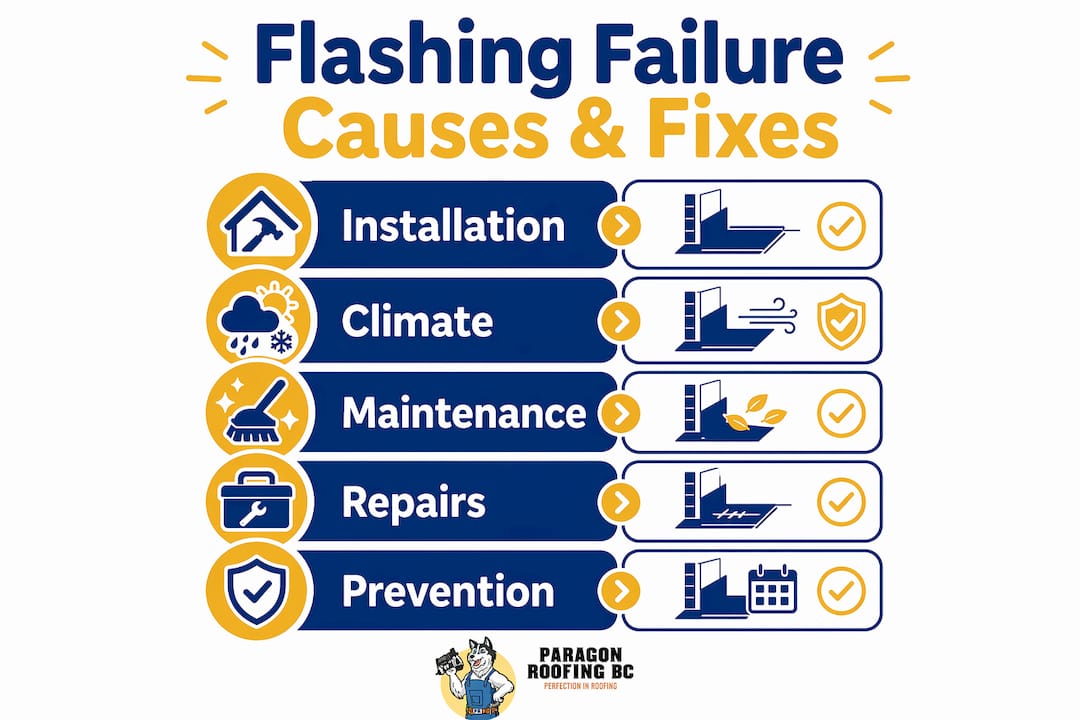
The first visible sign of a flashing problem is almost always a water stain on an interior ceiling or wall near a roof transition. By the time you see that stain, water has already been moving through the system for a while. The stain is the end of the trail, not the beginning.
Visible rust staining or corroded flashing on the exterior is a direct indicator of seal failure and needs immediate assessment. Rust means the protective coating is gone and the metal is actively degrading. Left alone, corroded flashing will perforate and let water through freely.
Watch for these warning signs during your next roof walkthrough:
- Water stains on interior ceilings or walls near parapets, chimneys, or skylights
- Rust streaks running down exterior walls from flashing locations
- Cracked, dried, or missing sealant at flashing edges
- Lifted or bent flashing sections, especially after a wind event
- Moss or algae growing directly on or around metal flashing
- Soft or spongy decking felt through the roofing material near transitions
Many flashing failures go unnoticed until significant water damage has already occurred. That is why waiting for a visible leak is the wrong approach for any commercial property. A professional inspection catches lifted edges, cracked sealant, and early corrosion before they become full water intrusion events.
For property managers, the practical approach is a twice-yearly visual check from ground level combined with a professional inspection every 12–18 months. A trained eye on the roof surface will find problems that a ground-level scan will miss entirely.
Best repair and maintenance practices for storefront roof flashing
The right repair depends entirely on what caused the failure and how far it has progressed. Paragonroofingbc uses a straightforward decision framework on every commercial inspection:
- Assess the scope first. Walk the entire roof and document every flashing location. Do not assume the visible leak point is the only problem area.
- Reseal where sealant has cracked or pulled away. Use a compatible, UV-stable sealant rated for metal-to-roofing transitions. This works well when the underlying metal is still sound.
- Tighten or replace fasteners. Backed-out screws and nails create gaps that sealant alone cannot bridge. Reset or replace them before resealing.
- Patch isolated damage. Small perforations or pinhole corrosion in otherwise sound flashing can be patched with compatible metal and sealed properly.
- Replace fully when corrosion is widespread. Widespread corrosion and installation faults require full replacement, not repeated patching. Patching corroded metal is like putting a bandage over rust.
- Integrate flashing work with any re-roofing project. Replacing flashing during a roof replacement eliminates the weakest-link problem and improves long-term watertightness across the whole system.
Pro Tip: Always request that your roofer documents the flashing condition with photos before and after any repair. This creates a baseline for future inspections and protects you if a warranty dispute arises.
Here is a quick reference for repair decisions:
| Condition | Recommended action |
|---|---|
| Cracked or missing sealant only | Reseal with compatible product |
| Backed-out fasteners | Reset or replace fasteners, then reseal |
| Isolated perforation or small hole | Patch with compatible metal and seal |
| Surface rust, coating intact | Clean, prime, and apply rust-inhibiting sealant |
| Through-corrosion or widespread rust | Full flashing replacement required |
| Installation fault (sealant-only mount) | Full replacement with proper mortar embedding |
For ongoing maintenance, schedule debris removal from valleys and drains every autumn and spring. West Vancouver’s tree canopy means leaves, needles, and organic matter pile up fast. That debris traps moisture directly against your flashing and shortens its lifespan measurably.
Preventing storefront roof flashing failure through design and upkeep
Prevention starts at installation. Flashing embedded in mortar joints at wall and parapet transitions holds far longer than surface-mounted sealant applications. The mortar creates a mechanical bond that does not dry out or crack with UV exposure. If your storefront is being re-roofed or a new section is being built, insist on proper mortar-embedded counter-flashing at every wall transition.
Material choice matters in West Vancouver’s wet climate. Copper and stainless steel flashings resist corrosion far better than painted galvanised steel, which can begin rusting within a few years in coastal conditions. Aluminium is lightweight and corrosion-resistant but requires careful detailing at fastener points to prevent galvanic reactions with other metals.
A solid prevention programme for West Vancouver storefronts includes:
- Annual professional inspection of all flashing locations, including valleys, parapets, chimneys, and wall junctions
- Biannual debris removal from valleys and roof drains, timed before the heavy rain season in october and after it ends in april
- Immediate follow-up on any interior water stain, no matter how small
- Sealant renewal every 5–7 years on surface-applied joints, even when no visible cracking is present
- Moss treatment applied to roof surfaces and flashing areas to prevent organic growth from lifting edges
Debris buildup in roof valleys traps moisture and accelerates flashing wear. Valleys are the lowest point on any sloped roof section, and they collect everything the wind and rain carry across the surface. Keeping them clear is the single highest-return maintenance task a property manager can perform.
The roof maintenance checklist Paragonroofingbc recommends for property managers covers all of these points in a structured seasonal format. Consistent upkeep prevents the kind of deferred-maintenance failures that turn a $400 reseal into a $6,000 replacement.
How does West Vancouver’s climate uniquely impact storefront flashing durability?
West Vancouver sits at the intersection of coastal moisture, heavy rainfall, and seasonal freeze-thaw cycles. That combination is harder on roof flashing than almost any other climate in Canada. A storefront in Ambleside or Dundarave faces months of near-continuous wet conditions from october through march, followed by a dry summer that bakes and cracks any sealant that survived the winter.
Roof valleys suffer accelerated degradation in Pacific Northwest climates because they concentrate both water volume and debris in a single channel. A valley on a West Vancouver storefront may carry ten times the water volume of a flat roof section during a heavy rain event. That concentrated flow wears flashing faster and pushes water under edges that would otherwise stay sealed.
West Vancouver’s coastal climate does not give flashing a break. The wet season keeps metal surfaces saturated for months, moss takes hold in the gaps, and then the freeze-thaw cycles of january and february finish the job. By the time a property manager notices a ceiling stain, the flashing has usually been failing quietly for one or two full seasons. Early inspection is the only thing that catches it before the damage compounds.
The rain patterns across Vancouver mean that even a minor flashing gap becomes a significant water entry point over a full wet season. A gap that lets in a trickle during a light shower becomes a full-on stream during a November atmospheric river event. Local knowledge of these conditions is what separates a repair that lasts from one that fails again the following winter.
Key takeaways
Storefront roof flashing failure in West Vancouver is caused by installation shortcuts, coastal moisture, and deferred maintenance, and the most effective fix combines proper material choice with regular professional inspection.
| Point | Details |
|---|---|
| Installation is the root cause | Counter-flashing must be embedded in mortar, not just surface-sealed with sealant. |
| Rust signals immediate action | Visible corrosion on flashing means the seal has already failed and replacement is likely needed. |
| Valleys need regular cleaning | Debris in roof valleys traps moisture and accelerates flashing wear in West Vancouver’s wet climate. |
| Repair scope drives method | Reseal minor cracks, but replace flashing when corrosion is widespread or installation was faulty. |
| Annual inspections prevent major costs | Professional inspections every 12–18 months catch failures before they cause structural damage. |
What I’ve learned about flashing failures on West Vancouver storefronts
Hey, it’s Harman here. After inspecting commercial roofs across West Vancouver for years, the pattern I see most often is not dramatic storm damage. It is quiet, incremental failure that started on the day the building was first roofed.
The most common scenario: a storefront gets a new roof, the roofer leaves the original counter-flashing in place to save time, and within three or four years the property manager is chasing a leak that moves every time it rains. The water travels along the old flashing, enters at one point, and shows up on the ceiling somewhere completely different. It is genuinely difficult to trace without getting on the roof and probing every transition.
What property managers often overlook is the valley. Everyone checks the obvious spots: the skylight, the chimney, the parapet cap. But the valley is where the real action happens on a West Vancouver roof. It collects everything. Leaves, needles, moss, standing water. I have seen valleys so packed with organic debris that the flashing underneath was completely hidden. By the time we cleared it out, the metal was perforated in three places.
My honest advice: do not wait for a leak to schedule an inspection. Get someone on the roof in september before the rains start, and again in april after they ease off. The flashing repair steps that prevent a major failure cost a fraction of what you will spend once water has been sitting in your roof deck for a season. Proactive inspection is not an expense. It is the cheapest insurance your building has.
— Harman
Paragonroofingbc’s West Vancouver storefront flashing services
Paragonroofingbc specialises in commercial roof flashing inspections, repairs, and full replacements for storefronts across West Vancouver. Whether you are managing a single retail unit or a multi-tenant commercial strip, the team brings hands-on local experience with the specific conditions that wear down flashing fastest in this climate.
From targeted reseals to full valley flashing replacement, Paragonroofingbc provides clear assessments and honest recommendations without upselling work that is not needed. If you are seeing water stains, rust streaks, or have not had a professional inspection in over a year, now is the right time to get eyes on your roof. Reach out to Paragonroofingbc to schedule a roof leak assessment for your West Vancouver storefront before the next rain season arrives.
FAQ
What is roof flashing and why does it fail?
Roof flashing is thin metal sheeting installed at joints and transitions to direct water away from vulnerable areas. It fails most often due to improper installation, sealant breakdown, corrosion, or debris accumulation in valleys.
How do I know if my storefront flashing has failed?
Water stains on interior ceilings or walls near roof transitions, visible rust on exterior flashing, and cracked or missing sealant are the clearest signs of flashing failure. A professional inspection confirms the extent of damage.
Can failed flashing be repaired or does it need full replacement?
Minor sealant cracks and isolated perforations can be repaired, but widespread corrosion or installation faults require full flashing replacement to prevent recurring leaks.
How often should West Vancouver storefronts have flashing inspected?
A professional flashing inspection every 12–18 months is the standard recommendation, with biannual debris removal from valleys and drains timed around the wet season.
Why are roof valleys the first area to fail in West Vancouver?
Valleys concentrate water and debris more than any other roof area, and West Vancouver’s heavy rainfall and organic debris load accelerate corrosion and wear at these points faster than anywhere else on the roof.
Recommended
Our Roofing Blog

Have more questions about roofing?
Check out our FAQs or give us a call today to speak to an expert roofer in Vancouver Lower Mainland, BC. We're here to help our neighbours make educated decisions about their roof. For our team, we value helping clients save money while making their roofs last.