
Why Delta BC flat roofs fail at drains: the real causes
Why Delta BC flat roofs fail at drains: the real causes
Delta BC flat roofs fail at drains for three compounding reasons: insufficient slope below the current minimum of 1/4 inch per foot, clogged or undersized drains blocked by debris and moss, and structural deflection shifting low points away from where the drains actually sit. When any one of these problems exists on its own, you get nuisance ponding. When two or three combine, you get membrane failure, saturated insulation, and eventually interior flooding. The 48-hour ponding rule is the standard diagnostic benchmark: water still sitting on your roof two full days after the rain stops is not a cosmetic issue. It is a drainage failure.
Here is what that looks like in practice on a Delta property:
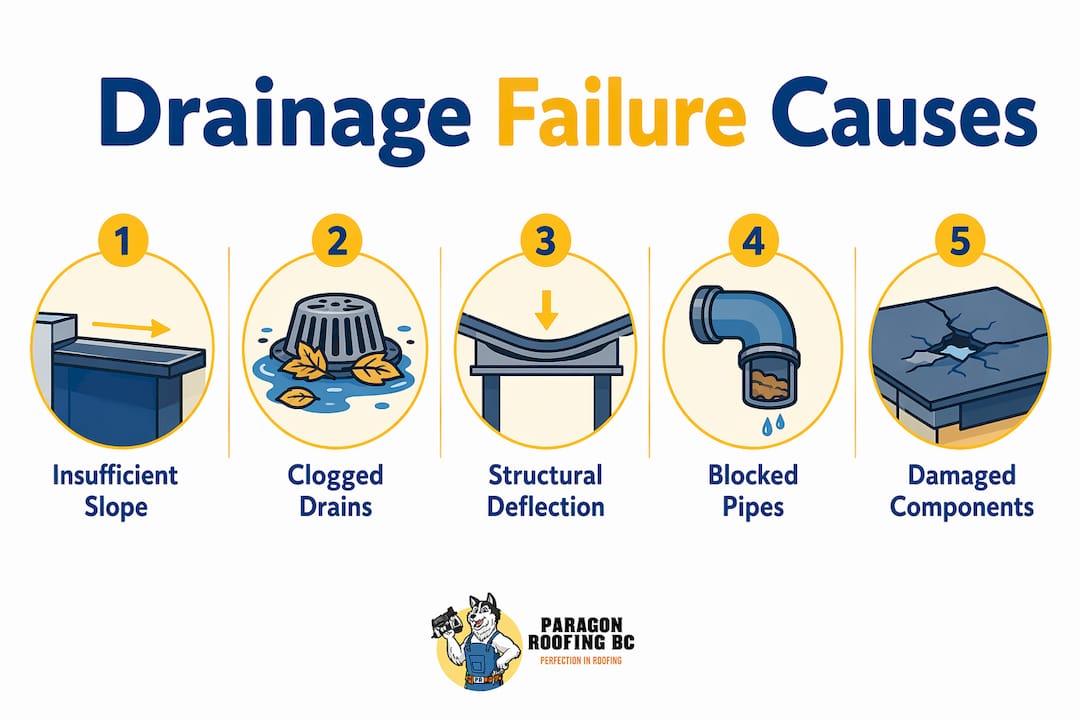
- Insufficient slope: Many buildings constructed before 2000 were built to 1/8 inch per foot, a standard that produces ponding even when drains are perfectly clear.
- Clogged drains and scuppers: Leaves, moss, and debris from Delta’s coastal tree canopy block internal drains and perimeter scuppers, especially in fall and spring.
- Structural deflection: Joists and deck panels sag over decades under sustained load, creating new low points that have nothing to do with where the original drains were placed.
- Undersized drain piping: Drain systems sized to older rainfall intensity data can be overwhelmed by the heavier storm events Delta now sees regularly.
- Damaged drain components: Freeze-thaw cycling and prolonged ponding stress crack flashing collars and break drain seals, turning a small gap into a steady interior drip.
Delta’s combination of heavy autumn rainfall, coastal humidity, and mild but wet winters makes every one of these failure modes worse than they would be in a drier climate. Getting ahead of them is far cheaper than dealing with the aftermath.
Why Delta BC’s climate makes flat roof drainage so critical
Delta sits in one of the wettest corners of Metro Vancouver. November alone averages roughly 8.8 inches of rainfall, and the shoulder seasons bring sustained wet periods that keep flat roofs wet for days at a time. That sustained moisture is the core problem. A roof that drains quickly after each rain stays relatively healthy. A roof that holds water for 48 hours or more after every storm is under constant attack.
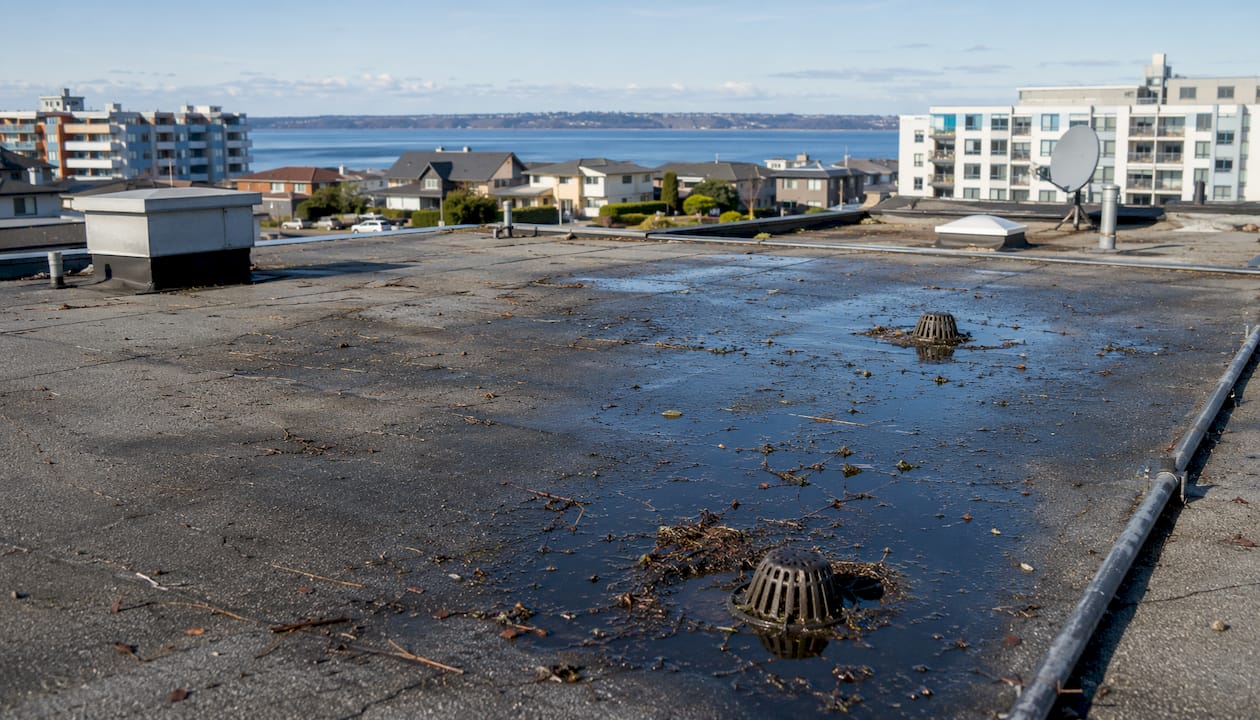
Standing water does several things at once. It adds live load to the deck structure, with even a thin layer of water adding measurable weight per square metre. It keeps the membrane wet, accelerating UV degradation at the water’s edge and promoting algae and moss growth that then blocks the very drains meant to remove it. It also holds moisture against every penetration and flashing detail on the roof, and those details are where leaks almost always start.
Delta’s mild winters matter too. The city rarely sees the hard freezes of the Interior, but it does see enough freeze-thaw cycling to damage drain seals and crack brittle flashing collars. A clogged drain that fills with water and then freezes overnight can split the drain pipe from the inside, sending a surge of water into the building when temperatures rise. That is not a theoretical risk on older Delta commercial buildings. It happens.
Moss is a particular problem here. Coastal humidity and shade from nearby trees create ideal conditions for moss growth on flat roofs, and moss holds water against the membrane long after the rain stops. It also creeps into drain strainers and scupper openings, slowly choking off flow. Managing rainwater on flat roofs in this climate requires treating moss as a drainage threat, not just a cosmetic one.
Drainage failures intensify maintenance and warranty risks. Ponding water voids most major flat roof warranties and accelerates membrane failure by 50–70%, according to NRCA membrane studies. Acting before a warranty inspector documents ponding is the only way to protect your coverage.
Common drainage problems causing flat roof failures at drains in Delta BC
Most flat roof drainage failures in Delta share a short list of root causes. Understanding which one you are dealing with determines whether you need a drain cleaning, a slope correction, or a full retrofit.
Insufficient original slope
The single most common cause of ponding on Delta flat roofs is a slope that was never adequate to begin with. Modern IBC and IRC codes require a minimum 1/4 inch per foot positive slope to drains. Many buildings constructed before 2000 were built to a lower slope standard sometimes accepted under older codes, which produces ponding even when drains are clear during moderate rainfall. The roof was never going to drain properly. It was just a matter of time before the membrane showed it.
Clogged drains and scuppers
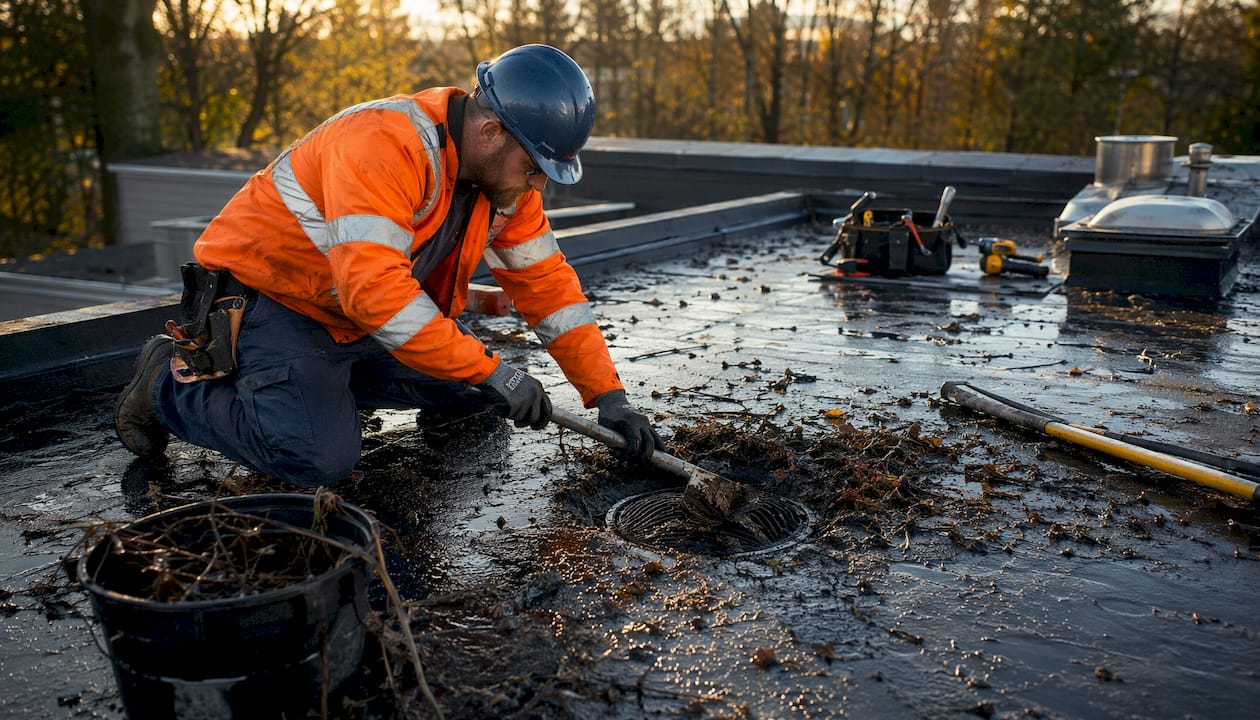
Leaves and debris from Delta’s tree canopy block scuppers and internal drains regularly, particularly in fall and spring. A blocked scupper on a parapet roof can turn a manageable rain event into a pond that sits for days. Internal drains are worse, because the clog is often invisible from the roof surface until water is already backing up. Every inspection should include a physical drain flow test, not just a visual check of the strainer.
Structural deflection moving low points away from drains
Buildings age. Steel joists, wood trusses, and concrete slabs all deflect under sustained load over time. A roof that drained correctly in 1995 may have developed new low points by 2026 simply because the structure has sagged. Those new low points are rarely where the drains are. Water pools in the middle of bays, away from any drain, and sits there. Structural deflection is the second most common cause of ponding on older flat roofs, and it is often misdiagnosed as a drain clog.
Undersized or blocked drain pipes
A drain system sized to 1990s rainfall intensity data may be overwhelmed by the heavier storm events Delta now experiences. Even if the drain is clear, an undersized pipe simply cannot move water fast enough during a heavy downpour. The roof floods temporarily, and if the slope is marginal, that temporary flood becomes a multi-day pond.
Damaged drain components
Freeze-thaw cycling and prolonged ponding stress crack flashing collars and break the seal between the drain body and the membrane. Think of a drain penetration like a dental margin: even a small shift in the seal allows water to find the gap long before any visible damage appears on the ceiling below. Brittle sealant around drain collars is one of the most overlooked sources of flat roof leaks in Delta.
Pro Tip: Do not assume the original drain locations are still the low points on your roof. On any building more than 15 years old, structural sagging may have created new depressions that are nowhere near the drains. A proper inspection maps actual water flow patterns, not just drain positions.
What happens to your building when drainage fails
Drainage failure at the drain is rarely just a surface problem. The damage works its way through the entire roof assembly and into the building below, often quietly, for months before anyone notices.
- Insulation saturation: Water that breaches the membrane soaks into the insulation layer below. Wet insulation loses its thermal value almost entirely and adds significant weight to the deck. Once insulation is saturated, it rarely dries out on its own. The only fix is removal and replacement.
- Membrane deterioration: Sustained ponding accelerates UV degradation at the water line and softens membrane seams. TPO and EPDM systems are particularly vulnerable. Ponding accelerates membrane failure, which is why many single-ply manufacturers exclude ponding from warranty coverage.
- Flashing failures at penetrations: Water pooling around drain collars, pipe penetrations, and parapet walls puts constant hydrostatic pressure on every flashing detail. Those details were not designed to sit submerged. They fail at the seal, and the leak that follows is often attributed to the wrong cause entirely.
- Structural deck overload: Water is heavy. Even a shallow pond across a large roof area adds load that the deck structure was not designed to carry continuously. Deck deflection worsens, which deepens the pond, which adds more load. This feedback loop is what causes structural collapse on roofs where primary drains clog and no secondary overflow drain exists.
- Frozen drain pipe bursts: In Delta’s mild but occasionally freezing winters, a clogged internal drain fills with water and freezes. Ice expansion damages the drain seal and can split the pipe near the roof surface. When temperatures rise, the stored water floods the building interior. This is not a slow leak. It is a sudden, large-volume event.
- Indoor humidity and mould: Saturated insulation and slow interior leaks raise indoor humidity levels, creating conditions for mould growth inside wall cavities and ceiling assemblies. By the time mould is visible, the moisture damage is already extensive.
Early warning signs of drainage failure on flat roofs
Catching drainage problems early saves a lot of money. These are the signs worth acting on immediately, not at the next scheduled inspection.
- Ponding water visible more than 48 hours after rain stops. This is the industry-standard threshold for drainage failure. If water is still sitting on your roof two days after the last rainfall, the drainage system is not working.
- Repeated roof leaks near drain areas or internal dripping. Leaks that keep coming back in the same spot, especially near drains or penetrations, point to a failed seal at the drain collar rather than a general membrane problem.
- Debris and moss accumulation at or around drains. A drain strainer buried under a mat of leaves and moss is not draining. If you can see it from the roof edge or a nearby window, it needs clearing now.
- Cracked or brittle membrane around drain collars. The membrane around a drain takes more stress than anywhere else on the roof. Cracking or chalking in that zone is a sign the seal is already compromised.
- Sagging or pooling depressions developing away from drains. New low spots appearing in the middle of roof bays, away from any drain, indicate structural deflection. These spots will pond every time it rains and will not resolve with drain cleaning alone.
- Slower drainage than usual after rain. If a roof that used to clear within a few hours now holds water for a day or more, something has changed: a partial clog, a shifted drain, or a new structural sag.
For a broader look at commercial roof repair issues in BC, these same warning signs apply across most flat roof building types.
How to prevent flat roof drainage failures in Delta BC
Prevention in Delta is mostly about staying ahead of the debris and catching slope problems before they become structural ones. The maintenance tasks are straightforward. The discipline to do them on schedule is what most property owners and managers struggle with.
Regular drain and scupper clearing
Clear all drains, scuppers, and gutters of leaves, moss, and debris at least twice a year: once in late fall after the leaves have dropped, and again in early spring. Delta’s tree canopy makes fall the critical window. A blocked drain going into November is a drain that will pond all winter.
Annual drain flow testing
Clearing the strainer is not the same as confirming the drain works. An annual flow test, where water is run through the drain to confirm it moves freely through the pipe and out of the building, catches partial clogs and pipe damage that a visual check misses. This takes 15 minutes and can prevent a burst pipe event.
Secondary overflow drain installation and verification
Every primary drain on a flat roof must have a secondary overflow path at least 2 inches above the primary drain level, as required by IPC 1106. On older Delta buildings, this secondary drain is often missing entirely. A clogged primary drain without a working overflow can accumulate water loads of 30 to 50 lbs per square foot, exceeding the structural live load capacity of most commercial decks. Verify overflow function on every inspection.
Slope correction with tapered polyiso insulation
If your roof was built to 1/8 inch per foot or less, drain cleaning will never fully solve the ponding problem. Tapered polyiso insulation is the permanent fix, factory cut to deliver 1/4 inch per foot or more across the entire roof surface and direct water to drains. A full tapered retrofit on a 4,000 sq ft roof runs from roughly $1,500 for a single drain addition up to $14,000 or more for a complete tapered insulation system. That cost is painful. It is still far less than the interior damage from a drainage failure that goes unaddressed for two or three winters.
Timely flashing and membrane repair around drains
Cracked sealant and lifted flashing at drain collars should be repaired as soon as they are identified, not deferred to the next budget cycle. A failed drain seal is an open water path into the building every time it rains.
Additional drain installation for undersized systems
If your roof has only one drain per large bay, or if the existing pipe diameter is undersized for current storm intensity, adding drains is a legitimate fix for localized ponding. Adding a single internal drain typically costs several thousand dollars and can resolve ponding in one specific area where the drain count was simply inadequate.
Pro Tip: Schedule your drain clearing and inspection in late October, before Delta’s heavy November rains arrive. A roof that goes into the wet season with clear drains and confirmed overflow function is a roof that will get through winter without a crisis call.
For a full step-by-step approach to flat roof drainage in BC, Paragonroofingbc has a detailed workflow guide built around local conditions.
What Paragonroofingbc sees on Delta flat roofs every season
Having inspected and worked on flat roofs across Delta for years, Paragonroofingbc sees the same patterns repeat on property after property. The problems are predictable. So are the solutions, when you catch them early enough.
The most common installation mistake on older Delta flat roofs is drain placement at column locations. Columns are high points after structural deflection occurs, not low points. Water migrates to the middle of bays between columns, exactly where there is no drain. The 48-hour ponding threshold is the clearest signal that this has happened. When Paragonroofingbc inspects a roof and finds water still sitting two days after the last rain, the first question is not “is the drain clogged?” It is “is the drain still in the right place?”
The second pattern is missing overflow drains on buildings constructed before 2000. IPC 1106 secondary drainage requirements were not universally adopted until relatively recently, and many Delta commercial buildings were built without any overflow path. That is the highest structural risk on the roof. A single clogged primary drain on a roof without overflow drainage can accumulate enough water to threaten deck integrity during a heavy storm.
Here is what Paragonroofingbc recommends as a baseline inspection and maintenance checklist for Delta flat roofs:
- Confirm all primary drains are clear and flow-tested annually.
- Verify secondary overflow drains exist and are positioned at least 2 inches above primary drain level, per IPC 1106.
- Check roof slope with a level or water test to confirm 1/4 inch per foot minimum to drains.
- Inspect all drain collars and flashing for cracking, lifting, or sealant failure.
- Map any new ponding depressions and compare to original drain locations to identify structural deflection.
- Clear moss from drain areas and treat with a moss inhibitor appropriate for roofing membranes.
- Document drain locations and overflow paths so the next inspector has a baseline to compare against.
Paragonroofingbc also implements tapered polyiso insulation retrofits and drain additions on Delta properties where the original slope is inadequate, bringing roofs up to current 2026 drainage standards and protecting the building through the wet season. For drainage challenges across BC, the approach is always the same: fix the slope first, then confirm the drain count, then verify overflow.
The 48-hour ponding rule is the most reliable field diagnostic available. If water is still on the roof two days after rain stops, the drainage system needs professional evaluation, not just a drain cleaning.
Repair versus replacement: what drainage failure actually costs you
When drainage failure has already caused damage, the decision between repair and replacement comes down to how far the damage has spread and how compromised the slope is.
Localized ponding near a single drain, caused by a clog or a missing drain, is a repair scenario. Clearing the drain and adding a new internal drain or scupper typically costs $1,500 to $4,000 per drain. If the membrane around the drain collar is still intact, that repair can extend the roof’s service life by years. This is the best-case outcome, and it is only available when the problem is caught early.
When the slope is fundamentally wrong, no amount of drain additions will fix it. A roof built to 1/8 inch per foot or less will pond across the entire surface regardless of how many drains you add. The only real fix is a tapered insulation retrofit, which on a 4,000 sq ft roof runs up to $14,000 or more depending on the system. That cost is significant, but it is a one-time correction that brings the roof to current code and restores warranty eligibility.
Full replacement becomes the calculation when insulation is saturated, the membrane has failed across multiple areas, and the deck structure has been compromised by prolonged water loading. At that point, repair costs stack up quickly and often exceed the cost of a properly specified replacement. A replacement done right, with tapered insulation, correctly sized drains, and secondary overflow drainage, eliminates the drainage problem permanently rather than patching it season after season.
The practical rule: if ponding is localized and the membrane is sound, repair. If ponding is widespread and the slope is the root cause, budget for a tapered retrofit. If the assembly is saturated and the deck is compromised, replace and do it correctly the first time.
Key takeaways
Delta BC flat roofs fail at drains primarily because of insufficient slope, clogged or undersized drains, and structural deflection that moves low points away from drain locations, and addressing all three is the only way to stop the cycle.
| Point | Details |
|---|---|
| Minimum slope requirement | Current code requires 1/4 inch per foot to drains; pre-2000 roofs often have 1/8 inch per foot, which causes chronic ponding. |
| 48-hour ponding threshold | Water still on the roof two days after rain stops is the industry-standard indicator of drainage failure requiring action. |
| Secondary overflow drains | IPC 1106 requires a secondary drain at least 2 inches above the primary; missing overflow drains are the highest structural risk on older Delta buildings. |
| Seasonal maintenance timing | Clear drains and test flow in late October before Delta’s heavy November rains to prevent winter ponding events. |
| Repair vs. replacement | Localized ponding near a single drain is a repair; widespread slope failure requires a tapered insulation retrofit costing up to $14,000 or more on a 4,000 sq ft roof. |
The drainage problem Delta flat roofs keep teaching us
After years of inspecting flat roofs across Delta, the pattern that stands out most is not the dramatic failures. It is the slow ones. A drain that has been partially clogged for two seasons. A flashing collar that cracked last winter and has been leaking a tablespoon of water per rainstorm ever since. A roof that was built to 1/8 inch per foot in 1988 and has been ponding every November for 35 years while the insulation quietly saturated below.
Property owners and managers in Delta often call Paragonroofingbc after a visible interior leak, and by that point the damage is already weeks or months old. The ceiling stain is the last thing to show up. The insulation was wet long before that, and the membrane was failing before the insulation got wet. The 48-hour ponding rule exists precisely because it catches the problem at the surface, before it works its way through the assembly.
What I find most underestimated is the structural deflection issue. Owners accept that drains clog and need cleaning. They rarely consider that the drain might now be in the wrong place entirely because the building has shifted under it. A drain that was correctly positioned at installation can become functionally useless as the structure ages, and no amount of cleaning will change that. Re-evaluating drain locations on any building over 20 years old is not optional maintenance. It is the inspection that prevents the expensive surprise.
The other thing worth saying plainly: secondary overflow drains are not a nice upgrade. On a Delta building without them, a single clogged primary drain during a November storm is a structural event waiting to happen. The water loads that accumulate when primary drainage fails exceed what most commercial decks were designed to carry. Paragonroofingbc treats overflow drain verification as a non-negotiable part of every flat roof inspection, because the consequence of missing it is not a leak. It is a collapse.
Proactive inspection, scheduled before the rainy season, costs a fraction of what reactive repair costs after a winter of unchecked ponding. That is the clearest advice anyone who works on Delta flat roofs can give you.
Ready to protect your Delta flat roof before the rains hit?

If your flat roof is showing any of the warning signs covered here, ponding water, slow drainage, cracked flashing at drains, or a roof built before 2000 with no overflow drainage, Paragonroofingbc can assess it before the damage compounds. We serve Delta BC and the surrounding Lower Mainland with flat roof inspections, drain repairs, tapered insulation retrofits, and full roof leak detection and repair services. Get in touch for a free on-site assessment and find out exactly what your drainage system needs to get through the wet season.
FAQ
What is the main problem with flat roof drainage in Delta BC?
The three root causes are insufficient slope below 1/4 inch per foot, clogged or undersized drains blocked by debris and moss, and structural deflection that shifts low points away from drain locations. Delta’s heavy autumn rainfall makes all three worse than they would be in a drier climate.
Where do flat roofs leak most often?
Flat roofs leak most often at drain collars, flashing penetrations, and parapet wall transitions, because these are the points where the membrane must seal around a gap or change direction. Ponding water near any of these details puts constant pressure on the seal and accelerates failure.
How long should a flat roof last in Delta BC?
A properly installed and maintained flat roof in Delta BC typically lasts 20–30 years depending on the membrane system. Chronic ponding caused by drainage failure can cut that service life significantly, which is why manufacturers exclude ponding from warranty coverage.
How many drains should a flat roof have?
The NRCA recommends a minimum of two drains per roof area regardless of size, with each primary drain paired with a secondary overflow drain positioned at least 2 inches above the primary, as required by IPC 1106. Drain count and pipe sizing should also be matched to local rainfall intensity data for the specific location.
What does the 48-hour ponding rule mean for my roof?
Water that remains on a flat roof more than 48 hours after rain stops is formally classified as ponding under IBC standards. It signals a drainage failure, voids most major single-ply warranties, and requires professional evaluation to determine whether the cause is a clog, an inadequate slope, or structural deflection.
Recommended
Our Roofing Blog


Have more questions about roofing?
Check out our FAQs or give us a call today to speak to an expert roofer in Vancouver Lower Mainland, BC. We're here to help our neighbours make educated decisions about their roof. For our team, we value helping clients save money while making their roofs last.