
Why West Vancouver attics over-ventilate: causes and fixes
Why West Vancouver attics over-ventilate: causes and fixes
West Vancouver attics over-ventilate primarily because coastal winds drive air exchange rates far beyond what the BC Building Code’s standard 1:300 ventilation ratio assumes. Research funded by BC Housing found that at a wind pressure of just 2 Pa, a typical attic’s air changes per hour jump to 5 times the rate produced by buoyancy alone. The cruel irony is that this extra airflow does not dry out the attic. It pulls in saturated marine air, which then condenses on cold roof sheathing and feeds mould growth, even in homes that fully meet code requirements.
Here is what is driving the problem:
- Coastal wind pressure increases attic air exchange rates substantially above calm winter conditions, often several times higher during storms
- High ambient humidity means the outdoor air flooding the attic is already near saturation, so it deposits moisture rather than removing it
- Increased insulation levels reduce heat loss from the living space into the attic, leaving the sheathing colder and more prone to condensation
- North-facing roof surfaces receive less solar warming, so they stay cold longer and accumulate moisture faster
- Mould appears at soffit vents first , exactly where ventilation rates are highest, which is a telltale sign that more airflow is making things worse
How West Vancouver’s climate drives attic ventilation issues
West Vancouver sits in a coastal marine climate zone where the combination of persistent rain, mild temperatures, and regular windstorms creates conditions that standard ventilation guidelines were never designed to handle.
| Climate Factor | Local Condition | Effect on Attic |
|---|---|---|
| Annual rainfall | Among the highest in Metro Vancouver | Keeps outdoor air near saturation for months |
| Winter temperatures | Mild but consistently cool (2°C) | Limits attic air’s capacity to absorb moisture |
| Wind exposure | Regular storms off Howe Sound and the Pacific | Drives high ACH rates year-round |
| Solar hours (winter) | Low, especially on north-facing slopes | Reduces daytime drying of sheathing |
| Relative humidity | Frequently above 80% October through March | Saturates incoming ventilation air |
The drying capacity of outdoor air in winter is low precisely because conditions are constantly wet and sunshine hours are limited. When insulation levels are high, there is also less warmth escaping from the living space to heat the attic air, so the sheathing stays cold. RDH Building Science has investigated hundreds of Lower Mainland attics and found mould on the underside of sheathing to be a common condition, with problems appearing more often on north-facing elevations because those surfaces receive less solar warming throughout the day.
Key climate impacts on attic moisture balance:
- Outdoor air is often at or near 100% relative humidity from October through April
- North-facing sheathing stays below the dew point of ambient air on clear nights due to radiative cooling
- Low winter sun angles mean south-facing surfaces dry out faster, creating uneven moisture loads across the same attic
- Wind-driven ventilation delivers nearly the same ACH in summer as in winter, so the problem is not strictly seasonal
What the BC Building Code says about attic ventilation
The BC Building Code requires a minimum of 1 square unit of vent area for every 300 square units of insulated ceiling area, commonly written as the 1:300 ratio. That standard has been in place since the 1953 National Building Code of Canada and has changed very little since, despite major increases in insulation requirements over the decades.
The intent behind the ratio is sound: provide enough airflow to dilute any moisture that migrates from the living space into the attic, and keep the sheathing dry enough to prevent rot and mould. Ventilation is supposed to be split between low intake vents (typically soffit vents) and high exhaust vents (ridge or roof vents), so that air flows in at the bottom and exits at the top. You can read more about how vent types compare for Vancouver’s specific conditions.
Key code principles and ventilation guidelines:
- Minimum 1:300 net free vent area ratio (can be reduced to 1:600 if at least 50% of venting is placed in the upper portion of the attic)
- Intake vents should be placed at the eaves or soffits to draw in cooler outside air
- Exhaust vents should be positioned at or near the ridge to allow warm, moist air to escape
- Vents must be protected against rain infiltration and insect entry
- Vapour barriers on the warm side of insulation are required to limit moisture migration from the living space
The 1:300 ratio was designed for climates where outdoor air is relatively dry. BC Housing research confirms that in coastal marine climates like Vancouver, this ratio can actually provide more ventilation than needed, making outdoor humidity the dominant moisture source rather than indoor air leakage.
The code minimum is a floor, not a target. In West Vancouver, hitting that minimum while ignoring wind exposure and ambient humidity is what gets homeowners into trouble.
What happens when your West Vancouver attic gets too much ventilation
More ventilation sounds like it should mean a drier attic. In West Vancouver, the opposite is often true. When coastal winds push saturated air through the attic at high rates, the sheathing cannot warm up fast enough to stay above the dew point, and condensation forms directly on the wood.
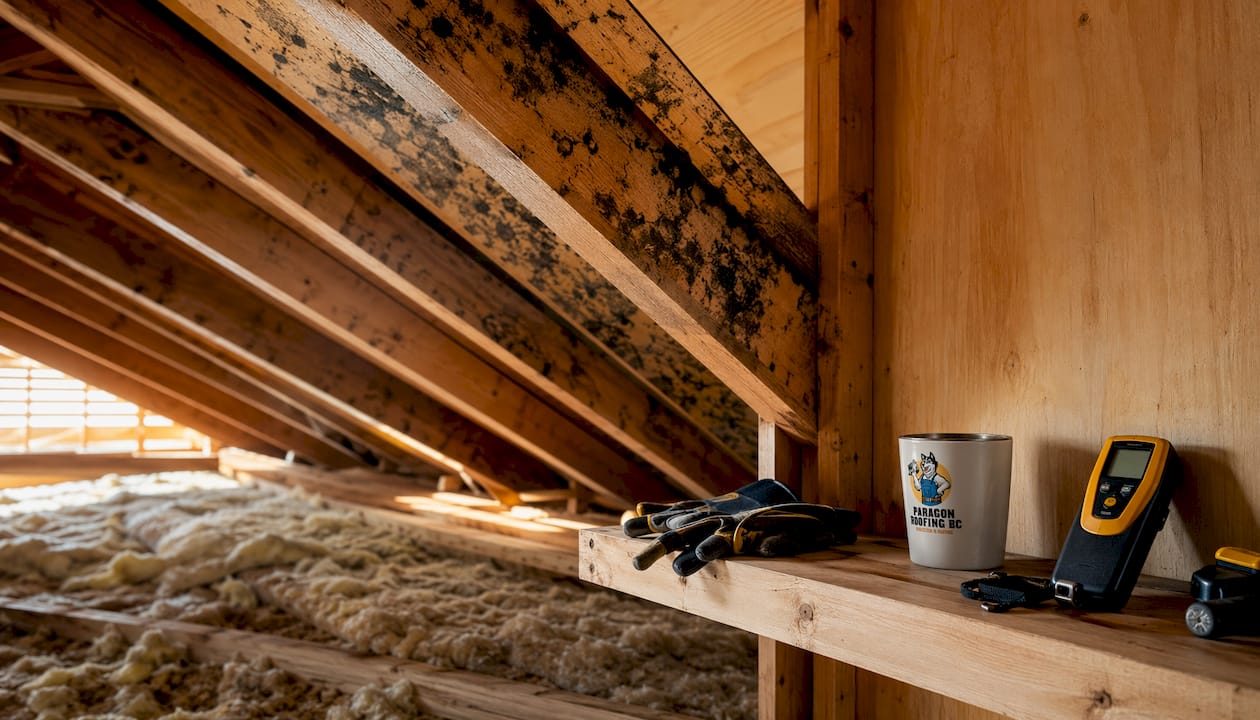
RDH Building Science monitored roof assemblies from September 2012 through March 2014 and found that sheathing moisture content ranged from 20% to 30% during the rainy fall through spring months, consistently above the threshold for fungal growth. Mould appeared on all monitored assemblies within the first year, starting on north-facing surfaces.
Negative impacts of excess attic ventilation in this climate:
- Mould at soffit vents: staining appears precisely where airflow is highest, not where it is lowest
- Condensation on cold sheathing: night sky radiation cools the roof surface below the dew point of the incoming air, depositing liquid water even when indoor humidity is low
- Increased heating loads: BC Housing CFD research confirms that attic ventilation in winter creates an energy penalty by pulling conditioned air out of the building envelope
- Structural damage: persistent moisture above 20% moisture content accelerates wood decay and can compromise roof framing over time
- Health risks: mould spores in the attic space, while unlikely to migrate directly into the living area, indicate a moisture problem that can spread to other building assemblies
Meeting code ventilation requirements does not prevent mould in West Vancouver. BC Housing documented attics that fully complied with code, had airtight ceilings, and showed low indoor moisture loads, yet still developed localized staining on plywood sheathing near the soffits.
The pattern is consistent enough that building science professionals now treat mould at soffit vents as a diagnostic sign of wind-driven over-ventilation rather than insufficient airflow.
How to prevent over-ventilation problems in your West Vancouver attic
The fix is not to seal the attic completely and it is not to add more vents. The goal is a balanced, controlled assembly that accounts for local wind exposure and ambient humidity.
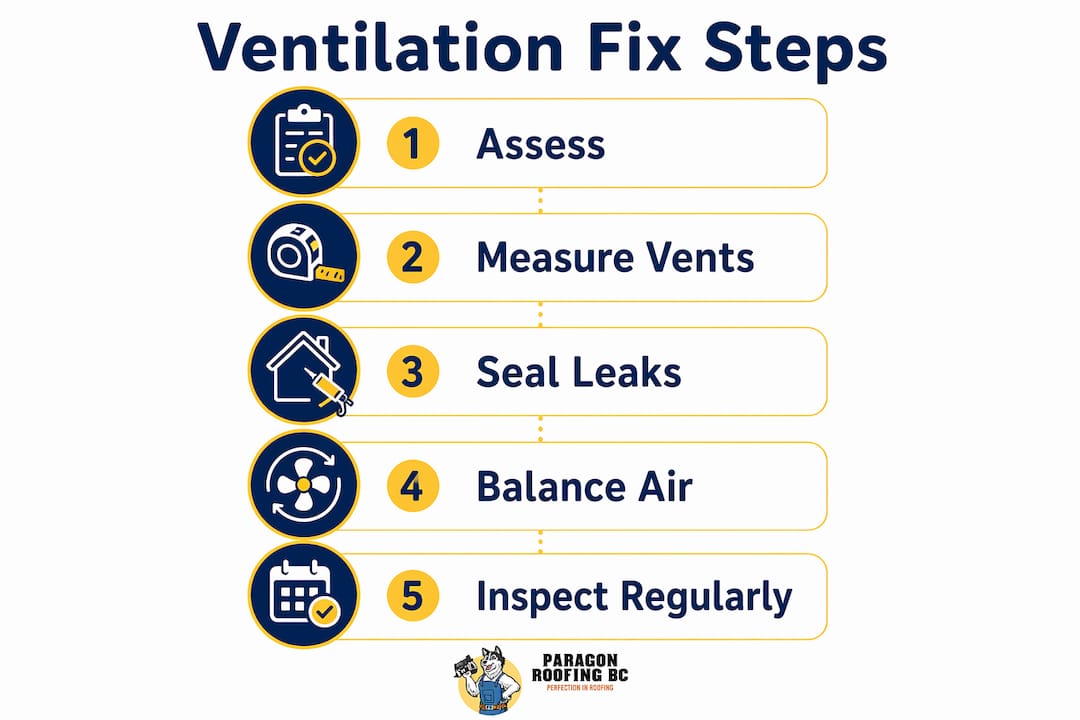
Seal air leaks in the attic ceiling first. Oak Ridge National Laboratory research confirms that sealing air leakage through attic hatches, recessed lighting, plumbing penetrations, and electrical boxes reduces condensation risk more effectively than adjusting vent counts. These penetrations are the primary pathways for warm, moist indoor air to reach cold sheathing. Addressing them is the highest-return step you can take.
Practical steps to balance attic ventilation for West Vancouver conditions:
- Seal all ceiling penetrations before adjusting vent area: attic hatches, pot lights, plumbing stacks, and exhaust fans
- Do not add vents beyond code minimums in wind-exposed locations; extra soffit vents on the windward side increase moisture intrusion
- Maintain balanced intake and exhaust so air flows through the attic rather than pooling; an imbalanced system creates pressure differentials that pull in more humid air
- Use baffles at every rafter bay to keep insulation from blocking soffit vents and to direct incoming air along the underside of the sheathing
- Specify adequate insulation R-values for the local climate zone; higher insulation reduces heat loss into the attic, which lowers sheathing temperature and increases condensation risk unless ventilation is carefully managed
- Consider a building science assessment before adding or modifying vents, particularly on north-facing roof sections
Pro Tip: If you see mould staining near your soffit vents rather than near the ridge, that is a strong indicator of wind-driven over-ventilation, not under-ventilation. Adding more vents will make it worse. Start with air sealing and get a professional moisture assessment before touching the vent layout.
For a deeper look at how attic insulation and ventilation interact with moisture and mould in the Vancouver area, the relationship between R-value and sheathing temperature is worth understanding before making any changes.
What the research says about wind-driven over-ventilation
The most important piece of data for West Vancouver homeowners comes from a computational fluid dynamics study commissioned by BC Housing. It modelled attic airflow under real coastal conditions and produced results that challenge the conventional “more ventilation is better” assumption.
| Wind Pressure | Ventilation Rate (Winter ACH) | Multiple of Buoyancy-Only Rate |
|---|---|---|
| No wind (buoyancy only) | Approximately 4 air changes per hour | — |
| 0.6 Pa (typical wind) | 9 ACH | 2.5 times |
| 2 Pa (moderate storm) | 20 ACH | 5 times |
At 2 Pa of wind pressure, which is a moderate coastal storm rather than an exceptional event, the attic cycles through air exchange rates several times higher than calm conditions. Outdoor air during West Vancouver winters is frequently at or near saturation, contributing moisture to the attic.
Wind-driven ventilation rates are nearly the same in summer and winter. Unlike buoyancy-driven airflow, which drops significantly in summer when temperature differences are smaller, wind-induced ACH remains high year-round. This means moisture intrusion from over-ventilation is not a winter-only problem in coastal BC.
The research also found that at higher wind pressures, incoming air flows directly along the underside of the sheathing before exiting at the ridge. That airflow path maximises contact between saturated outdoor air and the coldest surfaces in the attic, which is exactly where condensation forms. Building science experts at RDH caution that simply increasing attic ventilation can worsen moisture issues in Pacific Northwest climates, and the CFD data from BC Housing supports that position directly.
Common construction and design factors that lead to over-ventilation
West Vancouver homes were not designed to fail. Most of the over-ventilation problems we see come from a combination of well-intentioned design decisions and construction practices that made sense under older assumptions.
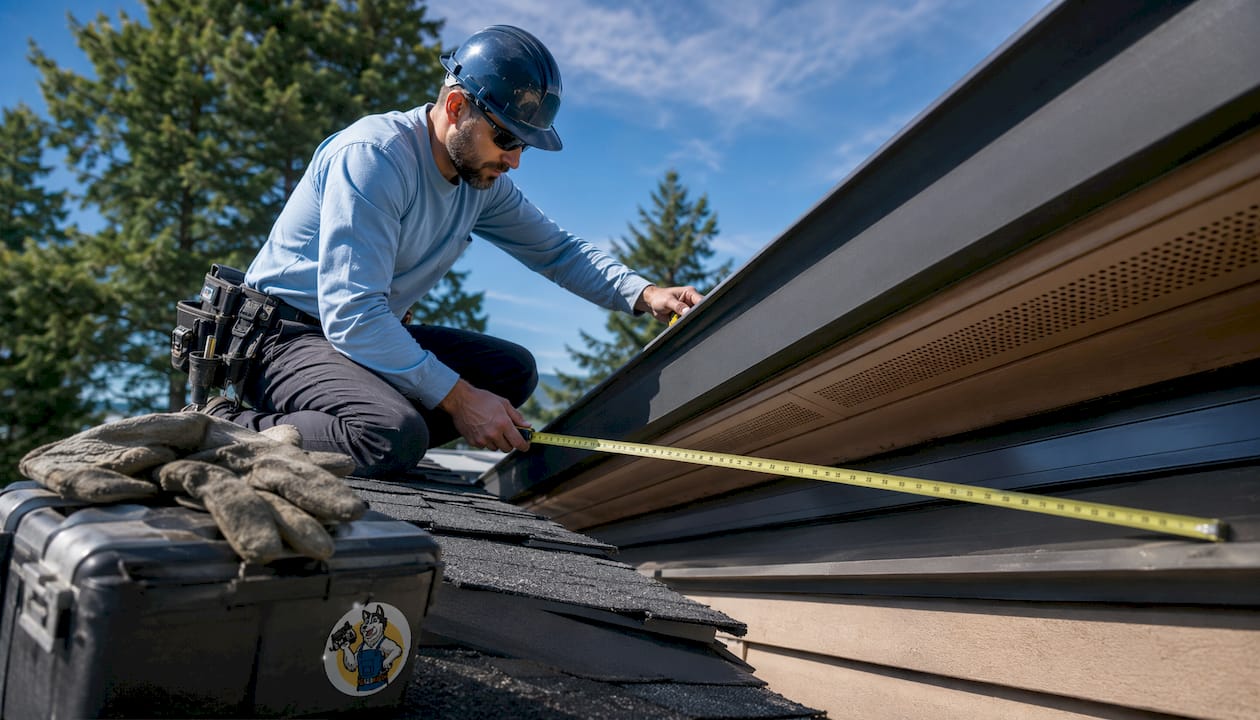
Oversized soffit vent runs are one of the most common contributors. Builders often install continuous soffit venting along the full length of the eave, which maximises intake area. On a wind-exposed site in West Vancouver, that continuous opening acts like a scoop, channelling storm air directly into the attic at rates the ridge vent cannot balance.
High-pitched roofs compound the problem. A steeper roof creates a larger attic volume and a taller stack, which increases buoyancy-driven ventilation even before wind is factored in. University of Alberta modelling cited in BC Housing research predicted that high-pitched roofs tend to have more moisture problems than low-pitched ones for exactly this reason.
Other design and construction factors that contribute:
- Inadequate baffles or missing baffles at rafter bays allow insulation to block soffit vents unevenly, creating pressure imbalances that pull more air through open sections
- Recessed pot lights and unsealed attic hatches add indoor moisture to an already humid attic environment, compounding the outdoor humidity problem
- Exhaust fans vented into the attic rather than through the roof or wall add concentrated moisture directly to the space
- Older homes with minimal ceiling insulation allowed more heat to escape into the attic, which helped dry things out; retrofitting insulation without adjusting ventilation removes that drying benefit
- Wind-exposed sites on the upper slopes of the North Shore mountains face higher average wind pressures than sheltered valley locations, so the same vent layout produces very different ACH rates depending on where the house sits
How over-ventilation problems shift through the seasons
Attic ventilation needs are not static, and the way over-ventilation shows up in a West Vancouver attic changes noticeably from one season to the next.
October through March is when the risk is highest. Outdoor relative humidity climbs, temperatures drop, and the sheathing loses heat through night sky radiation faster than it gains it from the weak winter sun. Wind events are frequent, so ACH rates spike repeatedly. Sheathing moisture content builds up incrementally with each wet cycle, and by January or February it typically peaks. Studies monitoring Vancouver-area attics found wood moisture content in conventionally vented roofs reaching 30% during these months, well above the 20% threshold for fungal activity.
April and May bring a transition. Temperatures rise, solar hours increase, and the sheathing begins to dry. South-facing surfaces recover quickly; north-facing ones lag by weeks. If moisture content has been elevated all winter, mould that established itself in January does not disappear when spring arrives.
June through September is the period when wind-driven ventilation is least damaging, because outdoor humidity drops and the air entering the attic has more capacity to carry moisture away. Buoyancy-driven ventilation also increases with solar gain, which helps. This is the window when attic repairs, air sealing work, and ventilation adjustments are most practical and most effective.
The key seasonal insight is that wind-driven ACH stays nearly constant year-round, as BC Housing’s CFD modelling confirmed. So while the outdoor air is drier in summer and the damage is lower, the mechanism driving over-ventilation never fully switches off. A home that over-ventilates in January will over-ventilate in July; the consequences are just less severe when the air is drier.
Pro Tip: Schedule your attic inspection in late February or early March, when sheathing moisture is at its seasonal peak. That timing gives you the clearest picture of how your attic is actually performing under worst-case conditions, not the optimistic snapshot you get in August.
Paragonroofingbc can assess and correct your attic ventilation
If you have spotted mould near your soffit vents, noticed frost on the underside of your sheathing, or simply want to know whether your West Vancouver home is at risk, Paragonroofingbc offers hands-on attic ventilation assessments and corrective work grounded in local building science.

The team at Paragonroofingbc works specifically in West Vancouver, North Vancouver, Burnaby, Surrey, Coquitlam, and Delta, which means every recommendation accounts for the wind exposure, roof pitch, and construction era of homes in this part of the Lower Mainland. Rather than defaulting to “add more vents,” the approach starts with air sealing, checks the intake-to-exhaust balance, and evaluates whether the existing vent layout is appropriate for the site’s actual wind conditions. For homes that need a full residential roofing assessment or a ventilation correction as part of a re-roof, Paragonroofingbc brings the same field experience to both. Contact Paragonroofingbc to book an attic inspection and get a clear picture of what your roof assembly is actually doing.
FAQ
Can an attic have too much ventilation?
Yes, particularly in coastal climates like West Vancouver. BC Housing research confirms that the 1:300 code ratio can provide excessive ventilation in marine climates, drawing in saturated outdoor air that condenses on cold sheathing and promotes mould growth.
What happens when an attic is poorly ventilated?
Moisture from the living space accumulates in the attic, raising sheathing moisture content above the threshold for fungal growth and eventually causing rot in the framing. Both under-ventilation and over-ventilation can produce mould; the cause and the fix are different for each.
Why do attics in West Vancouver get mould even with proper venting?
Because the outdoor air itself is the primary moisture source in coastal BC, not indoor air leakage. RDH Building Science found that well-constructed attics meeting all code requirements still developed mould within the first year of monitoring, driven by condensation from saturated incoming air on cold north-facing sheathing.
Why don’t attic fans solve the problem in coastal climates?
Powered attic fans increase air exchange rates, which in a humid coastal environment means pulling in more saturated outdoor air. In West Vancouver, where wind is already driving ACH rates to 9–20 during storms, adding mechanical ventilation typically worsens moisture accumulation rather than reducing it.
What is the most effective fix for over-ventilation moisture problems?
Sealing air leaks in the attic ceiling, including attic hatches, recessed lights, and plumbing penetrations, reduces moisture intrusion more reliably than adjusting vent counts. Oak Ridge National Laboratory research supports air sealing as the priority step before any ventilation modifications are made.
Key takeaways
West Vancouver attics over-ventilate because coastal wind pressure drives air exchange rates up to 5 times the buoyancy-only baseline, flooding the attic with saturated marine air that condenses on cold sheathing and causes mould even in code-compliant homes.
| Point | Details |
|---|---|
| Wind multiplies ventilation rates | At 2 Pa wind pressure, attic ACH reaches 20, five times the buoyancy-only rate of approximately 4 air changes per hour. |
| Outdoor air is the moisture source | In coastal BC, incoming ventilation air is often near saturation, making more vents a liability rather than a solution. |
| Mould appears at soffit vents first | Staining at the highest-airflow locations confirms wind-driven over-ventilation, not under-ventilation. |
| Air sealing outperforms added vents | Sealing attic hatches, pot lights, and penetrations reduces condensation risk more effectively than increasing vent area. |
| Paragonroofingbc assesses local attics | Paragonroofingbc provides West Vancouver attic inspections and ventilation corrections based on site-specific wind exposure and building science. |
Recommended
Our Roofing Blog


Have more questions about roofing?
Check out our FAQs or give us a call today to speak to an expert roofer in Vancouver Lower Mainland, BC. We're here to help our neighbours make educated decisions about their roof. For our team, we value helping clients save money while making their roofs last.