Roof leak detection guide for BC homeowners
TL;DR:
- Living in British Columbia exposes homes to unpredictable, wet weather that heavily stresses roofs and may cause hidden leaks. Proper detection involves attic inspections, moisture testing, and professional diagnostics like thermal imaging to find concealed entry points and prevent costly damage. Regular maintenance, proper ventilation, and timely professional evaluations are essential for long-term leak prevention in BC’s challenging climate.
Living in British Columbia means coping with some of the wettest, most unpredictable weather in the country, and your roof takes the full brunt of it every single season. What most homeowners don’t realise is that a small, seemingly harmless drip can spiral into serious structural damage averaging $8,500 within just 48 hours if left unaddressed. Worse, the spot where water shows up on your ceiling is rarely where the leak actually starts, which is why so many initial repairs fail. This guide walks you through a proven, step-by-step detection process so you can protect your home, avoid costly mistakes, and know exactly when to call in the professionals.
Table of Contents
- Understanding roof leaks in British Columbia
- Preparing for detection: Tools, signs, and prerequisites
- Step-by-step roof leak detection process
- Advanced diagnostics: Professional leak detection methods
- Leak prevention: Ventilation, code compliance, and ongoing maintenance
- Why quick fixes fail: The truth about roof leak detection in BC
- Expert help for roof leak detection and repair in BC
- Frequently asked questions
Key Takeaways
| Point | Details |
|---|---|
| Leak source is often hidden | Visible stains rarely indicate the true entry point, so tracing leaks requires careful interior and attic inspection. |
| Professional diagnostics save money | Investing in expert leak detection prevents costly errors and protects your home from escalating damage. |
| BC code shapes prevention | Following provincial ventilation and insulation standards is crucial for long-term leak prevention. |
| DIY fixes rarely suffice | Quick patching without proper tracing usually leads to repeat leaks and higher repair costs. |
Understanding roof leaks in British Columbia
BC’s climate is genuinely unlike anywhere else in Canada. The Lower Mainland gets battered by weeks of sustained rain, the Interior deals with heavy snow loads, and coastal areas face wind-driven storms that force water sideways under shingles. All of that adds up to a roofing environment where leaks are more common, and more deceptive, than in most other provinces.
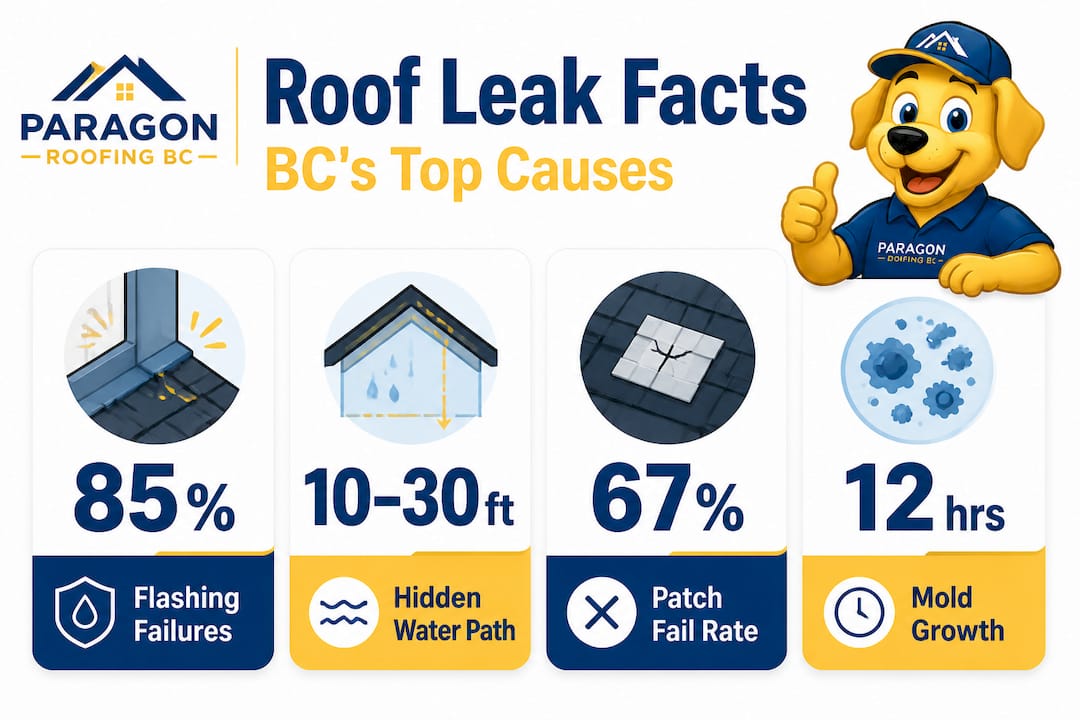
Flashing failures cause 85% of roof leaks, particularly around valleys, chimneys, and skylights. Damaged or curling shingles, clogged gutters, ice dams, and poor ventilation round out the top causes. In BC specifically, our freeze-thaw cycles are brutal on flashing and sealant materials, expanding and contracting them until they crack and let water in.
Here’s the tricky part: water travels 10 to 30 feet from the actual entry point before it becomes visible as a stain or drip on your ceiling. That’s why 73% of homeowners, and even many contractors, misidentify the leak source. You might be patching your bedroom ceiling while the real culprit is a failing chimney flashing on the opposite side of the roof peak.
| Leak cause | Likelihood in BC | Typical location |
|---|---|---|
| Flashing failure | Very high | Chimney, valleys, skylights |
| Damaged shingles | High | Field of roof, edges |
| Clogged gutters | High | Fascia, soffit area |
| Ice dams | Moderate to high | Eaves, lower roof edge |
| Poor ventilation | Moderate | Widespread, attic space |
Common warning signs that a leak may already be progressing include:
- Yellow or brown ceiling stains that grow after rainfall
- Peeling or bubbling interior paint near exterior walls
- A persistent musty odour in upstairs rooms
- Visible mould growth in attic corners
- Sagging drywall or soft spots in the ceiling
“Water stains are the last symptom, not the first sign. By the time you see discolouration, moisture has already been working through your roof structure for days or weeks.”
Understanding this from the start sets you up for smarter detection. For more on preventing roof leak damage before it escalates, and on preparing for BC winters before the rains hit hard, a little preparation goes a long way.
Preparing for detection: Tools, signs, and prerequisites
Before you do anything physical, gather the right tools and know what you’re looking for. Think of it like a doctor’s visit: you wouldn’t want your physician to diagnose you without the right equipment. The same applies here.
Basic detection toolkit:
| Tool | Purpose |
|---|---|
| Flashlight (high-lumen) | Illuminate dark attic spaces and rafters |
| Moisture metre | Quantify dampness in wood or drywall |
| Digital camera or smartphone | Document stains, damage, and locations |
| Notepad or inspection app | Record measurements and observations |
| Tape measure | Map leak location relative to roof features |
| Safety glasses and gloves | Protect against insulation fibres and mould |
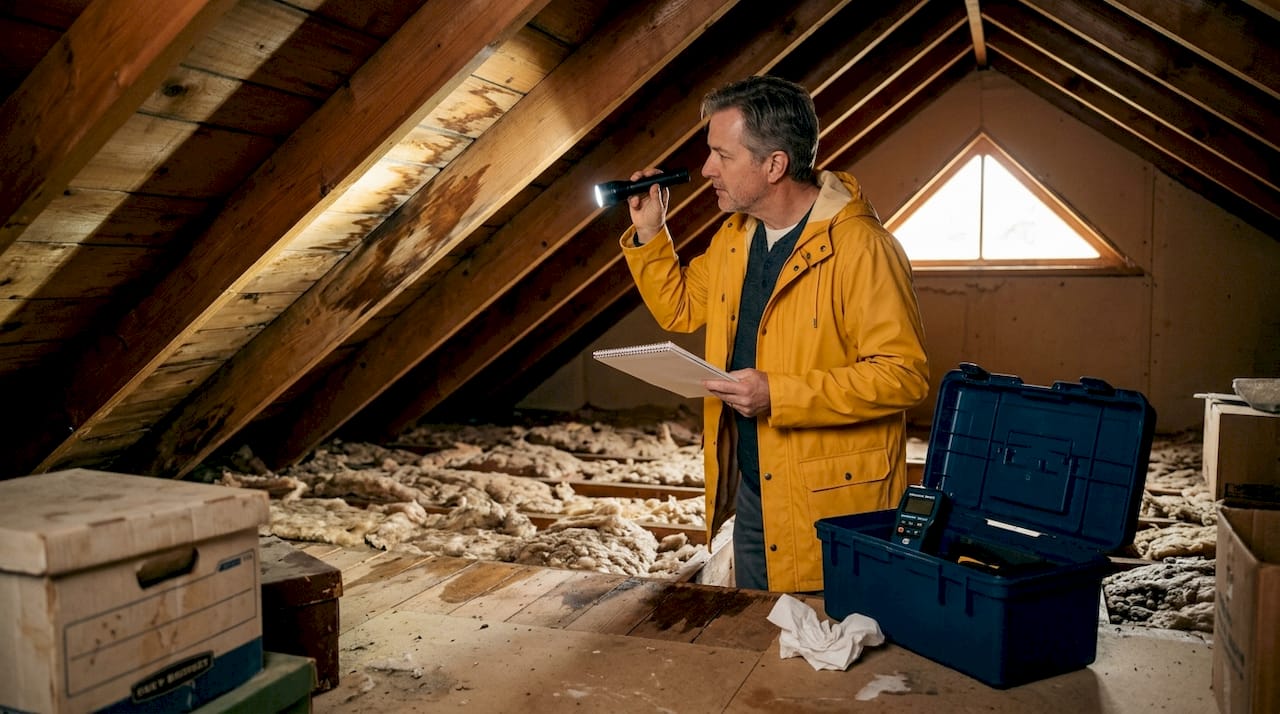
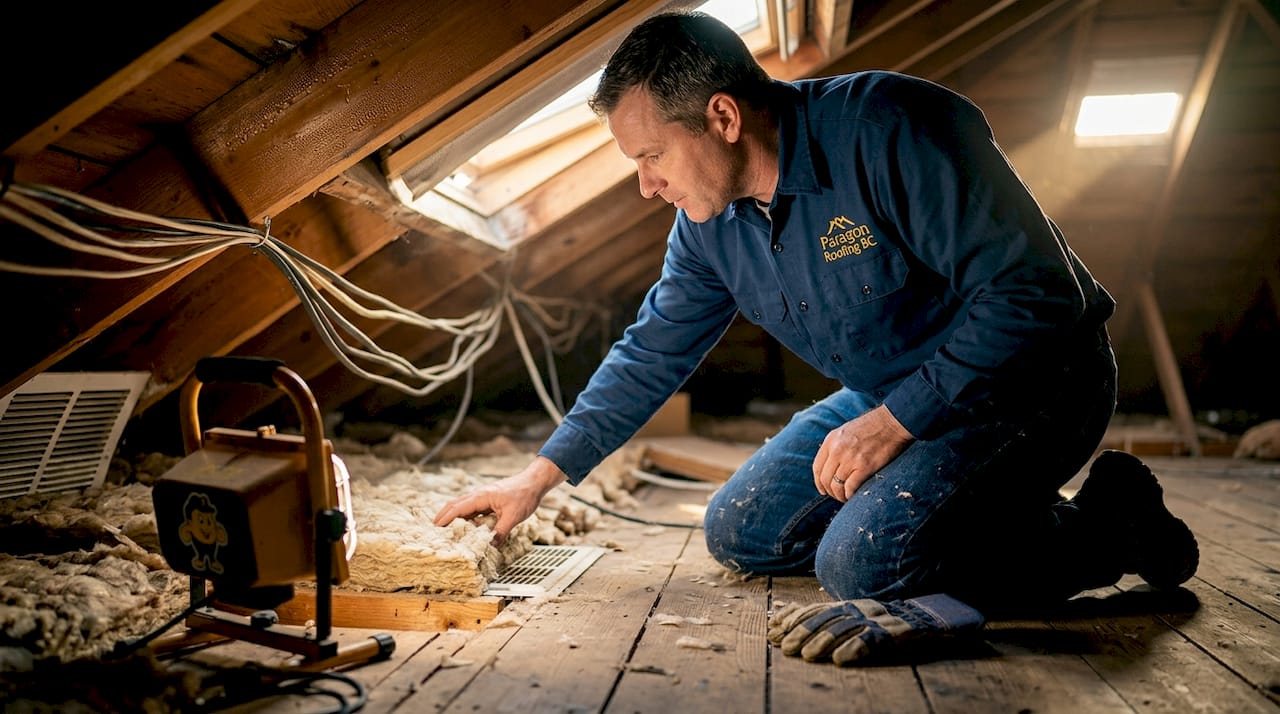
Interior inspection begins with scanning ceilings, walls, and attic spaces for water stains, mould, damp insulation, and musty odours. The attic is where the real clues hide. Look for water trails running along rafters, darkened or discoloured wood, wet or compressed insulation, and any daylight visible through the roof deck.
Key interior and attic warning signs to check:
- Rafters or sheathing with dark staining or soft spots
- Insulation that is clumped, flattened, or visibly wet
- Rust stains near metal fasteners or nails
- Daylight visible through gaps or holes in the roof deck
- Efflorescence (white mineral deposits) on masonry surfaces
It’s also smart to check your attic insulation and ventilation setup, since poor airflow creates condensation that can mimic a roof leak almost perfectly. Many BC homeowners have spent money “fixing” a roof that wasn’t actually leaking at all.
Pro Tip: Take dated, geo-tagged photos at every stage of your inspection. These become invaluable when describing the issue to a roofing professional and can save hours of diagnostic time.
Reviewing your maintenance tips for BC roofs before you start can also help you recognise normal wear versus active leakage.
Step-by-step roof leak detection process
With your tools ready and your attic checked, here’s how to work through detection methodically. Skipping steps is where homeowners lose money.
-
Start with the most recent rainfall event. Note exactly where you saw dripping or staining. Mark those spots on a rough sketch of your ceiling layout.
-
Access your attic during daylight hours. Look for wet insulation, watermarks on rafters, or daylight coming through the decking. Trace any wet trails uphill toward the ridge, because water always enters higher than it appears.
-
Distinguish between a true roof leak and condensation. Condensation forms uniformly across cold surfaces and tends to appear in winter. A leak leaves trails and concentrated wet spots. This distinction matters because condensation versus infiltration is one of the most common diagnostic errors, particularly in BC winters when ice dams trap meltwater under shingles.
-
Check plumbing and HVAC before blaming the roof. Bathroom exhaust fans venting into the attic instead of outside are a notorious culprit. So are condensate lines from air handlers.
-
Move to the exterior only when safe. Walk the perimeter and look for lifted, cracked, or missing shingles at a safe distance with binoculars. Check visible flashing around all penetrations. Never walk on a wet roof without fall protection.
-
Perform a controlled hose test if needed. Have a helper stay inside while you run water slowly over suspect areas, starting low and working up. Spend at least five minutes per zone before moving upward.
-
Avoid patching the stain. This is the single biggest mistake we see. 67% of initial repairs are made at the wrong location because homeowners patch the ceiling stain rather than tracing back to the entry point.
-
Consider when to call a professional. If you cannot identify the source after the interior and attic inspection, or if you have a multi-plane roof, a flat membrane section, or a strata property, it’s time to bring in professional diagnostics.
Timing matters enormously here. Mould begins doubling every 12 hours in wet conditions, so delay is genuinely costly. Proper professional diagnostics run $500 to $800 but routinely prevent far larger damage. Visual inspection alone only identifies about 30% of leak sources.
On complex properties, you may also need to decide early whether you’re dealing with a repair or something bigger. Reviewing whether to repair or replace your roof can help frame that decision, especially if your shingles are already aging. For metal roofs, it’s worth understanding the role of metal roof condensation before drawing conclusions.
Advanced diagnostics: Professional leak detection methods
When visual inspection and hose tests fall short, professional tools change the game entirely. These aren’t just gadgets for technicians. They’re the difference between fixing a leak once and fixing it five times.
Professional diagnostic methods used in BC:
- Thermal imaging (infrared cameras): Detects temperature differences caused by moisture trapped in roofing assemblies. Wet insulation retains heat differently than dry material, making it visible to a thermal camera even when bone dry to the eye.
- Moisture metres and moisture mapping: Measure quantitative moisture content in wood, concrete, and drywall. Useful for documenting the spread of damage.
- Electronic leak detection (ELD): Used on flat and low-slope roofs, ELD passes a low-voltage or high-voltage electrical current across the membrane surface. Water completes the circuit and pinpoints breaches with remarkable accuracy.
- Borescopes: Fibre-optic cameras inserted through small holes to inspect wall cavities and concealed roof assemblies without demolition.
- Drone inspections: Useful for steep roofs, high-rises, and commercial buildings where physical access is impractical or unsafe.
“Wind-driven rain is extremely common in Metro Vancouver, and a standard hose test simply cannot replicate the force and angle of a storm. Thermal imaging is essential for non-invasive, accurate detection in this climate.”
Professional thermal and ELD diagnostics typically take two to four hours and deliver a complete moisture map, pinpointing entry points that would otherwise take days to find through trial and error. For high-rise buildings and strata complexes, BC building code actually mandates testing and prevention protocols. Early intervention on a high-rise can prevent damage exceeding $15,000 , which explains why strata councils increasingly budget for annual thermal scans.
The professional advantage isn’t just better tools. It’s the ability to prioritise attic and interior tracing over reactive exterior patching, ensuring repairs target the true source every time.
For guidance on roof ventilation and commercial roof repair processes in BC, these resources offer strong context before calling in a contractor.
Leak prevention: Ventilation, code compliance, and ongoing maintenance
Detection is reactive. Prevention is where you really save money. BC’s building code sets clear standards that homeowners often aren’t aware of until something goes wrong.
BC Building Code requires a minimum venting ratio of 1:300 (one square foot of vent for every 300 square feet of attic floor space). Asphalt shingles need a minimum roof pitch of 4:12, while low-slope applications require enhanced underlayment and a 2:12 minimum. Airtightness matters too because air leakage carries moisture into the attic that condenses and mimics leak damage. Spray foam insulation requires engineered ventilation solutions to avoid trapping moisture.
Practical prevention checklist:
- Clean gutters and downspouts every spring and fall
- Inspect flashing around all penetrations annually
- Check attic venting is unobstructed after insulation upgrades
- Trim overhanging tree branches that deposit debris and retain moisture
- Replace sealant around skylights and plumbing boots every five to seven years
- Schedule a professional inspection before each wet season
Pro Tip: Book your seasonal roof inspection in September, before BC’s rain season peaks. Contractors are easier to schedule, and you’ll catch problems before they become emergencies.
Understanding why ventilation matters in Burnaby’s wet climate applies equally across the Lower Mainland. If your roof vents are damaged or improperly installed, that’s often the first thing to address. Roof vent repair and installation services can resolve those issues before they feed into larger problems.
Why quick fixes fail: The truth about roof leak detection in BC
Here’s something I’ve seen play out dozens of times over the years working with BC homeowners: someone spots a wet patch on their ceiling, runs up to the hardware store, buys a tube of roofing sealant, and slaps it on the most obvious suspect. Three months later, the leak is back. Sometimes worse.
The honest truth is that superficial patches fail about 67% of the time because the patch never reached the actual water entry point. Water entered somewhere else entirely and was simply redirected by the roof structure before showing up where you found it.
What makes BC particularly unforgiving is our climate. We don’t get a dry season long enough to fully dry out a compromised roof assembly before the next rain arrives. Moisture accumulates layer by layer through a season. By the time it’s visibly bad, you’ve already got rot or mould beginning to develop beneath the surface.
The homeowners who fare best are those who invest in diagnosis first, not materials. A thermal scan or a proper attic trace costs a fraction of tearing out water-damaged sheathing and drywall after a winter of hidden leakage. Following essential maintenance tips consistently actually reduces the likelihood of a surprise leak by catching deteriorating materials before they fail.
My genuine advice: treat your roof like your car. You wouldn’t skip oil changes and only visit the mechanic when the engine seizes. Scheduled inspections, proper ventilation maintenance, and early professional diagnostics are the only reliable way to stay ahead of BC’s relentless weather.
Expert help for roof leak detection and repair in BC
Knowing the process is empowering, but there are moments when the right move is picking up the phone. Whether you’re dealing with a persistent mystery leak, planning a residential roof installation , or need a full diagnostic assessment, having a qualified team in your corner makes an enormous difference.

At Paragon Roofing BC, we provide thorough leak diagnostics, seasonal inspections, and lasting repairs across Greater Vancouver and throughout British Columbia. Our maintenance and inspection services are designed specifically for BC’s climate, from high-rainfall coastal conditions to the freeze-thaw challenges of the Interior. We carry full certifications, use advanced thermal and moisture detection tools, and we don’t recommend repairs until we’ve confirmed the true source. If your roof is giving you trouble or you simply want peace of mind before another wet season, reach out to us for a professional assessment.
Frequently asked questions
Why do roof stains sometimes appear far from the actual leak?
Water follows the path of least resistance, often travelling 10 to 30 feet along rafters and roof decking before becoming visible as a ceiling stain, which is why the stain location almost never marks the true entry point.
Is it worth investing in professional leak detection?
Absolutely. Professional diagnostics costing $500 to $800 prevent the kind of escalation that easily reaches thousands in structural repairs, especially since 67% of DIY repairs target the wrong location entirely.
What is the most common cause of roof leaks in BC homes?
Flashing failures account for 85% of roof leaks, particularly at chimneys, valleys, and skylights, with BC’s freeze-thaw cycles and poor ventilation making these problems develop faster than in other climates.
How can I prevent roof leaks long-term in BC?
Follow BC Building Code requirements for venting ratios and roof pitch, keep insulation and attic airflow properly maintained, and schedule a professional inspection every spring and fall to catch deterioration before it becomes a leak.
Recommended
- Roof Leak Repair: Preventing Damage in Vancouver Homes
- Commercial Roof Repair Guide for British Columbia Buildings
- Leaking Roof Repair Vancouver (Step-by-Step Guide for Homeowners)
- Should I repair or replace my roof in Vancouver’s rainy climate?
- Procedimiento detectar origen de humedad paso a paso eficaz
- Guía paso a paso diagnóstico de humedades para viviendas seguras