Types of cedar roofing: your BC homeowner’s guide
TL;DR:
- Choosing premium-grade No. 1 Blue Label Western red cedar ensures superior moisture resistance and durability in BC’s coastal climate. Proper ventilation, early treatment, and selecting the right style—shingles or shakes—are crucial for longevity and appearance. Synthetic cedar options offer fire resistance and low maintenance, making them ideal for fire-prone or high-demand buildings.
Choosing the right roofing material for a BC home is never simple, but when it comes to cedar, the decision gets even more layered. The types of cedar roofing available today vary significantly in species, grade, style, and construction method, and each choice carries real consequences for how your roof performs through our relentless coastal rain, freeze-thaw cycles, and humid summers. If you’ve been trying to sort through cedar shingles versus shakes, Western red versus Alaskan yellow, or natural wood versus synthetic alternatives, you’re in the right place. This guide breaks it all down with the kind of practical detail that actually helps you make a confident call.
Table of Contents
- Key takeaways
- 1. Key criteria for evaluating types of cedar roofing
- 2. Western red cedar shingles and shakes: characteristics and suitability
- 3. Alaskan yellow cedar and Eastern white cedar: alternatives and considerations
- 4. Cedar shingles vs. shakes: style differences and performance implications
- 5. Synthetic cedar roofing options: emerging alternatives with durability benefits
- 6. Comparing cedar roofing options: performance, maintenance, and cost summary
- My honest take after years of cedar roofing in BC
- Ready to choose the right cedar roof? Paragonroofingbc can help
- FAQ
Key takeaways
| Point | Details |
|---|---|
| Grade matters most | No. 1 Blue Label cedar outperforms lower grades significantly in wet, coastal climates like Metro Vancouver. |
| Species choice affects lifespan | Western red cedar is the gold standard for BC roofing; Eastern white cedar is not recommended for roofing in moist climates. |
| Shakes vs. shingles serve different needs | Shakes suit rustic or heritage styles and high-wind zones; shingles offer a cleaner look for formal architecture. |
| Synthetic cedar is a serious option | Modern synthetic shakes replicate cedar texture authentically while offering fire resistance and 50-year warranties. |
| Ventilation is non-negotiable | Proper airflow beneath cedar roofing is critical in BC’s humidity to prevent premature decay and rot. |
1. Key criteria for evaluating types of cedar roofing
Before you start comparing products, you need a framework for what actually matters in our climate. BC’s Lower Mainland throws a lot at a roof: months of heavy rainfall, salty coastal air near the water, occasional freezing temperatures, and long stretches of damp grey weather that never quite dry things out. Not all cedar roofing options are built to handle that equally well.
Here are the criteria worth weighing before you commit:
- Climate resilience. Your cedar roof needs to resist moisture absorption, handle freeze-thaw movement without cracking, and dry out quickly between rains. Ventilation beneath the roof is critical here. A cedar breather membrane, for example, creates an air gap that lets moisture escape rather than build up against the decking.
- Wood species and grain quality. Tight vertical grain cedar resists warping and splitting far better than flat or mixed grain. This is one of those details that separates a 40-year roof from a 20-year one.
- Grade and treatment. Cedar comes in different grades, and the cedar grade you specify determines whether you’re buying heartwood with natural preservatives or a blend that will weather unevenly. Treatment with bleaching oil or preservatives adds years of protection.
- Shingle vs. shake. These are two distinct products with different textures, thicknesses, and performance profiles. More on this in section five.
- Maintenance requirements. Cedar is not a set-and-forget material. Regular cleaning, re-treatment, and inspection are part of owning a cedar roof. Cedar shingles last 30-plus years with proper care, but that care has a real cost and time commitment.
- Lifecycle cost vs. upfront price. A No. 1 grade cedar roof may cost more to install but saves significantly on repairs and early replacement compared to a lower-grade option installed cheaply.
Pro Tip: Ask your roofing contractor to confirm the cedar grade in writing before installation begins. Many homeowners assume they’re getting premium-grade cedar when a lower grade gets substituted during ordering.
2. Western red cedar shingles and shakes: characteristics and suitability
Western red cedar is the benchmark for roofing in British Columbia, and there’s a straightforward reason for that. The wood contains natural oils and thujaplicins, which are compounds that resist decay, insects, and fungal growth without any added chemicals. For a region as wet as ours, that built-in defence is genuinely valuable.
When you’re buying Western red cedar, grade selection is where the real decisions happen. No. 1 Blue Label cedar is 100% clear heartwood with tight vertical grain. It resists warping, splitting, and moisture absorption at a level that No. 2 Red Label simply cannot match. Red Label contains some flat grain and sapwood, which absorbs water and breaks down faster in our rainy winters.
A few more things worth knowing about Western red cedar:
- Green cedar is preferred for installation. Fresh-cut cedar shrinks slightly during its first dry summer, which actually improves fit and reduces the risk of buckling or cupping that can happen with pre-dried product.
- Treat early to prevent black staining. One of the most common complaints we hear about cedar roofs in Metro Vancouver is that black, blotchy mildew staining appears within a few years. Treating with bleaching oil made from linseed oil and bleach crystals protects the wood and promotes an even, attractive silver-grey patina instead.
- Vertical grain appearance. Tight-grained cedar has a cleaner, more uniform look and holds stain and treatment products much more evenly than mixed-grain wood.
Pro Tip: When specifying Western red cedar for a Metro Vancouver property, request green cedar from your supplier and confirm it is No. 1 Blue Label. The difference in performance between grades is significant over a 30-year roof life.
3. Alaskan yellow cedar and Eastern white cedar: alternatives and considerations
Not all cedar species are created equal for roofing, and a couple of alternatives come up often enough that they deserve honest discussion.
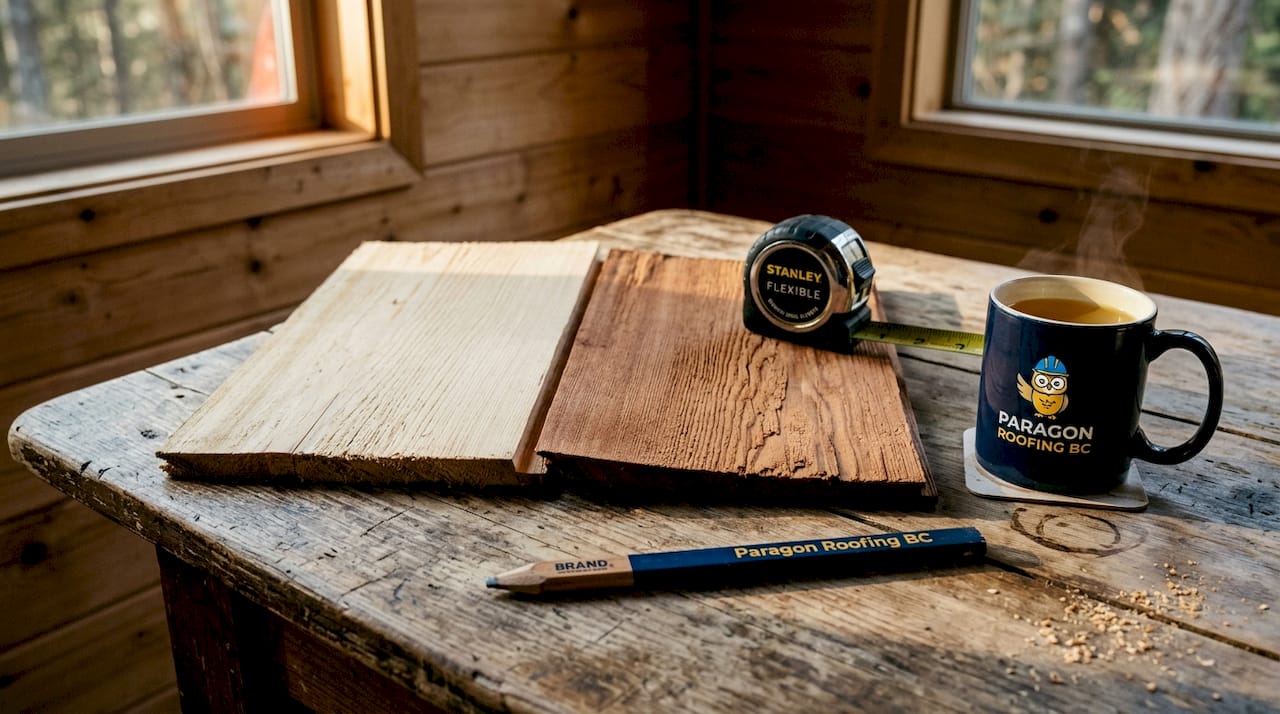
Alaskan yellow cedar is a genuinely strong performer. It is denser than Western red cedar, holds up well in both sunny and humid conditions, and has a slightly lighter, more uniform colour that some homeowners prefer aesthetically. It is stable, resistant to decay, and works well for roofing in BC’s coastal environment. The trade-off is availability and cost. Alaskan yellow cedar is less commonly stocked than Western red cedar, which can mean longer lead times and a higher price per square.
Eastern white cedar is the one that causes confusion. It looks similar, it’s often cheaper, and it carries the cedar name, so homeowners sometimes assume it will perform comparably. It won’t. Eastern white cedar breaks down faster than Western red cedar and is not recommended for roofing applications in moist climates like ours. It is better suited for siding or decorative features where it isn’t directly exposed to standing water and prolonged saturation.
Here’s a quick reference on these two alternatives:
- Alaskan yellow cedar: Strong choice for BC roofing, good decay resistance, lighter colour, higher cost, and limited local availability.
- Eastern white cedar: Better suited for siding, not roofing. Degrades faster in wet conditions and should be avoided on Lower Mainland roof installations.
- Cost factor: Western red cedar generally offers the best balance of performance and availability in BC, making it the most practical default.
If you’re considering Alaskan yellow cedar for a specific architectural reason or aesthetic preference, it’s a solid product. Just budget for the premium and plan your order timeline accordingly.
4. Cedar shingles vs. shakes: style differences and performance implications
This is the question we get most often from homeowners who are new to cedar roofing. Shingles and shakes are both cedar products, but they are manufactured differently, they look different, and they perform differently in ways that affect your maintenance routine and your roof’s longevity.
| Feature | Cedar shingles | Cedar shakes |
|---|---|---|
| Surface texture | Smooth, sawn on both sides | Rough, split face with natural texture |
| Thickness | Thinner, more uniform | Thicker, especially at the butt end |
| Appearance | Clean, formal, consistent | Rustic, textured, artisan character |
| Weather resistance | Good, slightly less wind uplift resistance | Very good, thickness adds durability |
| Maintenance | Regular treatment required | Similar, but texture traps debris more readily |
| Best suited for | Formal or traditional architecture | Heritage, rustic, or high-wind areas |
Cedar shingles are sawn smooth on both sides, giving them a clean, consistent appearance that suits formal or traditional residential architecture. Think Craftsman bungalows or colonial-style homes where a precise, tidy roofline complements the design. They lay flat and are easier to install uniformly.
Cedar shakes are split rather than sawn, which creates a rougher, more textured surface and a thicker profile at the butt end. That thickness adds real weather resistance and a degree of natural insulation. Shakes have a handcrafted, rustic character that suits West Coast contemporary homes, heritage properties, and cabins throughout the Sea-to-Sky and Gulf Island areas.
For property managers overseeing commercial or multi-family buildings, shingles often make more practical sense because their uniform installation is faster and their maintenance is somewhat simpler. For residential properties where aesthetics carry weight, shakes are often worth the extra care.
5. Synthetic cedar roofing options: emerging alternatives with durability benefits
Synthetic cedar shakes have moved well beyond the plastic-looking imitations of a decade ago. Today’s products are moulded from real cedar textures and engineered to perform in conditions where natural cedar struggles. If you manage a property in a fire-prone area of BC, or if you want the look of cedar without the maintenance commitment, synthetic deserves a serious look.
Here’s what makes modern synthetic cedar roofing genuinely competitive:
- Fire resistance. Synthetic cedar shakes are noncombustible, which is a meaningful advantage in areas where wildfire risk is a concern or where local building codes require fire-rated roofing materials.
- Hail and wind performance. Engineered construction handles impact and uplift forces better than thin natural shingles, which can split under hail strike or lift under sustained wind.
- Authentic appearance. Leading synthetic products are moulded from over 50 unique cedar textures, so the variation in grain pattern looks realistic rather than repetitive. From the street, a well-installed synthetic cedar roof is difficult to distinguish from the real thing.
- Warranty length. Fifty-year warranties are standard on quality synthetic products, compared to the 30-plus years you can expect from well-maintained natural cedar.
- Lower maintenance. No annual treatments, no re-staining, no mildew management. For a property manager with a portfolio of buildings, that represents genuine cost and time savings.
Pro Tip: If you’re choosing synthetic cedar, look for solid-body products rather than cavity-backed panels. Solid construction holds up better under hail and is less prone to cracking at cold temperatures, which matters in BC’s higher-elevation communities and inland valleys.
For more on synthetic roofing options suited to BC properties, Paragonroofingbc has detailed information covering materials available across the Lower Mainland.
6. Comparing cedar roofing options: performance, maintenance, and cost summary
Now that we’ve covered each type in detail, here’s a side-by-side view to help you match your property’s needs to the right product.
| Cedar type | Durability | Maintenance level | Appearance | Relative cost | Best BC application |
|---|---|---|---|---|---|
| Western red cedar (No. 1) | Excellent | Moderate | Warm, natural grain | Mid to high | Most residential and commercial roofing |
| Western red cedar (No. 2) | Moderate | Higher | Uneven patina | Lower | Budget projects, less-exposed areas |
| Alaskan yellow cedar | Excellent | Moderate | Lighter, uniform | High | Premium residential, coastal exposure |
| Eastern white cedar | Poor for roofing | High | Natural, attractive | Low to mid | Siding only, not recommended for roofing |
| Synthetic cedar shakes | Excellent | Low | Realistic cedar texture | Mid to high | Fire-prone areas, lower-maintenance builds |
The single most important column in that table is the last one. BC’s climate is the deciding factor. A low-cost option that requires high maintenance in a wet environment will cost more over a 20-year period than a premium product installed correctly from the start. The most frequent cause of premature cedar roof failure is specifying low-grade or mixed-grain cedar combined with poor ventilation. That’s a preventable problem with the right product selection and installation standards.
If you’d like to understand how long cedar roofs last under Lower Mainland conditions specifically, that breakdown is worth reading before you commit to a product.
My honest take after years of cedar roofing in BC
I’ve been installing and inspecting cedar roofs across Metro Vancouver and the Fraser Valley for a long time, and the pattern I see repeated is almost always the same. A homeowner goes with the lowest bid, the contractor uses No. 2 Red Label cedar with minimal treatment, skips the cedar breather membrane to save money, and within eight to ten years the roof looks terrible and starts failing at the seams.
The conversation I wish I could have with every homeowner before they sign a contract is simple. Spend the extra money on grade. Specify No. 1 Blue Label in writing. Insist on proper underlayment and ventilation. And decide early whether natural cedar or a quality synthetic product is the better fit for your maintenance budget and your fire risk profile. Those four decisions will shape your roof’s performance more than anything else.
I’ve also watched synthetic cedar go from a novelty to a genuinely smart choice for the right properties. A property manager overseeing several strata buildings doesn’t want to be scheduling cedar treatment programmes every few years across a whole portfolio. Synthetic cedar with a 50-year warranty and no re-treatment requirement makes sound financial sense in that context.
What I tell people who ask me which type is “best” is this: the best cedar roof is the one that matches your property’s exposure, your maintenance capacity, and your long-term budget. There is no single right answer, but there are definitely wrong ones, and most of them start with the wrong grade or the wrong species for our climate.
— Harman
Ready to choose the right cedar roof? Paragonroofingbc can help
Selecting between the different types of cedar roofing is a lot easier when you have someone with real BC experience looking at your specific property. Paragonroofingbc has been installing and maintaining cedar roofs across Vancouver, Burnaby, Delta, Maple Ridge, and the broader Lower Mainland for years, with a deep understanding of how our coastal climate affects every material decision.
Whether you’re considering Western red cedar shakes, premium shingles, or a synthetic cedar alternative, the team at Paragonroofingbc will assess your property, your budget, and your maintenance goals to recommend the right fit. Our cedar roof installation in Vancouver includes a thorough site assessment and honest product recommendations tailored to BC conditions. Reach out today to book a consultation or schedule an inspection. You’ll walk away with a clear plan and no surprises.
FAQ
What is the best type of cedar for roofing in BC?
Western red cedar, specifically No. 1 Blue Label grade, is the best choice for BC roofing because it is 100% heartwood with tight vertical grain, offering superior resistance to moisture, warping, and decay in coastal conditions.
How long does a cedar roof last in the Lower Mainland?
Cedar shingles and shakes typically last 30 or more years with proper maintenance, though lifespan varies based on grade, species, treatment, and ventilation quality beneath the roof.
Are synthetic cedar shakes worth considering for BC homes?
Yes. Modern synthetic cedar shakes offer noncombustible construction, 50-year warranties, and realistic cedar texture, making them a strong option for properties where fire resistance or reduced maintenance is a priority.
What is the difference between cedar shingles and cedar shakes?
Shingles are sawn smooth on both sides for a uniform, formal appearance, while shakes are hand-split for a rougher, thicker, and more rustic profile that adds durability and textural character.
Why does cedar roofing fail prematurely in wet climates?
The most common cause is using low-grade or mixed-grain cedar combined with poor ventilation. Without proper airflow beneath the roof, moisture builds up and accelerates decay, significantly shortening the roof’s lifespan.