
Common flat roof leak spots Burnaby homeowners should know
Common flat roof leak spots Burnaby homeowners should know

TL;DR:
- Flat roof leaks in Burnaby mainly occur at drains, flashings, seams, and penetrations due to heavy rainfall and freeze-thaw cycles. Early detection and maintenance of these weak points are essential to prevent costly repairs and shared liability in strata properties. Regular inspections and professional repairs help ensure roof longevity and prevent water damage.
Flat roofs in Burnaby leak from four primary locations: roof drains, flashings, membrane seams, and penetrations such as vents and skylights. These are not random weak points. They are the places where materials meet, where water collects, and where Burnaby’s heavy rainfall and freeze-thaw cycles do the most damage. Recognising these spots early is the difference between a quick repair and a full membrane replacement. For strata owners, the stakes are even higher. The B.C. Supreme Court ruled that flat roof membranes and flashings are common property, meaning all strata owners share repair costs whether their unit leaks or not.
1. Why roof drains are the top common flat roof leak spot in Burnaby
Blocked drains cause ponding water that stresses the membrane and accelerates deterioration. This is the single most frequent leak source Paragonroofingbc sees on Burnaby flat roofs. A drain clogged with leaves, moss, pine needles, or gravel cannot move water off the roof fast enough. Water sits, weight builds, and the membrane underneath starts to break down.
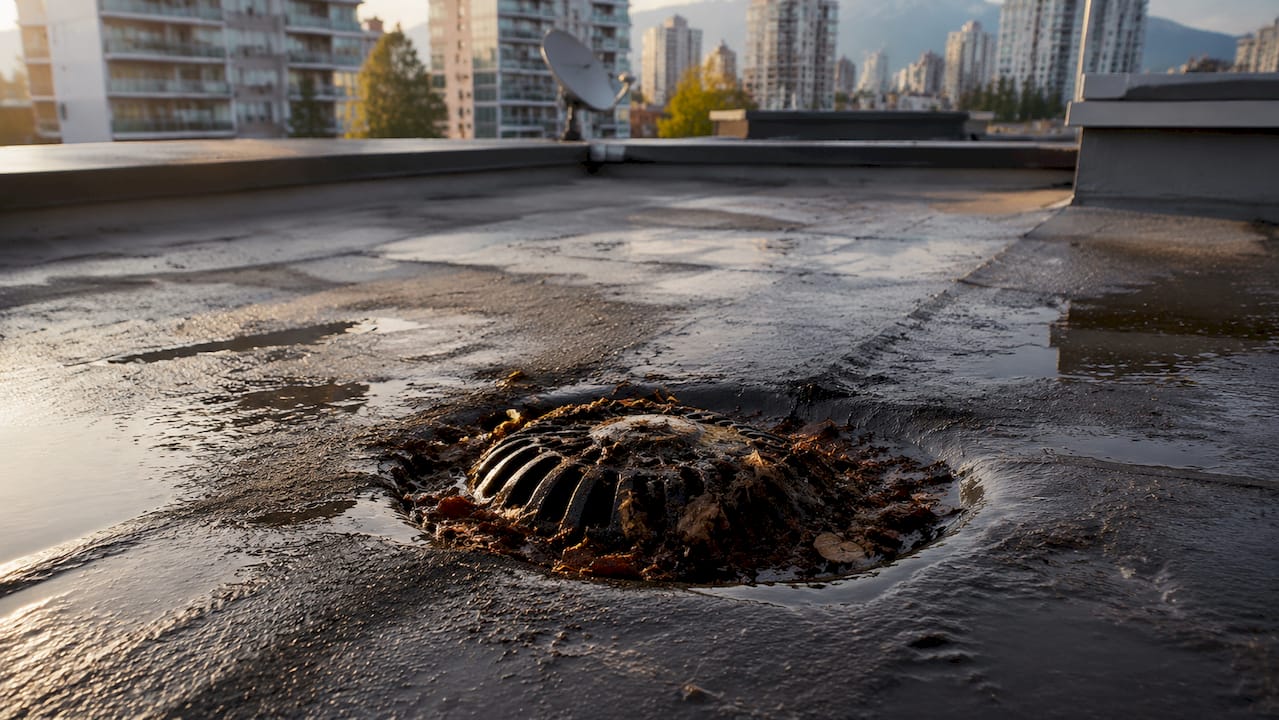
Burnaby’s wet seasons make this worse. From october through march, rainfall is nearly constant. A drain that works fine in summer can back up completely within days of the first autumn storm.
Signs your drain is causing problems:
- Water stains on interior ceilings directly below drain locations
- Visible moss or algae growing in a ring around the drain
- Dampness or soft spots in the roofing membrane near the drain collar
- Slow-draining water visible on the roof surface after rain stops
Pro Tip: Clean your flat roof drains at least twice a year: once in late september before the rains arrive, and again in february after the heaviest storms. If you have large trees nearby, check monthly.
Positive drainage design is a requirement under local building codes for low-slope roofs. A properly designed flat roof should shed water within 48 hours of rainfall. If yours holds water longer than that, the drainage system needs attention. Paragonroofingbc recommends a professional roof inspection if you notice consistent ponding water after every rain event.
2. How flashings at edges and transitions cause leaks
Flashings degrade from UV exposure, freeze-thaw cycles, and mechanical stress, making them a key factor in flat roof leakage across Burnaby. Flashings are the metal or membrane strips that seal the edges of your roof where it meets walls, parapets, curbs, and other vertical surfaces. Without them, water would pour straight into the building at every transition point.
The problem is that flashings move. Thermal expansion and contraction pull them away from the surfaces they seal. Freeze-thaw cycles crack the sealant that holds them in place. UV exposure makes the metal brittle and the membrane flashings stiff. Over time, gaps open up.
Common signs of flashing failure:
- Water stains on interior walls near the roofline, not just the ceiling
- Visible gaps or lifted edges along parapet walls
- Rust streaks running down exterior walls from metal flashing edges
- Bubbling or separation where the flashing meets the membrane
Pro Tip: Run your hand along the base of every parapet wall and roof edge after a heavy rain. If you feel moisture or see daylight through any gap, that flashing needs attention before the next storm.
Flashing repairs are not a DIY job on a flat roof. The connection between the flashing and the membrane must be watertight and properly bonded. A poor patch can trap moisture and make the problem worse. Paragonroofingbc handles flashing repairs as part of its Burnaby roof repair service, using materials matched to the existing membrane system.
3. What role membrane seams play in flat roof leaks
Seam adhesion fails as membranes age and the roof structure moves, which is a common deterioration pattern for both EPDM and torch-on systems in Burnaby. A flat roof membrane is not one continuous sheet. It is assembled from sections that are bonded together at seams. Those seams are only as strong as the adhesive or heat weld holding them. When that bond weakens, water finds its way underneath.
EPDM membranes use adhesive tape or bonded seams that can lift over time. Torch-on modified bitumen membranes rely on heat-welded laps that can separate if the original installation was rushed or if the roof moves significantly. Both systems are common in Burnaby residential and strata buildings.
| Seam type | Common failure mode | Repair method |
|---|---|---|
| EPDM adhesive seam | Tape lifts, edges curl | Seam tape reapplication or liquid seam sealer |
| Torch-on lap seam | Heat weld separates, blistering | Re-torch and press, or cut and patch |
| TPO heat-welded seam | Weld cracks under UV stress | Hot-air weld repair by trained technician |
Signs of seam failure include blistering or bubbling along a straight line across the roof surface. That line is almost always a seam underneath. You may also see water tracking along the seam line into the building, appearing as a stain that runs in a straight pattern rather than spreading from a single point.
Catching seam failures early matters. A small lifted seam costs far less to fix than a seam that has allowed water to saturate the insulation layer below the membrane.
4. Why roof penetrations like vents and skylights leak
Penetrations need careful inspection because failures create concentrated leak points that can be difficult to trace back to their source. Every pipe, vent, skylight, and HVAC connection that passes through a flat roof is a potential leak point. The membrane has to be cut to accommodate each penetration, and that cut edge must be sealed and flashed perfectly.
Common penetrations on Burnaby flat roofs include:
- Plumbing vent stacks
- Kitchen and bathroom exhaust vents
- Skylights and sun tunnels
- HVAC curbs and equipment bases
- Electrical conduit penetrations
Sealant around penetrations breaks down faster than the membrane itself. UV exposure, temperature swings, and the slight movement of the penetration itself all work against the seal. Once the sealant cracks or pulls away, water enters at that exact point and can travel a significant distance before appearing as a stain inside.
Skylights deserve special attention. The curb flashing around a skylight is one of the most complex details on a flat roof. If the flashing was not installed correctly, or if the skylight frame has shifted, water will find its way in. Paragonroofingbc recommends inspecting all penetration flashings and sealants every spring and after any major windstorm.
5. Other structural and environmental factors behind Burnaby flat roof leaks
Burnaby’s climate accelerates membrane aging through heavy rainfall and freeze-thaw cycles, creating leak risks that go beyond specific weak points. Even a roof with intact drains, flashings, seams, and penetrations can develop leaks if broader environmental factors are ignored.
Key factors that contribute to flat roof leaks over time:
- Ponding water: Water that sits on the membrane for more than 48 hours after rain accelerates UV degradation and encourages moss and algae growth. Ponding water degrades roof integrity steadily, even when the membrane looks intact from above.
- Moss and debris: Organic material traps moisture against the membrane surface. That constant dampness softens the membrane and creates conditions for biological growth that physically lifts and separates the surface layer.
- Freeze-thaw cycles: Water that enters a small crack or seam freezes overnight and expands. That expansion forces the crack wider. By spring, what was a hairline gap is now a visible split.
- UV exposure: Burnaby gets enough summer sun to harden and crack membrane surfaces over time, particularly on south-facing roof sections.
Routine roof maintenance in Burnaby addresses all of these factors together. Clearing debris, treating moss, and checking for standing water after storms are the simplest and most cost-effective things a homeowner can do.
Key takeaways
Flat roof leaks in Burnaby originate most often from drains, flashings, membrane seams, and penetrations, and local climate conditions accelerate damage at every one of these points.
| Point | Details |
|---|---|
| Drains are the top leak source | Blocked drains cause ponding water that breaks down the membrane faster than any other factor. |
| Flashings fail at transitions | UV damage and freeze-thaw cycles pull flashings away from walls and edges, opening gaps for water entry. |
| Seams weaken with age | EPDM and torch-on seam adhesion fails over time, showing up as blistering or straight-line water stains inside. |
| Penetrations need sealant checks | Sealant around vents, skylights, and HVAC curbs breaks down faster than the membrane and needs annual inspection. |
| Climate compounds every problem | Burnaby’s rainfall and freeze-thaw cycles accelerate damage at all four leak points simultaneously. |
What I’ve learned inspecting flat roofs across Burnaby
Hey, it’s Harman here. After years of walking flat roofs across Burnaby, the thing that surprises homeowners most is how rarely leaks appear directly above where the water is getting in. Water travels. It enters at a seam near the parapet, runs along the insulation layer, and shows up as a stain three metres away in the middle of the ceiling. That gap between entry point and visible damage is why so many homeowners patch the wrong spot and wonder why the leak comes back.
The other thing I see constantly is deferred maintenance. A blocked drain or a lifted flashing edge is a five-minute fix when you catch it early. Left alone through a Burnaby winter, that same problem becomes a saturated insulation layer and a membrane replacement. The cost difference is significant.
Strata owners in particular need to pay attention. The B.C. Supreme Court confirmed strata repair obligations for shared flat roof membranes and flashings. If your strata corporation is delaying roof maintenance, every owner is exposed to that liability. Push for scheduled inspections. Get the roof assessed before a leak forces the issue.
My honest recommendation: get a professional up on your flat roof every spring and every fall. Not because something is wrong, but because catching something small before it becomes something expensive is always the right call.
— Harman
Flat roof leak repairs in Burnaby: how Paragonroofingbc can help
Paragonroofingbc works with Burnaby homeowners and strata councils on flat roof leak detection, repair, and full membrane replacement. The team inspects all four primary leak zones: drains, flashings, seams, and penetrations, and provides a clear assessment of what needs attention now versus what can wait.

Whether you have a single-family home with a low-slope roof or a strata building with a shared flat roof system, Paragonroofingbc has the local experience to diagnose the problem correctly the first time. The team offers residential roofing services across Burnaby, including emergency leak response when water is actively entering your home. If your flat roof needs a full assessment or you have already spotted one of the warning signs covered here, reach out to Paragonroofingbc to book an inspection.
FAQ
What are the most common flat roof leak spots in Burnaby?
The most common leak spots are roof drains, flashings at edges and parapet walls, membrane seams, and penetrations like vents and skylights. Each of these areas is vulnerable to Burnaby’s heavy rainfall and freeze-thaw cycles.
How often should I inspect my flat roof in Burnaby?
Scheduled inspections twice a year are recommended: once in spring and once in autumn before the rainy season. Homeowners should also check after major windstorms or extended heavy rain.
What causes ponding water on a Burnaby flat roof?
Ponding water results from blocked drains, inadequate roof slope, or structural deflection that creates low spots. Water sitting on the membrane for more than 48 hours accelerates deterioration and encourages moss growth.
Who is responsible for flat roof repairs in a Burnaby strata?
The B.C. Supreme Court confirmed that flat roof membranes and flashings are common property in strata complexes. All strata owners share the cost of repairs, regardless of whether their individual unit is directly affected by the leak.
Can I fix a flat roof seam leak myself?
Temporary patches are possible, but a lasting repair requires proper surface preparation and materials matched to the existing membrane type. An improperly patched EPDM or torch-on seam can trap moisture and cause further damage beneath the membrane.
Recommended
Our Roofing Blog



Have more questions about roofing?
Check out our FAQs or give us a call today to speak to an expert roofer in Vancouver Lower Mainland, BC. We're here to help our neighbours make educated decisions about their roof. For our team, we value helping clients save money while making their roofs last.