
Why Surrey new builds have roofing defects: what owners need to know
Why Surrey new builds have roofing defects: what owners need to know

TL;DR:
- Roofing defects in Surrey new builds often result from rushed workmanship, inadequate inspections, and poor ventilation. Addressing these early through inspections and proper maintenance can prevent costly damages and extend roof lifespan. Regular checks during and after construction help homeowners protect their investment and ensure warranty coverage.
Roofing defects in Surrey new builds are defined as installation failures in flashing, ventilation, underlayment, or drainage that cause moisture ingress, structural decay, or energy loss shortly after occupancy. These are not random bad luck. They stem from workmanship shortcuts, generic ventilation strategies, and missed inspections during construction. New home warranty data shows 18% of all new home warranty claims within the first two years relate to roof issues. That figure tells you the roof is the single most vulnerable system in a new build. If you own or manage a Surrey property built in the last five years, understanding why surrey new builds have roofing defects is the first step toward protecting your investment.
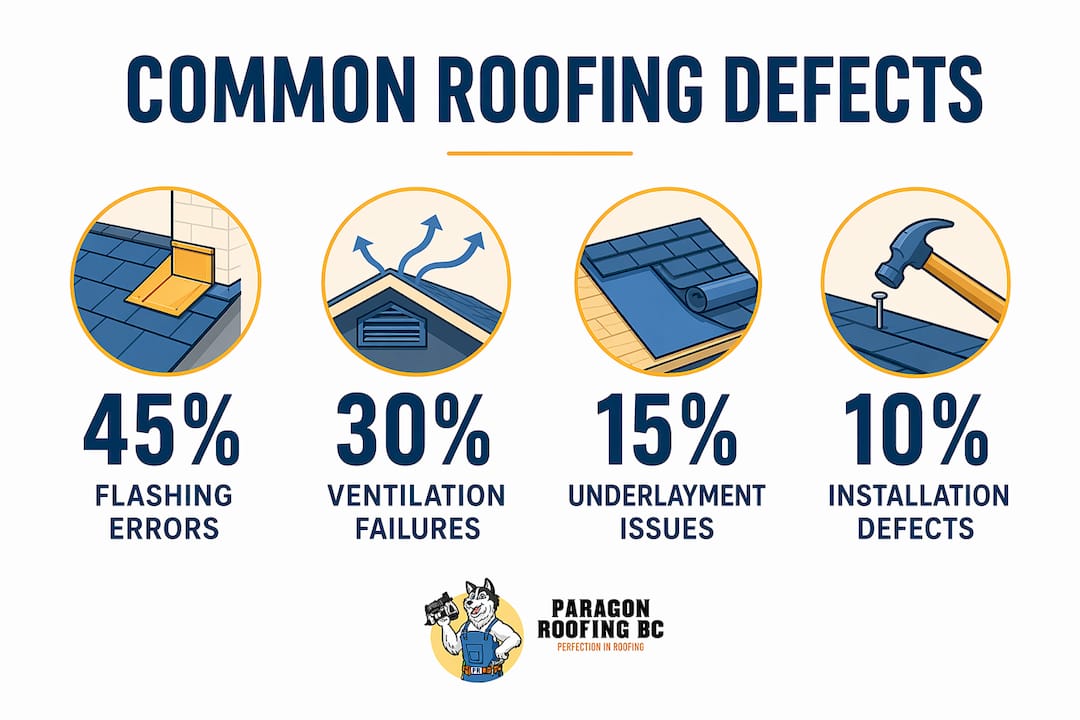
What are the most common roofing defects in Surrey new builds?
Defects in new construction roofs follow a predictable pattern. The same failures show up on job sites across Surrey, and most of them were avoidable.
- Flashing failures around penetrations. Vents, chimneys, and skylights require precise flashing integration with the underlayment. When that integration is rushed, water finds the gap. Flashing errors around vents often only surface 12–24 months after occupancy, which is right when many warranty periods are expiring.
- Inadequate ventilation. Ventilation is often treated as secondary during construction, causing trapped moisture, timber rot, and insulation degradation long before you see any visible symptoms. Surrey’s wet winters make this worse.
- Improper underlayment sequencing. Underlayment is the waterproof membrane under your shingles or tiles. When it is lapped in the wrong direction or fastened incorrectly, water tracks under the surface layer and pools on the deck.
- Drip edge flashing errors. Sheet metal drip edges do not settle flat over time. Any buckling or uneven overlap installed during construction is a permanent defect that worsens with every rain cycle.
- Gutter and downpipe problems. Poorly pitched gutters and undersized downpipes back water up against the fascia. Over a Surrey winter, that standing water causes rot and pushes moisture under the eave.
Pro Tip: Book a roof inspection for new builds within the first 12 months of occupancy. Most defects are still covered under warranty at that point, but they will not be at month 25.
The average new build contains over 140 defects across all systems. Roofing defects rank among the most critical because moisture ingress triggers cascading damage to insulation, timber, and interior finishes.

Why do roofing problems occur so often in Surrey new builds?
The root causes of Surrey build quality problems are structural, not accidental. They are baked into how new construction projects are managed.
-
Tight construction schedules. Developers work to completion deadlines that leave little room for thorough quality checks. Workmanship shortcuts during rushed final stages are the leading cause of missed flashing and sealing details on new roofs.
-
Multiple trades working simultaneously. Framers, plumbers, HVAC installers, and roofers often work on the same structure at the same time. Each trade creates penetrations through the roof deck. When no single contractor owns the final waterproofing of those penetrations, gaps get left behind.
-
Generic ventilation design. Developers apply one ventilation formula across entire subdivisions without accounting for roof pitch, attic volume, or local climate. Surrey’s coastal moisture and freeze-thaw cycles demand a ventilation calculation specific to each home. A generic approach leaves attics under-ventilated and prone to condensation.
-
No inspection during the drying-in phase. The drying-in phase is the window after the roof deck is sheathed but before interior finishes go in. Inspecting during this phase catches flashing overlaps, fastener problems, and membrane integration errors before they are buried under drywall and insulation. Most Surrey new builds skip this step entirely.
-
Materials not suited to local conditions. Coastal Surrey sees sustained rain from october through march, combined with periodic freeze-thaw events. Some builders use materials rated for drier climates or install them without the additional sealing that Lower Mainland conditions require.
Pro Tip: If you are buying a new build, ask the developer directly whether a third-party roof inspection was completed during the drying-in phase. If the answer is no or unclear, arrange your own inspection before closing.
How do roofing defects affect Surrey homeowners and property managers?
The consequences of roofing problems in new builds go well beyond a dripping ceiling. They compound quickly and quietly.
- Moisture damage to structure. Water that enters through a flashing gap or failed underlayment saturates roof decking, rafters, and wall framing. Timber rot and mould growth follow within months in Surrey’s climate. Roof defects cause leaks, mould, and insulation damage that compromise both safety and resale value.
- Repair costs that exceed expectations. Surrey roof leak diagnostics and repairs typically cost $700–$1,300 per incident. A single missed flashing detail can generate multiple leak events before the source is properly identified and fixed.
- Warranty gaps. Flashing errors and ventilation deficiencies often do not produce visible symptoms until 12–24 months after move-in. By the time water stains appear on your ceiling, the two-year workmanship warranty may have expired. That shifts the full repair cost to you.
- Declining resale value. A recorded history of roofing issues on a property disclosure statement reduces buyer confidence and negotiating power. Property managers overseeing strata buildings face the same problem at a larger scale.
- Ongoing maintenance burden. Defective roofs require more frequent attention. What should be a routine annual check becomes an emergency call every autumn.
The pattern Paragonroofingbc sees repeatedly in Surrey is this: a homeowner notices a small stain, patches it, and the stain returns. Repeated small repairs are almost always a symptom of a larger systemic defect, not isolated incidents.
What maintenance practices best protect Surrey new build roofs?
Prevention is far cheaper than remediation. A structured maintenance programme starting in year one catches defects while they are still minor and often still under warranty.
-
Inspect during and after the drying-in phase. If you are still in the purchase process, push for a third-party inspection before interior finishes go in. This is the single highest-value inspection you can arrange on a new build.
-
Clean gutters twice a year. Surrey’s tree canopy drops significant debris from september through december. Blocked gutters back water against the fascia and eave, accelerating rot and pushing moisture under the drip edge.
-
Check ventilation vents annually. Soffit vents and ridge vents can be blocked by insulation, bird nests, or debris. A blocked vent turns your attic into a moisture trap. Check that each vent is clear and that the net free area matches the attic square footage.
-
Inspect flashing around every penetration. Skylights, plumbing stacks, and exhaust vents each require a separate flashing inspection. Look for lifted edges, cracked sealant, or rust staining. Any gap wider than a credit card needs professional attention before the next rain season.
-
Start a scheduled maintenance programme. Roof maintenance programmes in Surrey start around $250 annually. That cost covers moss treatment, debris clearing, and a visual inspection that catches small problems before they become expensive ones.
Pro Tip: Follow a seasonal maintenance checklist tailored to Surrey’s climate. The most critical windows are late september before the rains arrive and late march after the freeze-thaw season ends.
The table below shows how inspection timing affects defect outcomes on Surrey new builds.
| Inspection timing | Defects typically found | Likely warranty coverage | Estimated repair cost |
|---|---|---|---|
| During drying-in phase | Flashing overlaps, fastener errors, membrane gaps | Yes, builder liable | Minimal or nil |
| Months 6–12 post-occupancy | Ventilation gaps, early moisture staining | Usually yes | Low to moderate |
| Months 13–24 post-occupancy | Active leaks, mould, timber staining | Partial or expired | $700–$1,300 per incident |
| After year 2 | Structural rot, insulation damage, deck failure | Expired | High, often $2,000+ |
What I have learned from inspecting Surrey new build roofs
Hey, it’s Harman here. After years of inspecting and repairing roofs across Surrey, the pattern that frustrates me most is not the defects themselves. It is how predictable they are.
The drying-in phase inspection is the one that almost never happens on Surrey new builds. Developers move fast, trades move through, and by the time the homeowner gets the keys, every flashing error is buried under insulation and drywall. I have pulled back insulation on roofs that were less than 18 months old and found decking that was already soft from moisture. The homeowner had no idea.
Ventilation is the other one that gets me. Builders apply the same ventilation formula to every house in a subdivision regardless of roof geometry or attic volume. Surrey’s climate does not forgive that kind of shortcut. An under-ventilated attic in this region will show timber staining within two winters. By year three, you are looking at a mould remediation bill on top of a roofing repair.
The uncomfortable truth is that “new” does not mean “correct.” A new roof installed poorly is more dangerous than an older roof maintained well, because the new one gives you false confidence. You stop looking for problems because you assume there are none.
My advice to every Surrey homeowner and property manager is this: treat the first two years of a new build roof as a probationary period. Inspect it, document what you find, and push warranty claims while you still can. The cost of a professional inspection is a fraction of what you will spend if you wait for the roof to tell you something is wrong.
— Harman
Paragonroofingbc’s Surrey new build roofing services
If you own or manage a Surrey new build and want to know exactly what condition your roof is in, Paragonroofingbc offers inspections built specifically for new construction. We look at flashing integration, ventilation adequacy, underlayment sequencing, and drip edge installation — the exact failure points that cause roofing problems in new builds.

Our Surrey roofing services cover inspections, maintenance programmes, and targeted repairs for flashing, gutters, and ventilation. We provide detailed written reports that support warranty claims and give property managers a clear record for future maintenance planning. Surrey homeowners and strata councils trust Paragonroofingbc for honest assessments and repairs done right the first time.
Key takeaways
Roofing defects in Surrey new builds stem from rushed workmanship, inadequate ventilation, and missed inspections during the drying-in phase, and they cost significantly more to fix after warranty coverage expires.
| Point | Details |
|---|---|
| Workmanship is the primary cause | Tight construction schedules lead to missed flashing and sealing on most Surrey new builds. |
| Ventilation failures are hidden | Generic ventilation designs cause moisture build-up that shows up years before visible symptoms appear. |
| Inspect during drying-in phase | This is the only window to catch flashing and fastener defects before interior finishes conceal them. |
| Warranty gaps are real | Flashing errors surface 12–24 months after occupancy, often after the two-year warranty has expired. |
| Annual maintenance pays off | Scheduled maintenance from around $250 per year prevents moss, debris, and minor defects from escalating. |
FAQ
What causes most roofing defects in Surrey new builds?
Rushed construction schedules and multiple trades working simultaneously are the leading causes. Missed flashing details and generic ventilation designs account for the majority of defects found in Surrey new construction roofs.
When do new build roofing defects typically appear?
Flashing errors and ventilation failures often surface 12–24 months after occupancy. That timing frequently coincides with the expiry of the builder’s two-year workmanship warranty, leaving homeowners responsible for repair costs.
How much does it cost to repair a roofing defect in Surrey?
Surrey roof leak diagnostics and repairs typically cost $700–$1,300 per incident. Defects caught early under warranty cost the homeowner nothing. Defects found after year two can exceed $2,000 once structural damage is included.
Can I claim roofing defects under my new home warranty?
Yes, if the defect is identified within the warranty period. Most builder warranties cover workmanship for two years. Document defects with photos and a professional inspection report as soon as you notice them.
How do I prevent roofing defects on a Surrey new build?
Arrange a third-party inspection during the drying-in phase if possible, and book a professional inspection within the first 12 months of occupancy. Follow a seasonal maintenance programme and clean gutters twice yearly to catch problems before they escalate.
Recommended
Our Roofing Blog


Have more questions about roofing?
Check out our FAQs or give us a call today to speak to an expert roofer in Vancouver Lower Mainland, BC. We're here to help our neighbours make educated decisions about their roof. For our team, we value helping clients save money while making their roofs last.