
Delta BC aging asphalt shingle warning signs: top 10
Delta BC aging asphalt shingle warning signs: top 10
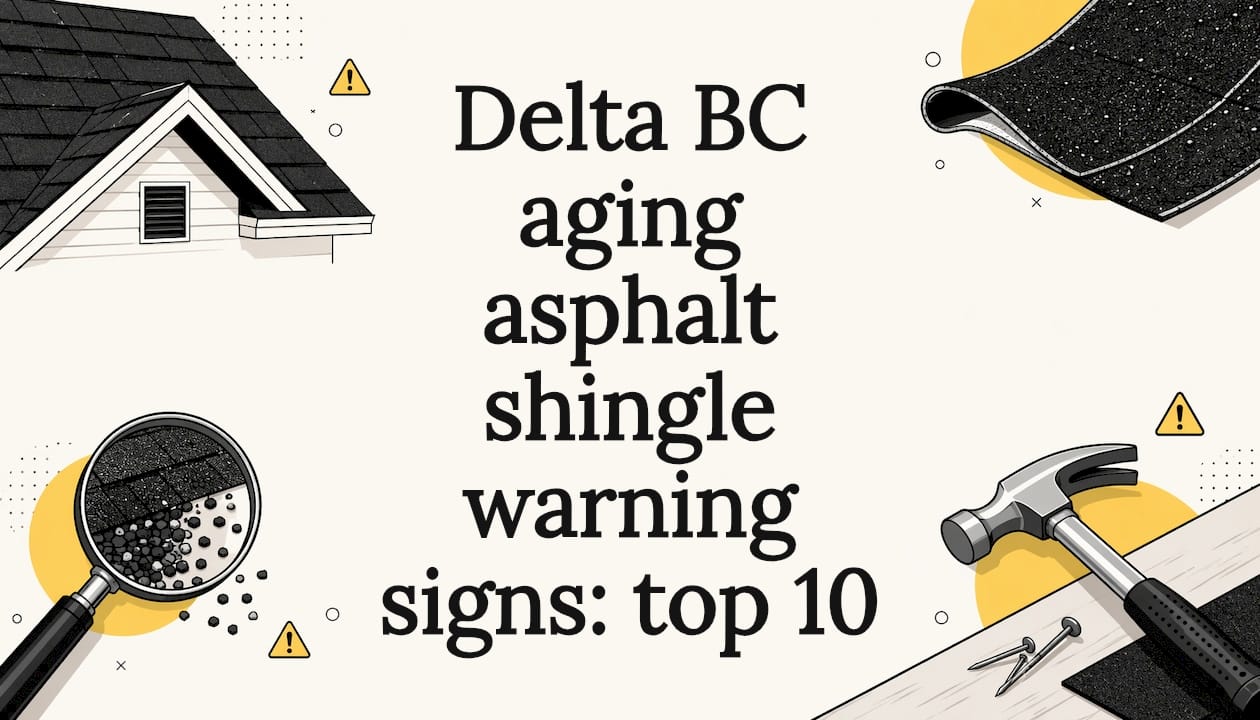
If you live in Delta, BC, these 10 visible signs mean your asphalt shingle roof is aging and needs inspection or urgent action: granule loss in gutters, curling or cupping edges, cracked or brittle shingles, missing or lifted tabs, moss and algae growth, faded or discoloured fields, loose or rusted flashing, interior water stains or attic daylight, sagging deck sections, and a history of repeated patch repairs. Spot three or more of these at once and it’s time to call a roofer, not wait for the next storm.
Quick checklist — 10 aging shingle warning signs:
- Granules collecting in eavestroughs or at downspout outlets
- Curling, cupping, or clawing shingle edges
- Cracked, brittle, or blistering shingles
- Missing or lifted shingle tabs
- Moss, algae, or persistent dark streaks across shaded slopes
- Faded, discoloured, or bald patches on any slope
- Rusted, split, or loose flashing at chimneys, skylights, or vents
- Water stains on attic rafters, insulation, or interior ceilings
- Daylight visible through roof sheathing from the attic
- Sagging or soft spots on the roof deck
When to call a roofer immediately: active leak, sagging deck, more than three warning signs present, or extensive granule loss across multiple slopes.
First documentation step: take date-stamped photos of your gutters, attic, and the most exposed slope before calling anyone. A clear photo set from gutters and attic dramatically speeds up a contractor’s diagnostic and reduces the need for repeat visits.

Table of Contents
- Delta BC aging asphalt shingle warning signs you can spot from the ground
- Flashing, vents, and roof penetrations that fail before the shingles do
- Gutter sediment, attic clues, and interior signs you might overlook
- How roof age and shingle type affect your remaining life in Delta
- Repair or replace? A clear decision guide for Delta homeowners
- Delta BC causes, prevention, and Paragon Roofing BC’s inspection checklist
- How to safely inspect and document your roof without getting hurt
- Key takeaways
- What Delta roofs actually look like after 15 years: a local roofer’s view
- Paragonroofingbc’s Delta inspection and repair services
- Further reading and Paragon resources for Delta homeowners
- FAQ
Delta BC aging asphalt shingle warning signs you can spot from the ground
You do not need to climb on your roof to catch most of these problems early. A slow walk around the perimeter, a look into your eavestroughs, and a glance up from the ladder base will reveal the majority of asphalt shingle deterioration signs before they turn into emergency calls.
Granules in eavestroughs are the single most reliable early indicator. Shingle granules act like heavy-duty sunscreen for the asphalt underneath. Once they wash away, raw asphalt is exposed to UV rays, which causes it to dry out and crack far faster than it should. After a heavy rain, scoop a handful of sediment from your eavestrough. If it looks like coarse black sand, your shingles are shedding.
Curling, cupping, and clawing edges are what happens when years of heat and moisture work on the asphalt mat. Cupping means the edges turn upward; clawing means the middle buckles while edges stay flat. Either way, those shingles are extremely vulnerable to being lifted by the wind-driven rain that rolls through Delta off the Strait of Georgia.
Blistering and cracking point to trapped moisture or inadequate attic ventilation. When heat builds up in a poorly vented attic, it cooks the shingles from below, forming bubbles that eventually rupture. In Delta’s damp coastal climate, that moisture has plenty of opportunity to get in.
Missing or lifted tabs after a windstorm might mean a single repair. Widespread missing tabs across a slope mean the adhesive strip has failed system-wide, and the shingles are past their useful life.
Faded or bald patches are spots where granules have completely worn away. From the ground they look darker or inconsistently coloured compared to the surrounding field. Binoculars help you spot them without leaving the driveway.
Photo guidance: photograph granule sediment in the eavestrough with a close-up shot, take a wide-angle photo of each slope, and capture a detail shot of any curled or lifted edge. Label each file with the date and compass direction of the slope.
Pro Tip: Don’t climb onto a wet or mossy roof to check granules. Instead, pull a small sample of eavestrough sediment into a white container after the next rain. The volume and colour of the granules tell you more than a visual scan from above, and you stay safely on the ground.
Flashing, vents, and roof penetrations that fail before the shingles do
Flashing failures and deteriorating seals are responsible for a large share of interior leaks, even on roofs where the shingles themselves still look passable. This is especially true in Delta, where coastal moisture and wind-driven rain push water sideways into every gap they can find.
Here is what to look for at each penetration:
- Chimney flashings: rusted base flashing, missing or open cap flashing, and step flashing that has pulled away from the brick or siding
- Skylight flashings: cracked or dried-out sealant at the frame corners, lifted apron flashing at the lower edge
- Plumbing stack seals: cracked rubber roof jack boots around vent pipes, which harden and split after 10–15 years of UV exposure
- Roof-to-wall transitions: open step flashing at dormers or additions, where the metal has corroded or the sealant has failed
- Valleys: granule loss concentrated in the valley line, or exposed underlayment where water volume is highest
Salt-laden air from the Fraser River delta and the Strait of Georgia accelerates corrosion on galvanised and aluminium flashings faster than you would see on an inland Metro Vancouver property. A flashing that might last 25 years in Coquitlam can show rust and separation in 12–15 years in Tsawwassen or Ladner. Inspect these details every autumn before the heavy rain season begins.
Gutter sediment, attic clues, and interior signs you might overlook
Gutter sediment, attic stains, and soft decking are often the first confirmatory signs of failure, the ones that tell you the exterior symptoms you spotted are already causing damage inside the building envelope.
Eavestrough checklist:
- Persistent granule build-up after every rain, not just after a single storm
- Black or dark grey sandy sediment at downspout outlets
- Uneven granule distribution across downspouts (heavy loss from one slope signals a problem area)
- Organic debris mixed with granules, which traps moisture against the fascia
Attic checklist:
- Daylight visible through the sheathing boards — a direct sign of missing or failed shingles
- Water stains or dark streaks on rafters, ridge board, or insulation batts
- Mould or mildew smell, especially near the eaves
- Soft, spongy, or discoloured sheathing that flexes underfoot (if a contractor walks the attic)
- Rust streaks below vent penetrations, indicating condensation or active water entry
Documentation tip: bring a phone with flash into the attic on a dry day. Flash photography picks up damp spots and staining that look invisible in ambient light. Date-stamp every photo and note which rafter bay or slope it corresponds to. This kind of organised evidence cuts a contractor’s diagnostic time significantly and gives you a clear record if an insurance claim becomes necessary.
How roof age and shingle type affect your remaining life in Delta
The honest answer on lifespan: Most asphalt shingles last between 15 and 25 years in practice, with Delta’s coastal climate often pushing roofs toward the lower end of that range. Builder-grade three-tab shingles typically last 15–18 years under good conditions, and signs of aging may appear by year 12–13 on exposed Delta roofs. Architectural (laminated) shingles usually perform for 22–25 years with quality installation and ventilation; poor ventilation can reduce that by several years. Premium shingles can approach 30 years with ideal install and regular maintenance, but flashings and seals often require attention first. On a 14-year-old south-facing builder-grade roof in Tsawwassen showing granule loss and curled tabs, an inspection is due now. A 22-year-old architectural roof in Ladner with widespread curling and granule loss is beyond the repair-and-wait stage; plan for replacement soon.
Previous repairs and existing layers matter too. If your roof already has two layers of shingles, a third is not permitted under BC building code, and the added weight and hidden deck condition make a full tear-off the only responsible path. A single previous repair on an otherwise sound roof is not a red flag on its own, but repeated patching of the same area signals a systemic problem.
Repair or replace? A clear decision guide for Delta homeowners
The single most practical signal is the pattern of damage: localized versus widespread. A few curled shingles on one corner after a windstorm is a repair. Curling, blistering, and granule loss across multiple slopes is a replacement conversation.
| Criteria | Repair | Replace |
|---|---|---|
| Extent of damage | Localized, one area or slope | Widespread across two or more slopes |
| Percentage of slope affected | Less than 20–25% | More than 25–30% |
| Roof age | Under 15 years (three-tab) or under 20 years (architectural) | Over 15 years (three-tab) or over 22 years (architectural) |
| Previous shingle layers | Single layer, deck in good condition | Two layers present, or deck shows rot or soft spots |
| Attic and deck condition | Dry, no staining, sheathing firm | Staining, mould, soft or delaminated sheathing |
| Insurance and insurability | No insurer concerns raised | Insurer flagging age at renewal or requiring inspection |
Action timeline: if the damage is localized and the roof is under 15 years old, schedule an inspection and repair within 30–60 days. If the roof is 15–20 years old with moderate widespread wear, a temporary patch buys time but plan a full replacement within 3–12 months. A roof over 20 years with multiple warning signs needs replacement planning now, with a 3–24 month horizon depending on how many signs are active and whether there is an active leak.
One note on insurance: many insurers in BC start asking questions about roofs over 15–20 years old at renewal time. An aging roof can trigger higher premiums, reduced coverage, or a requirement to replace before they will renew. Getting ahead of that conversation with a documented inspection report is worth the effort.
Delta BC causes, prevention, and Paragon Roofing BC’s inspection checklist
Delta’s climate creates a specific combination of stressors that accelerates shingle wear faster than most homeowners expect. Salt-laden air from the coast corrodes flashings and speeds granule depletion on exposed slopes. Wind-driven rain pushes water sideways into valleys, step flashings, and any gap in the roof-to-wall transition. Shaded north-facing slopes and valley lines stay damp long enough to grow moss, which traps moisture and slowly lifts shingle edges. Freeze-thaw cycles, while milder here than in the interior, still stress the asphalt mat through winter.
Seasonal maintenance checklist for Delta homeowners:
- Autumn (September/October): clear eavestroughs and downspouts before the heavy rain season; inspect gutters for granule build-up; trim branches overhanging the roof
- Spring (March/April): check for winter damage, moss growth in valleys and shaded slopes, and any lifted or missing tabs after windstorms
- Biannually: check attic ventilation (soffit and ridge vents clear of insulation or debris), look for condensation staining on rafters
- After major wind events: walk the perimeter and check for lifted tabs, displaced ridge caps, and debris accumulation in valleys
For moss control, a zinc or copper strip along the ridge line is a low-maintenance option that leaches a mild biocide down the slope with every rain. Do not pressure-wash shingles to remove moss; the force strips granules faster than the moss itself would. A soft-bristle brush or a diluted moss-treatment solution applied by hand is the right approach.
Photo guidance for contractor handoff: label each photo file with the date, the compass direction of the slope, and a short description (e.g., “2026-04-15 south slope granule loss” or “2026-04-15 chimney flashing rust”). Group attic photos in a separate folder. This organised set is exactly what Paragonroofingbc’s inspection team uses as a starting point when assessing remaining life and scoping repairs.
Paragonroofingbc conducts Delta inspections that include a photographic report, a remaining-life estimate, and a written repair-or-replace recommendation. That report gives you something concrete to work with, whether you are planning a budget, talking to your insurer, or deciding whether to act now or in the next season.
Pro Tip: Check your BC roof maintenance checklist every spring and autumn. Catching a loose flashing or a blocked downspout in October costs almost nothing. Finding the same problem in January, after three weeks of rain have soaked the decking, costs considerably more.
How to safely inspect and document your roof without getting hurt
Never climb onto a wet, icy, or moss-covered roof. That is the rule, full stop. The vast majority of what you need to document can be captured from the ground, a stable ladder at the eave line, or a drone.
Safe step-by-step inspection process:
- Ground-level walk: start at the perimeter with binoculars. Photograph each slope from the driveway or yard, noting any visible curling, missing tabs, dark patches, or ridge cap displacement.
- Eavestrough check: use a stable ladder at the eave, with a second person holding the base. Scoop sediment from the eavestrough into a light-coloured container and photograph it. Check the fascia for rot or water staining.
- Attic inspection: enter the attic on a dry day with a flashlight and a phone camera. Look for daylight, staining, mould, and soft sheathing. Photograph everything with flash and date-stamp the files.
- Ladder safety: always use a ladder rated for your weight, set at the correct angle, and secured at the top if possible. Never lean sideways off the ladder to reach further. Wear non-slip footwear.
- Buddy system: never inspect alone. Have someone present who can call for help if needed.
- Drone option: a consumer drone with a camera gives you a safe, close-up view of ridges, valleys, and flashings without any roof contact. Many homeowners find this the most practical option for a detailed exterior check.
Emergency actions for an active leak:
- Place buckets and lay down plastic sheeting to protect flooring and contents
- Use a tarp secured over the affected area from the outside only if it is safe to do so from the ground or a low eave; never climb in wet or windy conditions
- Call Paragonroofingbc’s leak detection and repair line for emergency response
- Shut off electrical circuits in any area where water is dripping near fixtures
Photo documentation checklist for your contractor estimate: wide shot of each slope, close-up of any damaged area, eavestrough sediment, attic staining, and any interior ceiling damage. Include a photo of your home’s address or a street sign so the contractor can confirm the property.
Key takeaways
Delta BC homeowners with three or more aging shingle warning signs, especially granule loss, widespread curling, or interior staining, should schedule a professional inspection within 30 days rather than waiting for an active leak.
| Point | Details |
|---|---|
| Document before you call | Date-stamped photos of gutters, attic, and each slope speed up any contractor’s diagnostic. |
| Three or more signs means act now | Granule loss, curling, and interior staining together indicate the roof is past the repair-only stage. |
| Lifespan is 15–25 years in practice | Delta’s coastal climate typically means a real lifespan closer to the lower end, with builder-grade three-tab shingles often showing problems as early as year 12–15. |
| Repair vs replace turns on damage pattern | Localized damage under 25% of a slope is a repair; widespread damage across multiple slopes is a replacement conversation. |
| Paragonroofingbc for Delta inspections | Paragonroofingbc provides a photographic inspection report, remaining-life estimate, and written repair-or-replace recommendation for Delta homeowners. |
What Delta roofs actually look like after 15 years: a local roofer’s view
The most common finding on Delta inspections is south-facing ridge wear paired with flashing corrosion at low-slope chimney bases. Those two problems together, on a roof that is 15 years or older, tell you almost everything you need to know about remaining life before you even open the attic hatch.
What surprises homeowners most is how fast the flashings go relative to the shingles. On a Tsawwassen property close to the water, a galvanised step flashing at a dormer wall can show active rust and separation while the shingles on the same slope still look reasonable from the driveway. Salt air does that. The shingle granules are doing their job, but the metal details are not keeping up.
The other pattern that shows up regularly in Ladner and North Delta is moss in shaded valley lines, combined with soft sheathing at the eave corners. The moss itself is not the primary problem; it is the sustained moisture it holds against the shingle surface and the underlying felt that eventually rots the decking. By the time you see the moss from the ground, the sheathing underneath has often been damp for two or three seasons already.
On-site, Paragonroofingbc documents remaining life by counting granule coverage across each slope, probing the sheathing at the eave corners and valleys, and checking the adhesive strip condition on a representative sample of shingles. That combination gives a reliable picture of how much useful life is left, and whether a targeted repair buys meaningful time or just delays an inevitable replacement.
Paragonroofingbc’s Delta inspection and repair services
Paragonroofingbc serves Delta homeowners and property managers with local knowledge of exactly the conditions described in this article: coastal salt air, wind-driven rain off the Strait, and the moss-and-moisture combination that shortens shingle life on shaded slopes.
A Paragonroofingbc Delta inspection covers the full scope: photographic documentation of every slope and penetration, eavestrough sediment assessment, attic check, flashing condition report, and a written remaining-life estimate with a clear repair-or-replace recommendation. You leave the appointment knowing exactly where you stand, with photos and notes you can share with your insurer or use to plan a budget.
Specific services available for Delta properties:
- Roof inspection with full photographic report and remaining-life estimate
- Leak detection and targeted repair for active or intermittent leaks
- Flashing replacement at chimneys, skylights, plumbing stacks, and wall transitions
- Full roof replacement planning with material selection guidance suited to Delta’s coastal exposure
- Emergency response for active leaks
To schedule a Delta inspection, visit Paragonroofingbc’s residential roofing services page and book directly. You will receive a photographic inspection report, a remaining-life estimate, and a written recommendation — concrete information you can act on.
Further reading and Paragon resources for Delta homeowners
- Asphalt shingle roofing in Delta — local service page covering Delta-specific shingle issues and inspection guidance
- Signs it’s time to replace your roof in Delta — Delta-focused blog post with photo documentation guidance
- Essential roof maintenance checklist for BC homeowners — seasonal maintenance tasks to extend shingle life
- Roof inspection checklist for Delta homebuyers — practical checklist for documenting issues before a contractor visit
- Why asphalt shingles in BC — background on material selection and performance in the Lower Mainland climate
- Residential roofing services — schedule a Delta inspection or replacement consultation
FAQ
How do I tell if my asphalt shingles are too old?
Look for granule loss in eavestroughs, curling or cupping edges, cracked or blistering surfaces, and bald patches on the slope. If your roof is over 15 years old and showing two or more of these signs, it is past the point where monitoring alone is the right response.
Does a 30-year shingle actually last 30 years?
Rarely in real-world conditions. Most asphalt shingles last between 15 and 25 years in practice, and manufacturer warranties are prorated, meaning you cover most of the replacement cost after year 10–15 anyway. In Delta’s coastal climate, exposure and moisture often mean shingles reach the lower end of that range.
What is the most common problem with asphalt shingles in Delta BC?
Granule loss on south-facing slopes combined with flashing corrosion at chimneys and wall transitions. Coastal moisture and wind-driven rain accelerate both problems faster than homeowners typically expect, and moss in shaded valley lines compounds the moisture damage over time.
When should I repair versus replace my shingle roof?
Repair when damage is localized to less than 25% of a single slope and the roof is under 15 years old. Plan replacement when damage is widespread across multiple slopes, the roof is over 15–20 years old, or the attic shows staining and soft sheathing. Damage pattern is the most reliable guide.
How do I safely check my roof without climbing on it?
Walk the perimeter with binoculars, check eavestrough sediment after rain, and inspect the attic from inside with a flashlight and phone camera. A consumer drone gives you a close-up view of ridges and flashings without any roof contact. If you need a ladder, stay at the eave line with a second person holding the base.
Recommended
- Roof life expectancy in BC: Learn lifespan facts, differences by material, signs of aging, and key maintenance tips for asphalt shingle roofs
- Why Asphalt Shingles in BC: Proven Value for Homes
- Essential roofing material comparisons for BC homes
- Asphalt shingles pros and cons for Surrey homeowners in 2026
Our Roofing Blog

Have more questions about roofing?
Check out our FAQs or give us a call today to speak to an expert roofer in Vancouver Lower Mainland, BC. We're here to help our neighbours make educated decisions about their roof. For our team, we value helping clients save money while making their roofs last.