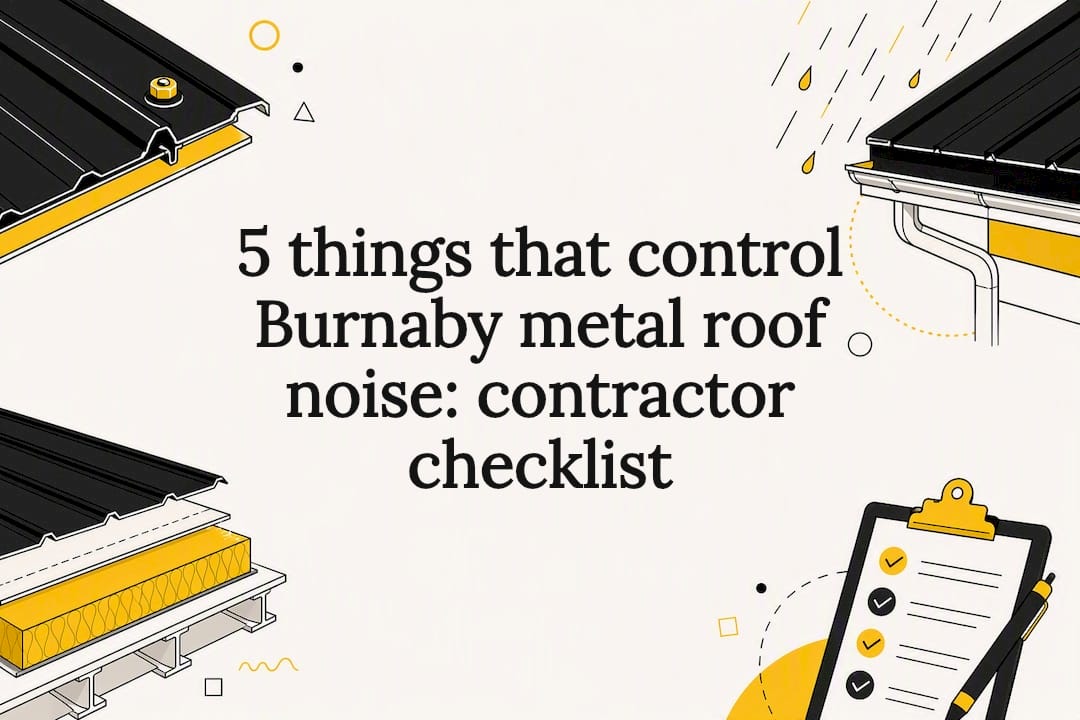
5 things that control Burnaby metal roof noise: contractor checklist
5 things that control Burnaby metal roof noise: contractor checklist
A properly built metal roof in Burnaby is not meaningfully louder inside than an asphalt roof once it rains. The assembly, not the metal, decides what you hear from your couch: solid decking, the right underlayment, and attic insulation do the heavy lifting. Fix those three (mass, absorption, and decoupling from the frame) and rain noise stops being a reason to avoid metal. Paragon Roofing BC deals with this question constantly across Burnaby’s older strata complexes and newer infill builds.
TL;DR:
- Properly installed metal roofs with solid decking, sound-deadening underlayment, and adequate attic insulation reach noise levels comparable to asphalt shingles during rain.
- Rain impact energy varies with storm types, with wind-driven rain causing more noise than steady light rain, making storm conditions a key factor in noise complaints.
- Fastener spacing, clip management, and roof pitch are critical installation details that significantly influence indoor noise levels over time.
- Retrofitting options like adding attic insulation, interior mass, or upgrading to a sound-deadening underlayment provide cost-effective noise reduction without complete roof replacement.
- For new roofs, choosing standing seam panels with concealed clips over solid decking offers the best long-term noise control, especially in rain-prone Burnaby climates.
Table of Contents
- How loud is a Burnaby metal roof, really?
- What actually controls the noise: decking, underlayment, insulation, and panel choice
- Noise-reduction strategies for Burnaby homes: retrofit and re-roof options
- A homeowner sound-check: documenting the noise before you call a contractor
- Paragon Roofing BC’s field checklist for quiet metal roofs in Burnaby
- What Burnaby homeowners actually say about metal roof noise
- Local building code context for roof noise in Burnaby
- How metal roofs compare with other Burnaby roofing materials besides asphalt
- Does years of rain noise actually affect comfort or health?
- Author perspective: setting realistic expectations for metal roofs in Burnaby
- Paragon Roofing BC services for quiet metal roofs in Burnaby
- Sources
- FAQ
How loud is a Burnaby metal roof, really?
Numbers help here, because “loud” means different things to different people standing in different rooms. A quiet library sits around 30 to 40 dBA. Normal conversation runs about 60 dBA. Every jump of roughly 10 dB roughly doubles how loud something feels to the human ear, while a shift of just 3 dB is close to the smallest change most listeners can actually detect. That threshold matters when you’re comparing roofing options, because a lot of the “metal roofs are so loud” chatter is built on gut feeling rather than measured difference.
The scary figures you’ve probably seen online, like an uninsulated sheet hitting 85 to 90 dB in heavy rain, come from test rigs and open-framed structures, not from a finished Burnaby house. Strip away the attic, the insulation, and the ceiling drywall, and yes, a bare metal panel over open joists will amplify every drop like a drum skin. That’s not what gets installed on a residential re-roof. Once you add solid decking, underlayment, and attic insulation, a metal roof’s interior sound level lands close enough to asphalt shingles that most homeowners can’t tell the difference blind. This Old House notes that proper underlayment and insulation bring metal roof noise in line with shingles in typical residential builds.
Quick reference: what different indoor sound levels feel like
| Sound level (approx.) | Everyday comparison |
|---|---|
| 30-40 dBA | Quiet library |
| 30 to 40 dBA | Normal conversation |
| 60 dBA | Properly assembled metal roof, moderate rain |
| high decibel range | Uninsulated single-skin metal sheet over open framing (lab conditions, not a finished home) |
Burnaby’s rain doesn’t fall the same way twice. A steady November drizzle produces a soft, even patter that most roofs handle fine. A wind-driven Pacific frontal system pushing rain sideways into a west-facing slope is a different animal: the raindrops hit at an angle, carry more effective impact energy, and hammer a wider portion of the roof plane at once. Environment and Climate Change Canada’s engineering climate data confirms the Lower Mainland sees these intensity swings regularly, which is exactly why a roof that sounds fine in a light shower can sound noticeably different during a January atmospheric river event. If your noise complaints cluster around specific storm types rather than all rain equally, that’s a strong clue the issue is wind-driven impact energy, not a defect in the roof itself.
What actually controls the noise: decking, underlayment, insulation, and panel choice
Homeowners tend to blame the metal. In field inspections, the metal is almost never the actual problem. Five things determine what you hear inside, and they stack in importance roughly in this order.
- Decking type : solid plywood or OSB decking adds mass and stiffness that a raindrop simply can’t excite the way it excites a thin panel spanning open purlins. Open-frame or skip-sheathed assemblies (common on older agricultural or accessory structures, rarer on Burnaby homes) are the loudest configuration you’ll find anywhere.
- Underlayment : synthetic and self-adhered membranes with a felt or foam backing absorb impact energy before it reaches the deck. A bare synthetic underlayment does less damping than a product built with a sound-deadening layer.
- Attic insulation : this is the biggest lever most homeowners overlook. A thick, continuous layer of attic insulation absorbs airborne sound after it has already passed through the roof assembly, which matters more for what you hear at ceiling level than almost anything happening above the deck.
- Panel profile, gauge, and pitch : thicker steel resists flexing and drumming better than thin-gauge panels, and roof pitch changes how directly rain impacts the surface. A peer-reviewed rainfall-noise study found that a roughly 25-degree pitch tends to minimize interior sound pressure levels compared with both flatter and steeper slopes, with thicker sheet stock consistently outperforming thinner stock across the tested range.
- Installation quality : this is where good crews separate themselves from bad ones.
Pro Tip: If your metal roof developed a new rattle or “pinging” sound after a windstorm rather than sounding consistent from day one, suspect a loose panel or a fastener that backed out, not a design flaw in the roofing system itself.
Installation mistakes deserve their own callout because they cause a disproportionate share of noise complaints. Incorrect clip spacing restricts the panel’s ability to expand and contract with temperature swings, which creates tension that shows up as ticking or popping sounds as the metal moves. Over-driven or under-driven fasteners leave panels either too rigid (transmitting more vibration into the deck) or loose enough to flutter in wind. The Metal Construction Association’s technical guidance is explicit that clip spacing and fastener management are central to controlling thermal movement, and thermal movement that isn’t managed properly is one of the most common root causes of an “everything is louder than it should be” complaint that shows up months after installation, not on day one.
Roof pitch interacts with all of this. Burnaby’s mix of steep character-home rooflines and the shallower slopes common on newer townhouse builds means two houses on the same street can genuinely experience different rain acoustics from an identical panel product, purely because of geometry.
Noise-reduction strategies for Burnaby homes: retrofit and re-roof options
Every effective fix falls into one of three categories: adding mass , adding absorption , or decoupling the panel from the structure so vibration has nowhere direct to travel. Homeowners who understand this framework can walk into a contractor conversation asking the right questions instead of just asking for “something quieter.”
If you’re not ready to re-roof, start here:
- Top up attic insulation. This is almost always the highest-value, lowest-cost move available, and it improves your energy bills as a side benefit. Natural Resources Canada’s building efficiency resources frame insulation upgrades as a standard efficiency lever, and the acoustic benefit rides along with the thermal one.
- Seal attic bypasses and improve ceiling airtightness. Gaps around pot lights, attic hatches, and plumbing stacks let airborne sound leak straight into living spaces.
- Add interior mass where the roof work isn’t feasible. A second layer of drywall with a viscoelastic damping compound like Green Glue between layers meaningfully cuts transmitted sound, and it’s a smaller project than touching the roof.
- Look at interior doors in noise-sensitive rooms. If a bedroom sits directly under a valley or a particularly exposed slope, a solid-core or acoustic-rated door limits sound bleeding into hallways; acoustic door upgrades are a recognized interior noise strategy worth pairing with attic work.
If you’re re-roofing anyway, this is where the real gains show up:
- Upgrade to a sound-deadening underlayment. Products built specifically for acoustic performance outperform basic synthetic felt by a noticeable margin, and the cost difference over the life of a roof is small.
- Re-deck with solid plywood or OSB if your current structure uses open framing or skip sheathing. This is the single biggest mass upgrade available and essentially eliminates drum-skin resonance.
- Choose standing seam over exposed-fastener panels where budget allows. Standing seam systems use concealed clips rather than through-panel screws, which reduces the metal-on-metal contact points that transmit vibration and cuts down on the long-term risk of fastener-related rattling.
- Specify a heavier gauge steel. Thicker panels flex less under raindrop impact, which is consistent with the pitch-and-thickness findings from the rainfall-noise study cited above.
- Confirm clip spacing and fastening practices with your contractor before work starts , since this is the detail most likely to cause complaints down the road if it’s rushed.
Here’s how those options stack up when you’re deciding where to start:
| Intervention | Primary mechanism | Relative cost | Typical impact on rain noise |
|---|---|---|---|
| Attic insulation top-up | Absorption | Low | High |
| Interior double drywall + damping compound | Mass (interior) | Low to moderate | Moderate to high |
| Acoustic underlayment (re-roof) | Absorption | Moderate | Moderate |
| Full re-decking with solid sheathing | Mass | Moderate to high | High |
| Standing seam with concealed clips | Decoupling | Moderate to high | Moderate to high |
| Heavier gauge steel panel | Mass / stiffness | Moderate | Moderate |
The order matters. If your roof already has solid decking and reasonable insulation but you’re still hearing more than you’d like, the fix is likely underlayment or a clip-spacing correction, not a full tear-off. If you’re planning a re-roof anyway because of age or storm damage, that’s the moment to bundle in the acoustic upgrades, since the marginal cost of a better underlayment or heavier gauge panel during a scheduled project is far lower than doing it as a standalone retrofit later. For a full breakdown of what a re-decking or replacement project involves in Burnaby’s climate, it’s worth a conversation before committing to a like-for-like swap.
A homeowner sound-check: documenting the noise before you call a contractor
A contractor can diagnose a real problem far faster when you arrive with evidence instead of just a description. Here’s a simple process that takes fifteen minutes during the next moderate rain.
- Pick the room where the noise bothers you most , usually a top-floor bedroom or a room directly under a valley or low-slope section, and stand or sit where you’d normally notice it.
- Record a 30 to 60-second video on your phone with the room otherwise quiet: no TV, no fans, no conversation.
- Note the rain type at the time: steady vertical rain, wind-driven rain hitting a specific slope, or a squall with gusts.
- Note when the noise started relative to the storm , since a sound that appears only during high wind points toward a loose panel or fastener issue rather than baseline rain acoustics.
- Photograph the attic space above the affected room if you have access, including visible insulation depth and any daylight gaps around the decking.
- Write down the roof’s approximate pitch and panel type if you know them (standing seam, exposed-fastener corrugated, or another profile), since this changes what a contractor expects to hear.
When you submit a service request, attach the video, the attic photos, and a short note along these lines: “Noise is most noticeable in the northeast bedroom during wind-driven rain from the southwest. Started roughly [X months] after installation. Attic insulation looks like [approximate depth].” That level of detail lets a contractor triage the issue before ever stepping on a ladder.
Red flags that point to an installation defect rather than normal acoustics: noise that has clearly gotten worse over time rather than staying consistent, ticking or popping sounds tied to temperature swings rather than rain, visible panel lift or movement in wind, and noise concentrated at one seam or valley rather than spread evenly across the roof.
Paragon Roofing BC’s field checklist for quiet metal roofs in Burnaby
Burnaby sits in a transition zone between Vancouver’s coastal rain patterns and the slightly drier eastern Fraser Valley, but it still gets its share of wind-driven storms funnelled through the Burrard Inlet and Fraser River corridors. We see roof pitches ranging from steep character rooflines in areas like Capitol Hill to the shallower slopes typical of newer Metrotown-area townhouse complexes. Pitch genuinely changes what a homeowner hears in a downpour.
When we spec a metal roof for noise-sensitive Burnaby clients, the checklist looks like this:
- Solid plywood or OSB decking, never open framing, on any residential install.
- A sound-deadening synthetic or self-adhered underlayment rated for the Lower Mainland’s moisture exposure.
- Attic insulation brought to a depth that meets current efficiency targets, not just legacy minimums.
- Correct clip spacing and fastener torque, checked against panel manufacturer specs rather than eyeballed.
- Properly detailed flashing at valleys, penetrations, and eaves, since poor flashing work is its own separate source of rattling and leaks that homeowners sometimes mistake for rain noise.
If you’re getting quotes from any contractor for a Burnaby metal roof, ask directly: what decking are you installing over, what underlayment product and brand, what’s the target attic insulation depth, and how are clips spaced relative to the panel manufacturer’s spec sheet? A contractor who can’t answer specifically hasn’t thought through the acoustic side of the job.
What Burnaby homeowners actually say about metal roof noise
Local complaints tend to follow a pattern rather than being random. The most common thread isn’t “metal roofs are loud” in general. It’s a specific room, under a specific slope, during a specific kind of storm. Bedrooms under low-slope sections or valleys come up far more often than main living areas, largely because those rooms sit closer to the roof plane with less attic buffer between the deck and the ceiling.
The second most common thread is timing. Homeowners who notice new noise months or years after installation, rather than immediately, are almost always describing a fastener or clip issue that developed through thermal cycling, not an inherent property of metal roofing. That distinction gets lost in casual conversation and online reviews, where “my metal roof got loud” reads the same whether the cause is a design choice made a decade ago or a maintenance issue that showed up last winter.
Strata councils fielding these complaints from multiple units in the same complex should treat it as useful diagnostic information: if only certain units or certain slopes generate complaints, that points toward a localized installation or flashing issue rather than a building-wide problem with the roofing system itself.
Local building code context for roof noise in Burnaby
There is no Burnaby bylaw or BC Building Code provision that sets a maximum decibel threshold for rain noise on a residential roof. Noise bylaws in the City of Burnaby address things like construction hours, mechanical equipment, and amplified sound. They don’t regulate how loud rain sounds inside a private home, because that’s a performance and comfort issue, not a life-safety or nuisance-to-neighbours issue the way a barking dog or a rooftop compressor might be.
What the building code does govern indirectly is the assembly itself: minimum insulation values, proper flashing and weatherproofing details, and structural requirements for decking and fastening all fall under standard residential construction requirements enforced through permitting. A roof that’s built to code, with proper decking, insulation, and flashing, will almost always land in an acceptable noise range as a byproduct of meeting those other requirements. There’s no separate acoustic permit or inspection step, which means the burden falls on choosing a contractor who treats noise control as part of good installation practice rather than an afterthought.
How metal roofs compare with other Burnaby roofing materials besides asphalt
Asphalt shingles aren’t the only alternative Burnaby homeowners weigh against metal. Synthetic shake and shingle products like Brava, Enviroshake, and Euroshield sit closer to metal than to asphalt in rain acoustics, since they’re installed over similar solid decking and underlayment assemblies, and their thicker, more rigid composite structure tends to dampen impact sound reasonably well on its own. Cedar shake, still common on older Burnaby character homes, is naturally one of the quietest roofing materials in rain because wood fibre absorbs impact energy rather than transmitting it, though cedar carries its own moisture and moss maintenance burden in this climate.
Flat and low-slope roofs finished with EPDM membrane or torch-on systems, common on Burnaby townhouse complexes and commercial buildings, behave differently again: the membrane itself is soft and somewhat sound-absorbing, but low pitch means rain sits and drains slowly rather than sheeting off quickly, which changes the acoustic signature entirely rather than making it simply louder or quieter. None of these alternatives are inherently “quieter roofing” in a way that should override other decision factors like longevity, moss resistance, or wind performance. Assembly quality drives the noise outcome across every material on this list, metal included.
Does years of rain noise actually affect comfort or health?
Chronic low-level noise inside a home, even noise well below hearing-damage thresholds, can measurably affect sleep quality and daily comfort over time. The relevant issue for Burnaby homeowners isn’t hearing damage. Properly assembled residential roofs don’t approach anywhere near the intensity needed for that. It’s the cumulative annoyance of a repetitive sound pattern during the region’s long, wet fall and winter stretch, when rain on the roof can be a near-daily occurrence for weeks at a time.
Sleep disruption from intermittent noise, even noise that doesn’t wake someone fully, is associated with reduced sleep quality and next-day fatigue in general noise-health research. A roof assembly that produces a dull, muffled patter rather than a sharp, resonant tapping is easier for most people to tune out or sleep through, which is one more practical argument for prioritizing the absorption and decoupling measures covered earlier rather than treating noise as a cosmetic complaint. For households with light sleepers, shift workers, or young children in bedrooms directly under exposed roof sections, the comfort case for addressing roof acoustics properly during a re-roof is stronger than for a household using that space only occasionally.
Author perspective: setting realistic expectations for metal roofs in Burnaby
The “tin can roof” worry is a holdover from decades-old agricultural buildings and cheap, uninsulated outbuildings, not a reflection of what a modern residential assembly does. That reputation sticks around because it’s a vivid mental image, and vivid images beat nuanced acoustic explanations every time. Once you separate the metal from the assembly around it, the actual trade-offs with asphalt are about longevity, weight, and upfront cost, not noise.
I’d steer a genuinely noise-sensitive client toward standing seam with concealed clips over solid decking and a sound-deadening underlayment every time, especially on bedroom-adjacent slopes. For a garage, workshop, or a low-traffic secondary structure, exposed-fastener panels are a perfectly reasonable, more affordable choice where the acoustic stakes are lower.
— Harman
Paragon Roofing BC services for quiet metal roofs in Burnaby
Paragon Roofing BC gives Burnaby homeowners a direct path to fixing rain noise instead of guessing at it: our inspections identify whether the cause is decking, underlayment, insulation, or installation before you spend a dollar on the wrong fix. Where a national retailer or generic contractor might quote a like-for-like reroof without asking about acoustics at all, we build the noise-control checklist into the quote itself.
A Paragon inspection covers the attic insulation depth, decking condition, clip and fastener spacing, and flashing details that drive rain acoustics, and most residential assessments wrap up within a single visit with a written summary you can act on right away. If you’re weighing a full metal roofing installation in Burnaby against sticking with shingles, or you’re already dealing with a rattling or resonant roof, our residential roofing services team can walk the roof, document what’s actually happening, and give you options ranked by cost and impact. Book an inspection and get a specific answer for your house instead of a general one.
Sources
FAQ
Are metal roofs on houses loud when it rains?
Not when properly installed. Solid decking, sound-deadening underlayment, and adequate attic insulation bring indoor rain noise close to asphalt shingle levels in a typical Burnaby home.
What is the biggest problem with metal roofs?
Noise gets the most attention, but the real risk is installation quality: incorrect clip spacing or fastener practice causes thermal movement issues that show up later as rattling, popping, or leaks.
How do I stop metal roof noise?
Start with attic insulation and sealing ceiling gaps if you’re not re-roofing; if you are re-roofing, add a sound-deadening underlayment, confirm solid decking, and consider standing seam panels with concealed clips.
What are the disadvantages of metal roofs?
Higher upfront cost than asphalt, the need for correct installation to avoid noise and thermal-movement issues, and sensitivity to poor workmanship are the main drawbacks; longevity and durability are generally advantages.
Does roof pitch affect how loud rain sounds inside?
Yes. Research on rainfall-induced roof noise found that a roughly 25-degree pitch tends to minimize interior sound levels, while flatter or steeper slopes can increase perceived loudness depending on panel thickness.
Recommended
Our Roofing Blog

Have more questions about roofing?
Check out our FAQs or give us a call today to speak to an expert roofer in Vancouver Lower Mainland, BC. We're here to help our neighbours make educated decisions about their roof. For our team, we value helping clients save money while making their roofs last.