North Vancouver gutter and fascia rot: what to do now
North Vancouver gutter and fascia rot: what to do now
TL;DR:
- Failing gutters are the main cause of fascia rot on North Vancouver homes, as water saturation leads to fungal decay. Visual signs like peeling paint and sagging gutters require prompt inspection and repair to prevent the rot from spreading into the rafters. Regular maintenance and proper material choices are essential to prevent recurrence in this wet climate.
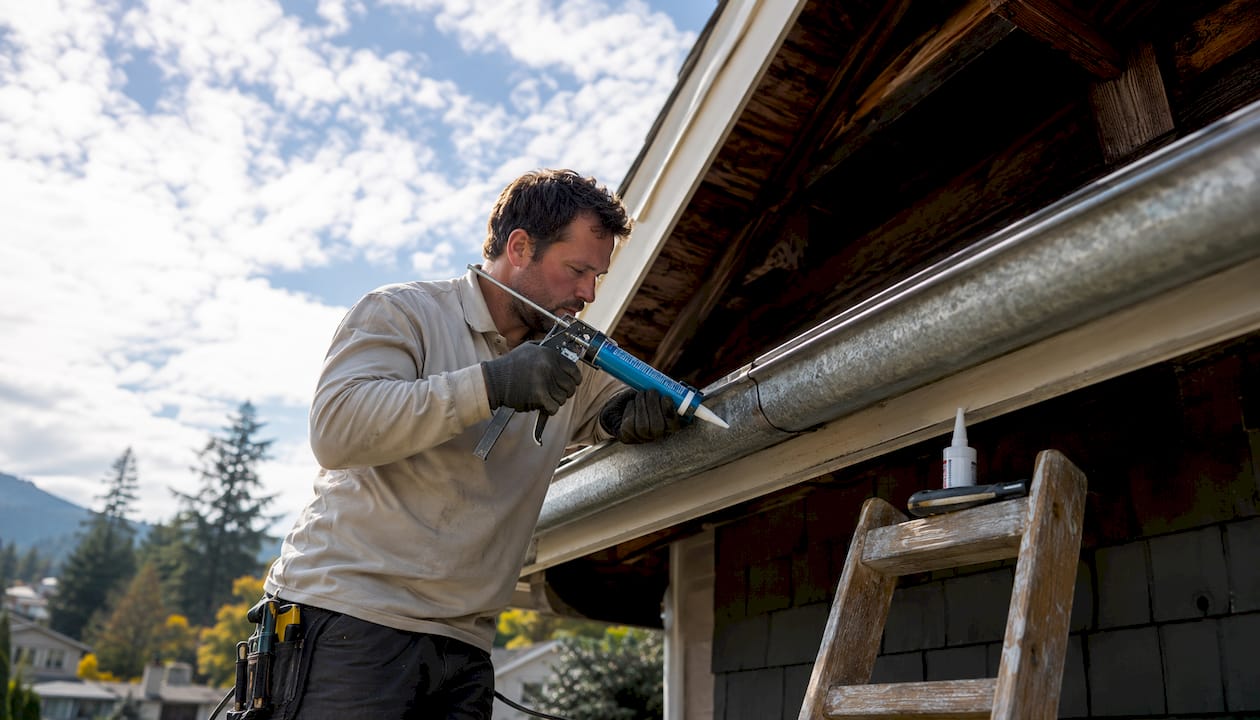
Yes, failing gutters are the most common cause of fascia rot on North Vancouver homes, and the connection is direct: when gutters overflow, block, or pull away from the roofline, water pools against the fascia board and saturates it. In North Vancouver’s coastal moisture conditions, that saturation rarely dries out between rain events, which means fungal decay sets in faster than most homeowners expect. If you’re seeing peeling paint, soft wood, or sagging gutters, this is not a cosmetic issue.
What to do right now:
- If gutters are visibly sagging or detached, place a tarp over the roofline edge to limit water entry until a professional arrives.
- Do not climb a ladder if conditions are wet or you’re unsure about the roof pitch. Ground-level observation is enough to confirm the key warning signs.
- Photograph the affected area from ground level: the gutter profile, any visible gaps between the gutter and fascia, and any paint peeling or discolouration on the board face.
- Book an on-site inspection with Paragonroofingbc as soon as possible. The longer saturated wood sits untreated, the deeper the rot travels, sometimes into the rafter tails behind the fascia.
Pro Tip: Take photos during or right after heavy rain. Water behaviour under load, such as overflow direction and where it contacts the fascia, tells a contractor far more than dry-day photos.
Table of Contents
- How do you spot fascia rot and gutter damage on your North Vancouver home?
- Why do failing gutters cause fascia rot in North Vancouver’s climate?
- What does a professional inspection and repair actually involve?
- What do North Vancouver repairs typically cost, and how long do they take?
- How do you prevent fascia rot from coming back on the North Shore?
- How do you choose the right contractor for gutter and fascia work in North Vancouver?
- Paragonroofingbc’s North Vancouver experience: what a typical repair looks like
- Key takeaways
- Why North Shore rooflines deserve a closer look than most homeowners give them
- Book a Paragonroofingbc inspection in North Vancouver
- Useful sources
- FAQ
How do you spot fascia rot and gutter damage on your North Vancouver home?
The earliest signs are easy to miss because they look like ordinary wear. Peeling or blistering paint on the fascia board is usually the first visible clue. Paint fails when the wood beneath it is repeatedly wet and cannot dry, and in North Vancouver that cycle runs almost year-round. Soft or spongy wood when you press a screwdriver tip against the board face is a more serious indicator. Visible dark staining, often grey or black, points to active fungal growth.
Visual signs at the roofline:
- Peeling, bubbling, or flaking paint on fascia boards
- Soft, crumbling, or discoloured wood along the board face or lower edge
- Sagging or visibly detached gutter sections
- Gaps between the back of the gutter and the fascia face
- Rust staining on the fascia from corroded gutter spikes or brackets
- Visible moss or algae growth on the fascia surface
Secondary signs you can check from the ground:
- Water pooling near the foundation directly below a gutter downspout or overflow point
- Moss or vegetation growing under the eaves on siding or trim
- A damp or musty smell near the attic edge, particularly after rain
- Interior water stains on ceilings near the eaves
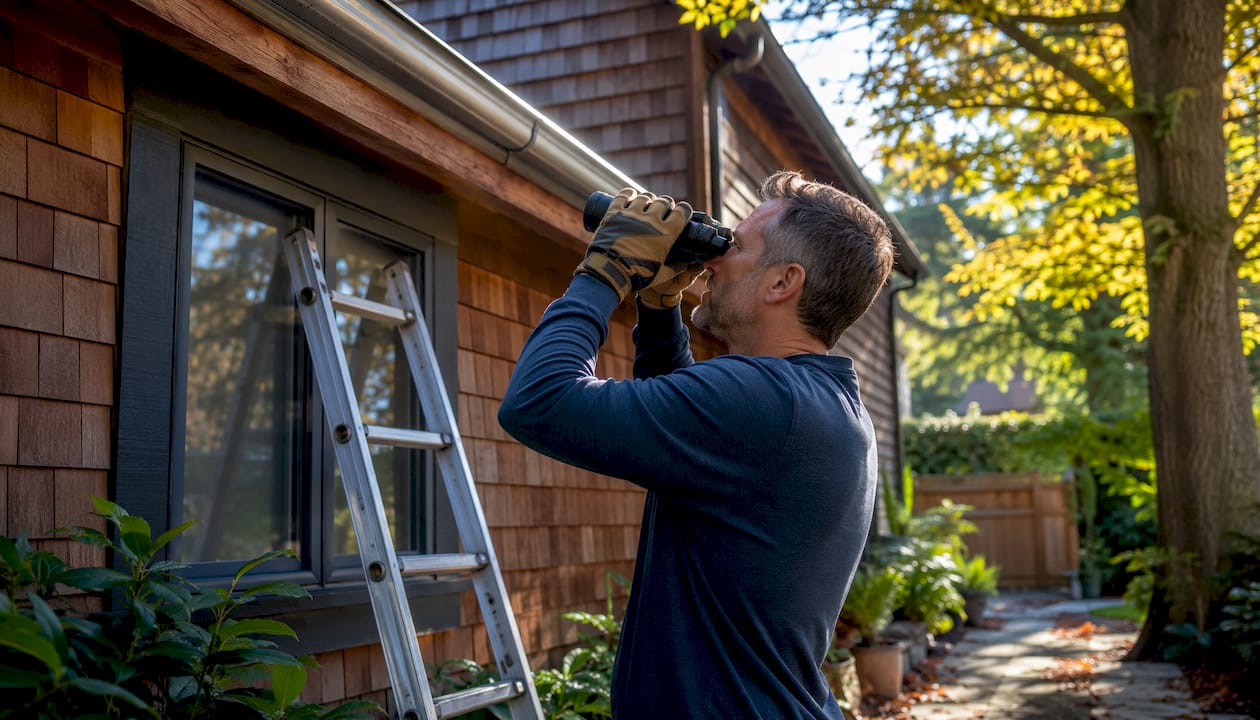
Most of these checks are safe from ground level with a pair of binoculars. What requires a professional is anything involving a moisture meter reading behind the fascia, checking whether rot has reached the rafter tails, or testing gutter slope and fastener integrity. Signs of fascia damage like sagging gutters and water spilling over the sides during rain are the ones that justify calling for an inspection the same day rather than scheduling it for next week.
Pro Tip: When photographing for a contractor, shoot the gutter profile from directly below (looking up) and from the side. A side-angle photo often reveals whether the gutter is sloping toward or away from the downspout, which is one of the first things an inspector checks.
Why do failing gutters cause fascia rot in North Vancouver’s climate?
The failure chain is straightforward, but North Vancouver’s climate makes each step faster and harder to reverse. It starts with a blocked or misaligned gutter. Water that cannot flow to the downspout backs up and overflows, but the more damaging pathway is the water that flows behind the gutter channel itself. A gutter that has pulled away even slightly from the fascia creates a gap where water channels directly onto the wood face and sits there.
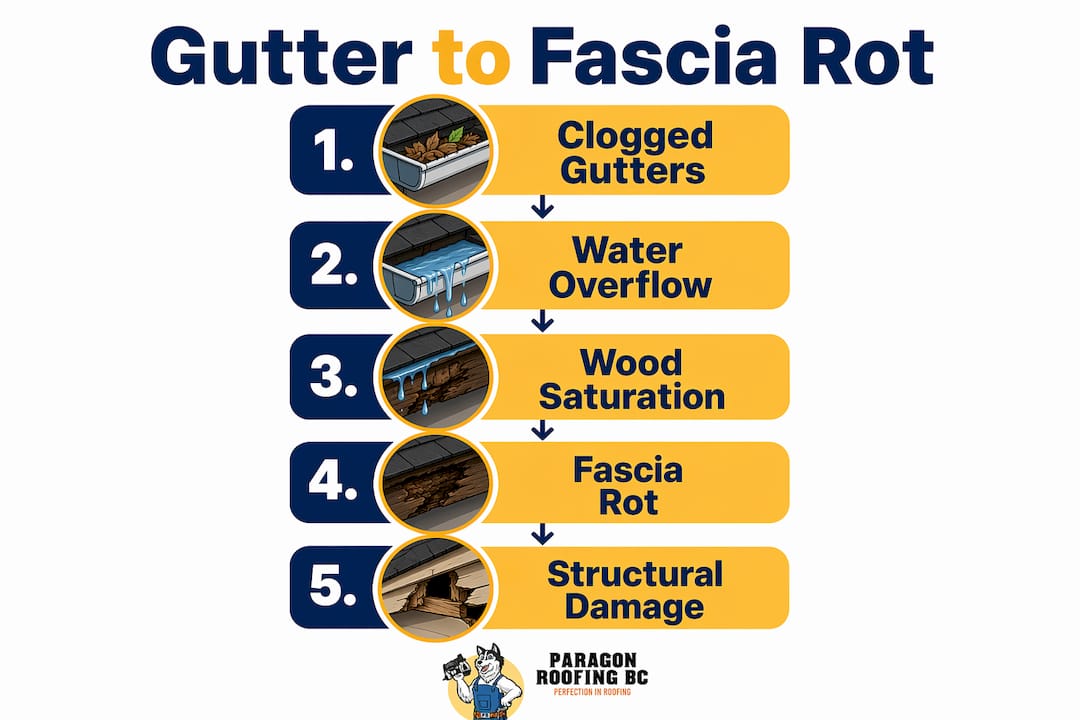
Coastal moisture and poor drying time mean even small flashing or gutter failures become persistent moisture sources that feed rot year-round. Unlike drier climates where a wet board might dry out between storms, the North Shore’s low-drying conditions keep wood fibre saturated for days or weeks at a stretch. Fungal decay does not need standing water; it needs sustained moisture above a threshold, and North Vancouver delivers that reliably from October through April.
The most common technical failure points inspectors find:
- Insufficient gutter slope causing water to pool at mid-span rather than drain to the downspout
- Blocked downspouts or partially blocked outlets that back water up under the drip edge
- Failed or missing drip-edge flashing that allows water to wick directly onto the fascia top
- Corroded or loose gutter spikes and brackets that let the gutter sag away from the fascia face
- Salt-air corrosion weakening metal fasteners and flashing seals, creating entry points for water
The salt air factor is worth calling out specifically. Homes within a few kilometres of Burrard Inlet or Indian Arm see accelerated corrosion in any exposed metal, including the gutter hangers, flashing, and the fasteners holding the fascia board to the rafter tails. Once those fasteners corrode and loosen, the gutter pulls away, the gap widens, and the rot accelerates.
When a gutter fails on a North Vancouver home, the fascia is almost always the first structural component to absorb the damage. The board sits directly behind the gutter channel, it’s made of wood in most older homes, and it has nowhere to drain. Fixing the gutter without addressing the fascia condition is like patching a leaking pipe without checking what the water already soaked.
Understanding the role soffits and fascia play in roof performance helps explain why this failure spreads so quickly once it starts.
What does a professional inspection and repair actually involve?
A proper inspection goes well beyond a visual check from the driveway. Here is the sequence a qualified contractor should follow:
- Visual survey from ground and ladder. Check gutter profile, slope, and attachment points. Look for paint failure, staining, and visible gaps between the gutter back and fascia face.
- Moisture meter readings. A pin-type or non-invasive moisture meter applied to the fascia face and ends tells you whether the wood is actively saturated, even when the surface looks dry or painted.
- Minor exploratory work. Removing a short section of gutter or probing the fascia edge reveals whether rot is surface-level or has penetrated to the back of the board and into the rafter tail behind it.
- Flashing and fastener check. Inspect the drip-edge flashing condition, gutter hanger spacing and corrosion, and whether the fascia-to-rafter connection is still structurally sound.
- Gutter slope and downspout flow test. Run water through the system to confirm slope direction, outlet flow rate, and whether any section pools or backs up.
Repair options, from least to most invasive:
- Gutter patching and resealing joints, combined with slope correction
- Localized fascia splice: cutting out the rotted section and splicing in new treated board
- Full fascia board replacement on one or more elevations
- Repainting or cladding with decay-resistant material after replacement
- Full gutter removal, fascia replacement, and reinstallation of new gutters with correct slope and corrosion-resistant hangers
Rotted fascia often requires full removal before gutters can be securely reattached. Skipping that step and simply screwing new gutters into soft wood means the repair fails within one or two seasons.
What a written scope should include:
- Photographs of all affected areas before work begins
- Moisture meter readings at key points
- Itemised costs for materials and labour, separated by scope item
- Specified materials (board species or composite, gutter gauge and profile, fastener type)
- Start and completion dates
- Workmanship warranty terms in writing
For temporary mitigation before the repair date, a homeowner can safely apply gutter sealant to leaking joints, redirect a disconnected downspout extension away from the foundation, and tarp the roofline edge if gutters are fully detached.
What do North Vancouver repairs typically cost, and how long do they take?
Cost ranges vary based on the extent of rot, access difficulty, and whether gutters need full replacement alongside the fascia work. The table below gives realistic brackets for common scopes on a typical North Vancouver detached home.
| Scope | Estimated Cost Range (CAD) | Typical Time on Site |
|---|---|---|
| Gutter resealing and slope correction | $300–$600 | Half day |
| Localized fascia splice (1–3 boards) | $600–$1,400 | 1 day |
| Full fascia replacement, one elevation | $1,000–$3,500 | 1–2 days |
| Full fascia + new gutters, one elevation | $2,500–$6,000 | 1–3 days |
| Full perimeter fascia + gutters, whole home | $6,000–$12,000 | 3–5 days |
These ranges reflect North Vancouver labour rates and material costs and will shift based on storey height, roof pitch, and whether rot has reached the rafter tails.
Factors that push a quote higher or extend the timeline:
- Hidden rot discovered behind the fascia during demo, requiring rafter tail repairs
- Multi-storey access requiring scaffolding rather than ladders
- Weather delays common in the October–March window
- Upgrading from standard wood fascia to composite or pre-finished aluminium
- Replacing soffits at the same time, which is often worth doing if they show moisture damage
Pro Tip: Ask for a separate line item for “contingency rot removal” in your quote. A good contractor will price a base scope and a contingency scope so you know the maximum cost before work starts, rather than getting a surprise invoice when hidden rot is found mid-job.
When comparing quotes, warranty length matters as much as price. A written workmanship warranty of two years or more on fascia and gutter work is a reasonable expectation from a licensed contractor.
How do you prevent fascia rot from coming back on the North Shore?
Prevention on the North Shore is mostly about maintenance rhythm and material choices. The climate does not give you a long dry season to catch up on deferred work, so the schedule has to be proactive.
Recommended maintenance schedule:
- Spring (April/May): Full gutter cleaning after the heavy rain season. Check all downspout outlets and flush with a hose to confirm flow.
- Late summer (August/September): Second cleaning before leaf fall. Inspect gutter hangers and fascia paint condition.
- Late autumn (November): Third cleaning after leaf drop in cedar-heavy neighbourhoods. Post-storm checks after any significant wind event.
- Annual roofline inspection: Have a contractor check flashing, fascia condition, and gutter slope once a year, ideally in early spring.
Homes with heavy tree cover need 2–3 cleanings per year because moss and organic debris accelerate clogging far faster than in open suburban settings.
Material choices that hold up in wet coastal conditions:
- Composite or pre-finished aluminium fascia boards instead of untreated wood, particularly for sapwood species that have no natural decay resistance
- Western red cedar is decay resistant for non-structural uses, but treated lumber or composite is often the better long-term choice in persistently wet conditions
- Stainless steel or hot-dipped galvanised fasteners and hangers rather than standard zinc-coated hardware
- Aluminium or galvanised steel gutters rather than vinyl, which becomes brittle in freeze-thaw cycles
Leaf guards reduce debris buildup, but gutter guards do not eliminate the need for inspection in Pacific Northwest conditions. Fine debris, moss spores, and shingle granules still accumulate under and around most guard systems.
Pro Tip: The single best preventive upgrade for most North Vancouver homes is improving the drip-edge flashing at the fascia top. A properly lapped metal drip edge directs water into the gutter rather than onto the fascia face, and it costs a fraction of a fascia replacement. If your home has no drip edge or a corroded one, ask for it to be included in any gutter or fascia repair scope.
For a broader seasonal checklist, the BC homeowner roof maintenance guide covers the full inspection sequence worth running each year.
How do you choose the right contractor for gutter and fascia work in North Vancouver?
Choosing under time pressure is how homeowners end up with a one-line quote and a repair that fails in 18 months. A few targeted questions on the first call will separate qualified contractors from the rest.
Questions to ask before booking an inspection:
- Are you licensed and insured in BC? Can you provide proof of both before work starts?
- Do you use a moisture meter during your inspection, or is it visual only?
- Will I receive a written, itemised scope with photos before any work begins?
- What materials do you specify for fascia replacement in wet coastal conditions?
- What is your workmanship warranty, and is it in writing?
- Can you give me a start date and a realistic completion window?
Red flags to watch for:
- A quote delivered verbally or as a single lump sum with no line items
- No photos included in the inspection report
- Pressure to sign a contract on the day of the estimate
- Refusal to provide proof of liability insurance or WCB coverage
- No written warranty, or a warranty that only covers materials and not labour
Decision checklist when comparing proposals:
- Scope clarity: does each proposal describe exactly what will be removed, treated, and replaced?
- Documented findings: are moisture readings and photos included?
- Materials specified: board species or composite type, gutter gauge, fastener material?
- Timeline realism: does the contractor account for weather delays in their schedule?
- Warranty terms: is the workmanship warranty written into the contract?
Paragonroofingbc’s inspection process includes on-site moisture readings, photographs of all affected areas, and a written itemised quote before any work is committed. That documentation also serves strata councils and property managers who need a paper trail for maintenance records or insurance claims.
Paragonroofingbc’s North Vancouver experience: what a typical repair looks like
A common scenario on North Shore homes built in the 1980s and 1990s goes like this: the homeowner notices sagging gutters on the north-facing elevation after a wet winter. On inspection, the gutter has pulled away from the fascia by 15–20 mm, and the fascia paint is peeling along the lower edge. A moisture meter reading on the board face comes back well above the safe threshold for wood, and probing the lower edge reveals soft, crumbling wood extending 40–50 mm into the board depth.
The diagnostic steps Paragonroofingbc uses on-site:
- Moisture meter readings at the fascia face, lower edge, and at the rafter tail connection point
- Gutter flow test to confirm slope direction and downspout outlet condition
- Photographic documentation of all affected areas before any demo work
- Minor exploratory removal of the gutter section to check the fascia-to-rafter connection
- Flashing inspection at the drip edge and any adjacent valley or step flashing
In a typical localized repair, the rotted board section is removed, the rafter tail is assessed and treated or sistered if needed, and new treated or composite fascia is installed with corrosion-resistant fasteners. The gutter is then reinstalled with corrected slope and new hangers. Before-and-after photos are included in the project file.
On North Shore homes, the rot we find behind gutters is almost never limited to the visible surface. Once water has been sitting behind a gutter channel for a season or two, it has usually worked its way into the back of the board and sometimes into the rafter tail. That’s why a moisture meter and a few minutes of exploratory work at the start saves a homeowner from a much larger repair bill six months later.
Paragonroofingbc provides a written workmanship warranty on fascia and gutter work, and recommends a follow-up check at the first post-repair rainy season to confirm gutter slope and flashing performance. For strata councils and property managers, the full project documentation, including photos, moisture readings, and scope notes, is available for building records.
Key takeaways
Failing gutters are the primary driver of fascia rot on North Vancouver homes, and addressing both components together is the only repair approach that holds up in the North Shore’s persistently wet climate.
| Point | Details |
|---|---|
| Gutters cause fascia rot | Overflow and backflow behind the gutter channel saturate fascia boards and trigger fungal decay. |
| North Shore climate accelerates decay | Low drying time means even minor gutter failures become year-round moisture sources that rot wood fast. |
| Inspect before you repair | A moisture meter reading and exploratory demo reveal hidden rot that a visual check misses entirely. |
| Budget realistically | Full fascia and gutter replacement on one elevation typically runs a moderate-to-high cost range in North Vancouver. |
| Paragonroofingbc | Provides on-site moisture diagnostics, itemised written quotes, and a workmanship warranty for North Vancouver fascia and gutter repairs. |
Why North Shore rooflines deserve a closer look than most homeowners give them
Here’s the thing about the gutter-to-fascia failure pattern on North Vancouver homes: it’s almost always further along than it looks. Paint peels on the surface, but the rot is in the back of the board. The gutter looks attached, but the fasteners are corroding from the inside. The downspout looks clear, but there’s a partial blockage two feet up that’s been backing water against the fascia for two winters.
What I’ve seen repeatedly on North Shore inspections is that homeowners wait until the gutter is visibly sagging before calling anyone. By that point, the fascia is usually past a splice repair and needs full replacement. The cost difference between catching it at the paint-peeling stage versus the sagging-gutter stage is significant, and the timeline difference is even more so. A localized repair in a dry September takes a day. A full fascia and gutter replacement in November, with weather delays and hidden rafter damage, takes a week and costs three to four times as much.
The other thing worth saying plainly: bigger gutters alone do not fix this. The repair that actually holds is the one that addresses the flashing, the fasteners, the slope, and the fascia condition together. Slapping a new gutter onto a rotted board is a repair that will be back in your inbox in 18 months.
Book a Paragonroofingbc inspection in North Vancouver
If you’re seeing any of the warning signs covered here, the most useful next step is a free on-site estimate. Paragonroofingbc serves North Vancouver and the surrounding North Shore, and our inspection process includes moisture meter readings, photographs, and a written itemised quote before any work is scheduled.
When you book, let us know what you’re seeing: sagging gutters, paint peeling, water pooling near the foundation, or interior staining near the eaves. That information helps us prioritise the inspection and bring the right tools. If the situation is urgent, we can also advise on temporary mitigation steps over the phone before the visit.
For residential roofing services across North Vancouver and the broader North Shore, or to book your free estimate, visit our gutter cleaning, repair, and installation page. Every project comes with a written workmanship warranty and full project documentation, including before-and-after photos and moisture readings, available for homeowners, strata councils, and property managers alike.
Useful sources
The following references were used for climate data, decay guidance, and local practice information in this article.
- Wood-frame envelopes in the coastal climate of British Columbia — CMHC publication on moisture, fungal decay, and material performance in BC’s coastal climate. Foundational reference for understanding why North Shore conditions accelerate wood deterioration.
- Performance of Stucco-Clad Wood-Frame Buildings in a Temperate Rain Forest — Case study of severe water ingress and fungal decay in a Vancouver-area wood-frame building, illustrating the consequences of flashing failures and moisture accumulation.
- How coastal rain and salt air quietly wear out your roof — Practical overview of corrosion mechanisms affecting metal roofing components on BC’s coast.
- Roof gutter cleaning: a Vancouver homeowner’s guide — Local guidance on cleaning frequency, debris risks, and gutter guard limitations in the Pacific Northwest.
- When to call for emergency gutter repair in North Vancouver — Practical guide to recognising signs that justify same-day repair versus scheduled work.
- Paragonroofingbc gutter cleaning, repair, and installation — Paragonroofingbc’s service page for North Vancouver gutter and roofline work, including booking and inspection information.
FAQ
Do gutters cause fascia to rot?
Yes. When gutters overflow, block, or pull away from the roofline, water flows directly onto the fascia board and saturates it. In North Vancouver’s wet coastal climate, that moisture rarely dries between rain events, which allows fungal decay to set in quickly.
Should there be a gap between the fascia and the gutter?
No. A gap between the back of the gutter and the fascia face is a failure point, not a design feature. Improper gutter slope or loose fasteners commonly cause this gap, and it allows water to channel directly onto the wood rather than into the gutter channel.
How much does it cost to replace fascia and gutters in North Vancouver?
A full fascia and gutter replacement on one elevation of a typical North Vancouver home usually costs between $2,500 and $6,000, depending on storey height, material choice, and whether hidden rot requires rafter tail repairs. A full perimeter replacement on a whole home typically runs $6,000–$12,000.
Do gutters attach to the fascia board?
Yes. Gutters are fastened directly to the fascia board using hangers or spikes. When the fascia is rotted or soft, those fasteners lose their grip and the gutter pulls away from the roofline, which is why fascia replacement is usually required before gutters can be securely reinstalled.
What are the emergency signs that need same-day repair?
Water spilling over the sides of gutters in steady rain, visibly detached or sagging gutters, interior water stains near the eaves, and soft spots on the fascia face are all signs that justify calling for immediate repair rather than scheduling work for a later date.
Recommended
Our Roofing Blog


Have more questions about roofing?
Check out our FAQs or give us a call today to speak to an expert roofer in Vancouver Lower Mainland, BC. We're here to help our neighbours make educated decisions about their roof. For our team, we value helping clients save money while making their roofs last.