
Why multi-family roof repairs take longer to complete
Why multi-family roof repairs take longer to complete
TL;DR:
- Multi-family roof repairs often take three to four times longer than single-family projects due to tenant coordination, approvals, and permits. Weather, hidden damage, and multi-step scheduling in complex buildings further extend timelines, requiring early planning and contingency buffers. Proper management and proactive approval processes help property managers avoid costly delays in Metro Vancouver’s coastal climate.
Multi-family roof repairs are defined by industry professionals as projects that take 3–4 times longer than single-family repairs due to tenant coordination, approval cycles, permitting, and phased construction requirements. If you manage a strata building in Surrey, a rental complex in Burnaby, or a townhouse portfolio in Coquitlam, you have probably watched a straightforward repair stretch from days into weeks without a clear explanation. The reasons are real and predictable. Understanding them lets you plan ahead, set accurate expectations with your board or ownership group, and avoid the costly surprises that catch most property managers off guard.
Why multi-family roof repairs take longer than single-family ones
The core reason multi-family roofing projects run long is not the physical labour. It is everything that happens before and between the work. A single-family home in Delta can have its roof repaired in 2–3 days. A four-building strata complex in Burnaby with the same total roof area can take 3–6 weeks once you factor in scheduling complexity and all the moving parts involved.
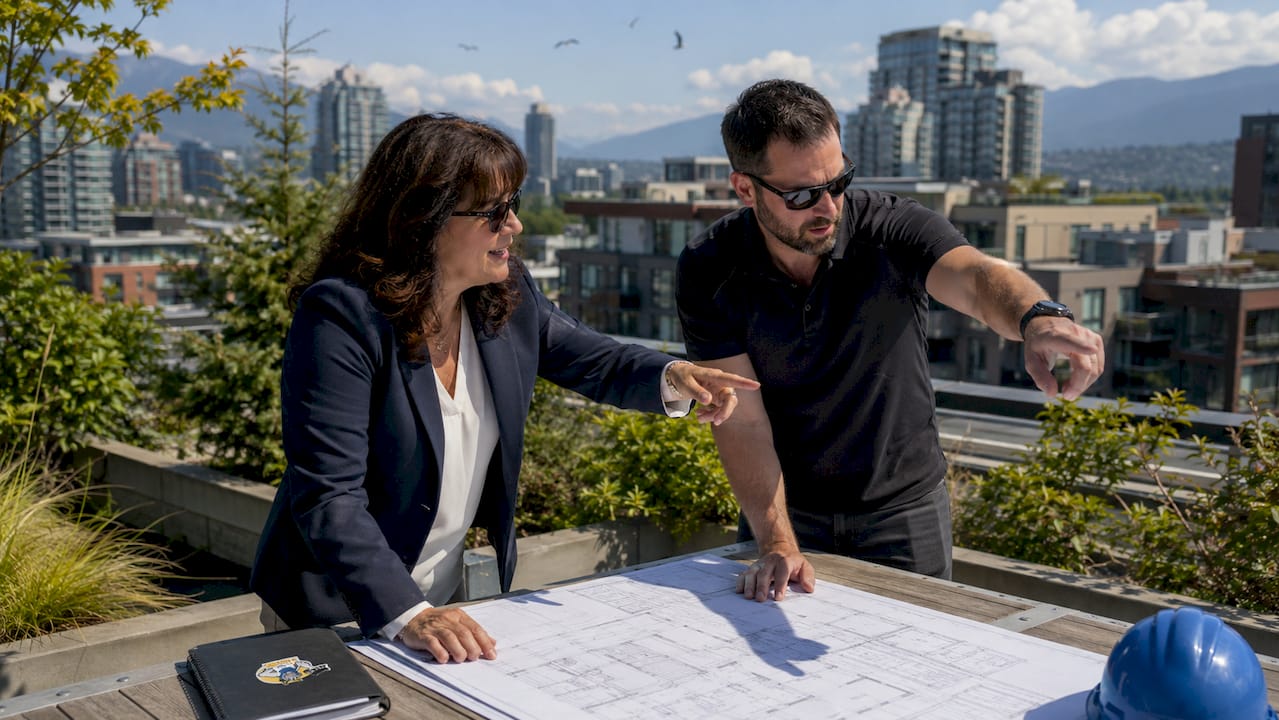
The industry term for this broader process is multi-family roofing project management , and it covers far more than shingles and underlayment. It includes tenant notification windows, board or strata council approvals, municipal permits, phased construction sequencing, and insurance documentation. Each of these layers adds time independently. Combined, they can push a project that looks simple on paper into a multi-month undertaking.
Property managers in Metro Vancouver face an additional layer of complexity because of the region’s coastal climate. Rain interruptions, post-storm contractor demand, and moisture-related hidden damage are all local realities that stretch timelines further than the national average.
What processes and approvals extend repair timelines in multi-family buildings?
Board approvals and tenant coordination are the most common bottlenecks in multi-family roofing timelines, and they add more time than the physical labour itself. This surprises a lot of property managers who assume the contractor’s schedule is the limiting factor. It rarely is.
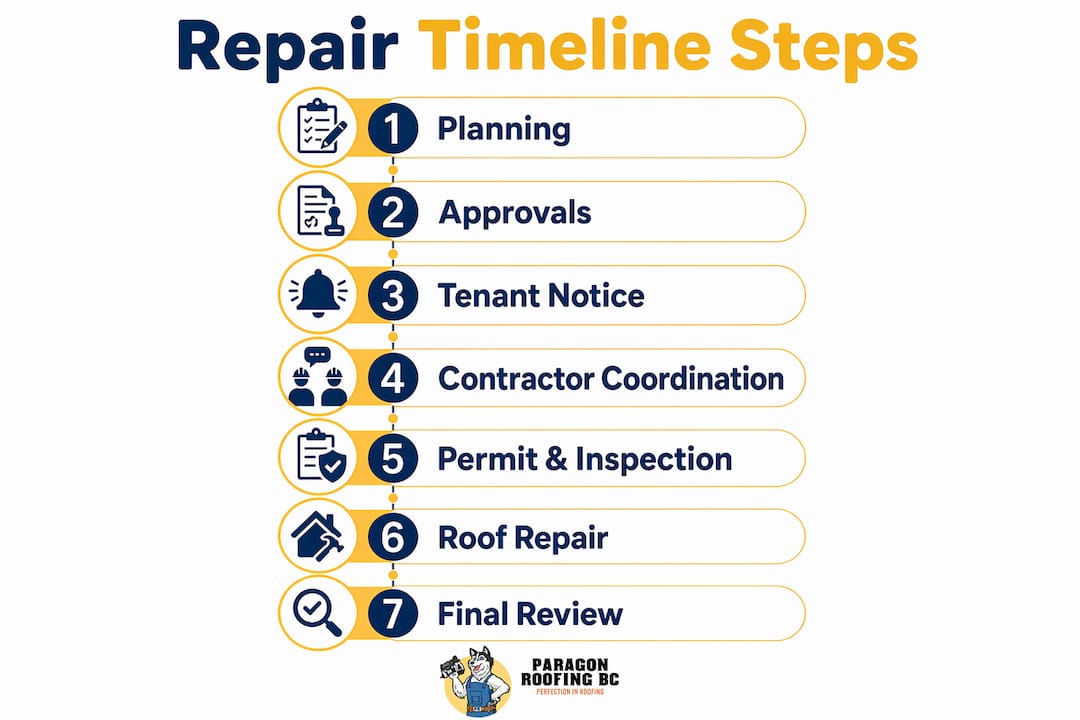
Here is what the administrative timeline typically looks like for a mid-size strata complex:
- Tenant notification: Most strata bylaws and residential tenancy regulations require 60–90 days advance notice before roofing work begins. Even if your contractor is available next week, you cannot legally start without completing this window.
- Board or ownership approval: Strata councils meet monthly at best. If a repair proposal misses one meeting cycle, you lose 30 days immediately. Larger capital expenditures often require a special general meeting, which adds another 4–6 weeks.
- Scope documentation: Before approval, most boards want written scope, contractor quotes, and a warranty summary. Gathering three competitive quotes alone can take 2–3 weeks.
- Permit application: Once approved, the permit application goes to the municipality. More on this in a later section, but expect 1–12 weeks depending on complexity.
- Contractor scheduling: After permits are issued, you join the contractor’s queue. In Surrey and Burnaby, that queue can run 2–4 weeks during peak season.
Planning should begin 12 months ahead for any multi-family roofing project. That timeline sounds excessive until you map out every approval step and realise the calendar fills up fast.
Pro Tip: Start your board presentation at least 14 months before your target repair date. Build in one missed meeting cycle as a buffer. It will happen.
When multiple contractors are involved, such as a roofer, a sheet metal specialist for flashing, and a waterproofing crew for flat sections, coordination adds another scheduling layer. Each trade has its own availability window, and sequencing them correctly without gaps takes active project management.
How do project scale and roofing complexity affect repair duration?
Physical scale is the second major driver of extended timelines, and it compounds every other factor. Think of a single-family roof as a basic sedan and a multi-family complex as a fully loaded transport truck. The fundamentals are the same, but the logistics are in a completely different category.
-
Larger roof area and multiple buildings increase material staging. A 20-unit complex in Coquitlam might have 8,000–12,000 square feet of roof surface across three buildings. Delivering, staging, and managing that volume of shingles, underlayment, and flashing requires a coordinated logistics plan, not just a pickup truck and a crew.
-
Roof design complexity multiplies labour time. Multi-family buildings often feature multiple pitches, valleys, dormers, mechanical penetrations, and parapet walls. Each transition point requires careful flashing and sealing. A roof with 12 penetrations takes proportionally longer than one with two, even if the square footage is identical.
-
Occupancy constraints require phased “dry-in” sequencing. You cannot tear off an entire building’s roof in one day when tenants are living underneath it. Quality control degrades when crews work on more than two buildings simultaneously. The standard approach is to complete dry-in on one section before moving to the next, which limits daily progress but protects both tenants and workmanship.
-
Hidden damage discovered after tear-off extends scope. Hidden damage from moisture penetration or rotted decking is a common timeline driver. Pre-repair inspections rarely reveal the full picture. Once the old material comes off, you may find saturated insulation, soft decking, or mould that requires remediation before new roofing can go down.
-
Crew deployment is intentionally limited for quality. Sending three crews to work three buildings at once sounds efficient, but it creates supervision gaps. Most experienced contractors in Metro Vancouver limit active buildings per crew to maintain quality, which means the schedule stretches by design.
Pro Tip: Budget a 15–20% contingency on both cost and time for hidden damage. Pre-repair inspections are useful but not definitive. The real scope often reveals itself on day one of tear-off.
What role do weather, contractor availability, and storm damage play?
Metro Vancouver’s coastal climate is not kind to roofing schedules. Rain, wind, and freeze-thaw cycles create interruptions that are simply not a factor in drier parts of Canada. For property managers in North Vancouver or West Vancouver, this is a year-round reality.
- Frequent rain causes weather pauses. Roofing in the rain is not just uncomfortable. It is a quality risk. Wet decking, compromised adhesion, and saturated underlayment all lead to callbacks. Experienced crews stop work when conditions are unsafe, which adds unpredictable gaps to the schedule.
- Post-storm contractor demand spikes. Contractor scheduling delays after major storms commonly range from 1–3 weeks due to high demand. When a wind event hits Surrey or Burnaby and damages multiple properties, every property manager calls their contractor at the same time. Multi-family buildings move to the back of the queue behind emergency single-family calls.
- Storm damage documentation adds days before work begins. Re-inspection and re-documentation of storm damage add 3–5 days to roofing projects and can increase labour costs by $2,500–$5,000 due to insurer and adjuster requirements. That delay is not the contractor’s fault. It is the insurance process.
- Hidden storm damage compounds the schedule. Storm impacts often cause damage that is not visible from the ground. Once a crew opens up the roof, they may find water-tracked damage that extends well beyond the original repair zone.
Storm damage delays arise mostly from insurance documentation and adjuster friction rather than the roof work itself. Having a documented protocol ready before a storm hits cuts days off the recovery timeline.
Local weather patterns in Metro Vancouver require flexible scheduling built into every project plan. A contractor who promises a fixed completion date without weather contingency is either inexperienced or not being straight with you. Navigating insurance claims after storm events is a skill set on its own, and it directly affects how fast repairs move forward.
How do permits, inspections, and code compliance affect timelines locally?
Permitting is the factor most property managers underestimate, and it is one of the most variable parts of the entire timeline. In Metro Vancouver, permit requirements for multi-family roofing are more stringent than for single-family homes, and the approval windows reflect that.
The table below shows typical permit and inspection timelines for roofing projects in BC:
| Project type | Permit approval time | Inspection timeline | Common delay cause |
|---|---|---|---|
| Single-family residential | 1–10 business days | 3–5 business days | Minor documentation gaps |
| Multi-family residential | 4–12 weeks | 1–2 weeks per phase | Incomplete drawings or specs |
| Commercial or complex | 8–16 weeks | 2–4 weeks | Code compliance upgrades required |
| Reinspection (any type) | Add 15–30 days | Varies | Failed inspection or missing docs |
Permit approval for multi-family roofing ranges from 4–12 weeks, with inspections adding another 1–2 weeks per phase. Incomplete documentation is a leading cause of permit delays, adding 15–30 days per correction cycle. That is not a minor inconvenience. One documentation error can push your project start date by a full month.
Code compliance upgrades are another hidden timeline driver. When a permit is pulled for a multi-family roof in Burnaby or Surrey, the municipality may require the project to bring the building up to current ventilation or fire-rating standards. These upgrades were not in the original scope, but they become mandatory once the permit is open. Budgeting for this possibility is part of responsible project planning.
Inspections in Metro Vancouver typically require advance booking, and inspectors are not always available on short notice. A phased project with three inspection points can accumulate 3–6 weeks of inspection-related waiting time alone. Commercial roof inspections follow a similar pattern, and property managers who have been through the process once know to build inspection windows into the master schedule from day one.
Key takeaways
Multi-family roof repairs take 3–4 times longer than single-family projects because of tenant notification requirements, board approvals, phased construction, permit complexity, and weather interruptions that compound at every stage.
| Point | Details |
|---|---|
| Start planning early | Begin the approval and notification process 12 months before your target repair date. |
| Approvals drive the timeline | Board and tenant coordination add more time than physical labour in most multi-family projects. |
| Budget for hidden damage | Reserve 15–20% contingency for rotted decking or moisture damage discovered after tear-off. |
| Permits vary widely | Multi-family permits take 4–12 weeks in BC; incomplete documentation adds 15–30 days per correction. |
| Weather requires flexibility | Metro Vancouver’s coastal climate causes unpredictable pauses; build weather buffers into every schedule. |
What I have learned managing multi-family roofing timelines in Metro Vancouver
Hey, it’s Harman here. After years of working on strata complexes, rental buildings, and townhouse portfolios across Surrey, Burnaby, and Coquitlam, the single biggest lesson I can share is this: the property managers who have the smoothest projects are the ones who treat roofing like a capital planning exercise, not a maintenance call.
The ones who struggle are usually the ones who call us in October expecting the work to be done before the November rains. By October, the permit queue is backed up, the contractor schedule is full, and the board has not approved the budget yet. That combination is a recipe for a stressful winter.
What actually works is starting the conversation with your board in January for a summer or fall project. Get the scope documented, get quotes, and submit the permit application before you need it. When the approval comes through, you are ready to move. When it does not come through on the first try because of a documentation gap, you still have time to correct it without blowing your schedule.
I also want to be honest about hidden damage. Delaying small repairs often leads to larger, more costly repairs due to moisture penetration and structural damage. Every time we open up a roof that has been patched and re-patched over the years, we find more than the inspection suggested. Budget for it. It is not a contractor upsell. It is the reality of older multi-family buildings in a wet climate.
The other thing I would push back on is the idea that faster is always better. Phased dry-in sequencing exists for a reason. A crew that rushes through three buildings at once to hit a deadline is a crew that is cutting corners somewhere. Quality takes the time it takes.
— Harman
How Paragonroofingbc helps property managers stay on schedule
Managing a multi-family roofing project in Metro Vancouver is genuinely complex, and the timeline pressures are real. Paragonroofingbc works directly with property managers and strata councils across Surrey, Burnaby, Coquitlam, and North Vancouver to handle the full scope: tenant notification planning, permit applications, phased scheduling, and insurance documentation for storm damage claims.
If you are dealing with a repair that keeps getting pushed back, or you are trying to plan ahead for a larger project, our team can walk you through a realistic timeline based on your building type and local permit requirements. We offer multi-family roofing services across Metro Vancouver and understand the specific challenges that come with coastal climate, strata governance, and BC building code compliance. Reach out to Paragonroofingbc to get a clear plan before the delays start stacking up.
FAQ
Why do multi-family roof repairs take so much longer than single-family ones?
Multi-family repairs take 3–4 times longer because they require tenant notification windows of 60–90 days, board approvals, municipal permits, and phased construction sequencing that single-family projects do not. The administrative process adds more time than the physical labour in most cases.
How far in advance should I start planning a multi-family roof repair?
Planning should begin at least 12 months before your target start date to accommodate board approvals, tenant notifications, permit applications, and contractor scheduling. Starting late is the most common reason projects get pushed into the following year.
How long does a roofing permit take for a multi-family building in BC?
Permit approval for multi-family roofing in Metro Vancouver typically takes 4–12 weeks, with inspections adding another 1–2 weeks per phase. Incomplete documentation is the leading cause of delays and can add 15–30 days per correction cycle.
What causes unexpected delays once roof repairs have already started?
Hidden damage discovered after tear-off is the most common cause of mid-project delays. Rotted decking, saturated insulation, and moisture-tracked damage are rarely visible during pre-repair inspections and often extend both the scope and the schedule once work begins.
Does weather in Metro Vancouver significantly affect repair timelines?
Yes. Coastal rain, wind events, and freeze-thaw cycles cause work stoppages that are not predictable at the time of scheduling. Post-storm contractor demand also spikes by 1–3 weeks, which pushes multi-family projects further back in the queue than single-family emergency calls.
Recommended
Our Roofing Blog
Have more questions about roofing?
Check out our FAQs or give us a call today to speak to an expert roofer in Vancouver Lower Mainland, BC. We're here to help our neighbours make educated decisions about their roof. For our team, we value helping clients save money while making their roofs last.