Burnaby commercial parapet leak examples: what to watch for
Burnaby commercial parapet leak examples: what to watch for
TL;DR:
- Water infiltrates parapet walls in Burnaby mainly due to flashing failures, sealant deterioration, and drainage issues. Using tracer gas detection helps locate leaks accurately, preventing unnecessary repairs. Regular inspections and proper waterproofing methods extend the lifespan of parapet structures in challenging climates.
Parapet wall water infiltration is defined as the entry of water through the vertical wall sections that extend above a flat or low-slope roof, and it is one of the most misdiagnosed sources of interior damage in Burnaby commercial buildings. These walls take the full force of coastal rain, wind-driven moisture, and freeze-thaw cycles that are common across the Lower Mainland. The burnaby commercial parapet leak examples that Paragonroofingbc encounters most often trace back to flashing failures, sealant breakdowns, and drainage problems at scuppers. Catching these failures early protects your tenants, your building envelope, and your maintenance budget.
Common Burnaby commercial parapet leak examples and their causes
Parapet leaks rarely announce themselves at the point of entry. A leak observed at a drain may actually trace back to a failure on the opposite parapet face. That disconnect is what makes these leaks so costly when left unaddressed.
The most frequent failure modes Paragonroofingbc sees on Burnaby commercial and strata buildings include:
- Flashing joint failures at coping seams. Metal coping caps protect the top of the parapet wall. When the seams between coping sections open up, water runs directly into the wall assembly. Flashings must extend adequately above the roof surface and overlap the membrane correctly to stop this.
- Counterflashing pulling away from reglets. Counterflashing is the metal piece set into a groove (called a reglet) in the wall face. When it pulls out or corrodes, water bypasses the entire base flashing below it. This is a structural failure, not a cosmetic one.
- Sealant-only terminations. Sealant alone fails within 5–8 years without mechanical counterflashing support. Many buildings in Burnaby still rely on caulking as the primary waterproofing at parapet terminations. That is a ticking clock.
- Scupper liner failures. Scuppers are the openings in the parapet wall that drain water off the roof. Improperly installed scuppers without continuous liners and tapered insulation (called a cricket) allow water to pool and seep through wall seams during heavy rain.
- Freeze-thaw crack expansion. Water expands approximately 9% when it freezes, forcing open hairline cracks in parapet masonry and sealant joints. Burnaby’s winter temperatures cross the freezing point repeatedly, which means small cracks grow fast.
Pro Tip: If you see staining or efflorescence (white salt deposits) on the face of your parapet wall, that is a reliable sign water is moving through the masonry. Do not wait for interior ceiling damage before calling for an inspection.
How tracer gas leak detection finds parapet waterproofing failures
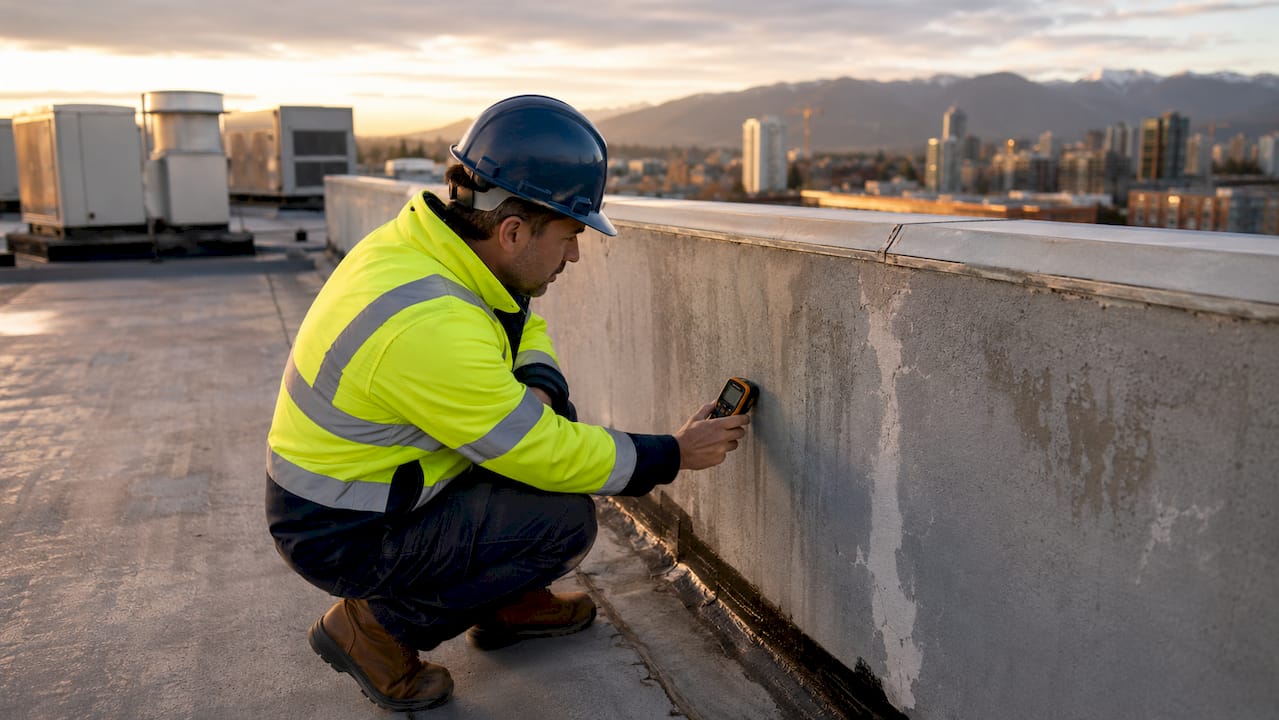
Visual inspection alone misses most parapet leaks. The entry point is often metres away from where water appears inside the building. Modern electronic leak detection using tracer gas solves this problem with precision.
Here is how the process works on a Burnaby commercial building:
- Pressurisation. The building or roof zone is sealed and pressurised with a safe, non-toxic tracer gas mixture.
- Targeted scanning. A technician scans the parapet wall, flashing terminations, coping seams, and vent boots with a calibrated detector.
- Breach identification. The detector pinpoints where gas escapes, which marks the exact location of the waterproofing failure.
- Documentation. The breach zones are mapped and photographed before any repair work begins.
Tracer gas diagnostics typically identify distinct breach zones such as failed flashing or a compromised vent boot within 90 minutes. That speed matters enormously in occupied commercial buildings where disruption costs money. Paragonroofingbc uses this method because it removes the guesswork and prevents unnecessary tear-off of sound membrane sections.
Comparing repair methods for Burnaby parapet wall water infiltration
Not every parapet repair method suits every failure type. Choosing the wrong approach wastes money and can trap moisture inside the wall assembly.
| Repair method | Best application | Key limitation |
|---|---|---|
| Elastomeric coating | Minor hairline cracks in stucco or masonry | Cannot replace flashing or fix joint failures |
| Reglet-set counterflashing | Counterflashing failures at wall terminations | Requires sound substrate for reglet installation |
| Sheet membrane replacement | Full base flashing replacement at parapet base | Complex geometry creates seam vulnerability |
| Liquid-applied PMMA membrane | Complex parapet corners, transitions, and legacy failures | Higher material cost than coatings |
Elastomeric coatings only bridge minor hairline cracks and cannot replace flashing or sealant repairs. Applying a coating over a failed flashing detail traps moisture inside the wall and accelerates deterioration. Paragonroofingbc sees this mistake regularly on Burnaby strata buildings where a previous contractor applied coating as a shortcut.
Liquid-applied PMMA membranes create a seamless, monolithic waterproof barrier that conforms to complex parapet geometries. They are particularly effective at transition points where sheet membranes create seam vulnerabilities. PMMA systems cure quickly, which reduces building exposure time during repairs.
Mechanical reglet-set counterflashing is the correct long-term fix for any counterflashing failure. Proper waterproofing requires reglet-set metal counterflashing, not caulking alone. The reglet anchors the flashing mechanically into the wall, so it cannot pull away under thermal movement or wind pressure.
Pro Tip: When budgeting a parapet repair, always include a line item for counterflashing replacement. Skipping it to save money upfront typically means a repeat repair within three to five years.
Preventative measures to minimise parapet wall water infiltration in Burnaby
Prevention costs a fraction of what emergency repairs do. Burnaby’s coastal climate and freeze-thaw winters make proactive parapet maintenance non-negotiable for commercial property managers.
- Schedule biannual roof inspections in spring and autumn. Spring inspections catch freeze-thaw damage before summer rain loads the building. Autumn inspections prepare the parapet for winter.
- Inspect all coping seams and counterflashing terminations. Look for open joints, lifted metal, and any sealant that has cracked or pulled away from the wall face.
- Check scupper liners and crickets every year. Scuppers without continuous liners are a guaranteed future leak. Confirm that tapered insulation directs water toward the scupper opening rather than pooling at the parapet base.
- Replace sealant before it fails. Caulking at parapet terminations has a service life of 5–8 years. Build a replacement schedule into your maintenance plan rather than waiting for visible failure.
- Clear debris from scuppers and roof drains after every major storm. Blocked drainage forces water to pond against the parapet base, which accelerates membrane and flashing deterioration.
- Address wind-driven rain risks at exposed parapet faces. Burnaby buildings near Metrotown and along Kingsway face significant wind exposure. Counterflashing on the windward parapet face takes the hardest hits and needs more frequent inspection.
- Act before freeze-thaw cycles worsen existing cracks. A hairline crack in october becomes a structural gap by march. Small repairs done in late summer prevent major failures in winter.
Consistent roof maintenance is the single most effective way to extend parapet waterproofing life. A well-maintained parapet system on a Burnaby commercial building should perform reliably for decades with the right repair schedule in place.
Key takeaways
Parapet wall leaks in Burnaby commercial buildings originate at flashing failures, sealant breakdowns, and drainage deficiencies, and they require targeted diagnostic methods and matched repair solutions to fix correctly.
| Point | Details |
|---|---|
| Leaks rarely appear at the entry point | Water travels through wall assemblies before appearing inside, making tracer gas detection the most reliable diagnostic tool. |
| Sealant has a limited service life | Caulking at parapet terminations fails within 5–8 years; mechanical counterflashing is the durable long-term solution. |
| Freeze-thaw cycles accelerate damage | Water expands 9% when freezing, widening cracks and joint failures in Burnaby’s winter climate. |
| Coatings cannot fix flashing failures | Elastomeric coatings trap moisture when applied over failed flashings; PMMA membranes suit complex parapet repairs. |
| Biannual inspections prevent major costs | Scheduling inspections in spring and autumn catches damage before it reaches the building interior. |
What I’ve learned from years of parapet leaks in Burnaby
Hey, it’s Harman here. After inspecting and repairing parapet walls on commercial buildings across Burnaby for years, the pattern I see most often is this: property managers assume the leak is at the roof membrane, not the parapet. They call for a roof repair, the membrane gets patched, and the leak continues. The actual entry point was a coping seam or a failed counterflashing three metres above the repair zone.
The second mistake I see regularly is the coating fix. Someone applies an elastomeric coating over the parapet face, it looks clean for a season, and then the leak comes back worse because moisture is now trapped inside the wall. Relying on coatings alone for parapet repairs is a frequent mistake that worsens moisture problems. I’ve had to remove coating layers to access failed flashings underneath, which adds cost that could have been avoided entirely.
My honest advice: invest in a proper tracer gas diagnostic before any repair work begins. It costs less than a day of unnecessary tear-off and tells you exactly where the money needs to go. Burnaby’s climate is not forgiving to parapet details that are “close enough.” Get it right the first time.
— Harman
Paragonroofingbc’s commercial parapet repair services in Burnaby
Paragonroofingbc has worked on commercial and strata parapet walls across Burnaby for years, and we know exactly how local climate conditions stress these building details. We use tracer gas diagnostics to locate failures precisely before any repair begins, which means no unnecessary tear-off and no repeat leaks.
Our team installs liquid-applied PMMA membranes, reglet-set counterflashing, and continuous scupper liners on commercial buildings throughout Burnaby and Metro Vancouver. If your building has a parapet leak that keeps coming back, or if you want a professional assessment before winter, our commercial roofing services cover everything from initial diagnostics to full waterproofing installation. Reach out to Paragonroofingbc for a site visit and get a clear picture of what your parapet actually needs.
FAQ
What are the most common causes of parapet leaks in Burnaby?
Flashing joint failures, sealant breakdown at terminations, and scupper liner deficiencies are the most common causes. Burnaby’s freeze-thaw climate accelerates all three failure types.
How does tracer gas leak detection work on a parapet wall?
The roof zone is pressurised with a safe tracer gas, and a technician scans the parapet for escaping gas to pinpoint the exact breach location. This process typically identifies the failure zone within 90 minutes.
Can I fix a parapet leak with an elastomeric coating?
Elastomeric coatings only bridge minor hairline cracks and cannot repair flashing or joint failures. Applying a coating over a failed flashing traps moisture and worsens the problem.
How often should a Burnaby commercial parapet be inspected?
Biannual inspections in spring and autumn are the standard recommendation. Burnaby’s coastal moisture and freeze-thaw winters make this frequency the minimum for reliable parapet performance.
How long does sealant last at parapet terminations?
Sealant at parapet terminations typically fails within 5–8 years. Mechanical reglet-set counterflashing is the correct long-term solution, with caulking used only as a secondary seal.
Recommended
Our Roofing Blog


Have more questions about roofing?
Check out our FAQs or give us a call today to speak to an expert roofer in Vancouver Lower Mainland, BC. We're here to help our neighbours make educated decisions about their roof. For our team, we value helping clients save money while making their roofs last.