Roofing material fire ratings explained for BC owners
Roofing material fire ratings explained for BC owners
TL;DR:
- Roof assembly fire ratings classify roofs into Class A, B, or C based on standardized fire resistance tests, influencing building code compliance and insurance premiums in BC wildfire zones. Properly assembling and documenting the complete roof system ensures the rating remains valid, as substitutions or damages can void the classification and compromise fire safety. Addressing ember intrusion with tested ember-resistant vents is critical, alongside selecting materials and verifying assembly details before installation to maintain fire protection and systems integrity.
Roofing material fire ratings classify roof assemblies into Class A, B, or C based on standardised fire resistance tests, and every property owner in British Columbia needs to understand this system before choosing or replacing a roof. The formal industry term is “roof assembly fire classification,” and it is governed by two primary standards: ASTM E108 and UL 790. These ratings are not just a marketing label. They determine whether your roof meets local building code, influences your insurance premiums, and in wildfire-prone areas of BC like the Fraser Valley and Coquitlam foothills, they can be the difference between a roof that slows a fire and one that accelerates it.
Roofing material fire ratings explained: how testing works
Roof fire ratings are assigned after standardised fire testing that measures exterior fire behaviour, flame spread, and ember penetration. The two governing standards, ASTM E108 and UL 790, are functionally identical in their test methods and are used interchangeably by manufacturers and inspectors across North America, including BC.
The testing process involves four distinct exposures applied to a full roof assembly mounted on a pitched test deck:
- Flame spread test. A gas burner applies a controlled flame directly to the roof surface for a set period. Testers measure how far the flame travels across the surface.
- Burning brand test. A wood brand of a specific size is ignited and placed on the roof to simulate a burning ember landing during a wildfire.
- Intermittent flame test. The burner cycles on and off repeatedly to simulate the pulsing nature of wind-driven fire exposure.
- Flying brand test. A fan drives flame across the roof surface to test whether the covering generates and launches burning debris.
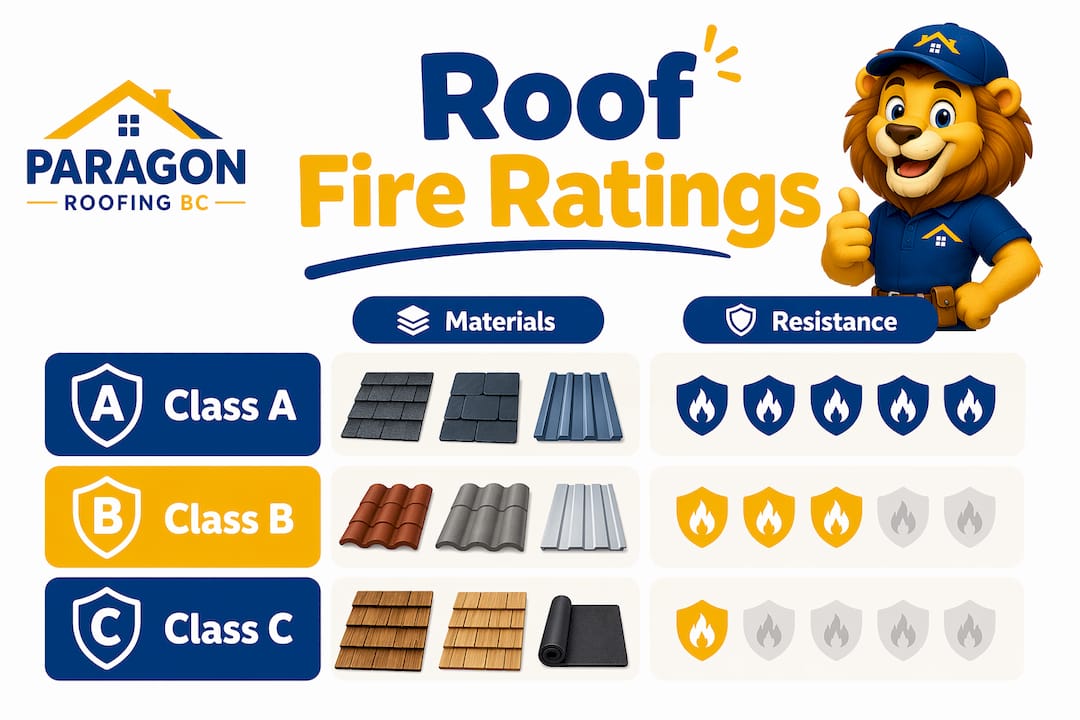
Each class has specific pass criteria. Class A limits flame spread to 6 feet or less and requires the roof to resist a large 12x12 inch burning brand. Class B allows flame spread up to 8 feet with a smaller brand, and Class C permits spread up to 13 feet with an even smaller brand exposure. Class A is the highest level of protection, and it is what most BC building codes require in designated fire hazard zones.
| Rating class | Max flame spread | Burning brand size | Typical materials |
|---|---|---|---|
| Class A | 6 feet | 12 x 12 inches | Metal, tile, Class A asphalt shingles |
| Class B | 8 feet | 6 x 6 inches | Some treated wood shakes |
| Class C | 13 feet | 1.5 x 1.5 inches | Basic untreated wood products |
Pro Tip: Always ask your contractor for the actual test report number, not just the marketing claim. A manufacturer’s brochure saying “Class A rated” means nothing unless it references a specific ASTM E108 or UL 790 listing tied to the exact assembly being installed on your property.
Why the whole roof assembly determines your fire rating
This is the part that catches most property owners off guard. Fire ratings apply to roof assemblies, not to individual materials in isolation. The assembly includes three layers working together: the roof deck (typically plywood or OSB), the underlayment, and the roof covering. Change any one of those components without checking the tested listing, and you may void the fire classification entirely.
Here is where things get complicated in the real world:
- A Class A asphalt shingle installed over a standard felt underlayment on a plywood deck may hold its Class A rating. Swap that felt for a synthetic underlayment that was not part of the tested assembly, and the classification is no longer valid.
- MFM Ultra HT underlayment earned a Class A WUI rating only when installed with compatible Class A asphalt shingles on a specific tested assembly. The approval is conditional on every component matching the listing.
- Substitutions of deck, underlayment, or cover boards are among the most common field failures inspectors find during permit reviews and post-installation audits.
Manufacturers provide submittal packages that link ASTM E108 test reports, UL 790 listings, and installation instructions. These packages must be followed exactly to retain fire rating validity during BC building inspections. If your contractor cannot produce that documentation on request, that is a serious red flag.
Pro Tip: Before your roof installation begins, ask for the manufacturer’s submittal package in writing. Cross-check the deck type, underlayment product name, and covering specification against what is actually being installed. This takes ten minutes and protects you from a compliance failure that could cost thousands to correct.
For a deeper look at how underlayment choices interact with fire ratings, the underlayment options for Vancouver homes guide covers the specifics of felt versus synthetic versus breathable membranes in our coastal climate.
Class A, B, and C: which rating does BC actually require?
Class A is the gold standard for fire resistance roofing, and it is the rating you should be targeting if your property sits anywhere near forested areas, dry hillsides, or the expanding wildfire interface zones in the Lower Mainland and Fraser Valley. Here is how the three classes break down in practical terms for BC property owners:
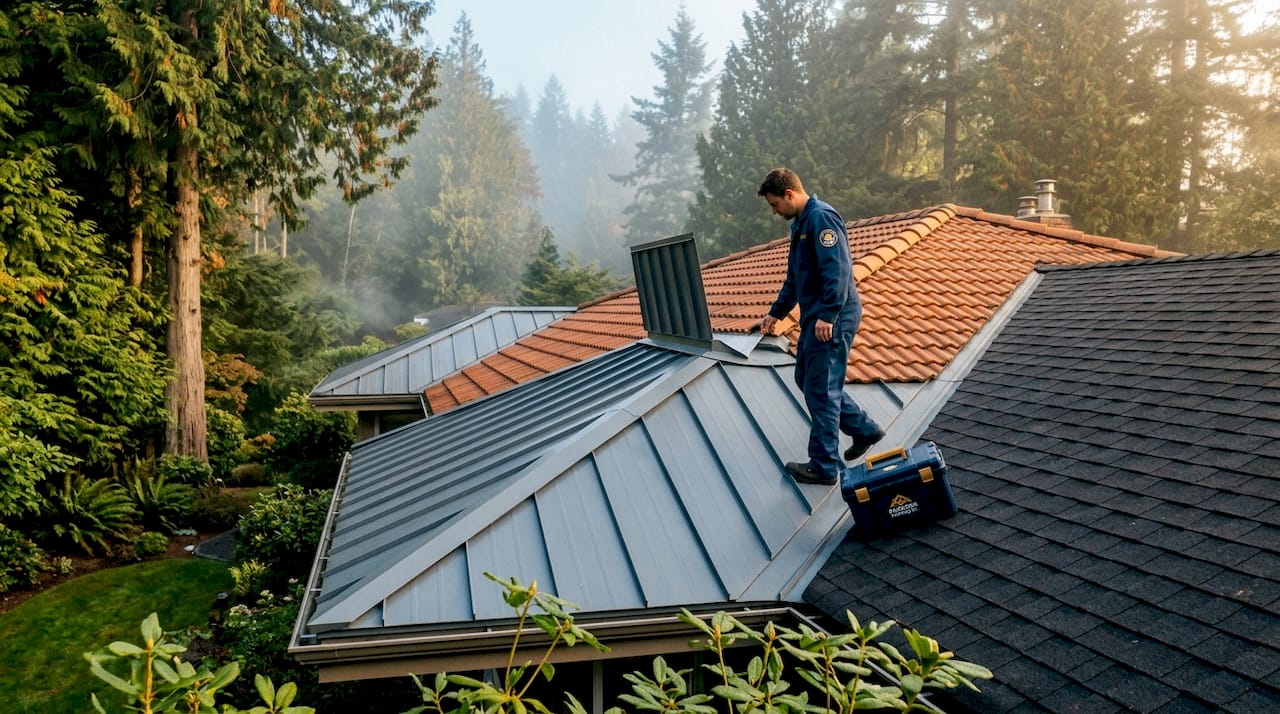
Class A materials include metal roofing (steel, aluminium, copper), concrete and clay tile, and asphalt shingles that have been tested as part of a Class A assembly. These are the best fire rated materials for properties in high-risk zones. They resist the largest burning brands and the longest flame exposures.
Class B materials include some pressure-treated wood shakes and certain modified bitumen systems. They offer moderate protection but fall short of what most BC municipalities now require in fire hazard zones.
Class C materials cover basic untreated wood products and some older roofing systems. In most of Metro Vancouver and surrounding municipalities, Class C is insufficient for new construction or major re-roofing projects.
BC’s building code aligns with the National Building Code of Canada, and local amendments in fire interface zones frequently mandate Class A assemblies. Insurance underwriters in BC are increasingly tying premium rates and coverage eligibility to fire rating class. A property with a verified Class A roof assembly can attract meaningfully lower premiums than one with a Class C or unrated system, particularly in Maple Ridge, Mission, and Abbotsford where wildfire risk mapping has expanded significantly.
You can compare roofing materials side by side to see how metal, tile, and asphalt shingles stack up on fire resistance, longevity, and cost in BC conditions.
How do ember intrusion and ventilation affect roof fire safety?
Choosing a Class A roof covering is necessary but not sufficient in a wildfire scenario. The primary ignition pathway in most structure fires during wildfires is not direct flame contact. It is ember intrusion through vents, gaps, and penetrations. Embers travel kilometres ahead of a fire front and land on roofs, in gutters, and inside attic vents.
Roof fire safety in wildfire zones requires addressing ember pathways beyond roof covering choice alone. Ember-resistant vents, tested under ASTM E2886, are the primary tool for blocking this pathway. These vents use fine mesh screens, baffles, or intumescent materials to stop embers from entering the attic while still allowing airflow.
Practical steps for BC property owners and managers:
- Replace standard louvred soffit and ridge vents with ember-resistant models tested to ASTM E2886. Products like Brandguard and Vulcan vents are purpose-built for this application.
- Ember-resistant vents reduce net free area, which means you may need additional vent area to maintain code-compliant attic ventilation. Failing to compensate causes moisture buildup, which is a serious concern in BC’s wet climate.
- Seal gaps around pipe penetrations, skylights, and chimney flashings. These are secondary ember entry points that a fire rating test does not address.
- Clear gutters and roof valleys of debris regularly. Accumulated organic material in gutters creates a ready fuel source for landing embers.
Pro Tip: When retrofitting ember-resistant vents, calculate your required net free area before ordering. A standard 1/16-inch mesh vent reduces airflow by roughly 50% compared to an open louvre. You will likely need to add vent area elsewhere to stay compliant with BC’s ventilation requirements.
What practical steps protect your fire rating and roof safety?
Getting a fire-rated roof installed is one thing. Keeping that rating valid through the life of the roof is another matter entirely. Here is a practical sequence for property owners and managers in BC:
- Verify the assembly listing before installation. Confirm that the deck type, underlayment product, and roof covering all appear together in the same tested listing. Do not accept verbal assurances. Get the listing number in writing.
- Document everything for permits and insurance. Keep copies of the manufacturer’s submittal package, the test report number, and the installation invoice specifying exact product names. BC building inspectors focus on matching installed components with tested listings, and missing documentation is a common cause of failed inspections.
- Use a contractor who understands assembly compliance. This is not a job for a generalist. Your contractor needs to know the difference between a material rating and an assembly rating, and they need to source compatible products from the same tested system.
- Schedule routine inspections focused on fire rating integrity. Check for missing or damaged shingles, compromised underlayment at flashings, and blocked or deteriorated vents. Any repair that introduces a non-listed component can void the assembly rating.
- Coordinate with your insurer after re-roofing. Provide your insurer with the assembly documentation so they can update your policy to reflect the correct fire rating class. This step is frequently skipped and can leave you underinsured.
For properties with asphalt shingles, the asphalt shingle installation guide covers compatible underlayment pairings and listing approvals specific to Canadian conditions.
Key takeaways
A roof’s fire rating is only as valid as the complete assembly it was tested on, making component compatibility and documentation the two most critical factors for BC property owners.
| Point | Details |
|---|---|
| Ratings cover assemblies, not materials | Changing any single component without checking the tested listing voids your fire classification. |
| Class A is the target standard | Class A limits flame spread to 6 feet and resists a 12x12 inch burning brand, making it the right choice for BC fire zones. |
| Ember intrusion is the primary risk | ASTM E2886 ember-resistant vents are required to address the main wildfire ignition pathway beyond roof covering choice. |
| Documentation protects you | Keeping manufacturer submittal packages and listing numbers on file is required for BC permits and insurance compliance. |
| Assembly substitutions cause failures | Inspectors regularly find fire rating voids caused by incorrect underlayment or deck substitutions during installation. |
What I have learned about fire ratings after years on BC roofs
Hey, it’s Harman here. After inspecting and installing roofs across Coquitlam, Maple Ridge, Delta, and Vancouver for years, the single biggest misconception I encounter is the belief that buying a “Class A shingle” automatically gives you a Class A roof. It does not. I have walked properties where a homeowner paid a premium for a top-tier asphalt shingle, only to find the contractor installed it over a non-listed synthetic underlayment on a tongue-and-groove deck that was never part of the tested assembly. The shingle is Class A. The roof is not.
The other thing I see constantly in BC is the ember vent problem. We are not California, but the wildfire interface in the Fraser Valley and around Maple Ridge has expanded dramatically. I have been on roofs in Abbotsford and Mission where the soffit vents were completely standard louvres with no ember protection whatsoever, despite the property sitting in a mapped interface zone. The roof covering was Class A. The attic was wide open to embers.
My honest advice: treat the fire rating conversation as a systems conversation, not a materials conversation. Ask your contractor to show you the listing number, not just the product name. And if you are in a fire interface zone, add ember-resistant vents to your scope of work. The cost is modest compared to what you are protecting.
— Harman
Fire-rated roofing installations across Metro Vancouver and the Lower Mainland
Paragonroofingbc installs and replaces fire-rated roof assemblies across Metro Vancouver, Coquitlam, Delta, and Maple Ridge, with full documentation for BC building permits and insurance compliance. Every installation uses verified assembly listings so your Class A rating holds up under inspection, not just on paper. Whether you are replacing an aging asphalt shingle system or upgrading to metal or tile for maximum fire resistance, the team at Paragonroofingbc can walk you through compatible assembly options for your specific property and zone.
If you are in Coquitlam, get a quote for a fire-rated roof installation that meets current BC code requirements. For Vancouver properties, roof installation in Vancouver covers residential and commercial assemblies with full fire rating compliance. Delta and Maple Ridge property owners can explore roof replacement in Delta and Maple Ridge roof replacement options with fire-rated materials suited to the Lower Mainland’s wildfire interface zones.
FAQ
What is the difference between Class A, B, and C roof ratings?
Class A is the highest fire resistance rating, limiting flame spread to 6 feet and resisting a 12x12 inch burning brand per ASTM E108. Class B and C offer progressively less protection, with larger permitted flame spread distances and smaller brand resistance requirements.
Does a Class A shingle automatically give me a Class A roof?
No. Fire ratings apply to the complete roof assembly, including the deck, underlayment, and covering. Installing a Class A shingle over a non-listed underlayment or deck type voids the assembly classification entirely.
Are fire ratings required by BC building code?
BC’s building code, including local amendments in fire hazard zones, frequently mandates Class A roof assemblies for new construction and major re-roofing projects, particularly in wildfire interface areas of the Lower Mainland and Fraser Valley.
What are ember-resistant vents and do I need them?
Ember-resistant vents are tested under ASTM E2886 and use mesh, baffles, or intumescent materials to block embers from entering the attic. They are strongly recommended, and in some BC fire interface zones required, because ember intrusion is the primary ignition pathway during wildfires.
How do I verify my roof has a valid fire rating?
Ask your contractor for the manufacturer’s submittal package, which links the ASTM E108 or UL 790 test report to the specific deck, underlayment, and covering combination installed on your property. Keep this documentation on file for building permits and insurance records.
Recommended
Our Roofing Blog
Have more questions about roofing?
Check out our FAQs or give us a call today to speak to an expert roofer in Vancouver Lower Mainland, BC. We're here to help our neighbours make educated decisions about their roof. For our team, we value helping clients save money while making their roofs last.